






Engineering next-gen software defined vehicles for the AI age


June 5, 2026 11 min read 384 views
Software defined vehicles (SDVs) are reshaping the automotive industry. Centralized computing, over-the-air updates, ADAS, personalization, and V2X connectivity are now standard expectations. A modern vehicle already runs on up to 100 million lines of code. In the AI-native era, strategic alliances are becoming increasingly important, especially in operating systems, cybersecurity, and autonomous driving. This article covers what SDVs are, the architecture behind them, and the challenges OEMs face around security, integration, and regulation.
The transformation of the automotive industry
The market for software defined vehicles was valued is expected to increase at a compound annual growth rate (CAGR) of 19.47% from 2024 to 2034, reaching around USD 300.98 billion.
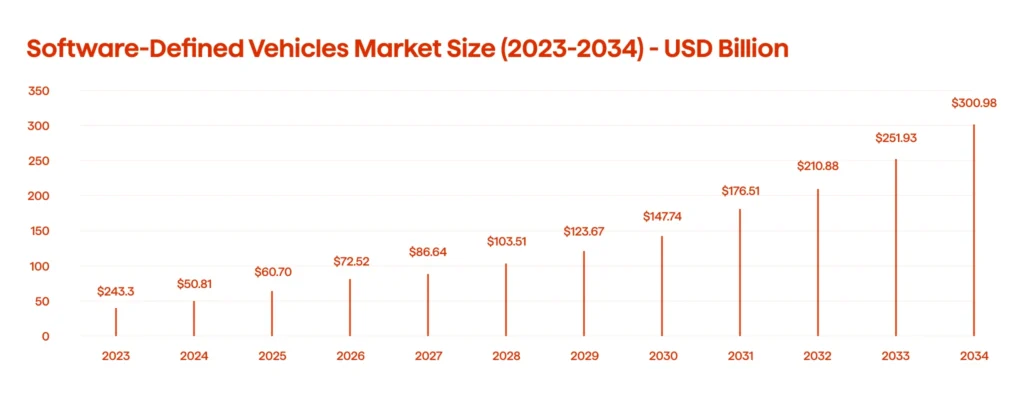
With software-centric innovation, the automotive sector is going through a fundamental transition. Unlike a traditional vehicle, an SDV is the result of replacing conventional mechanical systems with sophisticated electronics, advanced software stacks, and AI models that run directly on in-vehicle compute. Big data streams from sensors, cameras, and connection modules can be processed by centralized Electronic Control Units (ECUs) and domain-specific controllers, which OEMs and Tier 1 suppliers are progressively investing in. This change makes it possible to make decisions in real time, allocate resources effectively, and continuously improve functions through over-the-air (OTA) updates.
Among the major advancements are the incorporation of connected vehicle technology, electrification, and advanced driver assistance systems (ADAS). Powerful on-board computers are used in modern cars to enable vehicle operations ranging from autonomous drive algorithms to battery management in electric powertrains. Software is now the primary factor influencing performance, safety, and user experience. Previously dependent on separate ECUs for every subsystem, traditional software architecture is evolving into flexible platforms that can be quickly updated, fixed, and improved across vehicle models.
The accepted principles of competition are being rewritten by alliances between tech firms and manufacturers. Cloud-based data analytics, Generative AI, Agentic AI, and Machine Learning algorithms allow for ongoing vehicle function improvement, generating a feedback loop for quicker innovation. McKinsey estimates that AI has the potential to improve software features that make up 70%of the total automotive software market by 2035, from ADAS and infotainment to predictive maintenance and intrusion detection. Consumers now anticipate smooth communication, customized user interfaces, and regular updates, those aspects are more commonly seen in consumer electronics than in conventional automobiles.
The architecture of software defined vehicles
Software defined vehicles’ architecture is based on the combination of a modular software stack and robust computational platforms that decouple software and hardware, allowing for real-time processing and ongoing feature updates. Distributed electronic control units (ECUs) with preset functions for certain subsystems, such as the powertrain, entertainment, or body control, were the foundation of automotive electronics in the past. However, the siloed approach to vehicle architecture resulted in limitations in communications, scalability, and security.
Usually referred to as domain controllers or high-performance computers (HPCs), modern SDVs combine these functions into a smaller number of powerful central computing machines, often arranged in a zonal architecture that groups functions by physical region rather than by domain. These controllers use high-bandwidth in-vehicle networking technologies like Ethernet to operate many domains, including advanced driver assistance systems (ADAS), infotainment, and the chassis. By enabling smooth data transfer between sensors, actuators, and software programs, centralized architecture improves processing efficiency.
A strong software stack supports this architecture. A platform (usually Linux-based) is used for non-essential applications like infotainment and cloud connectivity, while a real-time operating system is used for safety-critical tasks. In addition to minimizing interference and lowering the possibility of system-wide failures, containerization and hypervisors segregate individual software components. The ability to update over-the-air (OTA) guarantees that these cars always have the newest security patches, feature additions, and bug fixes.
This architecture also incorporates contemporary data management best practices. Third-party services, Machine Learning techniques, and cloud infrastructure can all be seamlessly integrated thanks to high-level application programming interfaces (APIs), middleware, and data orchestration layers, decoupling the car’s hardware and software so they can evolve on independent cycles.
Essentially, here are the most critical parts that software defined vehicles include in their architecture:
- Centralized computing. Powertrain control, driving assistance, and on-board AI inference are integrated into specific units by high-performance domain controllers.
- In-vehicle networking. High-bandwidth data sharing between sensors, actuators, and onboard software modules is enabled via an Ethernet-based connection, facilitating system integration and ongoing software updates.
- Telecom equipment and connectivity. Vehicle-to-everything (V2X) communication is made possible by 5G or LTE modems, providing real-time data transfer of OTA updates, remote diagnostics, and cloud-based applications for increased efficiency and safety.
- Backend systems. Cloud systems manage data, analytics, and storage, with Machine Learning and Generative AI models powering predictive maintenance, traffic pattern analytics, and continuous feature optimization.
- APIs and secure integration. Open interfaces promote innovation in ride-sharing, fleet management, and customized entertainment, allowing third-party services and apps to communicate with vehicle data.
- Surrounding infrastructure. Intelligent traffic lights, edge AI nodes, and road sensors provide connectivity outside of the car and feed the system real-time data on traffic, hazards, and road conditions.
New features enabled by software defined vehicles
Over-the-air (OTA) updates
Software defined vehicles make use of robust connectivity to deliver regular vehicle software updates over the air, keeping core vehicle functionality like driver assistance and powertrain control current without a visit to the workshop. For example, a battery management program in an electric vehicle can be refreshed for improved range or charging efficiency whenever it is needed. This functionality maximizes performance and reduces downtime.
Advanced Driving Assistance Systems (ADAS)
Lane-keeping, adaptive cruise control, and automatic emergency braking are just a few of the new software functions SDVs can quickly update by centralizing management within high-performance processing hardware. To provide more precise hazard detection, over-the-air support enables real-time optimization of sensor fusion algorithms, which include radar, lidar, and cameras. Examples include Tesla’s Autopilot, which enhances lane-centering maneuvers and collision avoidance, increasing user confidence while advancing vehicle safety overall.
Personalized user experiences
Software defined cars provide scalable personalization by integrating user data from all domains. Driver profiles are securely stored in the cloud and can be used to regulate the climate, seats, and mirrors. This also applies to infotainment, such as voice assistant settings or favorite music streaming apps. For example, drivers can move their digital profiles across cars with Volkswagen’s ID models, giving them a consistent, user-focused driving experience each time.
Software defined cars provide scalable personalization by integrating user data from all domains of vehicle use. Driver profiles are securely stored in the cloud and can be used to regulate the climate, seats, and mirrors. This also applies to infotainment, such as voice assistant settings or favorite music streaming apps. For example, drivers can move their digital profiles across cars with Volkswagen’s ID models, giving them a consistent, user-focused driving experience each time.
Predictive maintenance
SDVs can keep an eye on things like tires, brakes, and fluid levels in real time thanks to sophisticated sensor suites and data analysis software. Automakers can anticipate any problems before they happen by processing that data in the cloud and notifying drivers to arrange service at the best times. BMW’s Condition Based Service system demonstrates how driving habits and mileage can be combined to provide insights into vehicle performance and create precise service reminders that reduce unscheduled downtime and prolong component life.
Subscriptions
Car manufacturers may activate features as needed thanks to modular software products, which open up a new revenue source and increase driver autonomy. Features can be remotely turned on and off — performance enhancements, improved navigation packages, advanced driving assistance, and even climate amenities. The commercial logic is strong: McKinsey projects that core connectivity use cases, from over-the-air upgrades to gaming and Wi-Fi, could generate $250 billion to $400 billion in annual revenue by 2030.
Vehicle-to-everything (V2X) connectivity
Cars can connect with each other, and the traffic infrastructure, including edge nodes, road sensors, and smart traffic lights. Through immediate updates about road conditions or upcoming red-light signals, this vehicle connectivity continuously improves traffic flow, eases congestion, and guarantees increased safety. As more vehicles rely on this connective layer, global infrastructure is expanding rapidly. The number of connected vehicles worldwide surged to over 75 million in 2025, a significant jump from 45 million in 2020. Furthermore, more than 65% of new models built in 2025 leave the factory equipped with integrated connectivity modules designed for V2X protocols.
Challenges and considerations in software defined vehicles
Protecting the data
Data privacy is one of the biggest challenges in SDVs. From driving behavior analysis to customized infotainment settings, SDVs are continuously sharing large volumes of data with backend systems and outside businesses. Automakers must guarantee strong encryption, safe storage, and open data-collecting practices as laws like the General Data Protection Regulation (GDPR) continue to change. Failing to do so puts firms at risk of financial and legal consequences in addition to undermining user trust.
Ensuring the vehicle’s software is dependable
Reliability across SDV development is mission-critical. Any glitch, malfunction, or unplanned failure in software might have real-world safety repercussions. Automakers use redundancy and a fail-safe architecture, which involves several sensors and computation units cross-checking signals, to prevent these risks. Additionally, they adhere to strict automobile safety requirements like ISO 26262. As a result, there is a lower chance of catastrophic system failures since all stages of development, from design to validation, comply with strict thresholds.
Managing the complexities of integration
Across several electronic control units (ECUs), SDVs run millions of lines of complex software code. For developers and integrators, this immense software complexity presents a hurdle. Effective integration of embedded software requires modular program design, standard communications protocols, and stringent test frameworks. For seamless data flow from powertrain control to infotainment domains, OEMs must work closely with Tier 1 vendors and technology partners to unify diverse codebases.
Closing the gap in interoperability
The largest issue with current vehicle systems is interoperability, particularly when using external services like cloud computing or smart infrastructure. Data sharing may be impeded by closed interfaces, making a holistic SDV ecosystem challenging to accomplish. Cross-industry collaboration and the establishment of open standards allow for the rapid enablement of novel applications like autonomous driving, traffic flow, and predictive maintenance.
Repair and maintenance for vehicle health
Considering the growing popularity of software defined vehicles, maintenance and repair involve more than just basic mechanical solutions. Professionals require advanced diagnostic tools and knowledge to identify software problems, firmware bugs, and buggy updates. Over-the-air (OTA) fixes can fix some problems remotely, but expert hands-on repair is still necessary for hardware and software malfunctions or embedded code flaws. Then, to meet the changing digital needs of SDVs, repair shops need to continuously invest in training and certification to match the pace of software development across the industry.
Getting over regulatory barriers
SDVs frequently have to deal with disjointed international legislation when navigating the legal system. Multinational firms have compliance issues due to regional variations in data security, emissions regulations, and vehicle design standards. A further barrier is presented by safety requirements, such as ISO 26262 and those on cybersecurity, that call for thorough testing and documentation to provide consistent reliability across all markets. One factor contributing to these difficulties is autonomous vehicle policy. While certain countries have implemented pilot programs and temporary regulations to allow for self-driving technology, others have more restrictive laws, creating a patchwork of limitations that deters testing and deployment across international borders. Furthermore, consumer protection regulations that require openness in the collection, storage, and utilization of personal data are still being created.
FAQ
The future of intelligent mobility
OEMs that treated software as an accessory to hardware are now competing with companies that treat hardware as a delivery mechanism for software. The shift demands more than new architecture. It requires new engineering org structures, new release cycles, new safety and cybersecurity practices, new commercial models for subscriptions and feature activation, and a tolerance for the kind of continuous deployment that consumer tech companies have practiced for two decades.
From E/E architecture to AI integration to cybersecurity, see how Avenga supports SDV technology end to end. Start a conversation.



Your business results matter
Achieve them with minimized risk through our bespoke innovation capabilities. Fill in the form below.