






How Artificial Intelligence is having a tangible impact on the automotive industry


June 16, 2026 10 min read 518 views
Waymo, Tesla, and NVIDIA are winning the headlines with a push towards an autonomous future, tweaking self-driving stacks while OEMs are embedding Level 2 and Level 3 capabilities into the mainstream. But amid the excitement around robo-taxis, another revolution is taking place within the factory racecourse: plants that use AI are finding their benefits just as transformative as driverless technology. In real-time, AI produces repeatable decisions based on thousands of sources of sensor data, enabling leaner, faster, and more resilient manufacturing processes — the kind of things the automotive ecosystem cannot ignore.
The article describes the impact of AI and how automotive industry leaders can employ production-side intelligence while their competition sleeps.
From stopwatches to sensors: What is the data foundation for smart automotive manufacturing?
Three decades ago, the future of automotive assembly was not known. The reality of AI in the automotive sector has changed that picture. Today, every torque tool, vision camera, and PLC stream gigabytes of time-stamped data, and AI algorithms collect the lot. This data is now the raw material that AI applications need to increase productivity. Barcode scans from kitting carts, high-resolution vibration signals, and millisecond robot-current time traces all flow through MQTT gateways before reaching the cloud or edge clusters, where AI and Machine Learning look for patterns that humans might miss.
Why is the sensor layer significant?
- Micron-level visibility. Microscopic telemetry can show robot-related hesitations of 0.3 seconds and oven door hesitations up to two seconds, all of which add up in weekly throughput loss.
- Reusable data fabric. Cleaned, timestamp-based streams allow new teams to leverage AI quickly – maintenance can get Remaining Useful Life (RUL) scores, and logistics can obtain pallet-route-based optimisations.
- Adaptive intelligence. AI enables real-time local inference: a weld-gun force curve drifting in under 100 ms triggers an MES notification without a round trip to the cloud.
- Generative augmentation. Generative AI technologies can produce infinite synthetic images of rare defects, so the vision classifier is enhanced, as there are often too few photographs of faults.
- Digital-twin fuel. The same packets that contribute to the digital doubles can be nighttime simulations that can validate “what-ifs” before reprogramming one robot’s path.
The integration of AI practically means stations can have self-awareness, and products can carry their quality passports. Artificial Intelligence in production does not retire the stopwatch. It reincarnates it into nanosecond timestamps embedded in thousands of synchronous data points, providing automotive leaders with the clarity needed to meet increasingly stringent takt times and mixed-model production needs.
See how Avenga applies AI across the SDLC to improve velocity, reliability, and cost efficiency at enterprise scale.
How does predictive maintenance end unplanned downtime?
On an automobile line, every minute of downtime is a chance to squander production and output, incur re-sequencing penalties, or add overtime to make up for lost production. By replacing parts early and keeping excess inventory, preventive maintenance, whether done on a calendar day or cycle counts, reduces this risk. AI is helping automakers eliminate this waste through predictive maintenance, which anticipates failures before they strand a weld gun or a robot mid-cycle.
Analysts forecast that the global predictive-maintenance market would increase at a 28.5% compound annual growth rate (CAGR) from USD 8.7 billion in 2023 to USD 107.3 billion by 2033, demonstrating the genuine momentum in the business. The industry is only midway through the adoption cycle, but a large portion of this capital is racing into automotive applications, where a single unscheduled stop on a closed-loop high-volume final assembly line might cost well over $10,000 per minute. 53% of firms are still waiting for the next bearing seizure or weld-cell blockage, while 47% employ predictive tools to varying degrees. The difference will grow as the cycle progresses, and any unmodeled breakdown will give the forecaster a nasty competitive edge.
The technology works fairly simply: edge sensors send vibration, current draw, acoustic envelopes, and thermal signatures from different robots, conveyors, and paint-booth motors to an AI system on-premises or in the cloud. The platform compares the live fingerprints to millions of historical “healthy” and “failing” patterns and generates a Remaining Useful Life (or RUL) score for each asset in real time. To maintain takt time, the system orders replacement automotive parts, reroutes any upstream jobs, and schedules a micro-stoppage at the next window when a spot-welding tip starts to diverge in the force curve, even if it is only a slight shift.
For example, BMW’s electric-SUV body shop in Spartanburg employs vision-based weld analytics to detect cap wear hours before burn-throughs occur. AI optimizes the swap schedule between model change-overs, and first-pass yield is better than 99%. Likewise, similar models on paint shop air handling units have reduced unscheduled downtime by two-digit percentages so that scarce technicians are dedicated to kaizen projects instead of firefighting.
For automotive companies, the calculus is as simple as it gets: predictive maintenance turns unpredictable chaos into planned micro-stops, reducing inventory, overtime, and warranty claims. And as the market surges and sensor prices decline, automotive manufacturers, on a reactive basis, will only be playing a more and more expensive game of catch-up.
What are the benefits of AI in automotive in-line quality inspection?
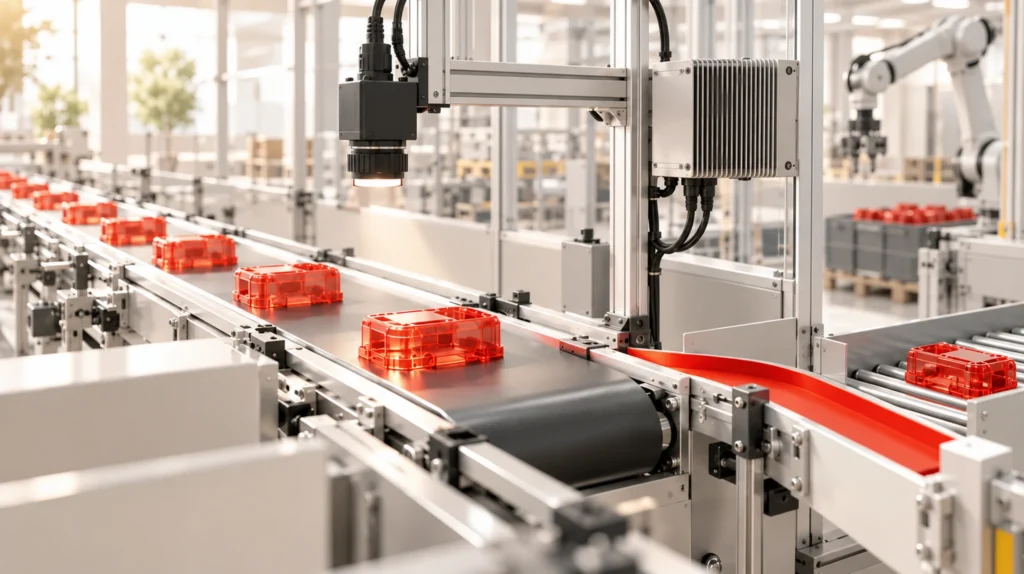
Repainting a damaged hood or removing a body shell from the line due to a miswelded body erodes an already small margin. To keep the conveyor running, AI is used to convert targeted audits into ongoing, station-level inspection. High-resolution frames from overhead vision systems are streamed to edge GPUs running a deep learning AI model trained on thousands of previously annotated samples, alongside edge cameras, thermal imagers, and acoustic microphones. The system detects a tiny crack, a paint nib that is microns broad, or an odd bearing hum in microseconds and redirects that particular component while those units are unaffected.
| Approach | Coverage | Defect scope | Response speed | Typical outcome |
|---|---|---|---|---|
| Manual spot checks | Limited samples | Obvious surface flaws | Minutes to hours | Rework or scrap discovered late |
| Rule-based vision | Expanded but rule-bound | Predefined dimensions or colors | Seconds | Acceptable for uniform parts, misses novel defects |
| AI inline vision & acoustics | Continuous, full line | Visual, thermal, and sound anomalies, including new failure modes | Sub-second | Defect isolated immediately; upstream process adjusted on the fly |
Looking for a trusted AI partner in automotive? Avenga offers a wide range of AI custom software development services for those looking to lead the market with innovation.
Beyond rejecting bad parts, the models learn process drift: a growing clustering of cosmetic flags at, say, the left rear door could lead engineers to recalibrate a robot torch before it makes out-of-spec welds. AI also feeds these signals back upstream into vehicle design reviews, so recurring issues at the body-in-white stage inform tolerance changes on the next program. Add in MES tags, and these live heat maps provide feedback loops back into scheduling and maintenance, turning an end-of-line gatekeeper into a self-tuning AI solution that improves first-pass yield and takes time out of launch ramps for any new model.
How do dynamic production scheduling and line balancing work?
An automotive line at full cadence will move the chassis every 50-odd seconds; one workstation away from the goal can reverberate through hundreds of second shifts and overtime recovery. Traditional scheduling binds sequence weeks out and uses manual calculation of buffer, fine until the supplier truck is late, the robot burns a bearing, or the operator calls in sick. This is one of the highest-value use cases in the automotive plant: AI-powered dynamic scheduling allows a changing model to replace rigid schedule assumptions and reschedule the immediate needs in real time.
Edge gateways stream cycle times, AGV locations, supply chain updates from supplier ASNs, and torque-tool health to a digital twin of the line. A reinforcement-learning engine executes thousands of micro-simulations each minute, looking for bottlenecks before they occur. If Station 14 slips six seconds because of torque gun increments, the model may pull a subassembly forward from Station 17, tell an AGV to bring additional pallets to a nearby buffer, or retune the upstream robot paths, all without stopping the conveyor. Operators get up-to-date work instructions on handhelds; the logistics team receives updated material requests in real time. Management sees takt variance compressed into real time.
AI is transforming how scheduling teams plan against the broader automotive value chain, since signals from the automotive supply chain now arrive in the same digital twin as the line data. The result is a unified picture of plant and supplier risk.
| AI-driven scheduling benefit | Operational impact |
| Reduced robot idling | Higher asset utilization; less energy wasted during micro-stoppages |
| Smaller WIP buffers | Lower inventory holding costs and less floor-space congestion |
| Live fit-checks for new model variants | Faster launches; issues surfaced against real-time constraints, not historical averages |
| Self-balancing line | Continuous reallocation of tasks keeps takt on target despite demand swings or mix changes |
Advanced driver assistance systems: Closing the feedback loop from road to factory
Production vehicles have now become mobile test rigs, streaming camera, radar, and lidar logs to the cloud. AI can analyze vehicle data at this scale and turn real-world miles into real-time process changes.
Picture this: a lane-keeping drift spike comes up, and the engineers trace it to vehicles built in week 38. They do a quick cross-query to MES and can see that Robot Cell B was torquing its camera brackets 0.4 N·m looser after a tool swap. The engineers change the screwdriver program, add a 30-second micro-stop for inline vision verification, and the fault rate disappears. No more firefighting, no mass recall.
The feedback also works in reverse. Vision models trained on millions of roadside frames, refined through ongoing AI development, deliver new algorithms to line-end calibration rigs. Instead of static light boxes, the rigs project synthetic glare and shadows, and AI personalizes the calibration profile so cameras leave the factory pre-tuned for the conditions each vehicle is most likely to face. There are fewer “ADAS reflash” returns and first-time-through yield increases.
This is automotive AI at its most useful: manufacturing precision enhances the next vehicle’s on-road performance, and field anomalies can change factory parameters in a matter of hours. As capabilities like this become embedded across the automotive industry, the relationship between design and production tightens with every release. Automotive companies running this closed loop benefit from lower warranty cost, quicker introduction of new driver-assist technologies, and a continuous improvement cycle where each mile driven maximizes the line’s production.
FAQ
The future of AI in the automotive industry is here
Henry Ford famously said, “If you always do what you’ve always done, you will always get what you’ve always got.” The succeeding iteration of the automotive industry will go to companies in line with this wisdom and thinking of data as their most capable AI tool. From predictive maintenance to self-balancing lines, AI enables manufacturing processes that pivot in milliseconds rather than across full shifts.
Advances in AI are pushing Artificial Intelligence in the automotive industry past the pilot phase, with new AI use cases emerging on every program. Manufacturers that use AI to improve every weld, torque, and calendar entry will lead the next era of mobility, and the leaders in automotive innovation are already building this loop into their core operating model.
Cut unplanned downtime, lift first-pass yield, and shorten model launches with Avenga’s AI engineering team. Start a conversation.


Your business results matter
Achieve them with minimized risk through our bespoke innovation capabilities. Fill in the form below.