







Remote vehicle diagnostics: Conduct car diagnostic tests digitally in 2026


June 12, 2026 11 min read 507 views
Fleet issues don’t usually kick off with something big and obvious. Most of the time, it’s something subtle, like a sensor acting up, a battery starting to fade, or maybe a misfire that only occurs when the vehicle’s really working. Usually, you don’t catch these issues until a driver notices something unusual and brings the truck in, at which point a technician runs the standard tests at the shop. Remote diagnostics changes all that.
These days, fleet managers can tap into AVL data and retrieve diagnostic trouble codes while the trucks are still in motion. They can catch problems early, identify which vehicles truly require attention, and have the necessary parts on hand before anyone even arrives at the shop. Continue reading to gain more insights into remote vehicle diagnostics.
Key takeaways on car diagnostic services
- Instead of waiting for failures, fleets can detect possible problems early thanks to remote vehicle diagnostics, which transforms vehicle health into a live signal.
- Ongoing surveillance lessens the impact of missed deliveries, towing, and unexpected failures.
- Pre-diagnosis increases diagnostic accuracy and speeds up turnaround time by providing the technician with context before the vehicle’s arrival.
- AVL vehicle data and vehicle diagnostics software facilitate more intelligent maintenance schedules, parts planning, and long-term fleet cost control.
Traditional vs. remote vehicle diagnostics
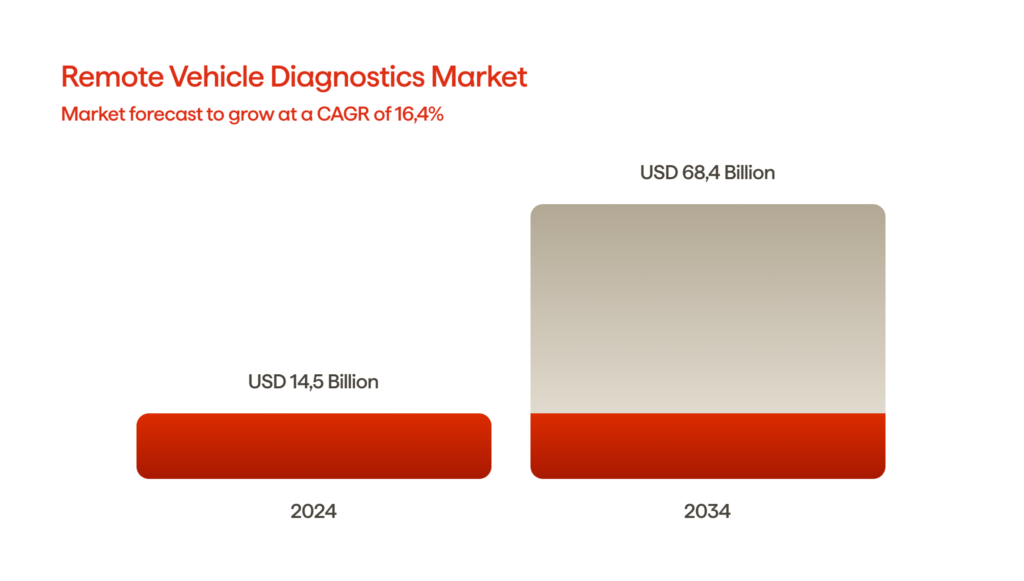
Things are moving quickly. In 2024, the global remote vehicle diagnostics market reached $14.5 billion, and it’s projected to surge to $64.8 billion by 2034, growing at a 16.4% annual rate. This isn’t just about numbers; it demonstrates how the automotive world is evolving. Fleets don’t have the luxury of waiting for a problem to land in the shop. With today’s software-packed vehicles, the warning signs pop up long before anything actually breaks down. So, catching issues early isn’t just smart, it’s necessary.
Traditional diagnostics (shop-first)
Diagnostic scans are typically performed when a driver notices something isn’t working correctly or during a regular service. A technician uses standard diagnostic tools (OBD and OEM) to retrieve fault code information from the vehicle’s computer, conduct a limited number of tests, and diagnose any issues found with the car. Although it is reactive, it is dependable. Too often, you don’t catch a problem until the vehicle’s already down. That leads to delays, wasted trips, or even missing the one issue that only pops up occasionally.
Remote diagnostics (road-first)
Remote diagnostics is like giving your vehicles a constant health check. They push telematics and fault data straight from the road to your central software. That means your team sees real-time updates on each vehicle’s health. Spot problems early, determine what actually needs fixing, and schedule repairs precisely when they’re needed. No more waiting for a service bay to open.
| Most vital difference | Traditional diagnostics | Remote diagnostics |
|---|---|---|
| Trigger | Driver report / scheduled inspection | Continuous monitoring + alerts |
| Location | In-shop | On-road + shop when needed |
| Speed to insight | Hours/days (depends on visit) | Minutes (data arrives automatically) |
| Detecting intermittent issues | Harder (may not reproduce) | Easier (captures patterns over time) |
| Preventing downtime | Limited (reactive) | Stronger (predictive, earlier action) |
| Planning repairs | Parts/techs are often arranged after diagnosis | Pre-triage enables parts + technician prep |
| Best for | Confirming root cause and physical inspection | Early warning, prioritization, fleet-scale control |
How remote vehicle diagnostics works end-to-end
Remote vehicle diagnostics acts like a silent partner for your fleet. It constantly collects data from your vehicles, turning it into real insights, and identifies issues before anyone has to dig around for the problem.
- Vehicle signal capture: Sensors/ECUs generate live health data (fault codes, temps, battery trends, exhaust signals) while the AVL vehicle is operating.
- Telematics aggregation: An AVL automotive device collects the signals and packages them into readable events, including both faults and “normal” baselines.
- On-board validation: To prevent alarms from being triggered by one-time faults, the device filters noise and verifies patterns (such as a fault repeating across journeys).
- Secure transmission: Encrypted channels are used to send data to the cloud via cellular, Wi-Fi, and satellite.
- Cloud normalization: By standardizing data across many makes and models, vehicle diagnostic software enables consistent analysis of a heterogeneous fleet.
- Real-time identification: Rules quickly identify frequent problems (misfires, overheating risk, exhaust/aftertreatment defects) before they escalate into more serious issues.
- Predictive analysis: By monitoring patterns rather than merely failures, models identify possible problems early (e.g., worsening fuel trim or frequent regen occurrences).
- Actionable alerts: The system produces a concise message that includes the severity, probable cause, and the first thing a technician should check.
- Workflow and learning loop: Work orders and scheduling updates are automatically processed, and post-repair results are fed back into the remote vehicle diagnostics system to improve accuracy.
This changes the whole approach to maintenance. You move from scrambling after breakdowns to actually planning ahead. Teams spot trouble sooner, make faster calls, and end up with fewer headaches out on the road.
Tap into expertise that spans the entire vehicle ecosystem, from ADAS and infotainment systems to AUTOSAR-based ECUs, diagnostics, and EV charging.
Core technologies enabling remote diagnostics
The concept behind remote vehicle diagnostics is simple: make a decision based on live vehicle signals before the vehicle stops working due to a mechanical failure. See how some of the most prominent companies in the industry enable this process.
- Robert Bosch GmbH leverages the Bosch IoT Suite, combining AI and IoT analytics to monitor systems in real-time and facilitate predictive maintenance. They’ve rolled out AI-powered ultrasonic sensors, too. These aren’t your standard sensors—they come with advanced height classification that significantly enhances detection for the latest mobility and safety technologies.
- Over at Continental AG, the team is rolling out remote vehicle diagnostics by combining advanced sensors with connected data pipelines. They’ve built a modular software platform that scales easily, plus they push updates over the air. Their big move? They’re separating software from hardware so that they can roll out new diagnostic features much faster—even with a bunch of different ECUs in play.
- ZF Friedrichshafen AG focuses on more intelligent electrification and transmission diagnostics. They employ live driving data and real-time analytics to identify issues early and minimize unscheduled repairs rather than merely adhering to a set service schedule. Instead of using a one-size-fits-all strategy, their ZF Health Check modifies service plans according to the real state of each component.
- Remote diagnostics are integrated into Verizon Connect’s Reveal fleet platform. Fleet managers gain a comprehensive view of their vehicles’ performance and health through real-time telematics analytics, which provide actionable insights. Their advantage? Strong IoT connectivity that is easily scalable due to international collaborations and growing eSIM coverage.
- Octo Group has enhanced its services by utilizing cutting-edge analytical methods to identify potential red flags. Octo empowers fleet managers to take action and resolve minor issues before they become severe ones by utilizing machine learning to identify anomalies in engine vibrations. By better managing their maintenance expenses and scheduling maintenance instead of responding to emergency-type breakdowns, companies may be proactive by doing ongoing health checks.
The technologies collect data, transmit it securely, and generate alerts, work orders, and efficiently manage maintenance intervals. It is precisely how fleets move away from simply providing ‘response’ to failure and adopt a proactive maintenance philosophy.
Benefits of remote diagnostics for fleet management
Remote vehicle diagnostics takes those surprise breakdowns and turns them into something your team can actually deal with ahead of time. No more just waiting for a truck to quit on you. Now, you spot the warning signs early, fix what matters most, and keep your fleet moving. That means more trucks on the road, fewer last-minute route changes, and less money lost to vehicles stuck in the shop.
It also cuts through the guesswork when something goes wrong. A warning light by itself doesn’t really tell you if you’re okay to finish the job or if you need to pull over right now. With remote diagnostics, you get the real story—actual fault codes, sensor data, the whole picture—so dispatch and maintenance can make better decisions. You dodge the frantic, unnecessary repairs and those risky, drawn-out delays.
When you’ve got that kind of visibility, you’re not just dodging breakdowns and pricey tows—you’re staying ahead of the mess. Spot issues with cooling systems, batteries, drivetrains, or emissions early, and you keep your trucks on the road, drivers safer, and you avoid paying the “emergency tax” that comes with last-minute recovery, rescheduling, and missed deliveries.
Techs work smarter, too. Instead of walking in blind, they have pre-diagnosis information on hand. Repairs move faster, plain and simple. Volvo Trucks North America’s VP of Connected Services puts it like this: pre-diagnosis can shave 20%–22% off repair turnaround, just because the shop’s ready before the truck even parks.
Last but not least, fleets actually see what’s going on with their vehicles and can enable proactive maintenance. Vehicle maintenance occurs when it’s truly necessary, based on real data and actual risk. That keeps parts working longer and maintains steady costs. Drivers notice the difference, too, including less downtime and fewer weird warning lights.
Implementation playbook
Fleets gain a fundamental understanding of vehicle health and can finally stay ahead of maintenance. No more sticking to a strict calendar—now you service vehicles when they actually need it.
| Step | Goal | What you do (brief) | Output |
|---|---|---|---|
| 1) Scope and fleet baseline | Target the highest ROI | Choose vehicle groups (age, mileage, routes), log top failure types, and define success KPIs | Pilot fleet + KPI targets |
| 2) Data and hardware setup | Start collecting clean signals | Confirm ECU/OBD/J1939 access, install/activate telematics, validate sensor coverage | Live data feed per vehicle |
| 3) Platform and integrations | Make data usable | Connect your vehicle diagnostics software to CMMS/TMS, configure dashboards, and set data retention | Single view of vehicle health |
| 4) Alert rules and triage | Avoid alert fatigue | Define severity levels, escalation owners, “stop-now vs finish-route” logic | Actionable alert playbook |
| 5) Shop workflow and parts readiness | Speed up repairs | Pre-diagnosis notes for technicians, parts pre-order rules, and service appointment routing | Faster turnaround loop |
| 6) Pilot review and scale | Lock in operational gains | Weekly review of false positives, downtime, two events, refine thresholds, and expand fleet | Scalable rollout plan |
Think of the first month as a trial run. You’re not aiming for perfection right away. Let real driving data come in, and your thresholds and processes will adjust naturally.
FAQ
Final words: Keep your vehicle safe and sound
Using remote vehicle diagnostics has transformed the way businesses manage fleets, shifting from a “fix it when it breaks” approach to a “see it coming and schedule it” approach. The proper diagnostic tests help technicians prioritize what is potentially wrong based on the level of severity, allowing for automated vehicle lifecycle management workflows to run more smoothly and quickly.
Want to learn more about AVL vehicle diagnostics? Contact Avenga, your trusted partner in vehicle systems technology.



Your business results matter
Achieve them with minimized risk through our bespoke innovation capabilities. Fill in the form below.