






What is digital out-of-home (DOOH) advertising and how does it work?

May 26, 2026 12 min read 639 views
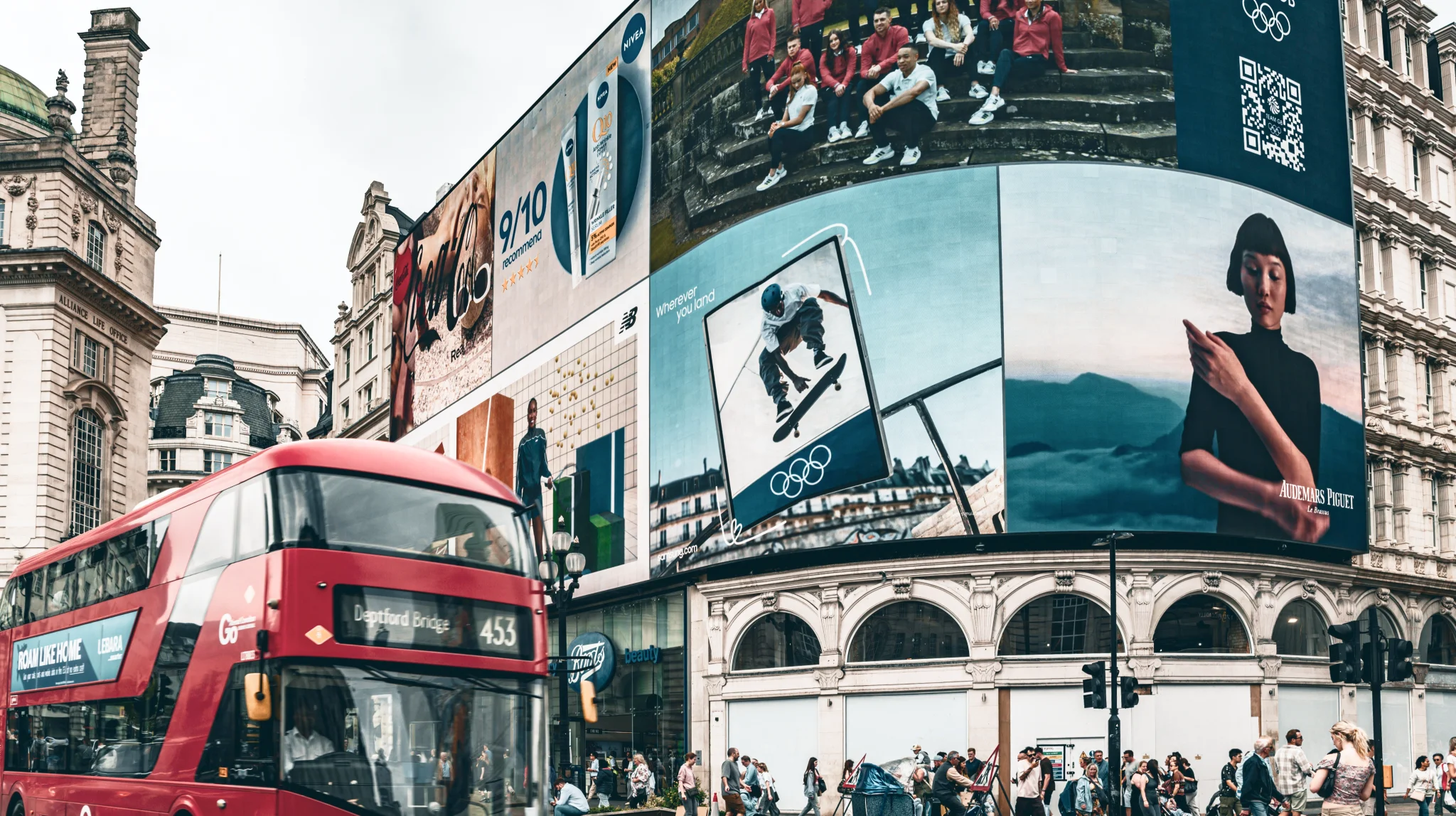
Digital out-of-home (DOOH) advertising is transforming the way brands reach consumers in public spaces. Combining the traditional impact of outdoor advertising with the precision of modern AdTech, DOOH delivers dynamic, data-driven campaigns that adapt to real-time conditions like weather, time of day, and audience demographics. In this article, we’ll explore what DOOH is, how it works, and why it’s reshaping advertising.
What is traditional OOH advertising?
Out-of-home (OOH) advertising is traditional (i.e., non-digital and non-programmatic) outdoor advertising. Also known as OOH media or outdoor media, OOH advertising is about sharing messages with consumers when they are in public places, commuting to work, waiting (e.g., in elevators), and in specific commercial locations. Typical OOH formats include billboards, on-car ads, bus-stop shelters, etc.
From OOH to digital out-of-home advertising (DOOH)
Digital out-of-home (DOOH) is basically OOH powered up with AdTech – geofencing, tracking, retargeting, personalizing, attribution, and measurement. It offers numerous advantages of the technology used in online display advertising, such as targeting and enhanced traffic data, but at the same time, it is completely immune to ad blockers, and OOH ads cannot be skipped by the user.
The shift from OOH to DOOH has reshaped how out-of-home ads get bought. Gone are the human middlemen. Gone are the slow, manual insertion orders. We’re now in the fast lane, headed toward a reality where machines buy ads programmatically. Here’s what digital OOH has in store for you.
Go beyond the fundamentals with Avenga’s AdTech book. Download a copy to maximize your advertising ROI.
Current state of the DOOH market
Worldwide, DOOH is on track to climb from $22.51 billion in 2026 to $56.1 billion by 2034, with a 12.09% CAGR. In the US, DOOH is expected to expand 14.5% in 2026, while traditional OOH spending inches up just 1.5%.
Programmatic is the engine. Three forces are pulling inventory toward data: programmatic buying, mobile advertising location data, and smart-city infrastructure, according to Mordor Intelligence.
Consolidation is reshaping the programmatic stack. Broadsign’s November 2025 acquisition of Place Exchange pushed its globally bookable screen network to 1.8 million. A month later, Place Exchange rolled out programmatic guaranteed deals for DOOH inside Google’s Display & Video 360.
What media-buying processes are possible with DOOH?
DOOH sounds complex, but the mechanics are straightforward once you know the playbook. Four media-buying methods do most of the heavy lifting across the industry:
Real-time bidding (RTB) is an auction-based bidding protocol in which advertisers compete against each other to display ads to specific users. RTB offers extensive capabilities and a wide range of inventory types and is universally considered one of the most flexible models on the market.
Programmatic direct is a one-to-one media-buying process much akin to the traditional method, whereby salespeople meet with advertisers in person to strike a deal. It is a very similar model to the private marketplace, with the exception that advertisers and publishers agree on specific inventory based on a fixed CPM.
Programmatic guaranteed (also known as private marketplace or PMP) is an invite-only auction process in which just a handful of advertisers bid against one another to buy a publisher’s inventory. This method is typically offered by publishers with more premium (i.e., coveted and expensive) inventory – think of major media sites like Forbes, Wall Street Journal, or The New York Times.
Non-programmatic guaranteed (direct) is the manual route. Sales teams scope needs, negotiate CPMs, and draft the insertion order (IO) over email. The inventory is sold at a fixed rate and reserved for the buyer. Specific placements or exposure conditions often command a premium.
Opportunities and benefits of DOOH advertising
DOOH has matured from a digital billboard novelty into a full-funnel, data-driven advertising channel. The following capabilities are now available to businesses:
Buying happens in the same place as everything else. DOOH inventory shows up inside the DSPs you’re already using for display, video, and CTV. That means one workflow for planning, targeting, optimization, and reporting. No more insertion orders sent over email.
Targeting goes well beyond location. DOOH offers access to anonymized mobile panel data and venue insights, so you can reach defined audience segments (e.g., commuters, gym regulars, frequent flyers, parents of young kids) wherever they physically are. Geography is one input among many; behavior and demographic context get layered on top. This makes place-based DOOH especially powerful, since screens in gyms, transit hubs, or shopping centers double as both location and audience signals.
Creatives can react to what is actually happening outside. Weather, time of day, traffic conditions, pollen counts, live sports scores, flight delays, even product availability in nearby stores — pretty much any feed can drive a contextually relevant DOOH creative swap. Coffee ads in the morning, cocktails by 6pm, umbrellas when the rain starts.
It also fits into broader omnichannel work. Audiences exposed to a DOOH ad can be picked up again on mobile, social, or CTV, using device IDs sourced from the same location signals. So, a screen by the highway becomes the top of a funnel that ends with someone tapping “buy” on their phone. This is part of the broader impact of OOH that extends well past the initial roadside view.
The ability to measure DOOH has caught up too. Verified impressions, footfall lift, brand-lift studies, QR/NFC engagement, site visits, app installs, in-store visits, and offline sales attribution. All of it is on the table now, and the IAB and MRC standards published in 2025 give the methodology some real backbone.
Challenges of digital DOOH
DOOH media is not priced the same way as online ads
CPM (cost-per-mille) is now the dominant DOOH currency, aligned with how display, video, and CTV are bought. The wrinkle: a single DOOH impression can be seen by multiple people, so DOOH CPMs are calculated against modeled audience exposure rather than 1:1 device delivery. Other pricing models still in play include share of voice (a fixed percentage of a network ad rotation) and loop frequency (multiple spots within one playback loop).
To tackle that, you can work with partners that report verified impressions, built from mobile location data, foot traffic patterns, and screen visibility, rather than raw playout counts.
DOOH viewability is hard to measure
In DOOH, each impression can be seen by many pairs of eyes, but we never know the exact numbers, which makes it difficult to compare prices with digital media impressions. Vendors can model traffic near a screen using mobile location data, but it remains an estimate. Standing near a board isn’t the same as seeing the ad, and early attempts to deploy facial recognition for demographic estimation faced strong privacy backlash and increasing regulatory scrutiny under GDPR and similar laws.
The industry has since moved toward privacy-safe alternatives: anonymized mobile location panels, computer vision that classifies aggregate audience attributes without storing biometric data, and “likelihood to see” (LTS) metrics introduced in the IAB guide.
You can replace exposure-only metrics with outcome-based ones. Tie an ad campaign to footfall lift, brand-lift studies, or QR/NFC engagement.
DOOH is physical (and premium) real estate
Because DOOH inventory is physical, it’s finite. That scarcity has historically made media owners cautious about exposing premium screens to open RTB, where prices can collapse. Large-format DOOH placements (think iconic spectaculars in city centers or hero billboards along major highways) sit at the top of that scarcity pyramid.
That caution looks justified in retrospect: even with rapid programmatic DOOH growth, inventory constraints are now slowing market adoption, and most premium placements (airport networks, transit, iconic billboards) still trade through programmatic guaranteed or direct deals rather than open auction.
For premium environments, you can use programmatic guaranteed to lock in inventory ahead of high-demand periods (holidays, sporting events, product launches). Reserve open RTB for flexible, audience-driven campaigns that matter more than specific placement.
Ad targeting, measurement, and attribution
Because OOH ads are physical advertising media operating in a one-to-many environment, there is no way to target individuals or conduct advanced attribution as is done in the online world with cookies and device IDs.
DOOH ad targeting will likely involve reaching a certain demographic at a certain time based on data collected from the environment, rather than targeting individuals. Similarly to attribution, marketers could simply look at the number of impressions an OOH ad received and compare it to conversions during all stages of a campaign.
The times of information and data collected for DOOH targeting and analytics vary, but typically include data from:
- Ticket sales from concerts, sporting events, etc.
- IR sensors placed near the entrances of buildings (e.g., shopping malls)
- Third-party measurement companies, such as Nielsen
- Sensors and cameras from companies like Quividi
- Mobile location data from ad exchanges and data brokers
DOOH content can also be tied to weather and time-of-day data.
You can treat DOOH as a full-funnel channel, not a standalone awareness buy. Activate it inside the same DSP as your display, mobile, and CTV, and, that way, DOOH-exposed audiences feed retargeting pools, and attribution can account for DOOH’s role across the whole journey rather than measuring it in a silo.
Under-demand and over-supply
Supply of digital out-of-home media is still much bigger than its demand, which would lead to underselling and underpricing of media. For media owners, this is a pricing opportunity. For buyers, it means premium inventory needs to be secured earlier than it used to.
You can plan campaigns further in advance, especially around tentpole moments, to tackle this challenge. Use automated guaranteed deals to reserve high-demand inventory at agreed prices and keep a flexible RTB layer for in-flight optimization.
FAQ
DOOH advertising in action
As a digital channel, DOOH no longer rests on novelty. The screens are there, the buying infrastructure works, and the measurement frameworks are mature enough to stand up in a quarterly review. For most businesses, the practical task is figuring out the right blend: how much programmatic guaranteed, how much open auction, which audiences to prioritize, and which markets to lead with. The brands that treat those choices as a deliberate strategy, rather than a default, are the ones consistently pulling ahead.
A short introductory call is often the most efficient way to determine whether DOOH is the right fit. Get in touch with our team to discuss your DOOH goals.


Your business results matter
Achieve them with minimized risk through our bespoke innovation capabilities. Fill in the form below.