





Generative AI in advertising: 7 practical use cases and examples


July 30, 2026 7 min read 428 views
Gen AI is changing how advertising teams create, adapt, and manage campaigns. In AdTech, it is being used to speed up content production, personalize ad experiences, improve campaign workflows, and support better decision-making across the creative process.
This article looks at seven practical ways Gen AI is used in advertising, along with the benefits it offers advertisers, agencies, and AdTech companies. It also shows how these applications are shaping the future of digital advertising.
Key points
- Gen AI supports more than ad creation. It can also repurpose content, personalize creative assets, generate campaign recommendations, and automate advertising workflows.
- Advertising teams can use Gen AI to produce and test more creative variations while reducing the manual work involved in campaign development and management.
- The strongest results come from combining Gen AI with human oversight, reliable campaign data, and clear brand and governance guidelines.
7 use cases of Generative AI in advertising
Generative AI in advertising goes far beyond creating text and images. Today, advertisers, agencies, and AdTech companies use Generative AI to streamline ad creation, personalize advertising campaigns, optimize creative assets, and support campaign planning. As AI continues to evolve, these capabilities are becoming a standard part of modern digital advertising workflows.
Below are seven practical examples of how Generative AI is used in advertising and the value it delivers across the creative process and campaign management.
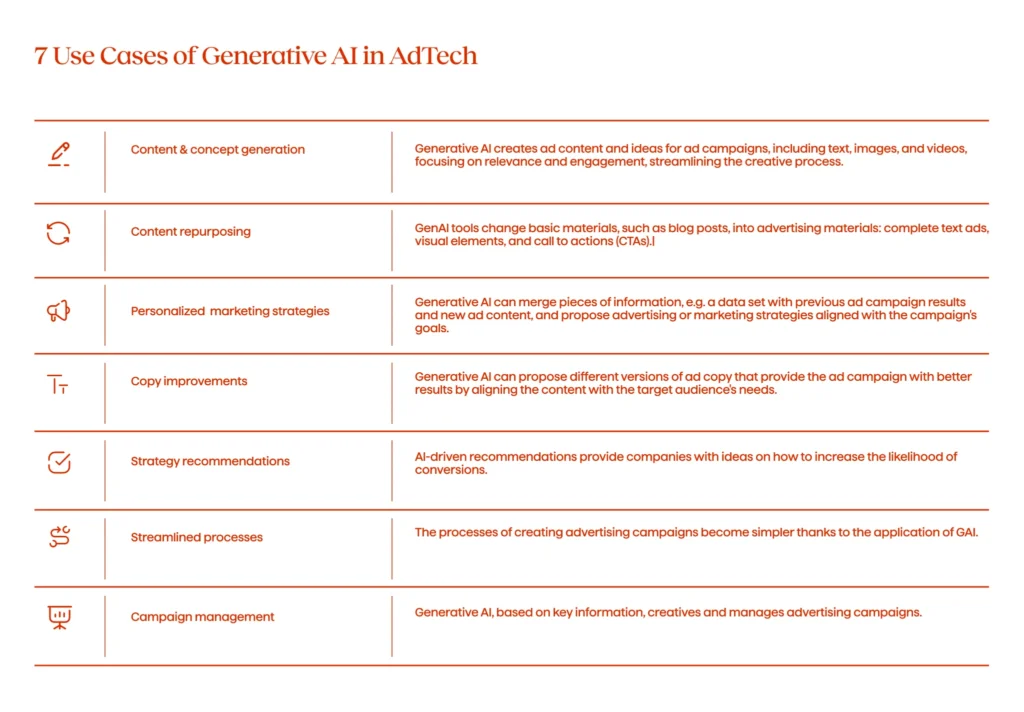
1. Content and concept creation
Many AdTech companies, such as ad agencies, create a lot of advertising assets: texts, images, videos, and audio ads. However, creating ads can take time and effort in terms of human resources.
To solve that issue, teams can support themselves by utilising Gen AI advertising solutions. Their productivity can increase significantly with tools combining generative models with other types of artificial intelligence.
With proper software, advertising specialists can:
- run ad assets analysis and spot trends faster
- generate a variety of fresh ad ideas tailored to different stages of the sales funnel
- create advertisements more effectively
2. Content repurposing
Generative AI models are specifically designed and trained to deliver new content. They excel at creation. Any Gen AI advertising solution needs input data to generate a new idea or content. For example, producing new headlines for Google ads requires submitting keywords. However, the input doesn’t have to be unique every time — Gen AI solutions will also exploit the old content.
Based on writing samples or whole pieces of content, ad agencies, advertisers, and AdTech companies can generate new formats in seconds: article to an advertisement, image to an infographic, or presentation to a sales email.
3. Advertisement personalization
Advertisers using Gen AI platforms can easily target audience groups with personalized content. Using proper solutions, advertisers can adjust messages, images, and videos to their prospective customers’ preferences, interests, and needs. This can be applied to various advertising formats, including traditional ads, product recommendations, customised emails, etc.
4. Ad copy improvements
Another way how AdTech companies can use Generative AI is by introducing ad copy improvements. Gen AI-powered solutions use natural language processing (NLP) to analyse and suggest improvements to created texts’ quality, effectiveness, correctness, etc.
5. Advertising strategies recommendations
Solutions utilising AI and Generative AI models can analyse insights from previous ad campaigns and prepare proposals for new, improved advertising strategies. The recommendations could include both general ideas and specific steps to follow.
Generative AI in AdTech can produce advertising recommendations in terms of:
- ways how marketers can use content
- types of content to prepare, such as video ads and audio ads
- campaign modifications, like recommendations for enhancing personalisation in ad creatives.
6. Advertising processes simplification
Generative AI is simplifying advertising workflows by reducing the manual effort required to create, review, publish, and optimize campaigns. Modern AI-powered advertising platforms can generate creative assets, adapt them for different channels, enforce brand guidelines, and streamline campaign activation from a single interface.
Adobe GenStudio for Performance Marketing is one example. The platform uses Generative AI to help marketing teams create on-brand ads for channels such as Meta, LinkedIn, display, and email, while also supporting content reviews, approvals, and performance insights in the same workflow.
7. Advertising campaign management
Generative AI is transforming campaign management by automating tasks that previously required constant manual adjustments. Advertisers can use AI to build campaign assets, optimize ad copy, allocate budgets, identify new audience opportunities, and improve performance across multiple channels from a single campaign.
Google Ads’ AI Max and Performance Max are examples of this approach. After advertisers provide campaign goals, creative assets, audience signals, and a landing page, Google’s AI helps generate and optimize ad variations while continuously adjusting targeting, bidding, and budget allocation to maximize campaign performance.
Download our AdTech Book to learn about key technologies, market shifts, and innovations transforming digital advertising.
What are the benefits of Generative AI tools for the advertising industry?
Generative AI for marketing and advertising offers significant advantages, from accelerating creative production to improving ad performance. By adopting Generative AI tools or building custom AI solutions, advertisers, agencies, and AdTech companies can use AI to support campaign development, automate repetitive workflows, and create more relevant advertising experiences at scale.
Increasing productivity
Generative AI streamlines and accelerates various aspects of the advertising process. AdTech businesses can employ generative models to create ad creatives swiftly, reducing the manual workload and significantly boosting productivity.
Testing against customer sentiment
Another advantage of generative AI is its ability to support customer sentiment analysis. AdTech companies can use AI to analyze user responses to ad creatives, headlines, and messaging variations. These insights allow teams to better understand audience preferences and refine advertising strategies to improve campaign relevance.
Scaling personalization
Generative AI facilitates personalized content creation at scale, enabling AdTech companies to tailor advertisements to their target audience’s individual preferences and behaviours. By leveraging generative models, advertisers can dynamically adjust messages, images, and videos, delivering hyper-personalized content across various advertising formats.
FAQ
The growing role of Generative AI in advertising
Generative AI is moving beyond simple content generation and becoming a larger part of the advertising workflow. In the future, advertisers can expect AI solutions to support more areas of campaign development, from generating ad creatives and testing variations to recommending strategies based on real-time performance data. As AI technologies continue to evolve, the biggest opportunity will come from combining automation with human creativity to build more relevant and effective advertising experiences.
Tap into expertise that supports every stage of AdTech software delivery. Contact our team to discuss your objectives.



Your business results matter
Achieve them with minimized risk through our bespoke innovation capabilities. Fill in the form below.