





What is programmatic audio and how does it work?


June 12, 2026 12 min read 541 views
The automated buying, selling, and delivery of audio ads across podcasts, music-streaming platforms, and digital radio is known as programmatic audio. As audiences increasingly consume digital audio content, this approach is gaining traction across the advertising industry.
Like many digital advertising innovations, programmatic audio has its roots in the evolution of programmatic advertising itself. In 1993, an innocuous, simple banner was displayed on Wired.com, teasing unsuspecting visitors to click on it. These were the meager beginnings of display advertising, and programmatic quickly arose to automate the growing demand for this emerging ad-delivery process.
There was no turning back from there; the novel way of buying media and managing online inventory took the industry by storm and was quickly adopted by publishers and advertisers. Today, programmatic is an expected and accepted way of buying digital media: online display ads, video ads, search ads, social media ads, advanced TV, and outdoor ads.
However, recent developments in programmatic suggest that the needle is slowly moving, and programmatic audio ads may soon gain more traction.
Why is programmatic audio growing in digital advertising?
Programmatic audio is growing in digital advertising as audiences shift toward streaming platforms and podcast listening, while advertisers increase investment in automated buying and selling of digital audio inventory. This trend is closely tied to broader changes in the advertising industry.
A number of big players are either looking at or already implementing programmatic audio. With announcements from Spotify, SoundCloud, TuneIn, Pandora, and Google leading the charge, a major shift may be underway.
The interest comes from wider changes in digital media, including the optimization of advertising processes, the decline of non-digital media, and the shift toward digital alternatives such as streaming TV, music streaming services, and digital radio. The industry continues to follow where audiences move, as more users engage with podcast and music-streaming services than ever before.
What is programmatic audio advertising?
Programmatic audio advertising uses automated technology to buy, sell, and insert ads in audio content such as podcasts, digital radio, and music-streaming services. The approach is part of programmatic advertising, which automates the purchase of digital advertising inventory with limited human involvement and fewer manual insertion orders.
For years, programmatic advertising has been a core part of digital advertising and has expanded beyond display and video into channels such as radio, audio advertising, out-of-home (OOH) advertising, and even traditional print.
The growing adoption of podcasts, digital radio, and music-streaming services is creating new opportunities for programmatic audio. By connecting advertisers with audio inventory across streaming platforms, the technology enables more efficient ad delivery and audience targeting within digital audio environments.
Considering the success of programmatic advertising across other channels, programmatic audio has significant potential. For many years, adoption was limited by lower publisher interest and the lack of dedicated technology and industry standards needed to support audio advertising at scale.
A similar pattern can be seen across other media channels. Declining interest in traditional TV accelerated the adoption of programmatic TV on OTT (over-the-top) devices, while new technology transformed out-of-home advertising through improved targeting, measurement, and retargeting. Likewise, the decline of traditional radio is contributing to the growth of digital radio and other forms of streaming audio.
How does programmatic audio advertising work?
Programmatic audio advertising works by using standardized frameworks and automated systems to deliver audio ads across streaming platforms, podcasts, and digital radio. For many years, the lack of clear specifications for digital audio advertising limited adoption across audio platforms and audio ad inventory.
Unlike display and video advertising, programmatic audio required dedicated standards to support buying and selling of audio ads at scale. This changed when the IAB (Interactive Advertising Bureau) introduced the Digital Audio Ad Serving Template (DAAST) in 2014 to define how audio advertisements should be delivered.
In 2018, DAAST was merged into VAST 4.1, a widely used standard for programmatic advertising. The updated framework introduced support for audio ad formats by adding an “adType” attribute, which enabled audio-only delivery across streaming platforms and music streaming services. The term “media player” also replaced “video player,” reflecting broader support for digital audio content.
The adoption of VAST improved communication between DSPs, ad servers, and publishers by creating a shared technical language for ad insertion and impression delivery across audio inventory. This made programmatic buying and selling of digital audio advertising more scalable across advertising platforms.
VAST also supports linear audio ad formats, where ads are inserted into audio content such as podcasts or streaming music. These formats include:
- Companion ads: display banners or visuals with brand messaging alongside the audio stream within the player during playback.
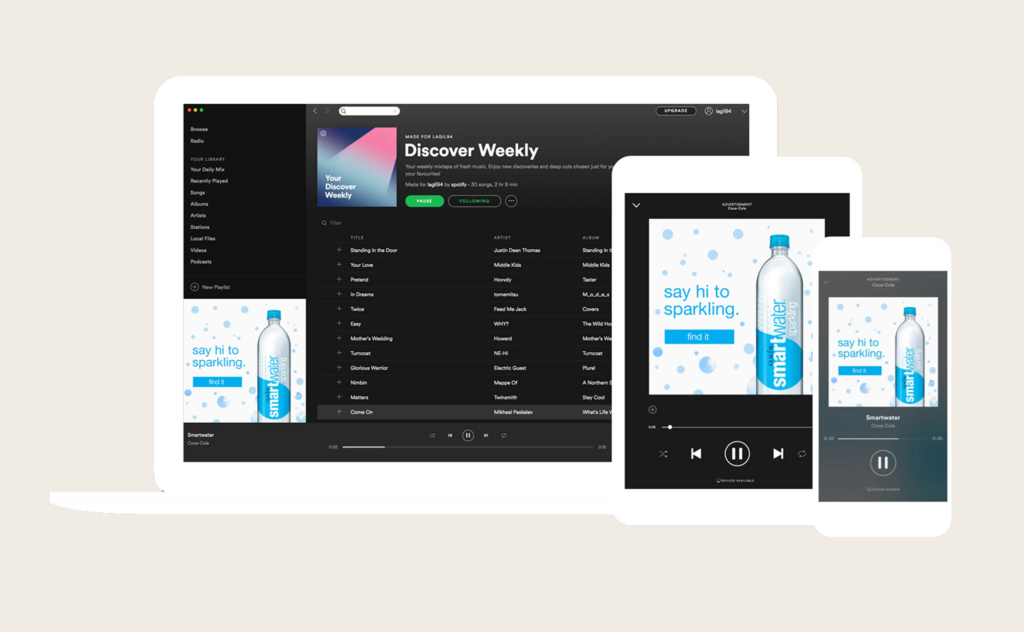
- Ad pods: “slots” for one or more audio ads in the content.
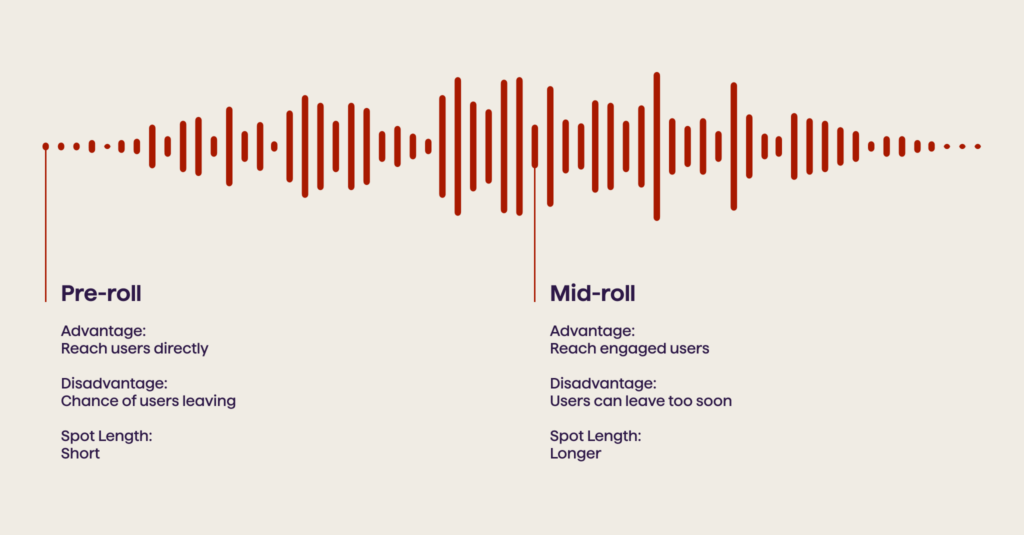
- Skippable ads: Ads in audio can appear as pre-roll (before the content) and mid-roll (in-content), each offering specific advantages.
Which companies are offering programmatic audio ads?
Several major digital advertising and audio platforms offer programmatic audio ads, including Spotify, SoundCloud, TuneIn, Pandora, Google, Rubicon Project, AppNexus, and BBC partner Acast. These companies operate across streaming platforms, podcast advertising, and digital audio inventory environments.
Google announced in June 2018 that it would enable programmatic audio advertising through Spotify, SoundCloud, TuneIn, and Google Play Music, allowing brands to purchase audio ads using DoubleClick Bid Manager. This setup connected advertisers with audio inventory across multiple streaming services through a single advertising platform.
Rubicon Project also invested in programmatic audio advertising in 2018. The AdTech provider focused on expanding demand-side access to digital audio inventory as media buyers increased interest in measurement, tracking, and scalable audio campaigns.
SoundCloud later expanded its offering by adding programmatic audio and video inventory through the AppNexus marketplace, increasing access to audio ad inventory across its audio platform.
Pandora launched a private audio marketplace that allows advertisers to buy and sell programmatic audio ads across its music streaming service and podcast content. This expanded access to targeted audio advertising within its ecosystem.
BBC partnered with Acast to introduce programmatic audio ads across its podcast distribution. Because BBC operates as a public broadcaster, ad delivery is applied only to international listeners, while UK audiences receive ad-free content. Acast uses contextual targeting, location data, and listener behavior signals to insert relevant audio advertisements in real time.
What are the benefits of programmatic audio advertising?
The full potential of programmatic audio has yet to be unlocked, but the numerous advantages of advertising programmatically in podcasts and music-streaming services are already evident – they result from the specificity of the audio medium itself (i.e. radio, podcast or music).
1. The growing popularity of music-streaming services
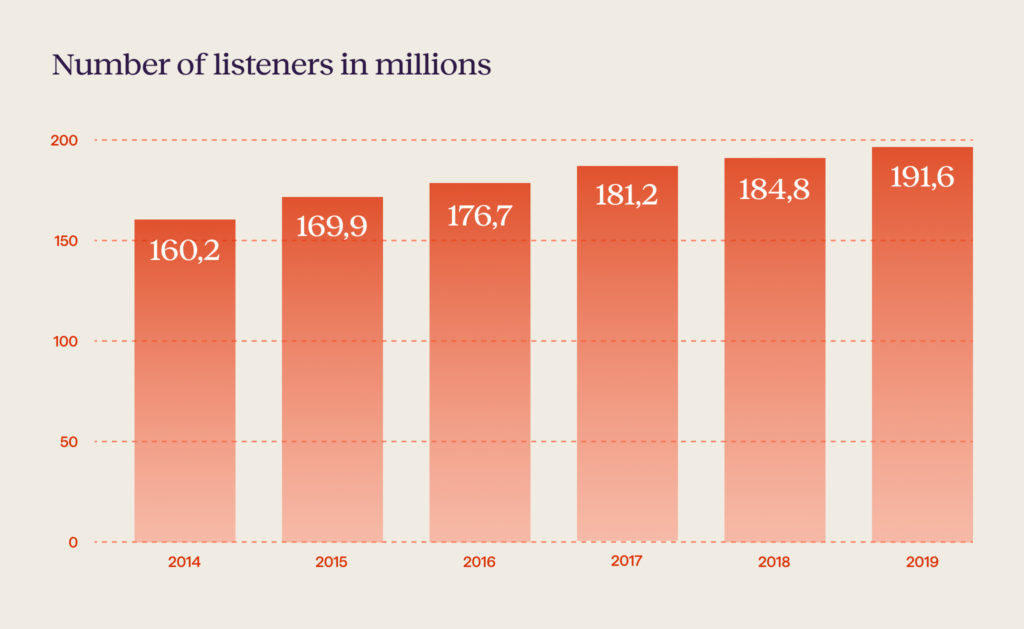
Independent research shows that ad-supported audiences on music-streaming platforms continue to grow. While premium plans allow users to enjoy ad-free music streaming, many listeners still choose free, ad-supported tiers, creating substantial audio inventory for digital audio advertising.
Spotify boasts a whopping 100m users worldwide, out of which 83m are paying subscribers and about 17m are non-paying subscribers who use the non-premium service and listen to ads.
Even if the figures are not as impressive as for display ads, audio advertising should be considered a more premium kind of advertising. Advertisers don’t have to compete for the user’s attention, as the the listeners aren’t physically able to listen (or watch) to anything else while an audio ad rolls – which makes the engagement much higher.
2. Mobile is the main driver of the programmatic-audio revolution
Digital audio listening continues to grow, driven largely by mobile devices and streaming platforms. According to Edison Research’s Infinite Dial 2025, 79% of Americans age 12+ listen to online audio each month, equivalent to approximately 228 million listeners. The study includes streaming music, podcasts, digital radio, and other online audio content.
Mobile usage plays a central role in this growth. As consumers increasingly access music, podcasts, and other audio content through smartphones and connected apps, advertisers gain access to authenticated audience data rather than relying solely on third-party cookies. This shift supports people-based marketing and aligns with evolving privacy requirements such as GDPR.
Programmatic audio offers the best of both worlds, allowing advertisers to reach their target audience across devices using a combination of first-party data, demographics, listening behavior, and traditional device signals. This approach enables more accurate audience targeting across streaming services, podcasts, and other forms of digital audio content.
3. Intimate brand-listener bond
With a majority of people listening to audio via headphones, an intimate bond is formed between the brand and listener. This not only helps advertisers ensure that their message is heard, but also provides an opportunity to personalize the message to that individual listener.
Results from a personalized-audio ad campaign conducted by A Million Ads found that listeners exposed to a personalized ad were 2.4x more likely to convert than listeners who heard a generic ad.
4. Affluent, well-educated audience
Podcast audiences tend to be more affluent and highly educated. Around 31% of listeners report household incomes above $100K, and 68% hold a bachelor’s degree or higher. This makes them a valuable audience for audience targeting in programmatic audio campaigns.
5. Audio ads are distraction-free
Podcasts are considered a distraction-free medium, as they can reach people in situations when no other media can. Because of the specificity of content, listeners are more focused than display-ad audiences and tend to consume podcasts in distraction-free environments – at home or during leisure.
6. Resistance to Adblock
People listening to audio on mobile devices can’t simply block ads like they can with display ads via ad-blocking tools. This presents an undeniable advantage to advertisers. Unlike in web browsers, users cannot jump to another tab or install an adblocker to get rid of ads altogether.
Early challenges of programmatic audio advertising
Until recently, programmatic audio was dealing with the initial growing pains. Most of these problems have already been addressed, but others will go away when the technology matures.
Undersupply and under-demand
Most crippling for the development of programmatic audio is the lack of scale, which is critical to attract advertisers and publishers. At the moment, supply of programmatic audio media is much bigger than the demand for it, leading to underselling and underpricing of inventory.
Again, this is another reason why real-time bidding (RTB) auctions are difficult to execute in programmatic audio advertising. For now, a guaranteed (non-programmatic or programmatic direct) approach makes more sense here until demand grows to match supply.
Incompatible technology
The existing technology driving digital ad-buying is not quite compatible with audio. While there are frameworks concerning the delivery of programmatic audio, this does not solve all its pains. The existing ad servers and ad exchanges are designed with display and video ads in mind, and so is the nomenclature. Case in point: ad view, viewability, impressions, cost per click – all these terms mean very little in the way of audio ads.
This means that getting fully on board with audio advertising entails heavy investing in the technology. Streaming platforms have to build a lot of the costly advertising technology themselves, which for many players may not offer a sufficient return on investment.
FAQ
The future of programmatic audio
Audio content like podcasts continues to gain popularity, and confidence in the medium as an advertising channel is growing accordingly. This is reflected in the IAB Podcast Ad Revenue Report, which projects that US podcast ad spend will exceed $3 billion in 2026, with global spend surpassing $5 billion — a 12.4% year-over-year growth rate that outpaces overall digital advertising and connected TV.
The always-connected, on-the-go lifestyle and the popularity of fitness remain conducive to consuming audio, especially on mobile devices — a trend already reflected in Edison Research’s Infinite Dial findings cited above. Unlocking the full potential of programmatic audio ads may take time, but the trajectory points in a positive direction: analysts at Madison & Wall project that automation in the digital audio sector will climb from 22% in 2025 to nearly 46% by 2030.
Our AdTech development teams can work with you to design, build, and maintain a custom-built AdTech platform for any programmatic advertising channel. Learn more.



Your business results matter
Achieve them with minimized risk through our bespoke innovation capabilities. Fill in the form below.