






Artificial Intelligence and Machine Learning in pharmacovigilance

June 25, 2026 19 min read 486 views
Find out about the insights pointing toward the current and prospective value of Artificial Intelligence and Machine Learning in Pharmacovigilance
Artificial Intelligence (AI) and Machine Learning (ML) are the most recognized technologies right now. While having a range of applications, they are taking pharmacovigilance to the next level.
Here, we will explore the phenomenon of pharmacovigilance (PV). Through use cases and prospects, we see how AI and ML in pharmacovigilance are reinventing the practice and creating more value. In turn, this means greater patient outcomes, better medicine, and new avenues for revenue.
The value of Artificial Intelligence systems and Machine Learning in healthcare
The global artificial intelligence market was valued at approximately $390.9 billion in 2025 and is projected to grow significantly over the coming years. The rapid expansion reflects increasing adoption of AI technologies across industries, including healthcare, where organizations use AI to improve efficiency, automate processes, and generate insights from large datasets.
Why do businesses use AI and ML?
Businesses use AI and ML to analyze large volumes of data, identify patterns, and generate accurate predictions. These capabilities help organizations make better decisions and uncover insights that would be difficult to detect manually.
Artificial Intelligence replicates human intelligence and can help tackle complex and high-dimensional data. In turn, Machine Learning employs traditional and deep learning capabilities to make accurate predictions and classify data points. Working in tandem, AI and ML are particularly effective at making sense of immense amounts of information.
Companies can apply AI and ML to a wide range of industries and markets. With the application of them picking up speed, AI and ML implementations are visible in the healthcare industry as well. Research by USM Systems points out that 50 percent of global healthcare companies plan to implement AI by 2025.
Notably, the pharmaceutical industry shows promising outcomes and opportunities for AI and ML as well.
How are AI and Machine Learning used in pharmaceutical drug discovery?
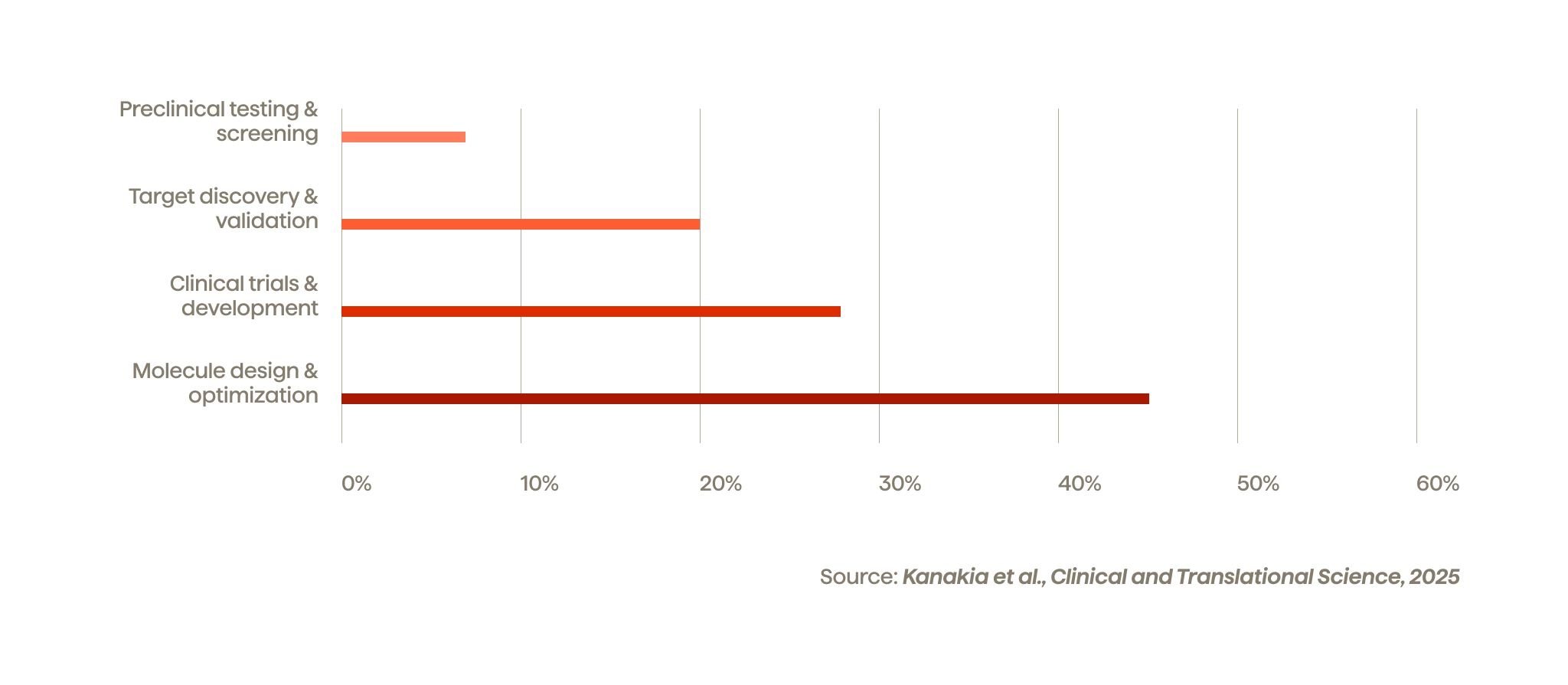
AI and ML accelerate drug discovery by processing datasets too large for manual analysis. According to a 2025 survey published in Clinical and Translational Science, molecule design and optimization leads AI adoption (45%), followed by clinical trials (28%), target discovery (20%), and preclinical testing (7%).
Why drug discovery?
Its prospects for growth and profit are key reasons. This research illustrates that the global AI, in the drug discovery market, will reach $1,434 billion by 2024, compared to $259 million in 2019. There is 40.8% projected annual growth. Here is more information on digitalization in drug discovery.
Along with drug discovery, there are a range of areas where companies implement AI and ML:
- Drug screening
- Designing drug molecules
- Advancing pharma product development
- Pharma manufacturing
- Quality control and assurance
- Clinical trial design
- Market positioning
- Market predicting and analysis
- Product cost estimation
As the research published by one of the most notable medical journals suggests, AI and ML in healthcare will change the approach to decision-making while making medicine more personalized to the needs of every patient.
Now, it is time to narrow down the focus and explore what PV is and how it changes pharma at this moment.
What is pharmacovigilance?
In a nutshell, pharmacovigilance (PV) is the practice of including both science and the activities related to detection, understanding, and the prevention of various drug-related safety issues. Assessment of adverse drug reactions (ADRs) is PV’s primary task. In fact, a 2023 systematic review and meta-analysis estimated that 8.3% of admissions to emergency departments or inpatient wards are related to ADRs, highlighting the significant impact of medication-related harm on healthcare systems. That is why PV is so vital.
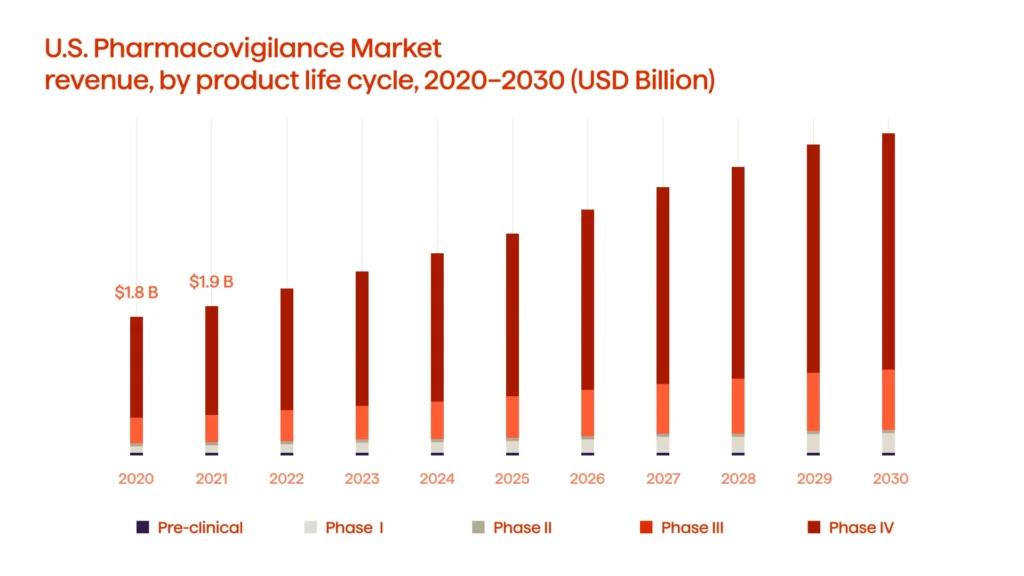
Currently, the global PV market is expanding fast. According to Grand View Research, the global pharmacovigilance market was valued at USD 7.95 billion in 2024 and is projected to reach USD 11.78 billion by 2030, reflecting a projected compound annual growth rate of approximately 10.5 percent and driven by increasing regulatory requirements, growing volumes of safety data, and continued investment in drug safety monitoring (see Fig. 2)
It’s prime time for companies to invest in PV. While the practice is developing, it also offers a range of application areas.
Areas of application
Companies working on how drug-related safety is engaged is a matter of great importance. PV helps improve the process and ensures new drugs will be less harmful and more useful than the previous ones. Achieving this outcome relies on a range of areas that PV covers:
- Quantifying drug-related harm to patients. This aspect entails finding drug-related issues and identifying solution strategies to avoid potential drug harm. Quantifying risk versus benefit presents a credible way of assessing a drug’s effectiveness.
- Communicating drug risk. Population risk is this practice’s focus. PV helps test population risk and the incidence of ADR in the selected groups. The resulting knowledge provides clinicians with tools for communicating drug risks to individual patients.
- Heterogeneity of patient response. Working as detectives, experts in PV try to determine the heterogeneity of patient response to drug therapy. Their hard work will provide critical information to data clinicians as they choose the best drug therapy for a patient.
- Patient-focused risk communication. PV explores new ways of designing patient-focused management solutions for ADRs. Comparing different ADR reports makes patient-specific risk information more accurate. In turn, it decreases the incidence of ADRs.
- Quality of ADR data. The principal goal of PV is to improve drug safety. The quality of ADR data represents a major barrier to meeting such a goal. The future of pharmacovigilance depends on the ability to analyze massive amounts of information to boost the ADR’s data quality.
- Active surveillance. Gathering ADR data relies upon evaluating patients’ real-time reactions to particular drug treatments. PV introduces various tools for active surveillance, which makes the process easier for clinicians, who in turn can offer valuable insights concerning patient-specific ADRs.
- New drug development and drug repurposing. New drug development and drug repurposing focus on making drugs safer. PV helps find the mechanistic basis of ADRs, which translates into greater drug efficacy and reduced toxicity.
These areas of application specifically focus on working a way around ADRs, which is another way PV helps make drugs safer. It also ensures clinicians have tools to help assign the drug therapy that follows the needs of individual patients. Yet, despite all the benefits and areas of application, there are limitations to traditional PV.
Challenges of traditional pharmacovigilance solutions
Traditional pharmacovigilance struggles with rising costs, growing data volumes, and limited scalability. As the number of adverse drug reaction reports increases, organizations face greater pressure to collect, process, and analyze safety data efficiently.
To improve patient outcomes, it is crucial to have high-quality ADR reports. Having such reports relies on effective data collection techniques and the ability to analyze large volumes of information. Companies and organizations often need to make significant investments in the technologies and processes required to support these activities at scale.
As a result, traditional PV costs more and more with the increasing stream of patient-specific ADR data. Industry estimates suggest that 40–80% of pharmacovigilance budgets are spent on case processing activities, making it one of the largest cost drivers within PV operations. As organizations look to improve efficiency, reducing the burden of manual case processing has become a key priority.
The exponentially rising number of available data points is another challenge for traditional PV.
Several authors vocalized their concerns in the following publication, which is offered by the experts from the International Society of Pharmacovigilance (ISoP). There will be an exponential increase in ADR-related data inflow because of the growing global population. Unfortunately, methods used in traditional PV are not suitable to handle such an enormous amount of data.
In other words, traditional PV is expected to cost more while not processing all the upcoming data. While many look for alternatives, AI and ML seemingly offer solutions to the challenges traditional PV faces.
When AI and ML meet the pharmacovigilance process
AI and ML help pharmacovigilance teams process growing volumes of safety data more efficiently while improving the accuracy of drug safety monitoring. As a result, these technologies can address many of the cost, scalability, and data management challenges facing traditional PV.
There is an array of potential solutions that AI and ML bring to the table:
- Cutting costs. Information from Deloitte’s report indicates that AI pharmacovigilance can potentially reduce the cost of the drug screening process by a staggering 80 percent.
- Better data analysis. Artificial Intelligence and Machine Learning in pharmacovigilance can help collect and analyze massive amounts of data, while eliminating human factors. Free-form text data is prevalent in pharma and healthcare in general, which makes AI and ML an even more efficient option.
- Automation. Integration of AI and ML brings a greater degree of automation in repetitive and routine tasks. This process will free up valuable resources which will help professionals focus on more value-adding objectives.
- Improved risk-benefit assessment. AI and ML can help improve the detection of potential drug-related events correlated to specific populations. They will boost the risk-benefit evaluation of new and existing drugs on the market.
- Extended outreach. Artificial Intelligence pharmacovigilance can work not only with healthcare resources, but the tools can tap into social media, news articles, and other public domain information. This will make ADR-related predictions more accurate, as well as offering real-world intelligence to improve personalized medicine.
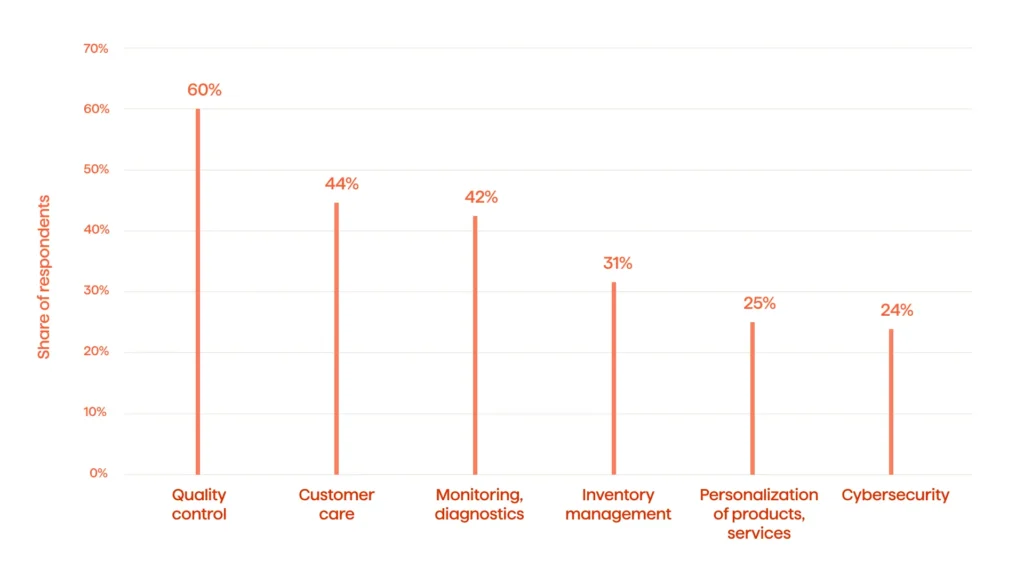
These solutions are among the top benefits AI and ML bring into PV, especially when applied to pharma and healthcare in general. Statista points out that 60% of companies using AI expect the technology to help improve quality control in the pharma and healthcare industry. Besides, businesses can use AI in an assortment of additional ways (see Fig. 3).
There is a bright future for AI and ML in pharma. Yet, to understand the practical applications of PV, current use cases should be examined.
Artificial Intelligence and Machine Learning pharmacovigilance use cases
AI and ML use cases show how pharmacovigilance teams can improve safety monitoring, automate routine work, and extract insights from large data sets. The examples below show how companies are applying these tools in real PV workflows and what they are getting out of them.
Predictive analytics
The scholarly article published by Drug Discovery Today argues that AI helps to manage massive chunks of data while ML helps make predictions based on that analysis. Working in tandem, AI and ML improve the speed of the go-to-market time for new drugs. The typical drug design lifecycle takes about 10-15 years. With AI and ML, professionals use statistical models to get valuable insights from past, present, and future events, which drastically reduces the drug design lifecycle
SciBite uses the full potential of predictive analytics brought by AI and ML. Applying AI to its R&D model, the company reduced the time of new drugs going to the market. New York University reports an estimated 80% of clinical data as being unstructured. AI and ML are the tools that can work with such a massive information segment as a means to boost processes within the PV area.
Social listening for accurate health and drug-related information
Gathering data through social media can be a daunting task. But, with the right tools at hand, social media platforms can offer a great deal of important information. The article published after the Pacific Symposium on Biocomputing shows how analyzing 5 million posts with AI can grant significant insights into the effectiveness of antidepressants. In addition, the study highlights the importance of social listening in determining drug safety combinations and ADRs.
Researchers actually managed to discover new adverse effects of several existing drugs. They utilized AI to analyze peoples’ posts within the public domain and gained information that other health professionals missed due to outdated data analysis instruments.
Improved automation of regulatory and safety systems
Adherence to regulatory and safety standards is the bedrock of PV. Regulators use ADR reports and individual case safety reports (ICSRs) to design new safety standards. With Artificial Intelligence and Machine Learning in pharmacovigilance, regulatory bodies can obtain a clearer picture of drug safety. It means greater capabilities in protecting consumers from hazardous products.
Recent industry initiatives demonstrate how AI is being integrated across pharmacovigilance workflows to support case processing, signal detection, and regulatory compliance. For example, in 2025, Tech Mahindra and NVIDIA introduced an AI-powered pharmacovigilance solution designed to automate safety workflows, improve data quality, and accelerate the identification of potential drug safety risks.
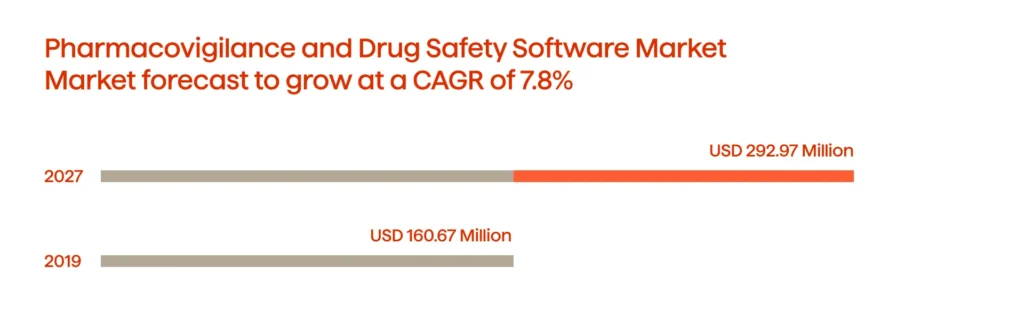
Moreover, the evidence suggests working on drug safety is a prospective realm showing great promise. In 2019, the PV and drug safety software market was worth $160.67 million. By 2027, it is expected to reach $292.97 million (see Fig. 4).
Developing proper drug safety regulations and standards improves patient outcomes and businesses’ profitability.
Automated case processing
In PV, case processing represents one of the most resource-intensive activities. As a result, the primary objective of leaders in the market is to drive costs out of case processing while maintaining data quality and regulatory compliance. This can be achieved through automation.
A 2025 collaboration between Tech Mahindra and NVIDIA demonstrated how AI-powered automation can improve pharmacovigilance operations, reducing turnaround times by up to 40%, improving data accuracy by 30%, and lowering operational costs by 25%. By automating repetitive tasks, organizations can streamline case processing and free up resources for higher-value pharmacovigilance activities.
Supporting clinical trial efficiency, interoperability, and effectiveness
AI and ML in PV offer major benefits in automating patient safety data and optimizing clinical trial effectiveness. Recent research highlights the growing role of AI in improving clinical trial safety, risk assessment, and operational efficiency across the drug development lifecycle.
In short, the case shows how AI-based technologies like signal detection, risk conceptualization, and tracking, coupled with ML algorithms, provide PV professionals with the leverage needed to achieve clinical trial efficiency, interoperability, and effectiveness within an economically feasible manner. Notably, some companies are already using AI to develop clinical trial software.
These use cases portray AI’s value, and how ML now creates PV. What is more, it’s time to dive into some prospective areas expected to bring even more value in the future.
What are the future opportunities for AI and ML in pharmacovigilance?
The future of pharmacovigilance is shaping up to be more predictive, automated, and data-driven. Smarter safety reporting, cloud-based data management, social media monitoring, personalized medicine, and advances in drug delivery are just some of the areas poised for growth.
At the heart of these developments is the ability to turn growing volumes of data into meaningful insights. Looking ahead, several emerging applications have the potential to take PV to the next level.
Smarter individual case safety report (ICSR) collection
Proper collection of ICSR reports represents a major issue in PV. Their analysis is an even greater challenge. According to the Uppsala Monitoring Centre, the World Health Organization’s global safety database, VigiBase®, now contains more than 40 million individual case safety reports (ICSRs), creating significant opportunities for identifying drug safety trends and adverse drug reactions. With the introduction of AI and ML into the ICSR collection process, the entire system becomes smarter.
The professionals predict that by 2030, ICSR reporting will be way more advanced than it is now. AI-based tools like Natural Language Processing (NLP) can analyze massive amounts of unstructured text within ICSRs, giving rise to AI-augmented ICSR management.
Cloud-based reporting
AI pharmacovigilance goes hand-in-hand with cloud-based computing. The experts anticipate data being collected and analyzed through available cloud technologies. It is expected that coupling cloud-based computing with AI and ML will improve PV’s cost-efficiency, scalability, and simplicity.
Social media and digital health
Social media is and will continue to play an integral role in healthcare. The research offered by PWC shows 90% of people between the ages of 18 and 24 say that they would trust medical information presented via social media networks. Additionally, a survey of more than 2,600 healthcare professionals found that 71.2% use social media, with many relying on these platforms for professional development, education, and access to medical information. It all comes down to this point – people use social media extensively and healthcare professionals can employ this phenomenon for bettering public health.
As to PV, the authors of the book The Era of Artificial Intelligence, Machine Learning, and Data Science in the Pharmaceutical Industry collectively point out that social media offers untapped potential for data extraction and analysis. The analysis that particularly works in social media status updates can lead to a more accurate classification of the ICSR. In a nutshell, social media expands the outreach of PV experts, and AI and ML help translate it into safer drug production.
Personalized medicine
Personalized medicine revolves around identifying a person’s biological, physical, physiological, and genetic markers in order to tailor individually optimized therapies. With Artificial Intelligence in pharmacovigilance, healthcare professionals can analyze thousands of markers and make much more accurate predictions on how specific drugs will affect particular individuals. Inevitably, drug therapies will become increasingly personalized, thus decreasing ADRs and improving drug efficiency.
Nanomedicine and drug delivery
Nanomedicine is not a realm of science-fiction, but instead is a reality now. The study published in the scholarly journal Drug Discovery Today shows how trailblazers use a combination of nanotechnology and medicine to diagnose, treat, and monitor a range of complex conditions. Experts work with HIV, cancer, malaria, and asthma. While nanomedicine is still in its inception, there are breakthroughs in the aspect of nanoparticle-modified drug delivery.
Recently published research from a scholarly journal indicates scientists and engineers are working on creating implantable nanorobots which are being developed for the better delivery of drugs. AI tools like NNs (neural networks), fuzzy logic, and integrations can mitigate the entire process.
The introduction of AI and ML into PV grasps only a part of the entirety of the pharmaceutical trends that are earning value from digitalization. While there are many prospective instruments on the way, professionals need to consider the array of challenges associated with the AI and ML integration into pharma and healthcare.
What are the main barriers to AI and ML adoption in pharmacovigilance?
The main barriers to AI and ML adoption in pharmacovigilance include data governance, workforce readiness, data protection, and intellectual property concerns. Addressing these challenges is essential for organizations looking to scale AI-driven safety monitoring and compliance processes.
AI and ML work with massive amounts of data, which entails collection, analysis, storage, and synthesis. Naturally, when there is data, some prerequisites need to be met. These include the following:
- Data Governance. Work with complex and unstructured data should be based upon pre-designed methods. While AI and ML can handle the data, people still need to properly program the algorithm.
- Data Science Professionals. Integrating AI and ML requires data science professionals to be involved. It means pharmaceutical and healthcare companies need to reserve space and resources for hiring these new types of experts, the ones familiar with AI and ML.
- Data Protection. People working with patient data must meticulously follow data security standards and guidelines. Naturally, further integration of AI and ML requires redesigning such measures to make them more up-to-date. But also, the systems working with sensitive data must entail high-grade encryption along with being HIPAA compliant.
- Intellectual Property right. AI and ML bring forward the issue of intellectual property rights. As more businesses switch to AI- and ML-driven approaches, the existing case law will have to change in order to ensure AI-driven biotech and pharmatech inventions will not slip through the gaps of existing intellectual property law.
FAQ
All in all
PV takes on the vital task of ensuring drug safety and improving patient outcomes. AI and ML prove to be of massive help when handling this objective. There is a very bright future for AI and ML in PV. Artificial Intelligence and Machine Learning in pharmacovigilance can create exponential value on many fronts.
In business terms, it means that investing in AI and ML along with data science, in general, is prospective. And, companies get a chance to make medicine safer while gaining profit along the way.
If you have any additional questions, feel free to contact us.



Your business results matter
Achieve them with minimized risk through our bespoke innovation capabilities. Fill in the form below.