






Telecom billing software systems: A comprehensive guide

February 9, 2026 11 min read 299 views
Billing is the real trust test in telecom. You can have the best-looking plan online, but if your invoice confuses people or looks off, they start doubting everything. And let’s be honest, the pressure’s only getting worse. Product bundles continue to grow, roaming rules change frequently, and usage-based pricing has become the norm.
Here’s the thing: most billing systems in the telecom industry just aren’t built for this pace. When you rely on manual checks and a hodgepodge of disconnected tools, money slips through the cracks, and customers take notice.
That’s precisely why telecommunications billing software is evolving rapidly right now. AI enables service providers to identify errors in usage data early, and APIs tie everything together, allowing billing to occur in real-time. In this article, we’ll delve into what’s changing and show you how to upgrade your billing process without disrupting everything.
Telecom billing system key takeaways
- Billing is a fundamental driver for growth. A scalable setup reduces leakage and keeps customer trust as products expand.
- Solid AI checks prevent bad usage records from affecting your billing later on.
- Automation makes a big difference. When billing handles itself, your team spends less time fighting fires, invoices go out faster, and you get paid sooner.
- With the right integrations, you can roll out new offers without compromising the integrity of your billing system. Flexibility here means you can move fast without tripping over your own tools.
Traditional billing challenges and pain points
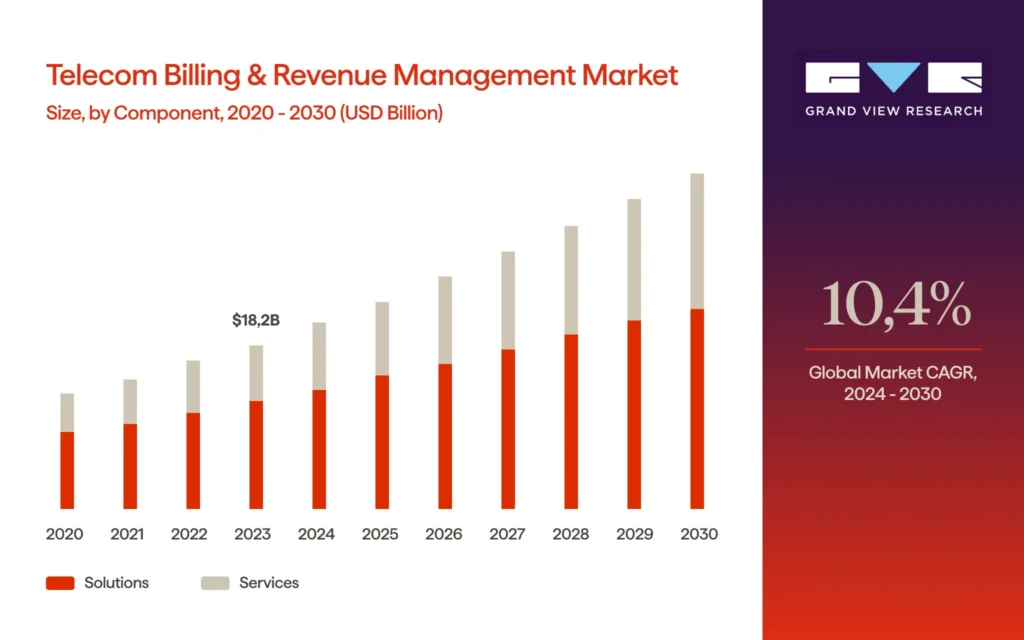
Billing is the nerve center where money, customer trust, and support all collide. It’s no wonder companies are investing heavily in it. In 2023, the global telecom billing and revenue management market hit $18.22 billion. And it’s not slowing down: analysts expect it to keep climbing at over 10% a year through 2030.
Let’s talk about the pain points. The first big one? Modern pricing. It’s gotten complicated. One customer might juggle a base plan, multiple add-ons, family sharing, roaming, device payments, discounts, and promo credits all at once. Now, spread that mess across prepaid, postpaid, enterprise deals, and IoT devices. Suddenly, billing isn’t just a system; it’s practically alive, constantly shifting. Old-school billing platforms, built for a handful of plans, simply can’t keep up. When marketing rolls out new offers every week, and every oddball case becomes a manual fix, the cracks start to show quickly.
Timing is the next challenge. Many operators still rely on outdated, batch-heavy pipelines—data arrives late, is patched up after the fact, and any adjustments are simply carried over into the next billing cycle. That’s when little glitches explode into real customer headaches: a weird overage here, a missing discount there, or a roaming fee nobody can actually explain on the spot. Support teams often waste hours piecing together what went wrong, jumping between different tools and systems. At that point, automated invoicing is pointless. People are back to crunching the numbers by hand.
Here’s the third pain point: revenue leakage and partner complexity. Usage records slip through the cracks—they get duplicated, dropped, or rated wrong. Bundles? Sometimes they’re applied inconsistently, all over the place. Then you’ve got partner settlements, whether it’s wholesale deals, MVNOs, or content bundles. That’s a whole other headache. Mismatched events and contract terms spark endless disputes, and it all piles up fast.
On top of these core issues, telecom operators also run into a set of “always-on” challenges that quietly inflate cost and risk:
- Telecom billing hidden costs. Manual fixes, endless reconciliation, shoddy audit trails, or unexpected vendor fees. They all pile up fast and hit your bottom line.
- Data security. Sensitive billing info moves between teams, tools, and even outside partners. You must enforce strict access controls and stay up-to-date with regulations, or you risk exposure.
- Late payments. Those drag out because of clunky collections, too few payment options, or weak dunning automation. Before you know it, cash flow gets squeezed.
- Ensuring subscription accuracy. Pro-rating, plan changes, device financing, running promotions, handling taxes in every region—mistakes here cost real money and trust.
- Strong management controls. You need better governance: clearer approvals, automated checks, and a way to track every rule change.
- Billing disputes. Customers want fast answers and proof. You need to identify the root cause quickly, present the charges clearly, and have the evidence ready—so everyone walks away satisfied.
Slower launches, increased operating expenses, and a billing experience that undermines client confidence are the results of all these problems.
Transform your legacy OSS and BSS platforms into modern, future-ready systems.
The modern telecom billing architecture baseline
Think of modern telecom billing solutions like a relay race. Each system hands off just enough information to turn raw network activity into an invoice you can actually trust. Up top, you’ve got CRM and order management — that’s everything the customer bought. At the bottom, network switches keep track of what the customer actually uses. The billing engine sits in the middle, balancing both sides to ensure everyone is charged the correct amount. This is especially tricky with usage-based billing and all those constantly changing offers.
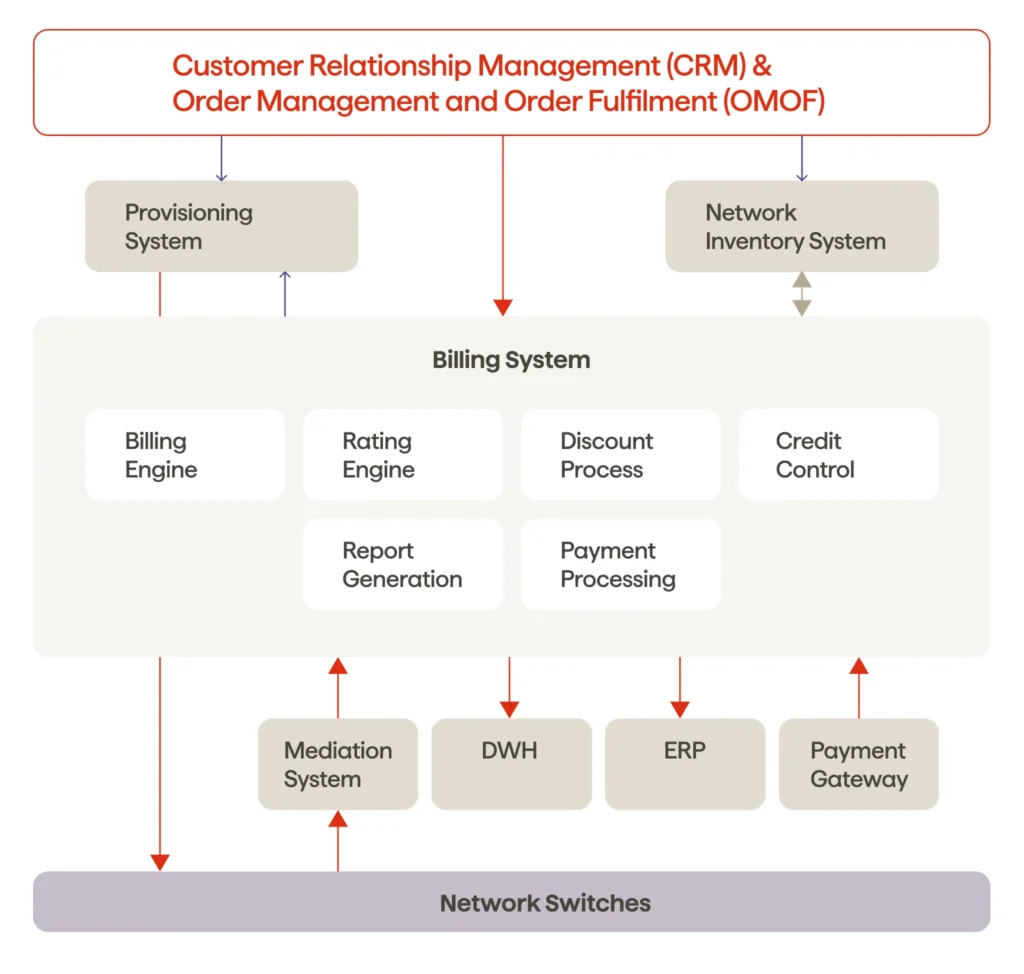
Everything kicks off with CRM and order management (OMOF). That’s where you’ll find all the products, contracts, and entitlements. Every time a customer upgrades, adds a bundle, or pauses a service, the update is sent to the provisioning system to activate the change and to the network inventory system to track what’s live. If these systems ever fall out of sync, customers end up with headaches — such as being billed for features they never actually used. That’s not just a technical issue; it’s a genuine customer experience problem.
On the network side, switches spit out all kinds of raw events—calls, data sessions, messages, you name it. The mediation system steps in to resolve issues. It captures those events, standardizes the formats, eliminates duplicates, adds additional details, and prepares everything for billing.
After that, the billing core takes over. The rating engine figures out prices, bundles, and roaming charges. Discounts and promotions are applied where they are intended to be. Credit control monitors spending limits and risk. The billing engine consolidates all the information and generates invoices. When it’s time to pay, the system connects to the payment gateway. Meanwhile, DWH and ERP handle analytics, reconciliation, and financial reporting. So, the billing solution isn’t just about sending invoices—it covers the whole operation, end to end.
| Layer in the map | What it does in practice | Why it matters |
| CRM + order management | Stores plans, contract terms, and entitlements | Sets the “source of truth” for what should be billed |
| Provisioning + inventory | Activates services and reflects the real network state | Prevents billing for services not actually enabled |
| Network switches + mediation | Converts raw usage into clean, consistent billing data | Foundation for accurate usage-based billing |
| Billing core (rating/discount/credit/billing) | Calculates charges and produces invoices | Where accuracy, transparency, and revenue protection happen |
| Payment gateway + ERP/DWH | Collects money and supports reconciliation/insights | Closes the loop on payment processing and finance control |
AI for usage data processing and validation
In telecom billing, problems typically begin long before the invoice arrives. It’s the messy usage data—late records, duplicates, and missing information—that really throws a wrench into things. One small error there, and suddenly you’re knee-deep in credits, billing disputes, and chasing down payments way past their due date. That’s where AI steps in and makes life easier, catching these headaches early.
Now, with billing software powered by machine learning, telecom companies can identify anomalies immediately. Think records that show impossible call times, random spikes, or the same session popping up twice. The system checks data from different sources, flags questionable items, and only sends the more complex cases to humans for further review. Customers notice the difference as billing becomes smoother, and people receive fewer unpleasant surprises, and when questions arise.
Speed isn’t just a nice-to-have—it’s critical. Take this: some companies using AI can roll out fixes 40% faster. What used to be a four-hour outage now gets fixed in just over an hour and a half. And here’s the thing—customers have zero patience for bad service. In fact, 70% say they’d think about leaving after just one lousy AI-powered interaction. That’s why billing systems need smart checks and balances, not just mindless automation.
Automated rating and charging systems
For telecom providers, rating and charging are where your business strategy turns into real revenue. This process takes every validated usage event and runs it through your pricing plans, bundles, roaming rules, thresholds, discounts, device financing, and taxes —all of it—so customers see charges that actually make sense. However, when rating and charging rely on manual work or a patchwork of outdated rules, things fall apart. Suddenly, customers see invoices that don’t match what they signed up for. Cue the calls, the disputes, the credits, and, honestly, a higher risk of losing that customer.
Automated rating and charging systems address this issue. They guarantee that your rules are applied the same way, every time, regardless of how big you scale. These systems bring order, ensuring that every event is rated correctly, every channel follows the same logic, and launching a new offer doesn’t disrupt what’s already working. That consistency is what keeps billing clean and straightforward—even as product teams dream up new bundles, partner features, or usage-based pricing.
Top billing services don’t just process payments—they keep up in near real time. That matters a lot for prepaid and hybrid plans, where customers want to see their balances and usage right away. When charging decisions come through quickly and make sense, people trust the system. Fewer complaints, fewer calls about weird charges, and customers can handle things themselves.
Get automated charging right, and it’s not just about cutting mistakes for the ops team. It protects your margins. You can test new pricing ideas without worrying about whether your system can handle them. The back end keeps pace, allowing you to move quickly and stay confident.
FAQ
Streamline telecom billing management with Avenga
Billing is crucial in telecom since it connects with every customer, every product you sell, and every single dollar that comes in. When you bring in AI validation, automated rating, and API integrations, billing stops being just another back-office chore. Suddenly, it’s the engine that drives revenue, keeps operations tight, and builds trust—even as things get bigger and more complicated.
And the benefits? They show up right away. Fewer mistakes on bills. Less time spent fighting over disputes. Faster cash flow. Customers notice, too—the experience just feels smoother, even when your pricing or products become more complex.
Want to learn more about seamless telecom services for better customer satisfaction? Contact Avenga, your trusted partner in the telecommunications industry.

What are the best practices to make your AI Proof of Concept (PoC) succeed?


Your business results matter
Achieve them with minimized risk through our bespoke innovation capabilities. Fill in the form below.