






Search advertising explained: how search ads work on Google and other search engines


June 30, 2026 8 min read 1109 views
Paid search advertising (also known as sponsored ads, search marketing, search-engine marketing, pay-per-click marketing, and cost-per-click marketing) is a technique that displays ads in search-engine results whenever someone searches for the services or products offered by the advertiser. In this way, the ad displayed perfectly matches each query.
Search advertising is very effective. It is based on users’ explicit needs rather than just on implicit information about what they might be after. This, naturally, increases the likelihood of clicks and conversions.
Google is the world’s leading provider of search ads. Its Ads service allows companies offering products or services to pay for their ads based on the queries of Internet users entered into the search box. It is quite simple — when your results page loads, there are ad boxes with relevant ads displayed next to organic results.
Businesses that advertise in the search results are not charged until somebody clicks on one of their ads, which is why it’s known as “pay-per-click” (PPC) advertising. Search engine companies typically offer this advertising technique.
What are search ads?
Search ads appear when people actively look for products or services on search engines like Google. They show up alongside organic results and are clearly marked as sponsored placements.
Search engines present these ads in different formats, but the distinction is always visible. Paid listings are labeled as sponsored, while organic results appear based on relevance to the query.
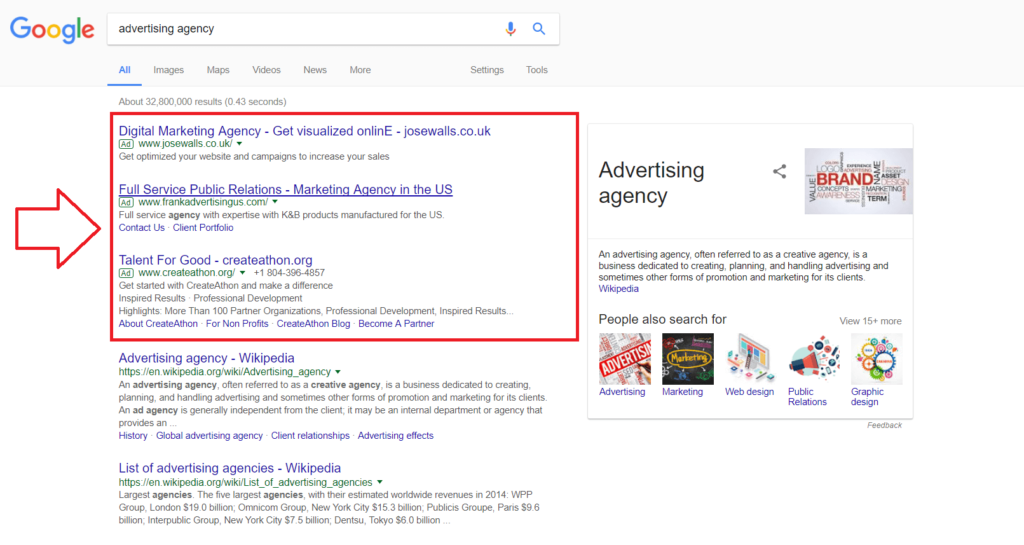
Sponsored entries are typically displayed as the top few results. Currently, Google is marking paid search results with a small green “Ad” symbol next to them, letting you know they are not organic. Some of Google’s previous implementations of sponsored results included different backgrounds (yellow, blue) and yellow-colored “Ad” icons.
Who offers search ads?
Most search-engine companies provide advertisers with platforms that allow them to display ads in their search results (Google does it via Google Ads, Bing does it via Microsoft Advertising, etc.). This is a natural way for search providers to capitalize on their huge user base and their users’ intent.
While the dominance of Google on the market of search ads is undeniable, a comprehensive search-marketing strategy should also consider displaying search ads on engines like Bing and Yahoo. Also, some markets demonstrate a penchant for specific search providers. For instance, Baidu, while obscure to most people in Europe and the US, is one of the leading internet companies in China.
While the global search-engine market is currently dominated by Google with a 71% market share, it is impossible to ignore the audiences gathered by some of the other search runners-up:
- Google (71%)
- Microsoft Bing (21%)
- Yahoo (2,5%)
- Baidu (1,5%)
How search ads work
The actual mechanics behind search ads are similar across most popular search engines, with some slight differences. As Google is the most popular search engine, we’ll use it as an example and explain how its search ads work.
Google uses a modified second-price auction system to rank the ads that appear on Google search engine results pages (SERPs) and determine the cost advertisers have to pay to appear at the top of the results page.
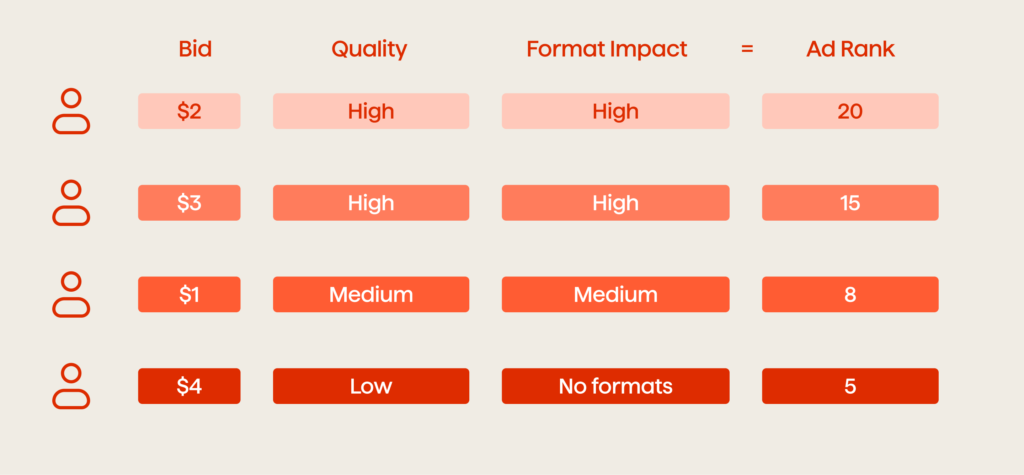
Google’s second-price auction mechanics basically mean that instead of paying the full price, advertisers pay the amount needed to beat the nearest competitor, depending on their Ad Rank (more on that below).
However, the system isn’t based just on bidding.
If Google only sold its ads to the highest bidders, the SERP would be littered with poor-quality paid ads linking to completely irrelevant landing pages, which would compromise the search engine’s reliability. To improve the experience for both users and advertisers, Google also takes into account an advertiser’s Ad Rank.
What is Ad Rank?
Ad Rank is Google’s PageRank equivalent for search ads. It is an algorithm used to determine how highly ads rank in the sponsored results and how much the advertiser has to pay when an internet user clicks the ad.
Google has always been upfront about what advertisers should do to increase their Ad Rank and position in paid search. Conversely, high positioning in organic search (PageRank) has always been the holy grail of online advertising, and algorithms governing it, unlike Ad Rank, still seem obscure and dynamically changing.
The Ad Rank formula that governs the appearance of ads consists of:
- Expected click-through rate — Google’s estimation of how likely it is the ad will be clicked. This is much like a self-learning system. Google knows the click-through rates of all the ads it displays; users “upvote” ads with their clicks. Consequently, Google shows more of what they like and estimates the rates for all future ads.
- Landing-page experience — Unsurprisingly, highly relevant landing pages get a higher Ad Rank score. This involves relevant and original content, easy navigation, and transparency.
- Ad relevance — Google analyzes the content of each ad to determine how well it relates to the query. This ensures that only useful ads are shown.
- Ad formats — Google also considers the expected impact of specific ad formats, which areenhancements to search-ad formats with additional information. Apart from the link to the website, ads may contain valuable extensions with structured data: extra information like ratings (see image below), prices, directions, and phone numbers.
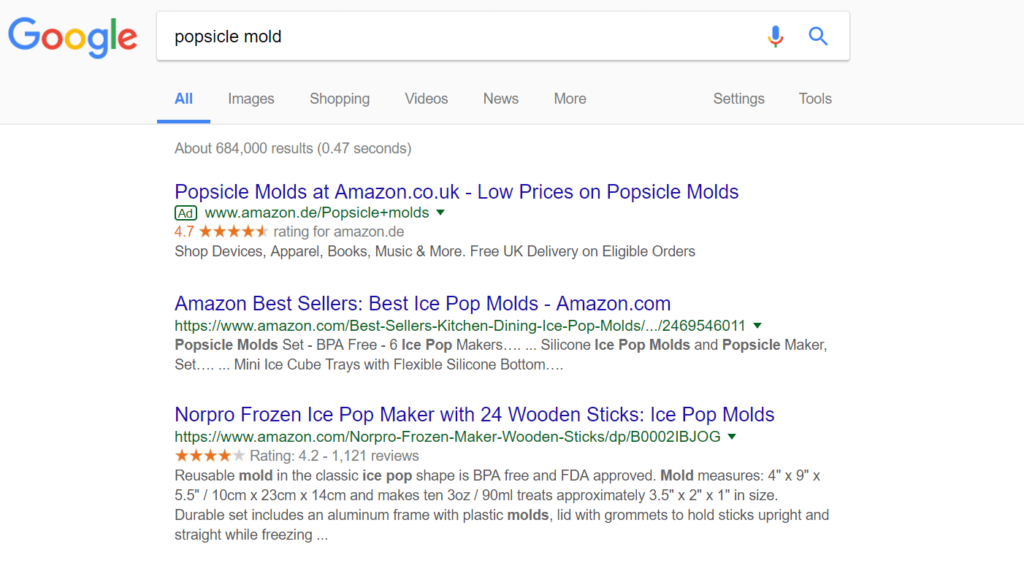
The above considerations make it virtually impossible for advertisers to simply pay their way to SERPs and get irrelevant ads displayed to users; bidding high does not secure a slot in the paid search results.
In this respect, Google search ads seem like a perfect, self-regulating system; people want to see only the ads that are relevant to them. Conversely, advertisers want to show relevant ads so that users can actually click them.
The video below comes from Google’s own YouTube channel and details the whole bidding and ranking process:
FAQ
Final thoughts
Paid search advertising is an effective way of advertising directly to your audience when they need your service or product. It offers excellent results for specific industries and may be more effective than traditional “spray-and-pray” ads.



Your business results matter
Achieve them with minimized risk through our bespoke innovation capabilities. Fill in the form below.