






First vs second-price auctions in programmatic advertising: key differences explained


July 22, 2026 9 min read 913 views
First-price and second-price auctions determine how advertisers compete for digital ad impressions and how much they ultimately pay in programmatic advertising. While second-price auctions dominated the early days of real-time bidding, the industry has gradually shifted toward first-price auctions, changing how advertisers bid and how publishers monetize their inventory.
If you have ever bought anything on eBay, you are probably familiar with the idea behind second-price auctions, where the winner pays the second-highest bid rather than their own offer. In this article, we’ll explain how both auction models work, why programmatic advertising moved toward first-price auctions, and what this shift means for advertisers and publishers.
What is the difference between first-price and second-price auctions?
A first-price auction requires the winning bidder to pay the full amount of their submitted bid, while a second-price auction allows the winner to pay slightly more than the second-highest bid. In real-time bidding (RTB), this difference determines the final cost of an ad impression and affects how advertisers approach their bidding strategies.
In a second-price auction, the winning bidder does not pay their original offer. Instead, they pay the price submitted by the second-highest bidder plus $0.01. The final amount paid for the impression is known as the clearing price.
Consider this second-price auction example (how it works on eBay):
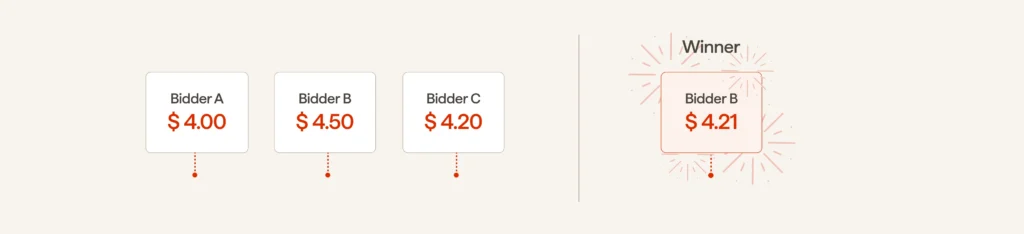
Bidder A = $4
Bidder B = $4.50
Bidder C = $4.20
The outcome:
Bidder B wins and gets the impression for the clearing price of $4.21 (second-highest price + $0.01). The reduction, or consumer surplus, in this example is the $0.29 the winning bidder “saved” on the impression.
The reduction presents an advantage for the bidders and an opportunity to save on overestimation of the value of the impression. Due to various floor optimizations and shenanigans, however, the clean second-price auction model is virtually nonexistent in the world of programmatic media buying.
For comparison, consider this first-price auction example:
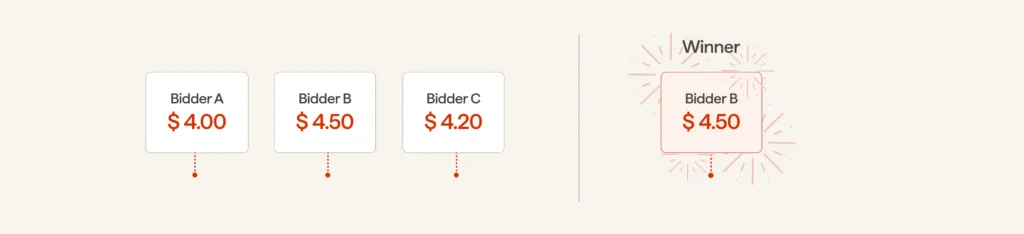
Bidder A = $4
Bidder B = $4.50
Bidder C = $4.20
The outcome:
Bidder B wins and gets the impression for $4.50. The first-price auction would require the winner to pay the full price they originally offered in the auction.
In the first-price auction model (also known as an English auction) the bidders pay exactly what they bid. While this auction mechanism gives publishers the highest eCPMs for their inventory, it can lead to unnaturally high prices, as buyers are forced to “guesstimate” how much their competition bid. This, in turn, can lead to overpaying, and a lower demand for that publisher’s inventory.
Hard price floor
A hard price floor is the minimum price the publisher will accept for the impressions the ad exchanges. Bids that are below this minimum price are simply discarded. This means sellers will not take any bids below the hard price floor.
Soft price floor
A soft price floor is a flexible minimum price that allows publishers to accept bids slightly below their preferred threshold instead of rejecting them entirely. Since bidders usually do not know the exact hard price floor set by the publisher, soft floors help capture additional demand from offers that fall close to the minimum acceptable price.
Unlike a hard price floor, which automatically rejects bids below a fixed threshold, a soft price floor gives publishers more flexibility to balance revenue optimization with fill rates.
Why the transition from second to first-price auctions?
The shift to first-price auctions in programmatic advertising happened mainly because of growing demand for greater transparency and simpler auction mechanics. As real-time bidding evolved, different exchanges introduced their own pricing strategies, including price floors and additional fees, making it increasingly difficult for advertisers to understand how the final clearing price was determined.
Although second-price auctions were designed to protect advertisers from overpaying, these additional mechanisms often reduced the transparency of the bidding process. In practice, many auctions no longer followed a pure second-price model and began operating more like hybrid auctions, combining elements of both first- and second-price auctions.
First-price auctions work better with header bidding
Header bidding (aka pre-bidding, advance bidding, and holistic yield management) offers SSPs an opportunity to create a second-price auction before running the final auction in a publisher’s ad server. SSPs conducting a fair second-price auction in the header will hold less competitive bids for the final auction, and end up with very low win rates, which prompts the transition to first-price auctions.
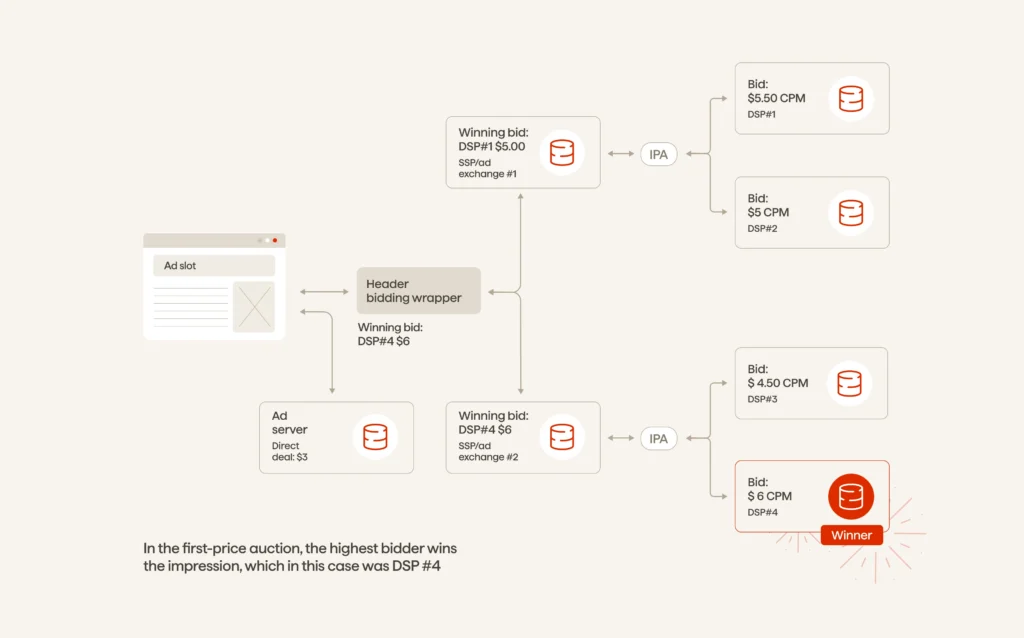
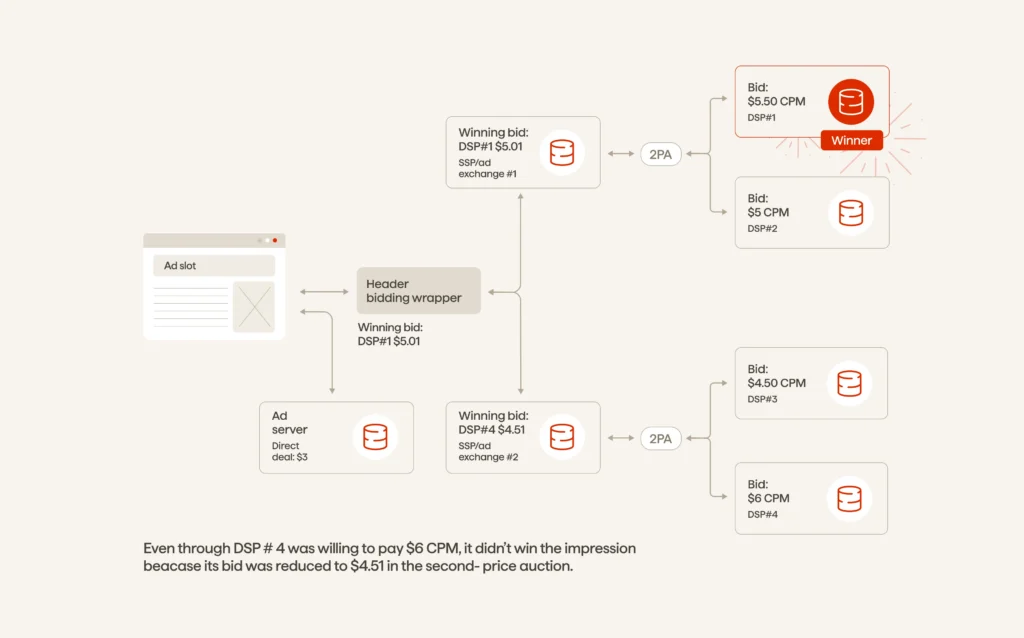
First-price auctions give buyers a better chance at winning the impression when header bidding is conducted, because instead of the winning bid from a second-price auction being pushed to the ad server, their true bid is the one that competes in the final auction.
Compare the following examples.
First-price auction:
Second-price auction:
What first-price auctions mean for the advertiser
First-price auctions give advertisers greater visibility into the cost of an impression because the winning bidder pays exactly the amount they submit. However, this also means advertisers need to carefully evaluate their bids, as overestimating the value of an impression can directly increase campaign costs. Truthful bidding in this model (i.e. bidding the real value of the impression) may, in fact, not only be much more challenging, but also more expensive.
The first-price auction allows both buyers and sellers to see the actual cost of the impression and the fees taken by the SSP/ad exchange will at least be known. The winning price is exactly what the advertiser agreed on, but there is a risk of overpaying for impressions.
The workings of the first-price auctions make sense economically only when the buyer knows the fair market value of the impressions they are bidding on, and understands the mechanics of hard- and soft-floor mechanisms.
Advertisers don’t like the feeling that they’re manipulated into bidding more than they should, which is exactly why some use algorithms to predict the price floors and bid accordingly. To do this, they will have to invest in technology that will specifically adapt to the rules of every auction.
What first-price auctions mean for the publisher
First-price auctions can increase publisher revenue because the winning bid is paid in full rather than reduced to the second-highest bid. However, publishers still need to balance higher prices with maintaining strong demand for their inventory. To do this, SSPs and ad exchanges are beginning to implement a combination of soft and hard price floors, essentially converting the auction into a hybrid between first- and second-price auctions.
Consider the example below:
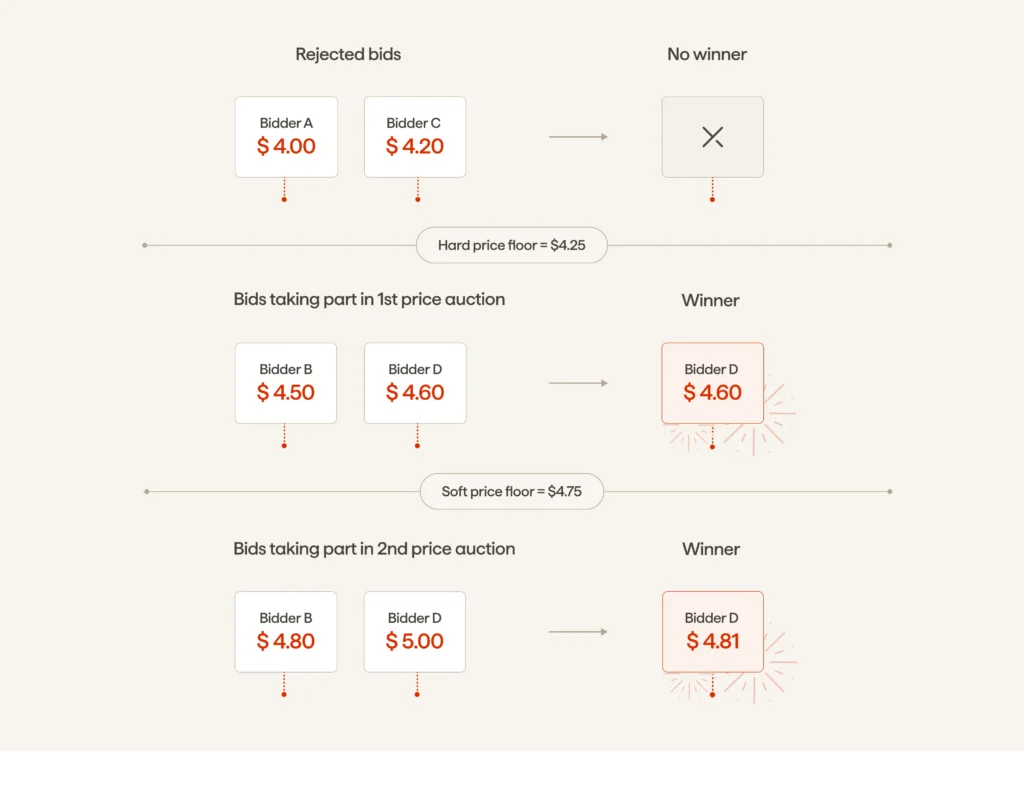
Explanation:
The hard price floor automatically eliminates all the bids under $4.25. The bids between the hard and soft floor take part in first-price auction, unless there are bids above the soft price floor, which will take part in second-price auction instead. This solution seems to offer the best of both worlds; high-value bidders can avoid paying surplus, as they are charged per the second price.
Conversely, in the absence of high-value bidders (no bids above $4.75), the low-value bidders (with bids below the soft price floor) are charged per the first price, thus maximizing the publisher’s yield.
Exchanges implement flooring methods to combat the low bid density. Header bidding further raises the floors, and exchanges are even considering abandoning the auction type altogether. Whether the first-price auction model will, with time, become gamed like the second-price model remains to be seen.
FAQ
Summary
First-price auctions have become the dominant model in programmatic advertising because they offer a simpler and more transparent approach to real-time bidding. Unlike second-price auctions, where advertisers pay based on the second-highest bid, first-price auctions require winners to pay their full submitted bid.
Have questions about first- and second-price auctions? Connect with us on LinkedIn, Facebook, and Twitter/X.



Your business results matter
Achieve them with minimized risk through our bespoke innovation capabilities. Fill in the form below.