





What is in-app mobile advertising and how does it work?

June 30, 2026 17 min read 3051 views
There were only 500 apps on the App Store when it launched alongside the iPhone in 2008. Back then, the mobile app market was still finding its footing.
Today, mobile apps are woven into nearly every part of daily life. Apple reports that the App Store ecosystem facilitated more than $1.4 trillion in developer billings and sales in 2025, highlighting just how far the app economy has come.
Consumers are also spending more time on their mobile devices than ever before. Research shows that 86% of people use another device while watching TV, with smartphones remaining the go-to second screen for everything from social media and messaging to researching products and services.
Taken together, these trends have turned in-app mobile advertising into a powerful channel for brands looking to connect with engaged audiences. As users spend more of their day inside mobile apps, advertisers have more opportunities to reach them in environments they already know and use.
In this article, you’ll learn what in-app mobile advertising is, how it differs from mobile advertising, and how the in-app advertising ecosystem works.
Key points
- In-app (aka, mobile app) advertising refers to displaying ads within mobile apps on smartphones and tablets.
- Mobile apps serve ads through the use of a software-development kit (SDK), meaning that developers have to integrate the given AdTech vendor’s SDK into their app.
- Gaming, social, utility, and entertainment companies rely heavily on in-app advertising (IAA) to generate revenue.
- As app developers get paid to serve advertisements within their mobile app, in-app advertising allows publishers to keep their content free for users, boosting downloads while earning scalable revenue.
- Nowadays, the app economy is dominated by free-to-download apps, with only a small portion (~5%) of users making in-app purchases (IAP) and generating revenue for apps.
- Consumers spent 5.3 trillion hours using mobile apps in 2025, while global app downloads reached nearly 150 billion and consumer spending climbed to a record $167 billion.
- The main types of in-app ad formats include playable ads, interstitial ads, offerwalls, rewarded video ads, video ads, expandable ads, standard banner ads, and native ads.
The growth of mobile advertising
These are just some of the events that have shaped mobile advertising into what it is today:
- Although the handheld mobile phone was developed in 1973, it wasn’t until 1992 that the first text message was sent.
- It was only in 1997 that free news headlines via short message service (SMS) were offered by a Finnish news provider.
- The first phone used for email was released in 1999.
- Mobile marketing came to life in 2000 when the Wireless Advertising Association in New York and the Wireless Marketing Association in London were created around the same time; together, they transformed into the Mobile Marketing Association in 2003.
- 2006 brought AdMob, the first leading mobile advertising platform, thus giving web developers and publishers the possibility to monetize mobile ads.
- Introduced to the public in 2007, Google’s Mobile AdSense allowed websites optimized for mobile browsers to display the same ads as a regular website.
- Before AdSense was released, the launch date of the first iPhone was announced in early 2007.
- iPad went on sale in 2010, and a few days afterwards, Apple introduced their advertising platform, iAD.
- Facebook’s Mobile Ads was launched in 2012. Prior to this launch, Facebook garnered no revenue from the mobile app because no advertising was available.
The release of the first iPhone in 2007 totally changed the game for mobile advertising, giving users the option to interact with a mobile ad in a new way: the touch-sensitive, multi-sensor interface enabled ads to be shrunken or enlarged, as well as rotated.
Considering that people use apps for all sorts of things, it’s not surprising that time spent “in-app” keeps increasing year-on-year (YOY).
However, users tend to spend more time in-app compared to on the mobile web these days, so although marketers and advertisers have more hours and ways to reach them each day, they have to think of innovative ways to actually catch the attention of their target audience.
Evidence of this continued shift can be seen in recent mobile app usage and spending trends:
- Consumers spent 5.3 trillion hours using mobile apps in 2025, highlighting just how central apps have become to everyday digital life.
- Global in-app purchase revenue reached $167 billion in 2025, up 10% year over year. For the first time, spending on non-gaming apps surpassed spending on mobile games.
- Mobile users now spend an average of 3.6 hours per day in apps and engage with 34 apps each month, giving advertisers more opportunities to connect with highly engaged audiences.
- While app downloads have leveled off in recent years, publishers continue to generate more value from existing users through subscriptions, in-app purchases, and more effective monetization strategies.
What is in-app advertising?
In-app advertising, aka mobile-app advertising, refers to displaying ads within mobile apps on smartphones and tablets. Brands and advertisers run ad campaigns across multiple mobile apps to increase brand awareness and conversions, just like they do with other digital advertising channels, such as web advertising.
Gaming, social, utility, and entertainment companies are quite dependent on in-app advertising (IAA).
Since app developers get paid to serve advertisements within their mobile app, publishers can keep their content free for users. Not only does this model keep content free, but it also drives the number of downloads up, as well as providing scalable revenue for app developers and publishers.
Currently, it’s rather rare for apps to require payment up front, as most have a freemium model that lets you download the software for free with the option to upgrade later in order to be able to use more features, remove ads, have access to more content, or buy stuff. Moreover, only a small portion (~5%) of users decide to make in-app purchases (IAP) and, therefore, generate revenue. There are apps that are capable of relying on IAP alone, but most of them prefer to use ad revenue from in-app advertising (IAA) as their main revenue stream.
Now that we’ve got the definition of in-app advertising out of the way, let’s move on to how in-app ads work.
How are in-app ads served?
Mobile apps need to use a software-development kit (SDK) in order to display ads, meaning that developers have to integrate the given AdTech vendor’s SDK into their app. In terms of how ads are shown, it’s done through an AdTech platform, such as a mobile ad network. An ad network is a platform that brings developers and advertisers together.
Due to constant changes in formats, programmatic ad buying, and real-time bidding, developers are now able to automate and handle ads more efficiently than in the past. In addition, ads have undergone advancements to enhance intuitiveness and seamless integration within the mobile user experience.
Like all the other digital advertising channels, the in-app mobile advertising ecosystem is divided into the buy side and the sell side, with various advertising technology (AdTech) platforms playing a key role in the delivery and measurement of in-app ads.
The buy side consists of stakeholders buying the ads. These are app developers and agencies who are responsible for designing mobile ads, coming up with a campaign strategy, and then launching the ad campaign.
The sell side, on the other hand, is made of apps selling ad space, known as publishers, with app publishers (developers) combining a mediation platform with various ad networks through a software development kit (SDK).
An ad network acts as a broker, meaning that it takes care of selling the publishers’ in-app inventory to the advertisers, along with handling the process of matching a publisher’s ad supply with the advertiser’s demand.
Apart from the ad network, we’ve also got the ad exchange. An ad exchange resembles a stock exchange, so instead of simply selling impressions by the thousand, the ad exchange lets advertisers select their desired audience and bid on individual impressions.
Two other key AdTech platforms are the demand-side platform (DSP) and the supply-side platform (SSP). The former gives advertisers access to inventory from numerous ad exchanges, while the latter lets publishers manage their in-app ad inventory and make it available to advertisers via an ad exchange and DSP.
So, how does the whole system work exactly? Well, it depends on how the in-app mobile ads are bought and sold.
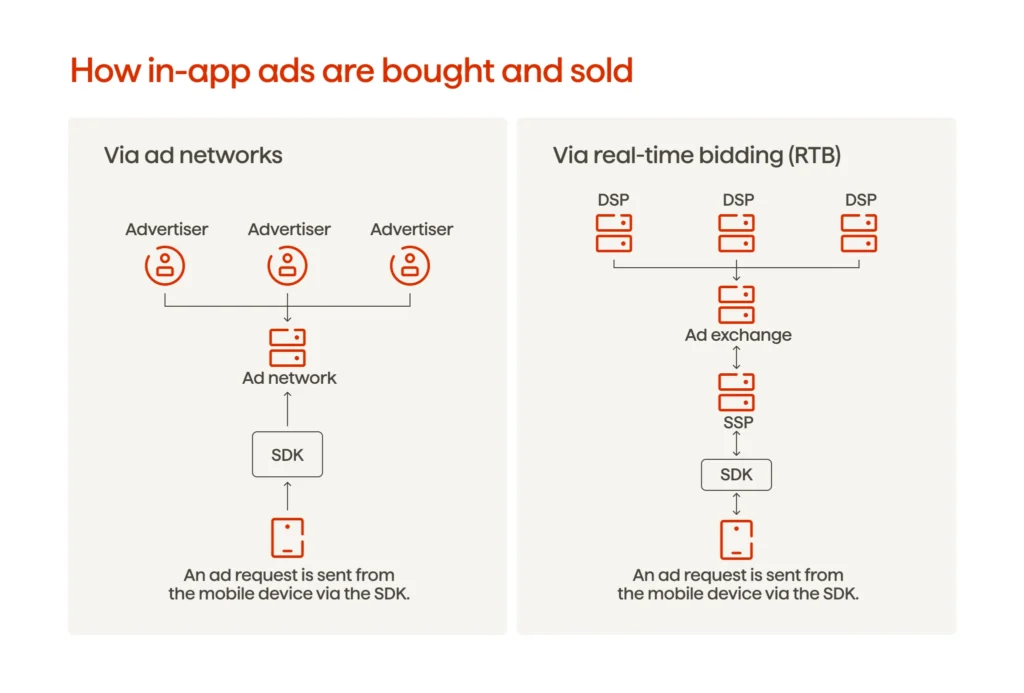
If an ad is being transacted via an ad network, then an ad request will be sent from the mobile app to an ad network via an SDK. The ad request will be matched with an advertiser’s campaign, and an ad will be selected. The ad will then be sent back to the mobile app and displayed to the user.
If the ad is being transacted via real-time bidding (RTB), then an ad request will be sent from the mobile app to an SSP via an SDK. The SSP will then pass on the ad request to an ad exchange, which will then pass on the bid request to multiple DSPs.
Each DSP will evaluate the bid request, match it with the advertisers’ ad campaigns, and send back a bid response. The ad exchange will then hold an auction where each of the bids from the various DSPs will compete against one another. The highest bid will win the impression, and the ad will be shown to the user.
Below is an overview of how in-app mobile ads are bought and sold via ad networks and RTB.
What’s the difference between in-app advertising and mobile advertising?
The biggest difference between in-app advertising and mobile advertising comes down to where the ads appear. In-app advertising is delivered inside mobile apps through an SDK, while mobile advertising on the mobile web is served through a browser, much like traditional website ads.
Here’s a short comparison between mobile and in-app advertising:
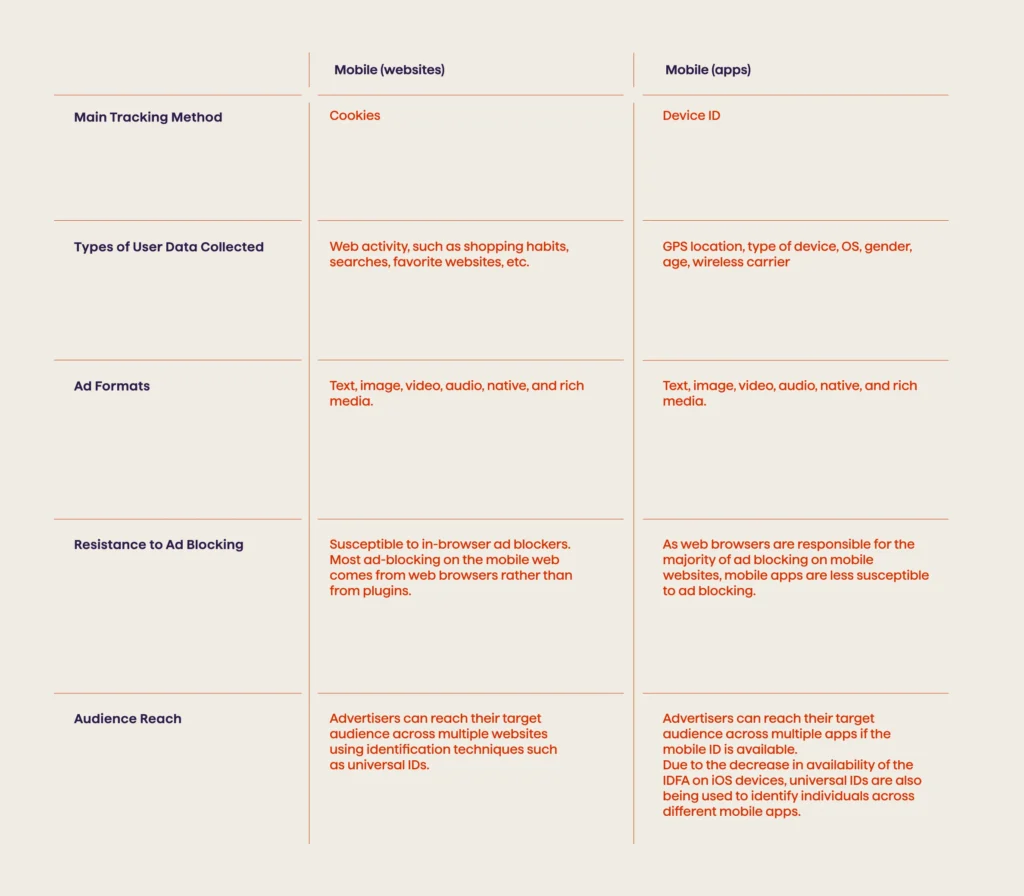
Now, let’s take a closer look at what sets these two advertising channels apart. When it comes to mobile devices using a browser to display ads, they don’t require a software development kit (SDK), as these ads are served in the same way as ads on websites.
Mobile apps, on the other hand, need developers to integrate the given AdTech vendor’s SDK so the app can define where ads will run, along with information about the ad medium (e.g., text, image, native, and video) and ad format (e.g., interstitial and banner).
Despite less time being spent on the mobile web compared to in-app activity, the mobile web offers more contextual and audience-targeting opportunities because new web pages are constantly being created. That gives advertisers the ability to reach audiences based on their interests across the broader Internet, making the mobile web a major opportunity when scale is the goal.
There’s also the matter of available formats. Most ad formats work well on the mobile web, from native ads that blend naturally into surrounding content to video ads that help advertisers capture attention beyond traditional display placements.
That said, the in-app environment offers a different kind of advantage. Because ads are integrated directly into the app experience, advertisers can use highly interactive formats such as rewarded video, playable ads, and offerwalls—formats that typically aren’t available on the mobile web.
It’s also worth pointing out that desktop and laptop computers may be shared among multiple users, while mobile phones are typically personal devices. Because installed apps are closely tied to a user’s habits and daily routines, the in-app environment creates a natural setting for more relevant and effective advertising touchpoints.
Examples of in-app ad formats
The most common types of in-app ads include playable ads, interstitial ads, offerwalls, rewarded video ads, video ads, expandable ads, banner ads, and native ads. Each format serves a different purpose, so the right choice depends on what you’re trying to achieve with your campaign, from driving installs and engagement to increasing conversions and revenue.
There’s no right or wrong answer as to which in-app ad format you should choose to get your desired results, but you can certainly find one that is suitable for your needs. The best way to do this is by deciding what you’re aiming to achieve with your campaign.
Each type of in-app ad offers its own benefits, so let’s take a look at what each one brings to the table.
Playable ads
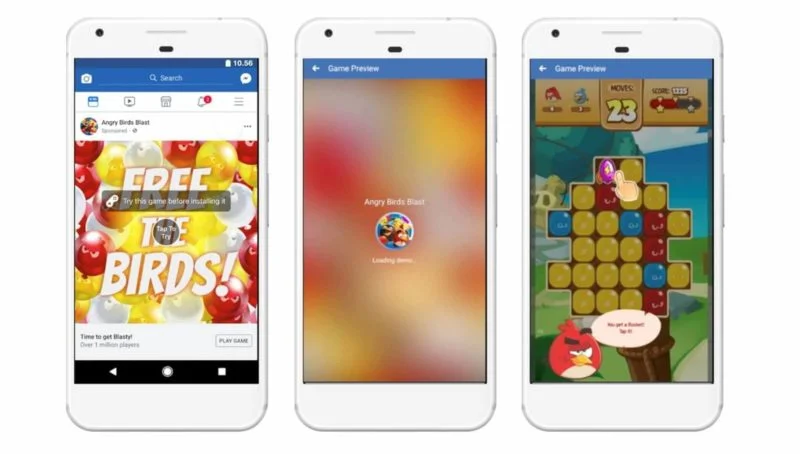
Playable ads let users try an app before installing it. Popular in mobile games and apps, these interactive ads give users a chance to experience gameplay or key features through a short demo before committing to an app download.
Because users actively engage with the ad, playable ads often deliver stronger engagement than traditional mobile app ads. They’re particularly effective for user acquisition strategies and frequently generate some of the highest eCPMs in the industry.
Interstitial ads
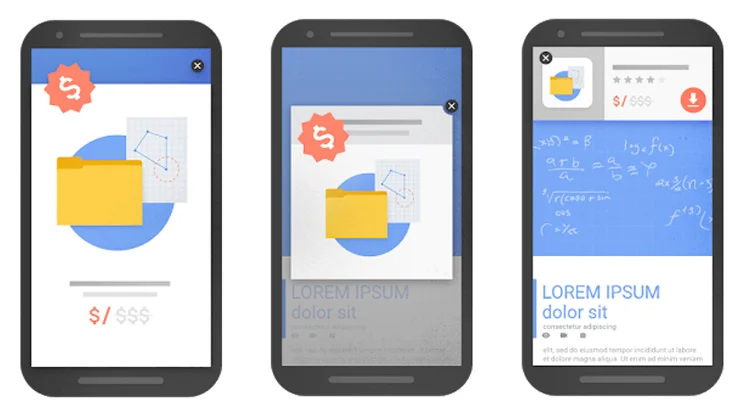
Interstitial ads provide users with rich, customizable, and appealing static or in-app video ads at natural pauses in an app’s flow, such as when a user opens the app, browses between pages, or switches between games. This frequency of ad exposure keeps the disruption of the user experience to a bare minimum. They do, however, require user action in order to be closed or display the desired content.
One of the most distinguishable interstitial ads is a splash ad, a full-screen interstitial ad shown when the app is opened but before any other content is loaded.
Offerwalls
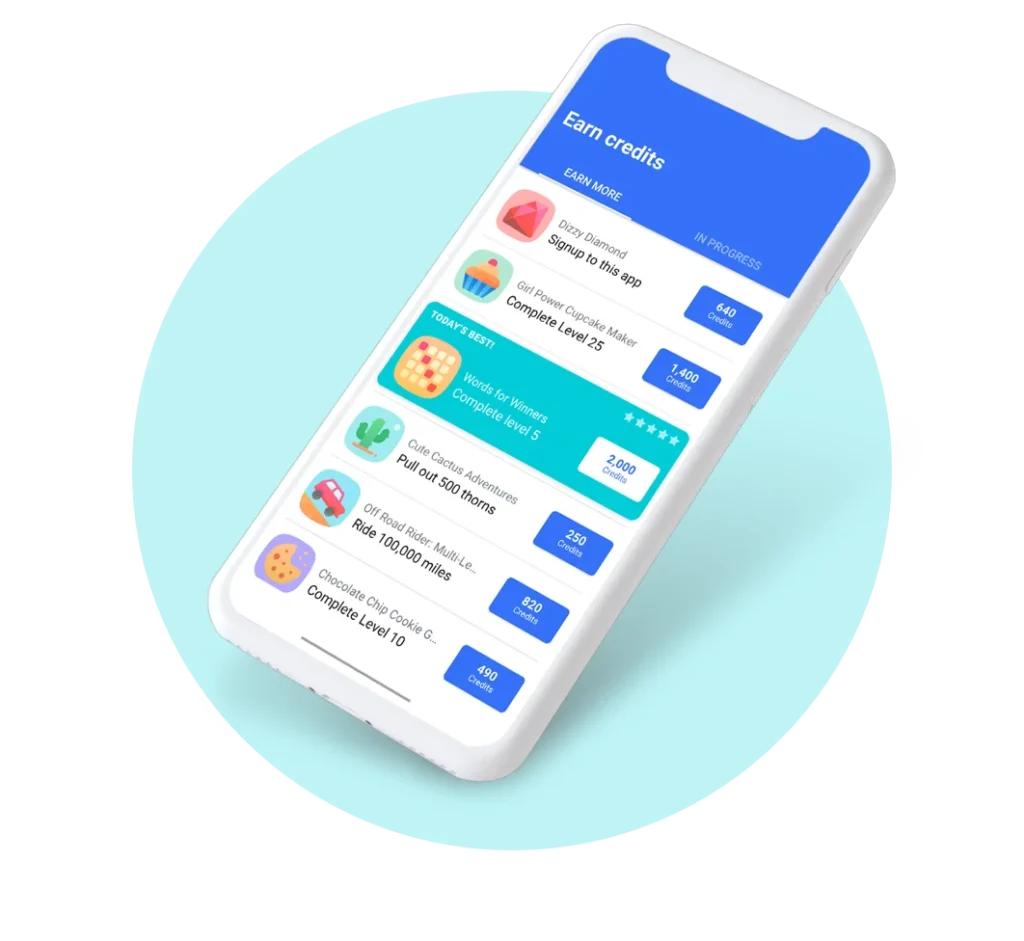
Offerwalls allow users to earn rewards by completing specific actions within an app. In many ways, they function like mini-stores, presenting users with offers such as app downloads, surveys, or registrations in exchange for rewards.
Users actively choose to engage with these offers, which often leads to longer session times and stronger monetization performance. Among in-app ad formats, offerwalls consistently rank near the top in terms of eCPM.
Rewarded video ads
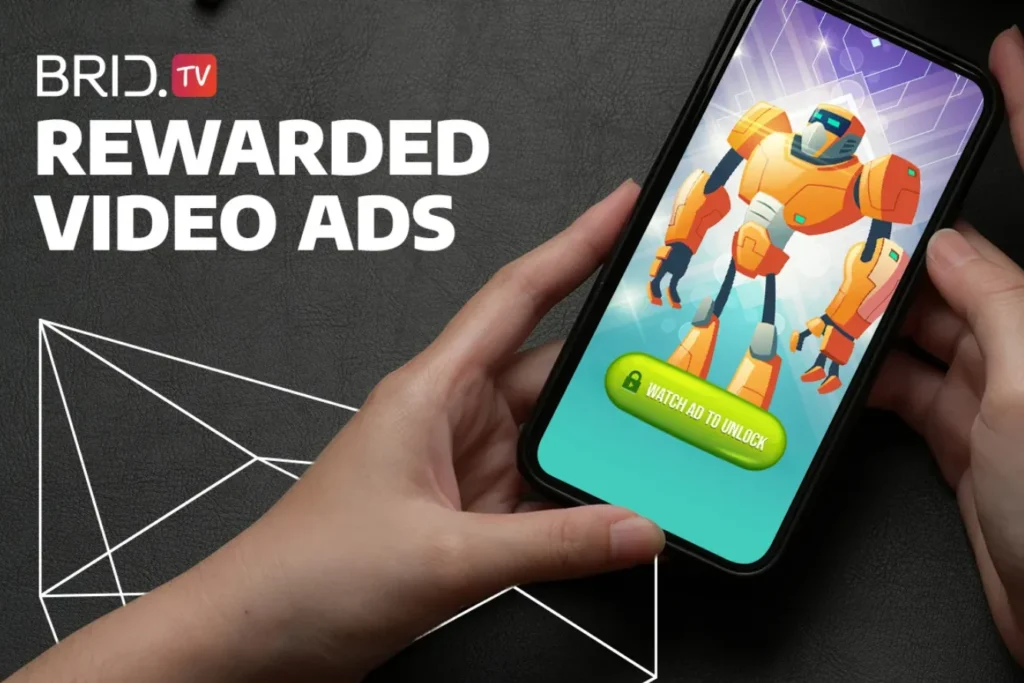
Rewarded video ads give users an in-app reward in exchange for watching an advertisement. Rewards may include extra lives, in-app coins, premium content, or other virtual items.
Participation is voluntary, which helps create a positive user experience. Beyond generating revenue, rewarded video ads can encourage repeat engagement and support in-app purchases.
Video ads
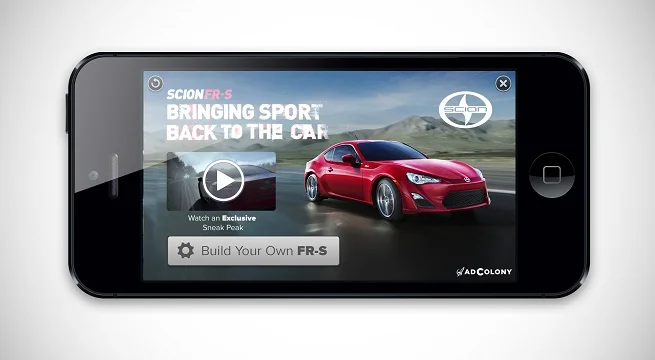
Video ads use short-form video content to deliver advertising messages within mobile apps. Most in-app video ads run between 15 and 30 seconds, making them well suited for promoting products, services, apps, and brands.
Compared to desktop advertising, in-app video ads often capture more attention from users. Mobile users are typically focused on a single screen and activity, giving advertisers a better chance of holding their attention and communicating a message effectively.
Expandable ads
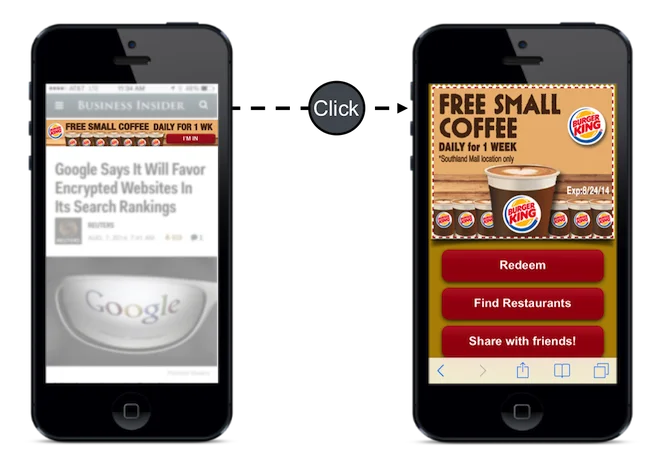
Expandable ads combine elements of banner and interstitial advertising. They typically begin as a teaser banner measuring 320×50 pixels before expanding into a larger format, often around 320×480 pixels, after user interaction.
The larger canvas gives advertisers additional room to communicate their message, showcase products, or include interactive elements.
Standard banner ads
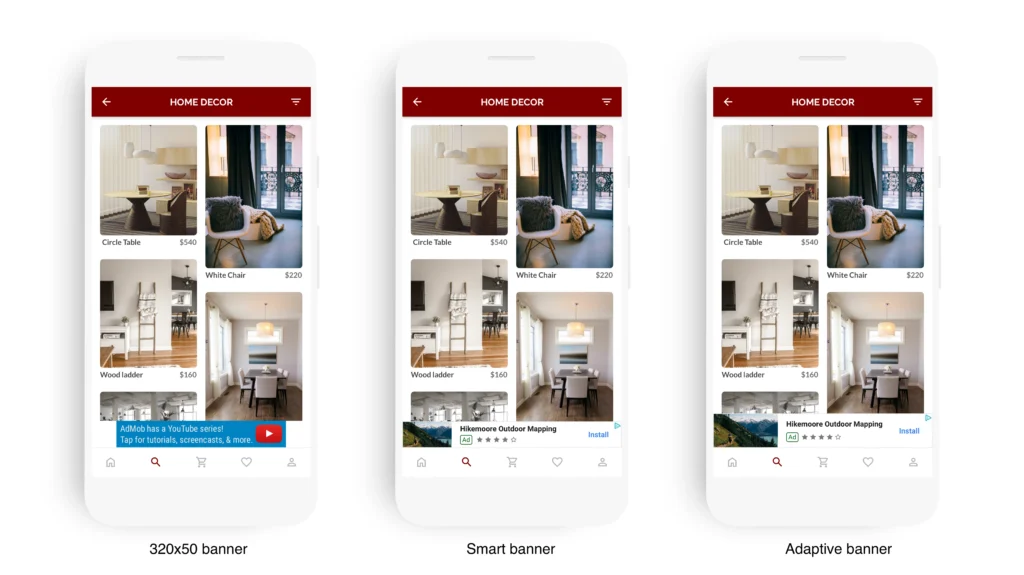
Standard banner ads are one of the most common in-app advertising formats. These display ads typically range from 320×50 to 300×50 pixels and usually appear at the top or bottom of a mobile screen.
While banner ads are relatively simple, they remain popular across many app categories. Early banner ads often struggled with engagement, but when placed thoughtfully and used in the right context, they can generate revenue without disrupting the user experience.
Native ads
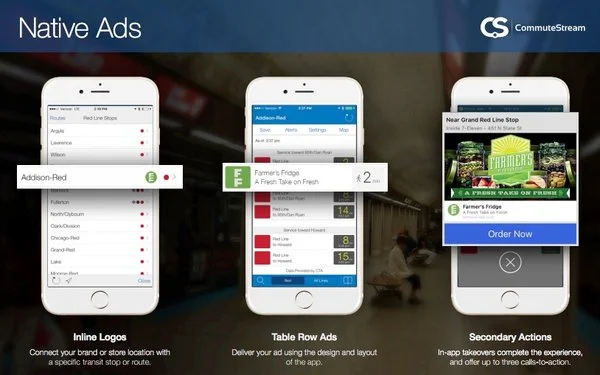
Native ads blend advertising messages into an app’s existing content and design. Rather than receiving a fully designed advertisement, publishers are typically given individual creative components that can be arranged to match the look and feel of the app.
This flexibility allows native ads to integrate more naturally into the in-app environment. As a result, there is no single standard for their appearance, format, or size.
FAQ
Closing the loop on mobile app advertising growth
Mobile app advertising sits at the center of how today’s mobile app market connects users, brands, and publishers. As app usage continues to grow across gaming apps, social platforms, and everyday utilities, in-app advertising has become a core driver of both app revenue and user acquisition.
The strongest results don’t come from a single in-app ad format or one-off campaign. They come from applying the right mobile app marketing strategies, following proven best practices, and aligning advertising efforts with each stage of the marketing funnel. When combined with solid app tracking and a clear understanding of app user behavior, in-app advertising becomes a reliable way to scale performance and improve the overall app experience.
If you’re ready to turn mobile app advertising into measurable growth, our team can help you get there. Get in touch with us for a free consultation and start building a smarter mobile app advertising strategy today.



Your business results matter
Achieve them with minimized risk through our bespoke innovation capabilities. Fill in the form below.