






Intelligent traffic management systems: the future of mobility and safety


June 12, 2026 8 min read 454 views
Intelligent traffic management systems (ITMS) use AI, IoT sensors, cameras, and real-time analytics to optimize traffic flow, reduce congestion, and improve road safety. Cities use intelligent traffic management software to adjust signal timing, detect incidents, prioritize emergency vehicles, and lower transportation-related emissions. The global ITMS market is projected to reach nearly USD 28 billion by 2030, reflecting growing demand for smarter urban mobility.
Key takeaways
- All road users benefit from increased mobility, reduced traffic congestion, and fewer collisions due to dynamic traffic management.
- Both providing the degree of real-time coordination required to manage today’s traffic flow and guaranteeing sufficient safety are two areas where traditional traffic management techniques are falling short.
- At intersections, traffic managers can swiftly manage traffic thanks to adaptive lights and real-time data. In addition to reducing delays and improving incident-clearing times, higher-priority vehicles (such as emergency or transit) keep moving.
- Intelligent traffic sensors offer benefits to the natural environment by reducing emissions and fuel waste, as well as the number of vehicles idling and commuting for freight and transit services.
Why traffic management solutions have become essential?
Intelligent traffic management systems have become essential because traditional traffic control methods struggle to keep pace with growing transportation demand, increasing congestion, and rising safety expectations. By using real-time data, AI-driven analytics, and adaptive signal control, these systems help cities optimize traffic flow, respond to incidents faster, and make more efficient use of existing road infrastructure. Growing adoption worldwide reflects this need, with the global intelligent traffic management system market expected to reach USD 24.9 billion by 2032.
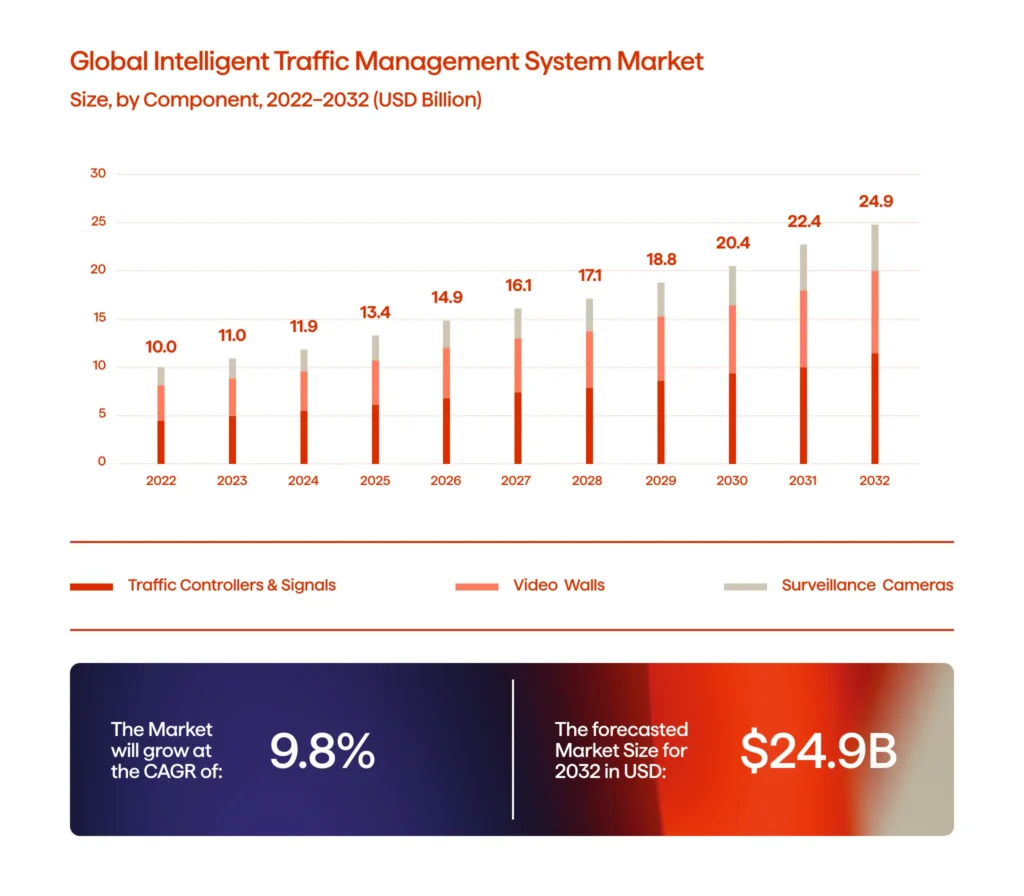
The demand for smarter traffic management is expected to increase further in the coming decades. According to the International Transport Forum’s Transport Outlook, global passenger transport demand could nearly triple by 2050, while freight demand is also projected to grow significantly. As more people and goods move through urban areas, transportation networks require more adaptive and data-driven ways to maintain efficiency without relying solely on new infrastructure.
One of the main benefits of intelligent traffic management is its ability to maintain a more consistent traffic flow. AI-powered signals and connected sensors continuously monitor road conditions and adjust traffic light timing in real time. This dynamic approach reduces delays at intersections, shortens queues, and helps vehicles move more efficiently through urban corridors.
Intelligent traffic management systems also play an important role in improving road safety. Computer vision cameras, connected infrastructure, and real-time monitoring tools can detect pedestrians, cyclists, stalled vehicles, and other potential hazards as they emerge. By identifying risks earlier, traffic operators can respond more quickly and provide road users with more accurate guidance, helping reduce collisions and improving overall road safety.
Another advantage is the ability to predict and prevent congestion before it escalates. Advanced analytics platforms process historical and real-time traffic data to identify patterns associated with bottlenecks, incidents, or unusually high traffic volumes. Traffic authorities can then adjust signal timing, implement diversion strategies, or prioritize specific traffic movements before conditions deteriorate.
Beyond mobility and safety, intelligent traffic management supports sustainability goals. Adaptive signal control reduces vehicle idling and stop-and-go traffic, lowering fuel consumption and transportation-related emissions. By improving the efficiency of existing road networks, cities can accommodate growing transportation demand while reducing the environmental impact of transportation.
Why are traditional traffic control systems no longer sufficient?
Traditional traffic control systems are no longer sufficient because fixed signal timing and manual traffic monitoring cannot adapt to real-time traffic conditions. As traffic volumes increase and transportation networks become more complex, static control methods create congestion, delay incident response, and limit opportunities to improve road safety.
Many conventional traffic signals still operate on pre-programmed schedules designed for predictable traffic patterns. Fixed-time control cannot respond to sudden increases in traffic volume, road closures, special events, or accidents. As a result, intersections may continue stopping vehicles on empty approaches while queues build on congested roads.
Traditional traffic control also has limited incident response capabilities. Basic vehicle detectors can identify traffic presence, but they cannot analyze road conditions, detect hazards, or predict disruptions. Following a collision or lane blockage, conventional signal plans often continue operating without adjustment, increasing delays and creating conditions that can contribute to secondary incidents.
Modern traffic management platforms address these limitations through real-time data analysis and adaptive control. AI-powered systems process information from cameras, IoT sensors, and connected infrastructure to adjust signal timing, prioritize emergency vehicles, and redirect traffic when conditions change. This dynamic approach helps stabilize traffic flow before localized disruptions affect the wider network.
Traditional traffic systems also struggle to support data-driven transportation planning. Without advanced analytics, traffic authorities cannot identify emerging congestion patterns or forecast future demand. Intelligent traffic management systems combine historical and real-time data to improve decision-making, reduce vehicle idling, and support safer, more efficient mobility.
| Traditional Traffic Control | Smart Traffic Management |
|---|---|
| Fixed-timer traffic lights | AI-driven adaptive signals |
| Reactive, manual decisions | Real-time data intelligence |
| Congestion and long queues | Smooth, optimized traffic flow |
| Limited incident management | Instant detection and response |
| Minimal focus on safety | Predictive analytics to improve safety |
| Isolated control systems | Connected, city-wide platforms |
What is traffic management software?
Traffic management software is a fundamental part of intelligent transportation systems. It operates by using data from cameras, roadway sensors, and connected infrastructure to monitor conditions, analyze patterns, and coordinate responses.
Key features of traffic management solutions
- Live monitoring & analytics. Real-time feeds from IoT devices, CCTV, and while loops detect incidents, queues, and speed anomalies as they occur.
- Adaptive signal control. Algorithms retime every traffic light to balance queues at each intersection, thereby limiting congestion throughout the city.
- Predictive insights. The system predicts jams after incidents, enabling action before they snowball.
- Centralized command. Dashboards integrate corridors, work zones, and priority for buses/emergency vehicles.
- Open integration. APIs connect parking, micro-mobility, freight, and weather to optimize the overall network.
Together, these features transform unresponsive streets into responsive networks — let’s now examine the specific benefits that cities might experience once they activate them.
What are the benefits of traffic management software?
Traffic management software improves mobility, safety, and operational efficiency by using real-time data to coordinate vehicles, cyclists, pedestrians, and traffic signals. This data-driven approach helps optimize traffic flow, reduce congestion, and improve the overall performance of transportation networks.
Moreover, modern traffic management systems support a more balanced distribution of traffic across the road network and can prioritize emergency vehicles and public transit when needed. Real-time monitoring and incident management tools enable faster responses to accidents, helping reduce delays, improve clearance times, and lower the risk of secondary collisions.
In the long term, traffic management software supports urban sustainability by reducing vehicle idling, fuel consumption, and transportation-related emissions. By optimizing the use of existing infrastructure, cities can accommodate growing mobility demand without relying solely on costly road expansion projects.
FAQ
Building smarter cities through intelligent traffic control
Cities do not need more asphalt; they need more intelligence. Active traffic management converts disconnected signals and siloed data into a connected, real-time network, reducing delays, improving incident management, and lowering emissions. The world is already moving: Europe is the worldwide leader in traffic enforcement cameras across the globe, with an incredible 68,991—of that, 8,933 red-light cameras, 46,500 speed enforcement, 3,148 dual cameras, 9,585 section-control, and 825 other: proving that data-driven safety isn’t optional anymore.
When there is alignment between software, sensors, and policy, the benefits accumulate quickly. Adaptive timing facilitates traffic flow at all intersections; incident response clears disruptions before queues begin to form; and emissions-aware operations reduce fuel burn, doing so without adding a single lane of capacity. Education and enforcement sustain safer behavior, and the efficiency of the economy returns hours to commuters and predictability to supply chains.
Want to learn more about automotive software development and effective traffic management? Contact Avenga, your trusted technology partner.


Your business results matter
Achieve them with minimized risk through our bespoke innovation capabilities. Fill in the form below.