






AI-powered demand forecast in the energy sector: Use cases and optimization


June 12, 2026 10 min read 330 views
Rather than having to react to changes in demand, what if you knew what to expect? The energy industry is currently exploring various methods for forecasting future energy usage by analyzing past data on how much energy machines and buildings consume, including the use of AI and machine learning.
AI correlated algorithmic solutions together with demand insights enable demand planners to generate far superior demand forecasts; therefore, enabling these planners to realize the full potential of AI related to demand planning, productivity, and durability of operations. Continue reading below to learn more about this technology.
AI-powered demand forecasting: Key takeaways
- By integrating real-time data with adaptive AI forecasting models, modern demand forecasting increases accuracy.
- AI simplifies decision-making by facilitating quicker, more adaptable responses to shifting circumstances.
- Supply is balanced at both high and low demand periods with the aid of a well-integrated forecasting system.
- Improved forecasting guarantees that energy production and the changing demand for goods and services are in sync.
The demand forecasting challenge in modern energy systems
Electric utility companies will need to change the way they operate by being more responsive to the growing demand for electric service, the new ways customers are using electricity, and where electricity is generated, which will no longer be predictable with the established linear characteristics that have been the trend in the past. This is where our energy and utilities software development team helps providers modernize.
The very high level of uncertainty surrounding this trend continues to be why the load analysis and demand forecasting area of the electric utility industry accounted for 38% of the entire electric utility industry in 2024, underscoring the importance of accurately forecasting demand to maintain operational stability and plan for the future.
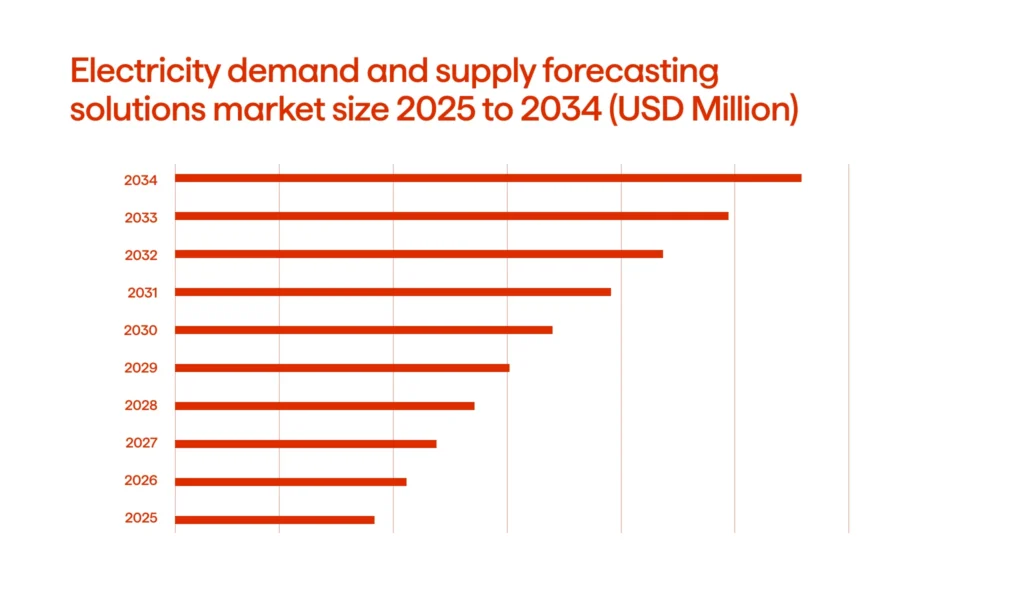
Plus, forecasting solutions indicate a general trend towards integrating multiple data sources into a single location. By doing so, energy providers foresee using integrated systems to combine grid and weather-related data, as well as supply chain information, to produce accurate demand forecasts and efficiently allocate the resources needed.
Legacy forecasting methods cannot handle new levels of complexity. Generally speaking, forecasting practices rely on preset historical averages and static (non-adjustable) assumptions that respond only to real-time changes (and, as a result, typically process small quantities of data) at a very slow rate.
These trends provide no flexible means to track changes across product orders (and, as a result, negatively impact both efficiency and supply levels).
Traditional demand forecasting methods vs. AI approaches
Energy systems aren’t as predictable as they used to be. That old-school forecasting built for stable, steady environments just doesn’t cut it anymore. Utilities these days face all kinds of twists: wild weather, the rise of distributed energy, and customers who keep changing their habits. As demand patterns evolve, standard inventory forecasting and prediction techniques will increasingly diverge from AI-based approaches.
This table provides an overview of how traditional forecasting methods compare with AI-powered methods across demand planning, supply chain management, and day-to-day decision-making.
| Capability | Traditional Forecasting Methods | AI-Based Forecasting Approaches |
|---|---|---|
| Data processing | Relies on limited historical datasets and predefined inputs | Processes large-scale, real-time data from multiple sources (IoT, weather, grid, market signals) |
| Handling demand patterns | Assumes stable, repeatable patterns based on past trends | Continuously learns and adapts to evolving and non-linear demand behavior |
| Accuracy of forecasts | Moderate accuracy, declines in volatile conditions | High accuracy due to pattern recognition and continuous model training |
| Real-time adaptability | Limited or delayed updates; often batch-based forecasting | Near real-time forecasting with continuous updates and recalibration |
| Integration with supply chain | Weak connection to supply chain systems; planning is often siloed | Strong integration with supply chain management for coordinated generation, storage, and distribution |
| Scenario planning | Manual scenario creation with limited variables | Automated scenario modeling using multiple variables and probabilistic simulations |
| Scalability | Difficult to scale across regions or complex grids | Easily scalable across distributed systems and large datasets |
| Automation level | High reliance on human intervention and manual adjustments | Automated workflows powered by advanced AI tools |
| Response to anomalies | Reactive; anomalies often detected after impact | Proactive detection of anomalies and early warnings |
| Support for demand planning | Static, periodic demand planning cycles | Dynamic, continuous AI-driven demand planning aligned with real-time conditions |
| Cross-domain insights | Limited ability to incorporate external factors (e.g., weather, market trends) | Integrates cross-domain data, improving decision-making across operations |
We break down the methods in our guide to AI forecasting techniques and demand forecasting tools.
Switching to AI forecasting tools isn’t just a numbers game. It actually helps build a more connected and nimble system. Instead of departments working in isolation, low-demand planning, grid operations, and supply chain teams can coordinate and respond together.
Weather data integration and climate pattern analysis
Advanced forecasting software helps capture these trends with far greater accuracy than ever before. It’s not just about matching temperatures anymore. AI enables businesses to dig into all kinds of data at once, read the subtle signals, and nail demand predictions, whether you’re looking ahead a few hours, days, or even longer.
At the core of this approach are several key capabilities:
- High-resolution weather data: temperature, humidity, wind speed, cloud cover, precipitation, and solar radiation allow for analysis on how the environment influences demand.
- Numerical weather prediction model integration: the NWP model correlates weather predictions with demand variations.
- Real-time demand signals: smart meters, grid sensors, and weather APIs capture how consumption responds dynamically to changing conditions.
- Time-series forecasting: AI models analyze hourly, daily, and seasonal trends to support both operational and strategic planning.
- Anomaly detection: systems identify unusual weather-driven usage spikes, such as those caused by extreme heat or cold.
- Seasonal decomposition: separates recurring patterns from irregular climate-driven changes, thereby improving the reliability of long-term forecasting.
- Satellite and climate data analysis: integrates historical datasets and satellite imagery to refine predictions, particularly for renewables.
- Scenario modeling: AI-based demand forecasting tools simulate different weather conditions to optimize supply-demand balance under uncertainty.
In practice, this means AI-enabled demand forecasting helps operators avoid costly surprises.
Renewable generation variability and forecasting
Forecasting energy gets tricky with renewables. Contrary to conventional power generation facilities, you cannot increase or decrease the output at your discretion. For instance, the use of solar energy is immediately affected by the cloud cover passing overhead. Wind generation varies depending on how fast the wind turbines turn.
According to Bluence, there are three main sources of data used to generate an accurate forecast for renewable energy systems. They include weather forecasts, historical site data, and actual sensor data from the plant facility. As such, the accuracy of any of the three data sources will alter the forecast’s original purpose.
Artificial intelligence really changes the game compared to old-school statistical forecasting. Utilities and renewable energy companies lean on machine learning to pull together all sorts of data — weather patterns, SCADA signals, how assets are performing, market prices, even how customers are using power. These types of systems create multiple predictions.
Solar generation is set to peak when few people need power. In that case, AI can jump in early—it might tell you to charge batteries sooner, kick off demand response, or tweak trading plans so you don’t end up wasting that solar energy. If the wind slows down faster than forecast, the system can sound the alarm to activate extra reserve capacity, keeping the grid steady before things get dicey. For the wider view, see AI in the energy sector: key applications.
The real value goes beyond just generating electricity. When utilities accurately anticipate demand, they can assess whether renewable energy output aligns with actual demand. That means they can plan dispatches and use storage more efficiently, avoiding costly last-minute fixes.
As time goes on, AI can identify patterns in which renewable supply and customer demand don’t align.
We solve operational challenges with practical, action-ready programs backed by clear reporting and hands-on support from start to finish.
Grid balancing, frequency regulation, and real-time data infrastructure
When supply and demand are poorly matched, frequency fluctuations and decreased reliability occur throughout the electrical system. For this reason, utilities are now using AI demand forecasting tools to identify potential points of volatility in our electrical grids before they occur, rather than waiting until they occur. This way, they can stay ahead, not just play catch-up.
Running the modern grid takes a powerful layer of real-time data. Smart meters, IoT sensors, SCADA systems, and distributed energy resource telemetry all send a constant stream of information to a central forecasting platform. This platform crunches the numbers fast, using high-frequency data to predict where demand and generation will shift—on a big scale and right down to the neighborhood level, all powered by AI.
AI forecasting processes data by performing several types of analytics, including short-term load projections, frequency response modeling, and probabilistic forecasting. As deployments become more sophisticated, the use of generative AI enables the simulation of many grid conditions, allowing operators to test how different factors may affect overall grid stability. Examples include sudden drops in renewable energy generation or sharp increases in energy demand.
Business impact and benefits of AI-based forecasting
These are the main advantages of AI-powered forecasting for businesses:
- More accurate demand prediction: AI models learn from real-time and historical data to accurately predict demand with higher precision.
- Optimized resource allocation: Better visibility into future product demand and energy consumption enables utilities to reduce overproduction and avoid shortages.
- Cost reduction: Improved forecasting minimizes imbalance penalties, reduces reliance on expensive backup generation, and lowers operational costs.
- Stronger supply chain coordination: Aligning energy production with product and service demand improves planning across procurement, storage, and distribution.
- Enhanced grid reliability: Early detection of demand changes supports faster responses and more stable system performance.
- Improved renewable integration: Forecasting enables better synchronization between renewable generation and consumption patterns.
- Data-driven decision-making: Advanced analytics provide actionable insights for both short-term operations and long-term strategy. Much of this runs on our data and analytics services.
- Scalable operations: AI systems adapt to growing data volumes and increasingly complex energy ecosystems without requiring major infrastructure changes.
With AI-based predictions, energy companies can operate more accurately, reduce risk, and create more resilient, future-ready systems.
FAQ
Anticipate future demand with Avenga
Avenga can provide a more holistic outlook on your upcoming needs through the application of analytics and artificial intelligence. By thoroughly evaluating data from your operations, market segment, and customers, you will achieve full accuracy in estimating the number of products to be manufactured.
Learn more by contacting Avenga, your trusted demand forecasting software partner.



Your business results matter
Achieve them with minimized risk through our bespoke innovation capabilities. Fill in the form below.