





Step up your retail customer engagement strategies 2026


June 13, 2026 10 min read 341 views
A major obstacle retail businesses face in capturing customer engagement is providing customers with too much information or too many choices. This approach is doomed to failure. The customer’s experience is unique and fluid, regardless of where they shop or browse. All shoppers want is a custom, affordable deal, and will not hesitate to switch brands if you cannot provide it.
To retain the customer’s high level of engagement with your business, you must evaluate the customer’s full journey, from ‘first interest’ in your business through to the ‘post-purchase’ experience. By accomplishing this, you will experience repeat purchases and true loyalty from your target customers.
Retail customer engagement key takeaways
- To boost retail customer engagement, retailers must connect data, channels, and experiences into one cohesive system. The system will serve customers across every touchpoint.
- A strong omnichannel retail strategy ensures consistency and relevance. It reduces friction and makes interactions feel seamless and intentional.
- Effective strategies to improve engagement rely on personalization, real-time insights, and continuous optimization. One-time campaigns are no longer a working strategy.
- Engagement is proactive. Retailers need to anticipate needs and act early to build loyalty and long-term value.
AI-powered personalization and recommendation engines
The average consumer expects a retailer to provide a personalized shopping experience. Retailers have begun using AI to create personalized interactions between website users and retailers across websites, mobile apps, chatbots, and physical retail locations. As with every interaction between a customer and a retailer, all interactions must be relevant, appropriate, and timely. For this reason, it’s been imperative for retailers to maintain a consistent customer experience across all retail channels. Due to this consistency, retailers can measure how many customers have suggested improvements for various retail experiences and create strategies to improve retail experiences based on those areas that consumers identify as needing improvement (pain points).
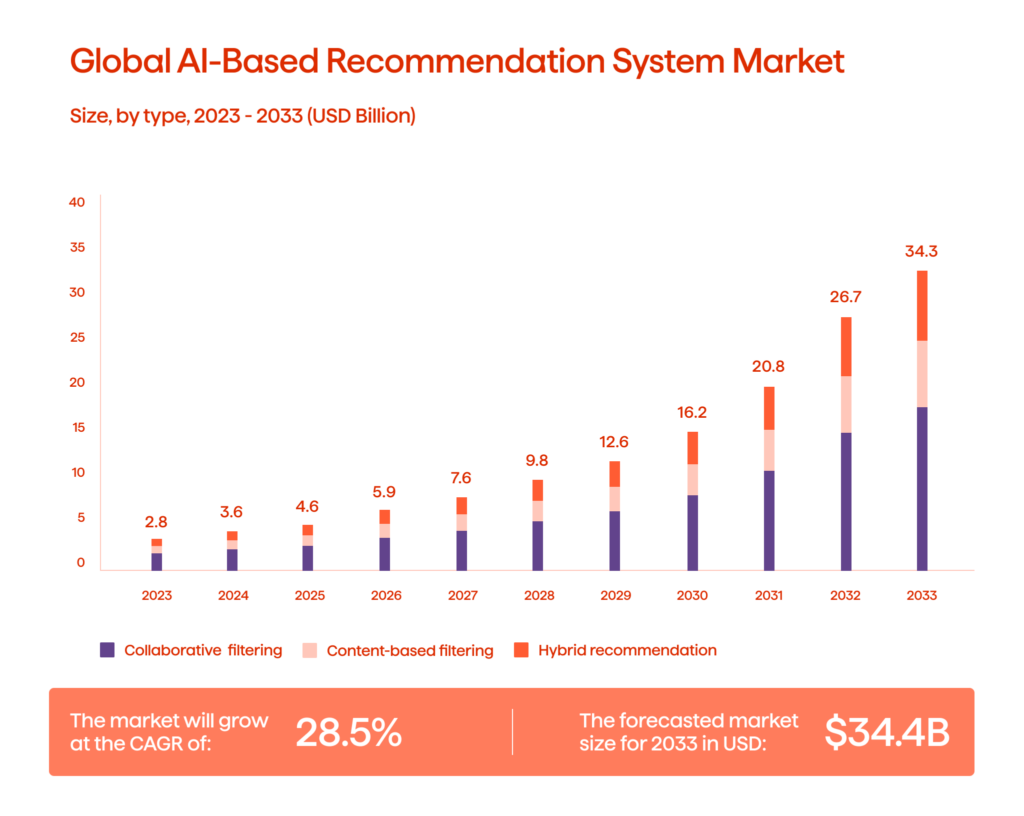
Look at the numbers. It’s pretty clear the market’s jumping on board. In 2023, AI-powered recommendation systems generated $2.8 billion in revenue globally. By 2033, that’s expected to hit $34.4 billion. We’re talking a huge leap, with a 28.5% annual growth rate. What’s fueling all this? Personalization works. Businesses see how much it boosts their results, so they’re doubling down. AI-driven shopping isn’t just flashy; it keeps customers engaged and drives repeat sales of up to 44% worldwide.
Recommendation engines are a game-changer for retailers. They don’t just spit out random products—these systems actually read the room, showing shoppers things like “people who bought this also bought” combos, items that work well together, or smart picks based on categories. For example, we built a product recommendation engine for Stylepit that personalizes campaigns and predicts product preferences at scale.
And they’re everywhere: websites, apps, emails, texts, even messaging platforms. This isn’t just surface-level personalization. It runs through the whole customer journey, making each touchpoint feel relevant. That’s how retailers engage customers and improve their loyalty.
We go deeper in our guide to hyper-personalized AI in the retail customer journey.
How exactly do AI algorithms make predictions?
AI predictions follow a continuous, structured process where each interaction refines understanding and improves outcomes.
Step 1: Collect customer data from various channels
AI collects signals across the entire customer Journey, including:
- a customer’s web browsing,
- mobile usage,
- product viewings,
- purchases, searches,
- shopping cart abandonments,
- email response activity, and
- loyalty programs.
By having a holistic view of a customer’s activity, businesses can begin to understand their evolving preferences.
Step 2: Turn raw data into actionable insights
The collected data is then analyzed to understand the purpose of the activity. Repeated product viewing, price comparisons, or engagement with promotional offers indicate the user’s intent to purchase.
Step 3: Build dynamic customer segments
The AI-driven segments develop in real time depending on customer behavior. For instance, an individual may go through various states, from casual exploration to high intent, in a single browsing session.
Step 4: Predict future behavior
Predictive modeling anticipates probable behaviors, such as buying something or losing interest. Early detection enables businesses to be proactive and increase customer lifetime value.
Step 5: Personalize the next best action
Algorithms foresee which product, message, or medium is relevant at any particular point in time. Appropriate and timely communication builds a sense of understanding amongst customers.
Our end-to-end software development services keep your retail operations secure, efficient, and customer-focused – from digital transformation to 24/7 support so that you can focus on business growth.
Conversational AI: chatbots, voice assistants, and virtual stylists in modern retail
As consumers shop, they can receive customer service support through conversation-based AI that assists them throughout their journey from discovery to purchase. Conversation-based AI will be available to assist throughout the entire customer experience.
This is part of a wider shift we cover in how to improve customer experience with AI.
For many brands, technology can create more effective connections and engage their current customers, fulfilling an increasing need for greater consumer support.
Chatbots: Zowie for Shopify-centric brands
Zowie is an automated support bot that helps Shopify retailers manage things like FAQs, refunds, subscriptions, and product questions. It plugs into your eCommerce and marketing tools and handles routine questions right away. Retailers get a lighter support workload and smoother operations. Customers don’t have to wait around—they get quick answers on the spot.
Virtual try-on: Sephora Virtual Artist
Sephora Virtual Artist uses AR to let users test makeup shades via its app and Facebook Messenger. Users will no longer have to guess what the products look like, as they can try them out virtually.
Style advisors: Levi’s Virtual Stylist and Tommy Hilfiger’s TMY.GRL
The Levi’s Virtual Stylist assists customers in finding the best-fitting jeans and in creating outfits based on their preferences—the Tommy Hilfiger TMY.GRL’s campaign used Facebook Messenger to promote mix-and-match purchases via conversational AI.
Voice assistants: Erica by Bank of America
Even though Erica works in the banking industry, this shows that voice chatbots can be leveraged to provide individual assistance on a larger scale. Using a voice-enabled chatbot is a great way for retailers to manage order tracking, inventory replenishment, and customer reward balances, while also providing individualized recommendations based on customers’ previous purchases.
With these tools implemented, retailers are providing customers with enhanced convenience and personalized shopping capabilities in the omnichannel experience and increasing customer loyalty across multiple channels.
In-store technology: digital signage, beacons, and proximity marketing
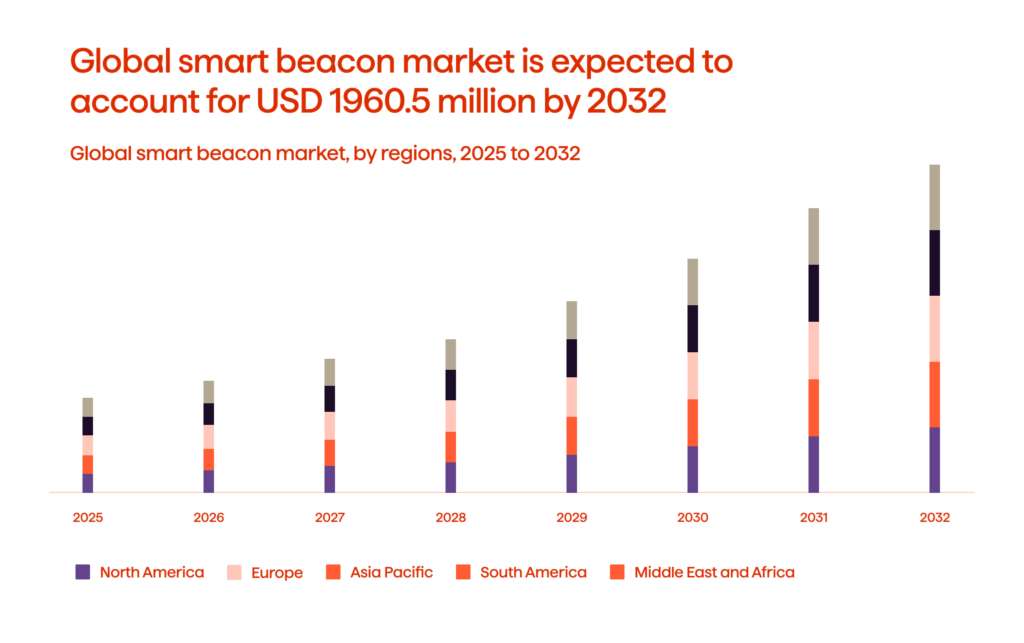
There is definitely a change in physical stores, and data backs it up. According to recent research reports, the worldwide smart beacon market was valued at $618.12 million in 2024 and is projected to reach $1,960.5 million in 2032, at a CAGR of 54.05%. Such growth is a clear indication of the importance of in-store technologies in today’s retail environment.
Bluetooth Low Energy (BLE) transmits signals to retail stores to help them better leverage available actions by triggering different events depending on whether customers are in range. Triggers can point to the varying needs of each person at a given time based on where they are physically located in this world. Some examples of triggers include: seasonal promotions, discounts, new products, and directions to various locations.
Plus, using digital signage gives retailers real (live) information about what their customers see when they go into their store. Static information has been replaced by data that changes over time, including factors such as time of day, stock availability, and customer grouping. An example of a point-of-entry sign would display the latest trends, while an aisle display sign would showcase items complementary to a customer’s needs.
Proximity marketing connects these technologies into one seamless customer shopping experience. With beacons, retailers can provide customers with connected shopping experiences while they are in-store. In this example, the customer uses a digital display to find a product, receives an offer in their mobile app, and then completes the transaction there.
Customer data platforms and unified customer views
To provide a consistent, personalized shopping experience across an increasingly fragmented retail marketplace, retailers must understand their customers. The implementation of a customer data platform (CDP) enables the retailer to collect, aggregate, and use all first-party data (also referred to as owned data) consistently across all operational areas of the business.
If you are new to the concept, start with what a customer data platform (CDP) is and how it helps marketers.
In its simplest terms, a CDP is a unified view of information gathered from multiple, independent sources that typically operate through many different channels (direct, digital, physical) to generate a composite profile of each customer. The data can be obtained from behavioral activities on websites, mobile applications, chats, and transactions such as purchases or returns, as well as demographics such as geographical locations or preferences. With a consolidated source of input, a retailer will be able to gain a complete perspective of their customer.
The advantage of customer data platforms for an organization is that they effectively connect with its customers by grouping data into actionable segments. Instead of treating each client equally with an identical message or offer, companies should identify target segments that reflect consumers’ motivations and their progress through the purchase cycle (i.e., new, existing, and inactive clients). For example, a business could develop messaging for both new and existing brand consumers, as well as for clients identified as inactive due to limited or no recent purchase activity.
A CDP’s role extends to data governance and consent management in addition to aggregating individual customer data. Good data management is essential for building a strong, trust-based relationship with customers, given the evolving privacy regulations regarding how organizations manage customer information.
Once data has been gathered and sorted, businesses can use it across all channels. Retailers can connect with customers through personalized communications (emails, apps, ads, and even in person) by leveraging an omnichannel strategy for retention and conversion.
Ultimately, customer engagement will be successful if it is relevant. Implementing a CDP will enable the retailer to evolve its marketing from a reactive to a proactive, data-driven function.
FAQ
Why tech-driven engagement is the new baseline for retention
Retention is not dependent on the number of channels that the retailer uses, but on how well those channels learn from the interactions. Technology is automating consumer interactions in today’s retail landscape and developing feedback loops to improve subsequent interactions. If systems take input from consumers, they will help customers make quick decisions and reduce the risk of frustration.
The true transformation happens when we move from a campaign-driven to an adaptation-driven approach, where instead of trying to force consumers to act, we use contextually aware, non-intrusive consumer prompting to prompt them to interact.
As customers’ expectations rise, retailers must respond quickly to changes to deliver high levels of customer satisfaction. The most successful retailers view customer engagement as a constantly evolving ecosystem rather than a “one-time campaign” initiative.
Want to learn more about customer engagement in retail stores? Talk to Avenga’s customer experience team to access the latest retail strategies.

Your business results matter
Achieve them with minimized risk through our bespoke innovation capabilities. Fill in the form below.