






Key healthcare technology trends for the second half of 2026


May 29, 2026 12 min read 514 views
The global healthcare information systems market is expected to grow at a compound annual growth rate (CAGR) of 13% and reach approximately USD 1,773.33 billion in 2034. That trajectory reflects the scale of change underway. Artificial Intelligence (and Agentic AI in particular) is redefining diagnostics and clinical decision-making. Telehealth and remote patient monitoring are extending care beyond the clinic. Mental health technology, including wearables and precision psychiatry, is gaining ground. Together, these trends point to a more connected, data-driven, and personalized healthcare ecosystem.
Keep reading to explore the latest digital health trends and how they redefine the market in 2026.
Artificial Intelligence: Revolutionizing diagnostics and treatment
There’s a reason AI keeps stealing the spotlight among experts—it delivers results like nothing else, specifically in the healthcare sector. While human care providers must process vast amounts of data daily (which can often be overwhelming), AI’s ability to analyze data quickly and efficiently leads to more accurate, objective diagnoses. One of the greatest benefits of this healthcare trend is its ability to detect anomalies early, giving patients a higher chance of overcoming the disease before significant damage is done.
The five-year survival rate for breast cancer is more than 90% when it is discovered at stage one. Similarly, the five-year survival rate for colorectal cancer is approximately 90% when detected early, compared to just 14% when detected later. Patients with cardiovascular diseases will also greatly benefit from modern healthcare: medical imaging, ECGs, and patient data are all analyzed using machine learning. AI provides noninvasive techniques for evaluating cardiovascular risks, potentially saving lives, with research demonstrating remarkable accuracy rates, such as a 93% categorization of heart disease.
But how exactly does it work? What makes AI technology such an unambiguous game-changer in transforming healthcare diagnosis and treatment? Here’s a detailed breakdown of the actions required to make a diagnosis:
- Data collection: AI relies on medical images (e.g., X-rays, MRIs, CT scans), Electronic Health Records (EHRs), genomic data, and wearable device showings.
- Data processing: Before processing, AI algorithms clean the data to remove irrelevant details, normalize it, and highlight the most critical information (e.g., tumor size or abnormal patterns). Advanced data analytics then turn that raw input into clinically meaningful signals.
- Pattern recognition: Artificial intelligence finds relationships between data and specific medical issues. Then, using machine learning algorithms, the historical data is examined for patterns, such as distinguishing between cancerous and normal tissue. To detect complex features in medical images, such as tiny abnormalities in chest X-rays, advanced deep learning models, like convolutional neural networks (CNNs), imitate human brain processes.
- Diagnosis generation: Using the extracted data, AI then provides a likelihood of a condition and compares each specific case to other ones in its database.
The findings are then presented to healthcare providers in user-friendly formats like annotated medical images and detailed reports, where the most critical information is highlighted.
Telemedicine, remote monitoring, and digital twins: The new normal
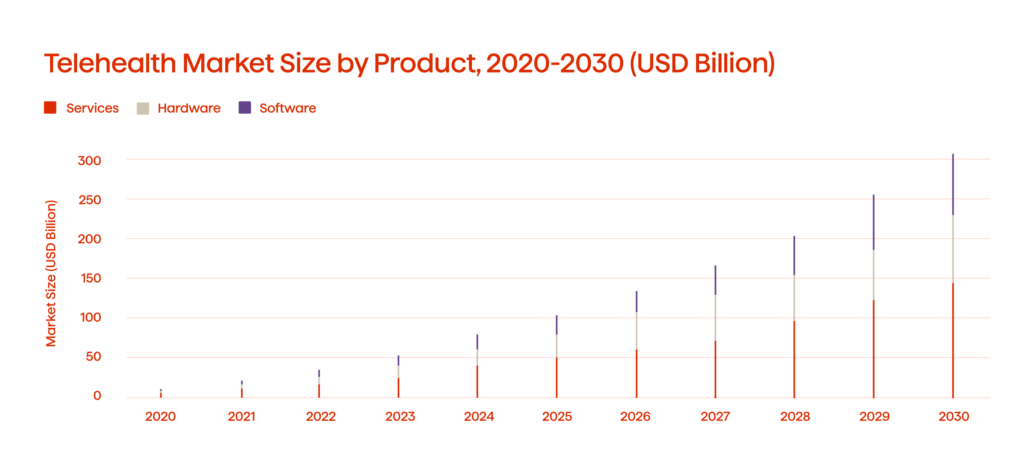
Telehealth gained significant momentum during the COVID-19 pandemic and has since become one of the most prominent technology trends in healthcare. While telemedicine and remote monitoring are often mistaken for telehealth, they are actually subsets of its broader scope. Understanding the distinction between these terms is essential to grasping the full impact of telehealth innovations in healthcare.
With nearly 90% of patients reporting some form of remote healthcare experience in the past year, it’s no surprise that almost 20% of major healthcare facilities in the United States have already embraced remote patient monitoring (RPM). Why? Because RPM has proven to be highly beneficial, especially when managing conditions like diabetes, supporting post-surgery recovery, and providing elderly care. Patients no longer need to schedule a physical appointment for every question or concern, saving both time and resources.
The appointment resembles a physical one: a patient schedules a meeting via the provider’s website, receives a confirmation email, joins via the link, and asks any relevant questions, updates the doctor on their well-being, and, in some cases, uploads medical documents or other relevant data before the consultation. The doctor conducts a physical examination of the patient, shares self-examination techniques, and offers a diagnosis or recommends next steps, such as additional tests, specialist referrals, or medications. Prescriptions, if required, are sent electronically to a pharmacy.
Similarly, remote patient monitoring (RPM) is the continuous monitoring of patient data through healthcare software like wearable devices and the Internet of Medical Things (IoMT). It’s a revolutionary approach, specifically due to its:
- Improved accessibility: Patients in remote or underserved areas can get access to consistent medical care without traveling.
- Enhanced chronic disease management: Provides real-time tracking for conditions like diabetes, hypertension, and heart disease, reducing complications.
- Early detection of health issues: Continuous monitoring helps identify potential problems before they escalate.
- Cost efficiency: Reduces the need for frequent hospital visits, admissions, or lengthy stays, cutting healthcare costs for patients and providers.
- Convenience for patients: Enables individuals to monitor their health from the comfort of their homes.
- Better patient engagement: Encourages patients to take an active role in their own health by providing them with tools and data.
- Data-driven insights for providers: Offers actionable data that helps healthcare professionals make informed decisions and tailor treatments.
- Reduction in healthcare system burden: Eases overcrowding in clinics and hospitals by addressing non-emergency needs remotely.
- Scalability: Uses technology to serve more patients simultaneously without compromising care quality.
- Integration with wearable devices: Supports seamless data collection through popular health techs like smartwatches and fitness trackers.
There are no limits to health innovation, and “digital twins” are yet another popular trend. This involves creating virtual reproductions using real-time data and sophisticated simulations of physical objects, such as a patient’s body or organs. These cutting-edge health technologies are used for individualized treatment planning, evaluating the effectiveness of medical treatments, and forecasting possible health consequences. For instance, digital twins might model how a patient’s body could react to various therapies, simulate what occurs after surgery, or improve the management of chronic diseases. Digital twins reduce risks and improve accuracy, positioning themselves as one of the emerging trends for enhanced patient care.
Interoperability and blockchain: Building secure, integrated systems
Interoperability has become one of the most vital healthcare technology trends in 2024, particularly with the increasing number of aging populations. It refers to the ability for electronic health data to be accessed, integrated, and used in a timely and secure manner, aiming to maximize the health of individuals and communities. Health data has long been difficult to access due to regulations and data security concerns, yet failing to access and process it can significantly harm patient health. Strong information technology infrastructure is what makes secure, large-scale data exchange possible. This is where interoperability comes in. Its goals are to:
- Improve patient outcomes by enabling healthcare providers to access a complete view of a patient’s medical history.
- Enhance health coordination by improving collaboration between different healthcare institutions.
- Empower patients to actively manage their own care by granting them easy access to their healthcare data.
- Reduce costs by minimizing redundancies, such as repeated tests or procedures.
- Support the integration of the latest healthcare software, such as wearables and IoMT.
Despite the evident benefits, many rural healthcare organizations must step up their interoperability game. Data shows that compared to 38% of small hospitals, over half (53%) of major hospitals frequently or regularly engaged in interoperable data interchange. The scales need to be balanced because hospitals that embrace it report improved rates of patient health information availability and decision-making.
Blockchain plays a major role in ensuring interoperability in healthcare. As a single source of truth, it allows various healthcare systems, stakeholders, and providers to access current, accurate patient data without concerns about errors or duplication. By offering this unified source of truth, blockchain fosters stakeholder trust and ensures data integrity, accuracy, and transparency. Its role in interoperability makes it an essential tool for creating a cohesive and effective healthcare ecosystem, helping to reduce administrative costs, speed up clinical workflow, and improve patient outcomes.
Digital therapeutics, personalized care, and safeguarding patient data
Digital therapeutics offer evidence-based treatments that improve outcomes and reduce healthcare costs through apps or online platforms for cognitive behavioral therapy. For example, mobile healthcare applications like Omada Health have demonstrated an average weight loss of up to 5% among users and have shown promising results in the treatment of chronic conditions like prediabetes. By leveraging wearables, electronic health records, and genetic testing, digital therapeutics can customize therapies for each patient, enhancing both accuracy and adherence. This personalized care approach increases the effectiveness of these interventions.
However, as more people use digital platforms, patient data becomes increasingly vulnerable to security threats. In 2022 alone, there were more than 700 documented breaches of medical records across the U.S. To combat these cybersecurity threats, data protection measures such as AI-powered threat detection, zero-trust architecture, and encryption are essential. With the widespread adoption of new healthcare technology trends, managing and protecting patient data has become a priority. Regulatory frameworks like HIPAA and GDPR play crucial roles in safeguarding data privacy and security.
Mental health and sustainability in digital healthcare
Mental health is a cornerstone of well-being, and treating it with all seriousness is critical, especially in 2025. The latest WHO data shows that approximately one in eight individuals globally suffers from a mental illness, which is roughly 970 million people.
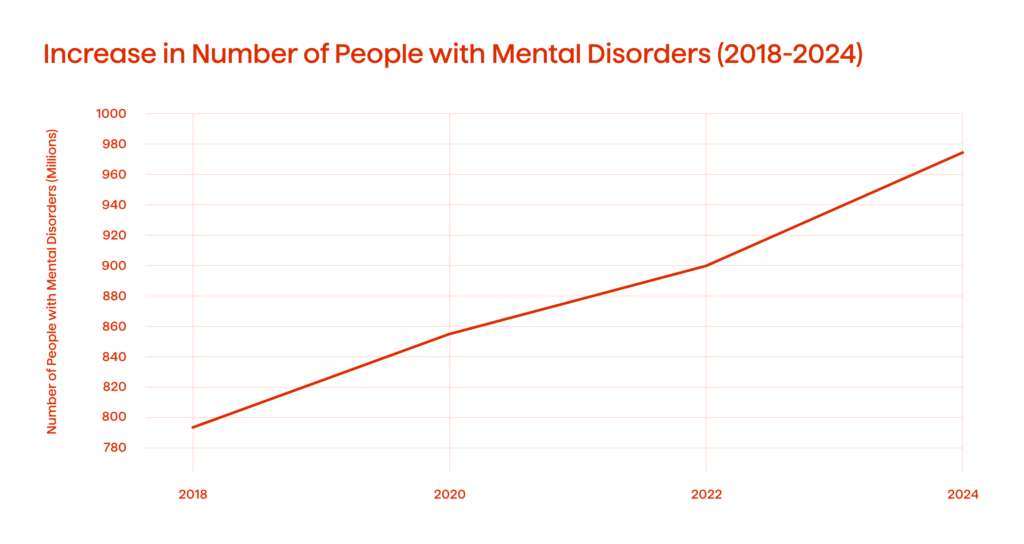
These statistics highlight the growing need for improved healthcare services that address mental health issues. There is a wide range of modern solutions emerging across the digital health ecosystem, including:
- Teletherapy Platforms: Offering remote access to counseling via video calls.
- AI Chatbots: Providing 24/7 support and coping strategies.
- Virtual Reality (VR): Used in exposure therapy for PTSD and anxiety.
- Mobile Apps: Offering tools for mindfulness, mood tracking, and cognitive behavioral therapy.
- Wearable Devices: Monitoring stress and emotional well-being.
- Precision Psychiatry: Delivering tailored treatments based on genetic data.
One of the most common trends in 2025 is addressing social determinants behind mental health issues. Studies repeatedly demonstrate that those with lower socioeconomic levels are more likely to suffer from mental health conditions like anxiety and depression. This highlights the increased emphasis on combining social support networks with mental health services in order to address underlying issues and provide fair access to care.
AR, VR, and wearables: Transforming patient engagement
What if each patient received individualized, immersive, and interactive healthcare? Wearable technologies, AR, and VR have made this possible, revolutionizing patient involvement in previously unthinkable ways.
Surgeons can now visualize more detailed anatomy during procedures, thanks to AR apps that enhance accuracy and improve outcomes. By overlaying medical data onto real-world scenarios, augmented reality helps patients better understand their diagnoses and treatment plans. This kind of medical technology is also reshaping how clinicians explain conditions, plan operations, and train new staff.
Meanwhile, virtual reality creates immersive, controlled environments that support chronic pain management, reduce pre-surgery anxiety, and aid in physical rehabilitation. As a drug-free alternative, VR therapy has been shown in multiple studies to alleviate pain by inducing relaxation.
Wearable technologies, from smartwatches to fitness trackers, provide patients with real-time insights into their heart rate, activity levels, and sleep patterns, empowering individuals to take control of their health. These devices, alongside connected medical equipment in clinics and hospitals, enable proactive health management, and the wearables market is projected to reach $69.2 billion by 2028, driven by growing demand. The volume of big data generated by these tools is what fuels the next wave of AI-driven diagnostics and personalized care. Together, these technologies go beyond medical devices; they foster deeper connections, empowering patients while improving healthcare efficiency. This, at its core, is what patient-centered care is all about.
FAQ
Capitalizing on the latest healthcare technology trends
The trends covered here share a common goal: better health outcomes for patients and more sustainable operations for providers. AI reduces diagnostic errors. Telehealth expands access to underserved populations. Strong cybersecurity preserves trust. Mental health tools meet a growing global need. Healthcare leaders who invest with clear priorities, strong governance, and a focus on measurable impact will define the next era of the industry. Want to learn more about the future of healthcare or have a project in mind? Contact Avenga, your trusted partner in healthcare technology.



Your business results matter
Achieve them with minimized risk through our bespoke innovation capabilities. Fill in the form below.