





Enhancing customer engagement in life sciences

July 31, 2026 14 min read 325 views
80% of customers believe a company’s experience is just as important as its products and services, according to Salesforce’s State of the Connected Customer survey. For life sciences organizations, creating meaningful engagement requires personalized, compliant, and connected interactions with healthcare professionals, patients, and other stakeholders.
This article explores the key elements of effective customer engagement, from evolving engagement models and CRM capabilities to AI, data analytics, and customer engagement platforms that support interactions across channels.
Understanding customer engagement in life sciences
Customer engagement refers to providing clients with exceptional experiences throughout their entire journey. A strong customer engagement strategy is central to the overall customer experience. In the highly regulated field of life sciences, trust, compliance, and value are far more important than “relationships” in customer engagement. The primary customers in life sciences — medical institutions, patients, caregivers, and healthcare professionals (HCPs) — require specialized engagement strategies.
- Healthcare professionals (HCPs). If you want to promote a medical product, service, or research, you must engage with doctors, nurses, or specialists. In an environment where HCPs anticipate evidence-based referral values for improved patient care and data for their medical decisions, the personal nature of contacts truly builds trust and education.
- Patients and caregivers. Since patients are at the heart of healthcare delivery, they require engagement tactics focused on support, education, and accessibility. Caregivers have a significant impact on patient outcomes, particularly when it comes to chronic diseases, thus their role must be taken into account for effective involvement.
- Clinics. Communication is more formal when interacting with clinics, hospitals, or research facilities; the engagement process is centered around collaboration, research projects, and the incorporation of new technology or treatment methods.
In life sciences, customer interaction extends beyond the promotion of products. It frequently entails the following:
- Education and assistance. Current, fact-based information about illnesses, treatments, and medical advancements.
- Customization. Tailored offers and communications according to information about different client segments.
- Omnichannel customer engagement. Ensuring smooth communication via social media, mobile apps, digital platforms, and in-person meetings while protecting patient privacy and legal requirements.
How has customer engagement evolved in life sciences?
Over the years, customer engagement in the life sciences has transformed from transactional to more personalized, data-driven approaches. When the sector first began, communication with customers was restricted to personal interactions featuring product advertising. As the industry grew, CRM systems became prevalent in the 1990s, helping to manage healthcare professionals’ (HCPs’) interactions and laying the foundation for relationship-based engagement.
In the 2000s, CRMs reached a new level of sophistication with the integration of social media, mobile apps, and email. This led to omnichannel engagement, which includes in-person contacts between sales and the HCPs they are assigned to. These advancements enabled businesses to provide more specialized messaging and targeted information to patients and healthcare professionals. Most importantly, the data created by CRMs offered profound insights that helped improve customer engagement and sparked a game-changing shift in customer experience.
As consumer engagement tactics advanced, regulatory requirements became stricter, introducing new compliance challenges. Regulations like the General Data Protection Regulation (GDPR) and the Health Insurance Portability and Accountability Act (HIPAA) require life sciences businesses to process customer data responsibly and safely. Therefore, to comply with these criteria, the CRM systems used in the life sciences also had to be adapted, particularly regarding patient data and physician outreach.
The increased focus on data security and privacy has given CRMs the chance to advance and optimize the engagement process while adhering to strict legal standards. These days, sophisticated CRM systems offer audit trails, encryption, and safe data storage to safeguard sensitive data.
By satisfying an increasing need for more integrated, customized, and scalable customer engagements, Customer Engagement Platforms (CEPs) have advanced significantly in comparison to standard CRM systems. While CEPs have successfully connected sales and service to offer real-time omnichannel engagement and a much broader view of customer experience management, CRMs were mostly used as a tool for storing and organizing customer data to streamline sales and service activities.
Customer engagement platforms vs. CRM systems: key differences
Modern life sciences organizations increasingly rely on both CRM systems and customer engagement platforms to manage complex stakeholder interactions. While CRM systems remain essential for customer relationship management, CEPs extend these capabilities through omnichannel communication, AI-powered insights, workflow automation, and personalized engagement.
| Capability | Traditional CRM Systems | Customer Engagement Platforms (CEPs) |
|---|---|---|
| Primary purpose | Manage customer data, accounts, and relationship activities. | Orchestrate personalized, omnichannel customer interactions across touchpoints. |
| Communication channels | Typically focused on sales and service interactions. | Integrate email, websites, mobile apps, chatbots, social media, and in-person engagement. |
| Customer insights | Provide reporting and analysis based on stored customer data. | Use AI and machine learning to analyze behavior, predict needs, and recommend actions. |
| Personalization | Support basic segmentation and targeted communication. | Enable dynamic, context-aware customer journeys with personalized content and experiences. |
| Automation | Automate predefined sales and service workflows. | Use AI-powered automation and conversational tools to manage more complex engagement processes. |
| Data visibility | Provide a centralized view of customer records and interactions. | Create a 360-degree view by connecting data across multiple customer touchpoints. |
The key differences between CEPs and CRM systems include:
- Omnichannel integrations. CEPs connect multiple communication channels, including chatbots, mobile applications, social media, email, websites, and in-person interactions, creating a consistent view of customer engagement across touchpoints. By bringing together engagement data, these platforms enable life sciences organizations to deliver more personalized experiences for healthcare providers, patients, and other stakeholders. However, many companies still struggle to meet evolving expectations, with only 28% of HCPs reporting that pharmaceutical companies’ engagement strategies effectively address their needs.
- Predictability of insights and real-time analysis. CEPs use AI and machine learning to analyze customer behavior in real time, allowing businesses to take the best possible actions. These actions include anticipating needs, tracking behaviors, and sending offers or personalized content.
- Personalized customer journeys. CEPs provide dynamic, context-aware consumer journeys by utilizing customer data to create highly customized experiences. This enables companies to interact with clients by presenting them with offers, communications, and material tailored to their tastes, habits, and past purchases.
- Automation workflows. CEPs make use of AI to automate repetitive processes and interactions. Conversational automation provides a smooth human touch, decreases manual labor, and improves customer satisfaction and process efficiency.
- Agentic AI. CEPs receive an advanced layer with agentic AI. The system acts autonomously to deconstruct complex tasks like HCP targeting, territory planning, and patient support. These intelligent agents go beyond traditional automation. They make real-time decisions, learn from data, and adapt fast.
- Sentiment and behavior analysis. CEPs use sentiment analysis and behavior tracking, providing a business with more customer insights like preferences and emotions. This information makes it possible to make better decisions and use proactive engagement tactics.
- 360-degree customer view. CEPs offer a cohesive picture of consumer interactions by extracting information from all touchpoints. This makes it possible for companies to provide a more responsive, individualized experience while guaranteeing uniformity in service and communication.
Best practices for effective life sciences engagement
Effective life sciences engagement requires more than the right technology. Organizations also need strategies that combine personalized communication, regulatory compliance, data-driven insights, and ongoing support for hcps, patients, and other stakeholders.
Providing the experiences and goods that customers want
Real-world evidence (RWE) obtained from post-marketing surveillance can be used by life sciences companies to improve their products and meet actual clinical demands. The most up-to-date research findings, legal compliance, and optimal patient care practices are guaranteed when key opinion leaders (KOLs) and medical advisory boards collaborate.
Ensuring a consistent brand’s voice
Having consistent brand messaging across all channels helps build trust with patients, doctors, and other stakeholders. It may be possible to verify the legitimacy and trustworthiness of brand communications by testing communication strategies against target audiences, such as patient advocacy or medical focus groups.
Prioritizing the onboarding of customers
Physician and patient adoption is facilitated by providing open, freely accessible information, such as websites with instructional resources, usage guidelines, and trial results. Setting up follow-up sessions via email or telemedicine guarantees that any early concerns are addressed, which promotes confidence in the good or service.
Creating positive incentives
Life sciences firms can encourage healthcare professionals to create a closer relationship with their brand by creating personalized loyalty programs or offering continuing medical education (CME) credits for extended involvement. Progress tracking and goal-setting tools give patients a sense of achievement and encourage ongoing engagement.
Contact centers for customer support
Advanced AI-driven triage solutions that assign medical science liaisons and expert staff to address in-depth questions enable a more effective and individualized support experience. It is also possible to track engagement history and follow-up activity by consolidating consumer interactions into a single platform.
Becoming a data-first organization
Accurate insight into customer behavior and treatment outcomes is developed by integrating data from clinical trials, CRM systems, and electronic health records (EHRs) into compliant analytics centers. Teams that receive data governance training are also more likely to make wise decisions and act proactively.
Targeted outsourcing
Businesses can outsource low-risk services like pharmacovigilance or patient support by collaborating with seasoned contract research organizations (CROs) and outside vendors with sound compliance frameworks. Well-defined KPIs help monitor service quality and regulatory compliance.
Why a fit-for-purpose customer engagement strategy matters in life sciences
Effective customer engagement helps life sciences organizations build trust, strengthen relationships with healthcare professionals (HCPs) and patients, and deliver more personalized experiences throughout the healthcare journey. By combining relevant communication, data-driven insights, and compliant engagement models, companies can improve stakeholder experiences while supporting better business and patient outcomes.
The importance of these strategies continues to grow, with Deloitte’s Life Sciences and Health Care Industry Insights Report highlighting customer engagement as a significant priority for biopharma executives, with 32% identifying engagement needs as an area requiring attention and investment.
Reason #1. Increased authenticity of the brand
Life sciences businesses are seen as trustworthy partners for improving healthcare when they interact with patients and healthcare professionals (HCPs) on a regular and transparent basis. Through the provision of accurate medical information, proactive assistance, and open communication, businesses may build trust, strengthen their brand image, and foster patient and clinical stakeholder loyalty.
Reason #2. Valuable real-world evidence (RWE)
In routine clinical practice, active consumers—whether HCPs or end users—provide insightful data on product performance. This data makes evidence-based marketing easier, streamlines trial designs, and supports product improvements. Companies have access to a wealth of RWE that helps them make better judgments and increase the clinical validity of their goods.
Reason #3. Quick product adoption
Effective customer interaction builds up the visibility of new therapies, allowing life sciences businesses to bridge the gap between regulatory approval and market uptake. Pre-emptive learning, extensive onboarding, and peer-to-peer endorsements can hasten uptake among HCPs and patients, ultimately driving adoption and establishing the therapy as a trusted solution.
Reason #4. Improved patient compliance
Strategic engagement goes beyond first-time prescribing to continued support throughout the treatment life cycle. With educational materials, digital solutions, and follow-up reminders, life sciences companies can overcome barriers to adherence, ensure proper use, and enhance treatment outcomes. Increased adherence also enables better real-world data and evidence of product benefit.
Reason #5. Collaborative opportunities with key opinion leaders (KOLs)
Partnerships with influential healthcare opinion leaders are essential to the development of new therapies, clinical guideline establishment, and best practice promotion. Early engagement with KOLs builds deep clinical insight and can speed the deployment of new medicines through healthcare systems, driving brand awareness and professional endorsement.
Reason #6. Increased competitive differentiation
Healthcare businesses that focus on meaningful engagement commit to improving customer service and provider experience—a unique competitive advantage in a saturated market. By repeated provision of relevant, evidence-based knowledge and personalized support, they stand out from the rest, build long-term relationships, and become go-to destinations for innovative healthcare solutions.
How do life sciences companies use technology for customer engagement?
Life sciences companies use customer engagement technology to unify data, personalize interactions, and deliver compliant, omnichannel experiences for healthcare professionals (HCPs), patients, and other stakeholders.
Customer Engagement Platforms (CEPs) achieve this by integrating data, analytics, and compliance functionality into one platform, allowing organizations to engage with all stakeholders in real-time, evidence-based dialogue.
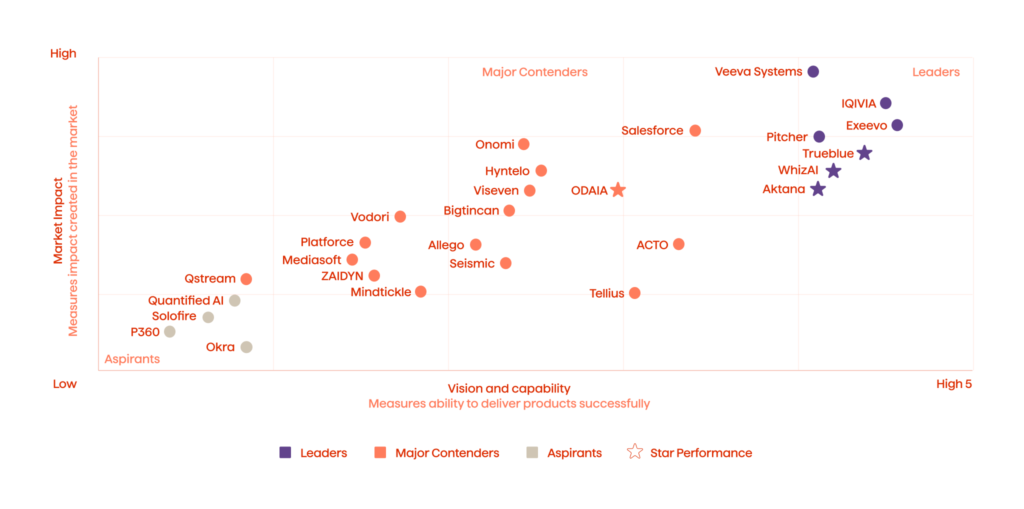
A look at players in the market — Veeva, IQVIA, Exeevo, Pitcher, Trueblue, WhizAI, and Aktana — is a reflection of how advanced platforms can orchestrate omnichannel customer communications with regulatory-compliant supervision. These solutions integrate patient data, prescribing data, and engagement metrics, allowing them to tailor messages for specific HCPs or patient segments. By offering clinical support, education, and care management programs, life sciences companies can strengthen their role in healthcare and enhance customer trust.
Salesforce, a top enterprise software player, has also gained traction with life sciences. In addition to its very public CRM capabilities, Salesforce provides AI-driven insights, marketing automation, and real-time reporting tailored specifically for healthcare use. This enables companies to stay agile, streamline outreach, and react to evolving HCP and patient needs.
Notably, Salesforce is preparing to launch its Life Sciences Cloud for Customer Engagement. It is a specialized solution designed to unify data, personalize outreach, and accelerate engagement strategies. Salesforce will make it work across clinical, medical, and commercial functions. The platform marks a significant step forward in the way life sciences companies orchestrate omnichannel engagement while staying fully compliant.
FAQ
How can technology support long-term customer engagement in life sciences?
Technology enables life sciences organizations to create personalized, data-driven engagement models that improve interactions with healthcare professionals (HCPs), patients, and other stakeholders. By connecting customer data, analytics, and communication channels, organizations can deliver more relevant experiences, gather actionable insights, and support engagement at scale.
Accenture’s healthcare loyalty research highlights the importance of consistent engagement throughout the customer journey, showing that only 65% of patients say they will definitely stay with their healthcare provider. The research also found that loyalty is strongly influenced by the quality of interactions patients receive, emphasizing the need for more personalized customer engagement across healthcare services.
Through continuous feedback collection and analysis, life sciences companies can refine everything from clinical trial designs to patient support programs, ensuring their offerings remain aligned with evolving stakeholder needs. Technologies such as customer engagement platforms, AI-powered analytics, and solutions that unify enterprise data help commercial and medical teams gain actionable insights and deliver more coordinated engagement with healthcare professionals and patients.
To support high levels of engagement, organizations need more than just a strategy — they need the right technology foundation. Avenga helps life sciences companies implement and optimize engagement solutions that support compliant communication, scalable data management, and more effective commercial engagement.
With expertise across data, AI, and enterprise platforms, Avenga supports life sciences organizations in creating scalable engagement solutions tailored to their commercial, medical, and patient needs.


Your business results matter
Achieve them with minimized risk through our bespoke innovation capabilities. Fill in the form below.