







Top 10 healthcare technology trends in 2027


October 23, 2026 10 min read 546 views
The priority for healthcare leaders in 2027 is connecting AI, patient data, and care delivery without weakening clinical accountability. The top healthcare technology trends include AI-assisted workflows, remote patient monitoring, interoperable systems, cybersecurity, and automation. These investments can improve patient care when their performance is tested in the intended setting, their limitations are understood, and healthcare professionals remain responsible for clinical decisions.
This guide examines 10 healthcare technology trends and the practical decisions behind adoption. It separates established capabilities from emerging technologies that still need careful evaluation. Avenga’s healthcare and life sciences services support the software, integration, and operating foundations needed to turn a promising idea into a dependable service.
Key takeaways: The top three trends in healthcare
Three priorities connect the trends for 2027: clinically appropriate AI, connected care, and dependable healthcare operations. A healthcare organization should evaluate them together because a faster task has limited value if it produces unreliable information or transfers more work to another team.
- Define the intended use, baseline performance, and accountable owner before selecting a technology.
- Connect digital health tools to clinical systems, escalation pathways, and patient support.
- Treat privacy, cybersecurity, accessibility, and interoperability as delivery requirements.
- Scale only after evidence shows that the service works for its intended users and setting.
How artificial intelligence and agentic AI are changing healthcare
AI in healthcare supports tasks such as summarizing records, assisting image review, and preparing documentation for clinician approval. AI technology can also introduce omissions, false statements, and performance differences between populations. The FDA’s 2025 draft guidance proposes a lifecycle approach to AI-enabled device software. It remains draft guidance, not a blanket authorization or guarantee of safety for individual products.
In modern healthcare, an AI system that flags medical images needs evaluation against its specific task and population. Test false positives, missed findings, image quality, and the time needed to review outputs. Document how medical data enters the system and how clinicians challenge a result. This approach helps the healthcare industry distinguish useful assistance from an emerging healthcare technology that is not ready for the intended setting.
For agentic systems, separate drafting from actions such as changing a medical record, sending a message, or scheduling a follow-up. Give each action a permission boundary, audit trail, and human approval point where risk warrants it. Avenga’s AI services connect use-case design with integration, evaluation, and monitoring, helping teams assess artificial intelligence in healthcare against a defined operational need.
How telehealth and remote patient monitoring shape patient care
Telehealth enables care interactions at a distance, while remote patient monitoring collects and shares measurements outside a traditional appointment. HHS’s remote monitoring guidance describes it as asynchronous telehealth and explains the roles of patients and providers. A healthcare provider still needs a review schedule, escalation criteria, and a way to respond when readings are missing or concerning.
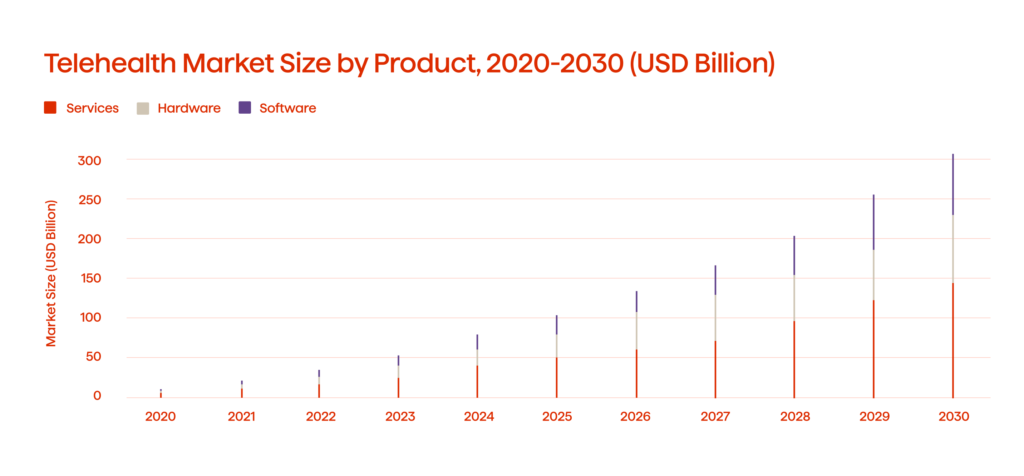
Design the service around clinical suitability and patient access rather than assuming every visit can move online. Healthcare workers need to know who reviews incoming data, when an in-person assessment is required, and what patients should expect outside staffed hours. Evaluate device setup, digital literacy, language needs, and connectivity alongside appointment availability before expanding the service.
How wearables and connected devices are used in healthcare
Wearable technology and the Internet of Medical Things connect measurements from smart devices with a wider care pathway. A consumer activity tracker is not interchangeable with a medical device intended for clinical decisions. Healthcare facilities should check intended use, measurement quality, usability, and integration requirements before connecting devices to clinical systems. Medical staff also need a plan for false alerts, battery failures, and lost connectivity.
How healthcare technology supports data security and interoperability
Interoperability lets healthcare systems exchange information in a form teams can actually use. A 2024 federal brief found that 43% of U.S. non-federal acute care hospitals routinely engaged in all four exchange domains in 2023: sending, receiving, finding, and integrating data. This historical baseline illustrates why exchanging a file is not the same as making information usable at the point of care.
Connected healthcare requires consistent patient matching, shared terminology, access controls, and traceable transformations between electronic health records and other healthcare applications. Blockchain technology does not resolve those problems by itself and is not a prerequisite for interoperability. Avenga’s data services support data engineering and governance so medical histories, laboratory results, and healthcare information retain their meaning across organizational boundaries.
Cybersecurity and secure healthcare technology
Cybersecurity protects service availability as well as confidential medical information. The FDA’s 2027 cybersecurity guidance covers device design, labeling, and premarket documentation for devices with cybersecurity risk. It supersedes the June 2025 version, but its device-specific recommendations should not be confused with a complete security framework for every hospital system.
For the wider healthcare environment, maintain asset inventories, restrict privileged access, test recovery, and assign responsibility for supplier vulnerabilities. Protect healthcare data through its collection, use, exchange, and retention, including data sent to AI services. Avenga’s cybersecurity services can support risk assessment and operational protection as connected medical equipment and cloud systems expand the attack surface.
Connect healthcare software, data, and AI around clinical responsibilities, secure integration, and measurable service goals.
How robotics and automation are changing healthcare delivery
Robotics and automation in healthcare cover different tasks, from moving supplies to supporting a clinician’s work. Administrative automation can route requests or reconcile information, while a clinical robotic system has a different risk profile and training requirement. Evaluate each application on its intended task rather than treating automation as a single capability. Healthcare practitioners need clear override procedures and a safe fallback when systems stop working.
Healthcare analytics and personalized healthcare
Healthcare analytics can combine clinical and operational signals to support planning and more individualized services. Useful applications in healthcare depend on data quality, appropriate population comparisons, and transparent limitations. A predictive score is not a diagnosis, and associations do not establish which treatment will help a particular person. Check whether the model remains valid across sites, patient groups, and changes in care practice before using it to influence decisions.
Digital therapeutics and mental health services
Digital therapeutics and remote mental health services need product-specific evidence and appropriate professional oversight. WHO’s 2025 mental-health update reports that more than one billion people live with a mental health condition, while many lack adequate care. That need does not establish that every app is effective. Healthcare services should assess clinical evidence, privacy, accessibility, escalation, and integration with existing support before adoption.
AR and VR applications in digital healthcare
Augmented and virtual reality create options for simulation, training, and patient education. Healthcare professionals can assess whether a particular application makes anatomy or a procedure easier to explain, but clinical benefit requires separate evidence. For medical facilities, evaluate equipment hygiene, accessibility, user discomfort, training time, and compatibility with existing systems. Avoid presenting immersive experiences as a replacement for professional assessment or an established treatment simply because they are engaging.
Digital twins and emerging technologies in healthcare systems
A digital twin is a model linked to observations about a physical system, such as a facility, device, or biological process. In healthcare management, simulation may help teams explore capacity or test operating scenarios before changing a real service. Patient-specific models require additional validation and should not be assumed to predict an individual’s response reliably. Match model complexity, update frequency, and validation evidence to the decision it will inform.
Challenges limiting adoption of healthcare technology trends
The main adoption barriers are fragmented systems, constrained budgets, workforce capacity, security risk, and unequal access. Technology in healthcare needs a workable service model as well as functioning software. Connectivity choices, including 5G technology, should follow coverage and resilience requirements rather than marketing claims. Improving healthcare also means considering device lifespan, maintenance, energy use, and whether a simpler solution would meet the same need.
The healthcare sector should compare proposed health technologies with the existing service, including total healthcare costs and staff effort. A global healthcare forecast does not show whether a local deployment will enhance patient care or fit its healthcare ecosystem. For each option, estimate integration, support, training, and replacement costs, then compare those assumptions with pilot results before committing to a wider purchase.
| Investment | Evidence to request | Measure in a pilot |
| Clinical AI | Intended-use evaluation and subgroup testing | Errors, review time, and override rates |
| Remote monitoring | Device suitability and staffed escalation pathway | Missing readings and response time |
| Data integration | Patient-matching and terminology checks | Reconciliation effort and data completeness |
| Operational automation | Exception handling and fallback tests | Completed tasks and correction workload |
Set a baseline before the pilot and count the work transferred to other teams, not just the time saved in one task. Healthcare organizations should assess total ownership costs, patient experience, and outcomes appropriate to the use case. Include healthcare professionals, patients, security teams, and procurement early, then document the conditions that would justify scaling, redesigning, or stopping the investment.
Healthcare technology should make a defined part of care easier to deliver without making responsibility harder to understand. Start with the clinical and operational need, connect the right data, and test the service with the people who will depend on it.
Hansa Andersson, Global Head of Healthcare and Life Sciences at Avenga
FAQ
Conclusion: Planning for the future of healthcare technology
The latest healthcare technology trends matter when they help organizations deliver dependable, accessible care. Prioritize a defined need, test the evidence, and build the data and operating controls required to sustain the service. To evaluate your next software, AI, or integration investment against practical healthcare requirements, Contact Avenga and define a suitable starting point.



Your business results matter
Achieve them with minimized risk through our bespoke innovation capabilities. Fill in the form below.