






OSS and BSS market: building next generation telecom networks

July 2, 2026 9 min read 451 views
A customer signs up for a new mobile plan expecting it to work within minutes. What seems like a simple request actually triggers a long chain of tasks. Product catalogs, order management systems, provisioning platforms, network inventories, charging systems, customer databases – all have to exchange information before the service can even be activated.
That coordination has become far more difficult as telecom networks have grown more complex. Even routine changes, such as updating a price plan, processing a service order, or modifying the network can affect multiple commercial and operational systems before customers see the outcome. It’s no wonder that in many modernization projects, the biggest challenge isn’t replacing individual platforms – it’s keeping information consistent as it moves between them.
OSS and BSS are often discussed as separate systems, but they rarely operate that way in practice. Every new service, pricing change, or customer request depends on information moving reliably between them. That’s also why modernization efforts increasingly focus on the connection between the two rather than on either system in isolation.
OSS and BSS: what’s the difference?
Every telecom service begins as a business request. Once a new order enters the system, the work splits into two very different worlds.
The customer interactions happen inside the Business Support System (BSS). It’s where operators manage any commercial processes such as customer accounts, product offers, or billing before any changes are made to the network.
Turning that request into a working service is the responsibility of Operational Support Systems (OSS). They provision network resources, activate services, monitor performance, and help keep the network running once the customer is connected.
Returning to our customer ordering a mobile plan: BSS records the purchase and confirms what the customer should receive. OSS will pick up the request, configure the network, and activate the service. From that point on, the service is ready to use.
Many operators use TM Forum Open APIs and Open Digital Architecture (ODA) to avoid building custom integrations between every system.
Here’s how those responsibilities are typically divided across the telecom service lifecycle.
| Phase | BSS Responsibilities | OSS Responsibilities |
| Product definition | Define product catalog, pricing models | Map services to technical capabilities and network resources |
| Customer onboarding | Order entry, eligibility checks, credit validation | Service provisioning, resource allocation |
| Service activation | Trigger activation workflow | Configure network, activate elements, assign IP, QoS, etc. |
| Ongoing usage | Usage metering, charging, billing | Collect usage data, monitor performance |
| Fault & assurance | Notify users, offer compensation | Fault detection, ticketing, resolution, SLA monitoring |
| Customer care | CRM, helpdesk, plan changes, complaints | Network diagnostics, service validation tools |
Traditionally, OSS BSS solutions were deployed as large, on-premises systems that changed slowly over time. Today, many operators introduce cloud-based capabilities alongside those existing platforms. Instead of replacing entire systems, they can update individual services, integrate new applications more easily, and scale network capacity as demand grows.
This gradual shift makes it easier to introduce new services, simplify operations, support broader digital transformation initiatives across the telecom industry – and thus, enhance customer experience. That flexibility has become one of the main reasons for the industry’s shift toward cloud computing.
Cloud OSS BSS market trends driving modernization
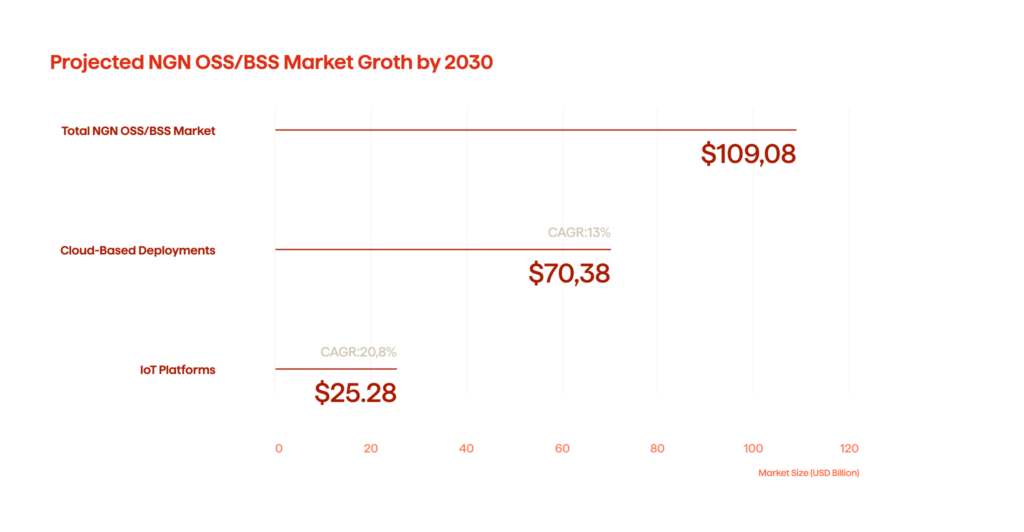
The OSS and BSS industry has grown significantly over the past decade. Growth is being driven by cloud adoption, 5G rollout, AI-supported operations, and continued investment in digital transformation across the telecom industry. Industry forecasts also expect the global OSS BSS market size to continue expanding, particularly for cloud deployments and next-generation platforms.
This market growth reflects a broader shift toward cloud and integrated OSS BSS solutions rather than large-scale platform replacement. With a 13% compound annual growth rate, cloud-based deployments will account for 64.5% of the market. With a 20.8% CAGR, IoT platforms alone will reach $25.2 billion.
Telecom operators rarely modernize their OSS BSS systems because the existing platforms suddenly stop working. Legacy OSS BSS rarely fail overnight. Instead, they become progressively harder to adapt as networks grow more complex and new services are introduced.
Services have become more distributed. Launching a new one often means coordinating far more systems than it did a few years ago. Information has to stay consistent across commercial and operational platforms before anything reaches the customer.
Cloud OSS BSS solutions make that transition easier because operators can modernize individual services instead of replacing entire environments. They also simplify integration with cloud service providers, allowing existing network operations to continue without major disruption.
While individual market analyses differ, they consistently identify cloud-based OSS BSS platforms, network automation, and AI-supported operations as the fastest-growing areas of investment during the forecast period.
Challenges shaping the OSS BSS market
Modernizing OSS and BSS platforms is crucial for telecom operators looking to remain viable in a hyperconnected, low-latency infrastructure era. However, moving from legacy, monolithic platforms to future-focused, cloud-native stacks presents many different technical and operational challenges.
Most OSS BSS adoption projects don’t become difficult because of a single technical decision. Complexity builds over time. Every customization or workaround that solved yesterday’s problem becomes another dependency when operators try to modernize today.
Only few telecom market players begin modernization with a clean environment. Legacy platforms continue running because they still support critical services, while newer applications are introduced alongside them. For long periods, both environments have to exchange information reliably, even though they were never designed to work together.
Few telecom operators rely on a single OSS BSS platform. Enterprise environments often combine solutions from vendors such as Amdocs, Netcracker, or Whale Cloud alongside internally developed applications. As a result, modernization projects focus as much on integrating existing OSS and BSS platforms as they do on replacing individual systems.
The challenge grows as more services are added. The same customer or service is often represented differently across multiple systems. Once those records stop matching, even routine tasks become harder to automate and operational teams spend more time fixing inconsistencies than delivering new services.
Engineers often find themselves supporting legacy platforms while learning entirely new ways of deploying and operating services. Cloud-native operations, automation, and continuous delivery require different skills from the systems many telecom teams have supported for years. Modernization succeeds much more often when teams adapt alongside the technology rather than after it has already changed.
Throughout all of this, customer services still have to remain available. That’s why most modernization programs happen in stages rather than through a single large migration.
Planning your OSS BSS modernization journey? See how Avenga can help you with complex technology environments.
Modernizing OSS for better network operations
Modern networks generate far more operational information than they did a few years ago. Every service activation, configuration change, performance event, and network fault creates data that has to be interpreted before operators can respond.
Imagine a network alarm appearing just after a new service has been activated. Before engineers can fix the problem, they first need to confirm which systems reflect the current network state. When inventory records, provisioning data, and monitoring tools disagree, finding the cause often takes longer than resolving the fault itself.
Modernizing OSS is largely about removing that uncertainty. When operational information stays consistent, engineers spend less time comparing systems and more time solving the actual problem. Many operators also introduce advanced capabilities such as machine learning in OSS for anomaly detection and predictive maintenance, although these approaches still depend on reliable operational data.
Only after teams trust the underlying data does automation become genuinely useful. Otherwise, automated workflows simply repeat the same inconsistencies that engineers have been working around for years. Further, faster fault resolution ultimately improves customer experience by reducing service interruptions.
For many operators, the decision to modernize OSS solutions comes after existing operational processes become difficult to scale. Better visibility and faster provisioning are often the first improvements teams notice.
Modernizing BSS for faster commercial changes
Launching a new telecom offer is rarely just a marketing decision. Before customers can buy it, pricing, billing, product catalogs, customer accounts, and order management all have to reflect the same change.
Something as simple as introducing a new pricing plan can require updates in several systems before customers ever see it. The more manual coordination involved, the longer it takes to launch the offer. Shorter release cycles also make it easier to improve customer experience, because new offers, pricing updates, and service changes reach customers more quickly.
Modernizing business support systems reduces much of that complexity. Commercial teams can introduce new offers more quickly because pricing, billing, and customer management become easier to update without changing the entire platform. Faster releases also help improve customer experience, since customers gain access to new products and service changes sooner.
Billing is often the last system operators want to change. Even small updates can affect invoices, revenue, and other connected processes, so most teams introduce changes gradually instead of replacing everything at once.
The goal isn’t simply to introduce new products faster. Commercial changes shouldn’t create new operational problems.
FAQ
Building the future of OSS and BSS
Modernizing telecom systems is rarely about replacing a single platform. The biggest improvements usually happen when information moves reliably between both environments.
Customers rarely notice when OSS and BSS work well. They only notice when something doesn’t.
If you’re planning to modernize your OSS and BSS environments, Avenga helps telecom operators integrate legacy and cloud-based platforms without disrupting existing services.



Your business results matter
Achieve them with minimized risk through our bespoke innovation capabilities. Fill in the form below.