







Retail supply chain management: Mastering retail supply chains with Avenga

July 9, 2026 12 min read 317 views
Retail supply chain management practices used to be measured by how efficiently goods moved from supplier to shelf. That model no longer matches how the industry works. Customers now expect products to be available across channels, delivered faster, returned easily, and priced competitively, even when demand shifts overnight. To meet customer demand without locking capital into excess stock, retailers need tighter inventory management, smarter logistics, and more connected warehouse management.
With the right technology partner, the flow of goods becomes more predictable, responsive, and scalable — not just an operational process, but a source of successful retail performance. Supply chain resilience is only half the equation, customers also judge retailers on the experience around delivery, returns, and service. Read Avenga’s take on differentiating through retail customer experience in 2026 for the other side of that equation.
Supply chain management in retail: Key takeaways
- The importance of supply chain modernization is no longer limited to cost reduction. Retailers need resilience, speed, and visibility to meet customer expectations in a volatile market.
- A smarter approach to supply chain management systems integrates forecasting, production, warehousing, and delivery rather than treating each function as a separate process.
- Strong logistics operations depend on real-time data, flexible carrier networks, automation, and the ability to adapt at every stage of the supply chain.
- Tools such as AI forecasting, digital twins, robotics, and inventory management software help retailers reduce stockouts, improve planning, and build a more effective supply chain management strategy.
Supply chain disruption landscape
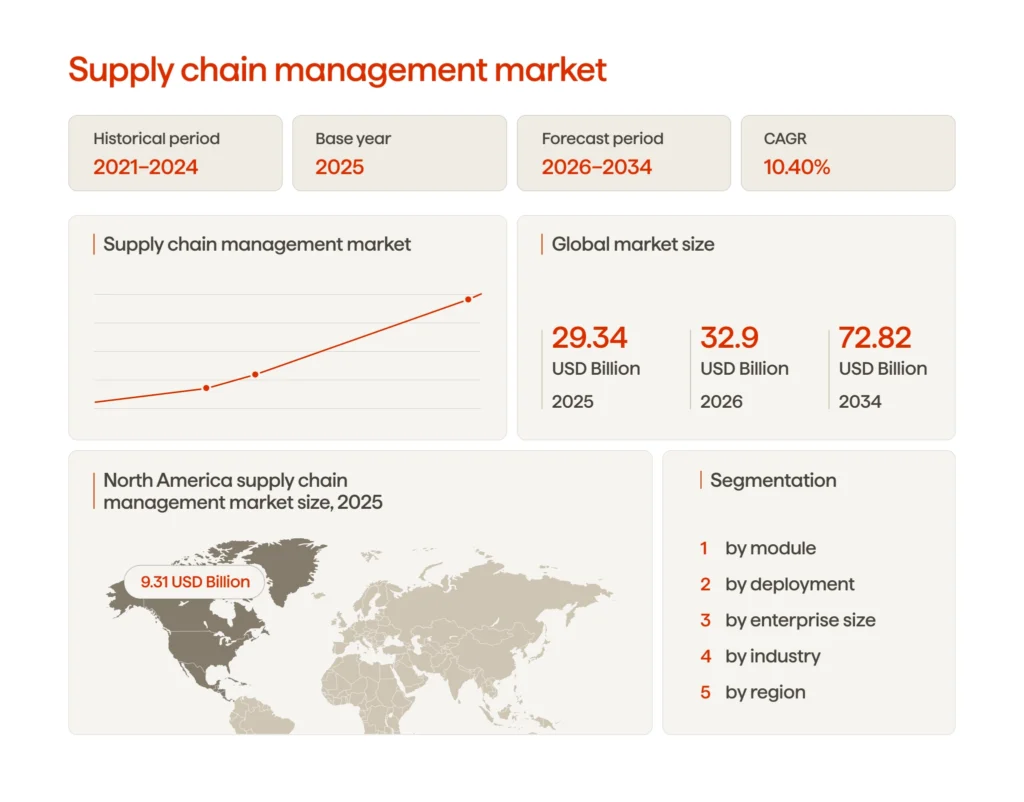
Volatile supply chains are no longer viewed as a phenomenon. They now make up the entire planning cycle for the retail industry. They impact purchasing decisions, inventory management, logistics activities, product warehousing, and the flow of products through the system. Supply chain technology investment is increasing at an accelerating rate. Based on 2025 estimates, it is expected to increase from USD 32.9 billion in 2026 to USD 72.82 billion in 2034. The global supply chain management industry’s projected value in 2025 was USD 29.34 billion.
Retailers now see efficiency as just one piece of the process of moving products through the supply chain. They must have supply chains capable of absorbing disruptions and meeting customer demand while maintaining profitability when any factors change.
Nearshoring, regionalization, and supplier diversification
Nearshoring is an effective way for retailers to mitigate long lead times, uncertain transportation pricing, and reliance upon distant sourcing markets. Retailers can shorten perceived lead times, react quickly to demand fluctuations, and reduce risks associated with global shipping delays by relocating production/sourcing to be near their largest customer markets.
The concept of regionalization moves away from a single supply chain framework, using regionalized networks that operate as independent entities, thereby providing a level of security across all aspects of their supply chain, including but not limited to sourcing, production, distribution, and final delivery of goods. When one region experiences a supply chain interruption, other regions can meet local market demand with shorter lead times.
Diverse suppliers enhance resilience for a majority of retailers, as they are heavily dependent on one (or even two) suppliers, markets, or transport routes, leaving them with less flexibility in the event of disruption. Having diverse suppliers adds flexibility to the supply chain, but it requires greater visibility, better data management, and higher levels of automation. Unless supply chain systems work cohesively, diversification can create increased complexity.
Manufacturing 4.0 and AI-driven forecasting
Manufacturing 4.0 is a new methodology for making production systems smarter by using connected networks of computer-controlled machines, real-time data, and automated processes. Companies now understand the relationship between all components in the manufacturing process rather than looking at any of them in isolation. Decisions are made based on current customer demand, available capacity in each part of the supply chain, current inventory levels at each location, and operational data from each part.
Using AI forecasting adds another aspect to this model. It helps retailers know how many, where, and when their products will be used to meet future needs. Slow responses are not tolerated in modern retail. Having any of these situations can put a lot of pressure on the supply chain if demand increases unexpectedly, goods do not arrive on time, or stock levels are uneven.
A fashion retail company could also rely on artificial intelligence to analyze upcoming weather conditions and learn that a certain type of jacket will sell more in the northern regions of the United States.
A grocery store chain can use its data analytics tools to project the increased demand for grocery items on holidays or weekends. Lastly, a home improvement retailer could use AI to predict increased demand for particular tools after regional weather events. In each case, supply chain automation helps translate these signals into production, replenishment, and allocation decisions.
| Area | Traditional approach | AI-driven Manufacturing 4.0 approach |
| Demand planning | Based mainly on past sales | Uses real-time and external data signals |
| Production | Fixed production schedules | Adjusts output based on forecasted demand |
| Inventory | Higher safety stock | Smarter inventory management by location |
| Supplier planning | Reactive ordering | Earlier visibility into material needs |
| Retail operations | Store-by-store decisions | Connected planning across channels |
Connecting demand forecasts with production cycles
The tremendous benefit of AI-based forecasting lies in its interaction with the production cycle. Simply providing a view of forecasted demand on a dashboard does not benefit either retailer or manufacturer. They need insight from the forecast to adjust procurement and production quantities, labor planning, warehouse capacity, and delivery planning.
For example, when an AI forecast indicates increased future demand for a product category in two locations, manufacturers can proactively ramp up production; suppliers can begin gathering materials; and warehouses can begin allocating space in anticipation of increased demand. This optimizes a company’s supply chain by linking production to the actual demand signal rather than to a prediction based on variables.
Managing the supply chain in this manner will also help to reduce waste. Retailers will not have to overproduce slow-moving items, and also won’t run out of stock for items that are growing in demand. This helps protect margins directly in industries with short product lifecycles, e.g., fashion, electronics, and seasonal goods.
Manufacturing 4.0 is changing how businesses use forecasting as a planning function versus an operational trigger. When all the systems are connected, a change in demand will instantly update the manufacturing schedule and the replenishment plan and automatically make logistics decisions.
Digital twins for scenario planning
Digital Twins can create virtual representations of any physical assets, processes, and supply chain members. Connections between data coming from different sources, such as actuators, IoT devices, ERP solutions, warehouse software, logistics software, and other relevant data sources, can be built, bringing together vital information regarding the performance of businesses in the retail and manufacturing sectors. The utility of Digital Twins as a more secure way to test decisions before any human intervention stems from the sheer complexity of modern supply chain operations.
The strength of the business case continues to grow. The digital twin market is expected to hit $149.8 billion by 2030. More than 42% of executives across a wide range of industry verticals are aware of the advantages of digital twinning, and 59% plan to integrate it into their operations by 2028. Retailers can demonstrate clear value in this area: improved forecasting, decreased delays, improved collaboration and coordination, and enhanced ability to mitigate disruption.
Testing on live equipment is slow and risky. We build digital twins that simulate machinery and production lines to shorten development cycles and improve accuracy.
What-if modeling and risk visibility
Conventional planning relies on historical data, which do not account for changes in demand, shipment delays, or unexpected transportation expenses. Digital twin technology enables retailers to experiment with the implications of such disruptions before they affect the supply network. Building and testing these simulations requires deep product engineering expertise. Avenga’s product engineering team builds the digital twin and simulation capabilities that make this kind of scenario planning possible.
For instance, modeling helps businesses see what happens if product demand in a region increases by 30%, if one of their suppliers fails to supply them, or if their central store becomes oversaturated during the peak purchasing season.
Improved visibility into risk enables more proactive actions. Having the ability to identify potential disruptions in advance allows teams to develop and evaluate options such as:
- switching suppliers,
- reallocating stock,
- increasing safety stock,
- changing delivery routes,
- and/or modifying production plans before the event occurs.
Warehouse and last-mile innovation
In the retail supply chain, warehouse and last-mile operations are critical to meeting delivery promises. Retailers can have strong demand forecasting and inventory management. Still, if the product is held in the wrong location and they lack sufficient capacity to deliver during peak periods, shortages can disrupt their supply and degrade the customer experience. Warehouse and last-mile innovation only pays off if the fulfillment layer on top is equally connected. See Avenga’s complete guide to omnichannel fulfillment for how retailers unify inventory, routing, and order promises across channels.
There is a major demand for supply chain innovation due to customer expectations for quick delivery, reliable availability, and flexible fulfillment channels in urban environments. Warehouses were historically created to support large quantities of inventory. Modern retail needs a supply chain that can adapt to smaller order sizes, faster delivery windows, seasonal spikes, and sudden demand shifts.
Robotics, micro-fulfillment, dark stores, and elastic delivery networks
The use of robotics enables warehouses to achieve higher throughput with less human intervention. This is due to the greater accuracy and fewer delays associated with robot-assisted picking, sorting, packing, and moving goods in warehouses. Several important metrics also become available through these robotic systems, such as picking speed, order accuracy, inventory transportation costs, and warehouse space utilization.
Micro-fulfillment centers provide inventory to customers near their locations, allowing retailers to develop and place small, compact fulfillment centers in high-demand areas rather than relying solely on traditional large regional warehouses for shipping products. By implementing micro-fulfillment centers, retailers can significantly reduce delivery distances, increase product availability, and improve overall replenishment speed for both online and in-store orders.
Unlike traditional retail, where customers shop in physical stores, dark stores focus entirely on receiving and fulfilling customers’ online orders, operating like warehouses or fulfillment centers. Dark stores are used by companies in the grocery, pharmacy, and quick-commerce businesses to make their local inventory management faster and more precise. Since dark stores don’t need to serve customers in physical locations, they can optimize their warehouse space for order picking and repacking.
Flexible last-mile delivery options are much more accessible thanks to elastic delivery networks. Retailers can use their own internal fleet or third-party carrier, as well as other delivery methods based on demand, location, and price. As a result, retailers can provide much faster deliveries and more adaptable supply chain solutions that allow for expansion or contraction while minimizing strain on gym operations.
FAQ
Conclusion: From cost center to growth catalyst
A modern supply chain for the retail industry is not simply focused on speeding up the movement of products; it is also about designing a business operating model that can sense and respond to changes before they affect customers. By using AI forecasting, digital twins, automated warehousing, and flexible logistics, retailers can improve the overall supply chain performance while maintaining their margins. From forecasting to last-mile delivery, Avenga’s retail technology services support every stage of the modern supply chain.
Regardless of whether these retail supply chains are run in-house or outsourced to third-party logistics providers, effective supply chain management also helps deliver increased efficiency, speed, resilience, and reliability for retailers.
Want to learn more about managing the retail supply chain challenges? Contact Avenga, your trusted supply chain success partner.


Your business results matter
Achieve them with minimized risk through our bespoke innovation capabilities. Fill in the form below.