







Top software testing trends for 2026: AI and the future of software testing


July 10, 2026 14 min read 606 views
Software quality is an asset that cannot be overlooked in 2026, as it directly affects whether your customers have a positive or negative experience. Modern delivery cannot function without QA and software testing.
Brands that deliver outstanding customer experiences generate 5.7 times more revenue than those that don’t. This highlights why modern software development cannot function effectively without software testing and quality assurance. When quality is paramount, there’s no room for shortcuts, because in the software industry, every polished detail builds loyalty, and every overlooked flaw risks losing that crown.
With the introduction of AI in quality assurance, much has changed. QA teams no longer need to rely on manual effort or handle regression testing, at least not in most cases. The modern QA process empowers experts, freeing up resources to focus on more critical, strategic tasks.
But we won’t reveal all the secrets just yet. You’ll explore AI in QA and other key software testing trends for 2026 as we continue.
Software testing trends for 2026: Key takeaways
- AI and ML now drive test generation, maintenance, and defect prediction, freeing QA for strategic work.
- Shift-left and continuous testing catch defects early, when they are cheapest to fix.
- Automation has expanded beyond functional tests into usability, endurance, stress, and security.
- Cloud-based testing adds scale, real-device coverage, and continuous security checks.
- Test data management must protect PII through masking, subsetting, and access controls.
AI-powered testing tools and their impact on quality in 2026
AI and ML have started to change the face of high software quality by automating tasks, reducing test maintenance, and improving defect detection. Testim.io, for example, is an automation testing tool for dynamic applications that keeps manual testing to a minimum. As a result, QA teams can increase feature coverage with reduced effort. Another tool called Applitools performs AI-driven visual testing for subtle UI changes on devices and browsers to ensure UX continuity.
Tools like Sealights introduce predictive analytics to QA by prioritizing high-risk areas of code, making agile testing more efficient. Sealights integrates with CI/CD pipelines to identify vulnerable code paths, helping QA experts focus on what matters most. This tool is excellent for saving time while enhancing software reliability. Similarly, Functionize optimizes regression testing by automatically updating tests in response to UI changes, reducing the need for constant rewriting and ensuring tests remain accurate. AI-powered tools can now generate atest case from a plain-language requirement, cutting the time between specification and executable test from hours to seconds.
Keep in mind, AI is not a silver bullet, as we explain in the limitations of AI in quality assurance.
In the future, AI’s role in QA will be even more transformative. We will see intelligent foresight and adaptation extend beyond mere automation. Imagine this, AI could anticipate potential vulnerabilities long before development begins. Over time, machine learning models will identify common patterns of mistakes, allowing AI systems to suggest how developers might construct code to avoid defects entirely, ensuring software of the highest quality possible.
But QA will not only catch issues, it will drive continuous improvement, offering predictive insights and proactive strategies to enhance the entire software development lifecycle. AI could enable a fully integrated quality ecosystem, where every step in the development chain is dynamically optimized for reliability and performance. Moving from reactive problem-solving to proactive quality enhancement, AI has the potential to transform QA from a necessary checkpoint into a strategic partner.
The next step is agentic QA, where AI agents generate, run, and self-heal tests with minimal human input. According to Avenga experts, this is the fastest-moving area of testing heading into 2026, though human oversight stays essential for risk and edge cases.
We go deeper in how AI is changing the testing game.
Testing AI-generated code: new challenges for QA teams
Generative AI adds a new layer of complexity to QA: testing AI-generated code requires teams to validate not just functionality but also the reliability and consistency of outputs that no human wrote.
Traditional test case design assumes predictable logic. AI-generated code does not always provide it. It can produce working outputs through unexpected paths, handle edge cases inconsistently, and skip entire branches of logic that a human reviewer would have flagged. Coverage metrics may look healthy while real gaps remain.
Two risks stand out. First, hallucinated functionality, code that compiles and passes basic checks but implements the wrong behavior entirely. Second, inconsistency across environments, where the same function returns different results depending on the model version or runtime context.
According to Avenga’s QA experts, the answer is not to test AI-generated code differently, but to test it more thoroughly: stronger boundary conditions, tighter requirement traceability, and explicit consistency checks built into the pipeline.
Shift-left and shift-right testing in modern DevOps workflows
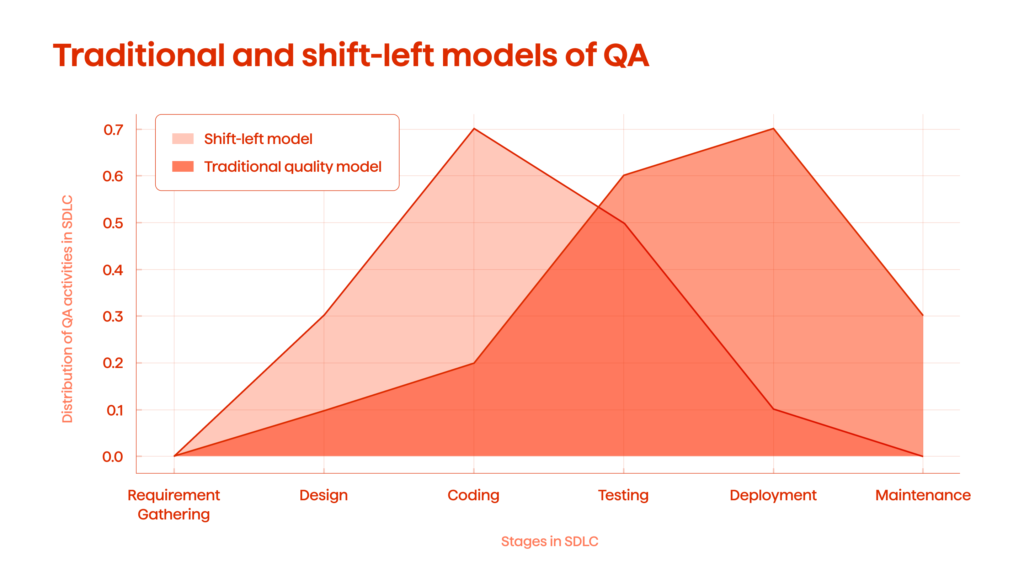
Testing as early as possible in the development life cycle is undervalued, though it’s essential to ensure everything works as intended. Shift-left testing involves moving testing activities to the earliest stages of development, thus giving room for QAs to detect bugs once they appear and address them there, rather than waiting at the end of development. That pays off in terms of time and financial savings.
To understand the value of shift-left testing, it’s important to consider where bugs originate. As coding progresses, the potential for issues increases, and if left untested, these can grow into serious and costly problems. When performance testing is delayed until the very end, teams often face a much worse scenario. Bugs become deeply embedded within a sea of interconnected code, requiring extensive rework to fix. As a result, customers face higher costs and longer time to market. An earlier study by IBM highlighted this problem, suggesting that correcting flaws after release can be up to 15 times more expensive than addressing them early on.
This emerging trend allows teams to test smaller chunks of code and address issues as they arise. This approach is more manageable and less disruptive to the larger code base. It also aligns well with DevOps practices, which emphasize continuous integration and deployment. With testing integrated directly into the CI/CD pipeline, every code commit triggers automated tests that provide real-time feedback to developers. Early detection helps minimize technical debt and accelerate developer iterations. As a trend in software quality assurance, this game-changing method enables teams to deliver stable, reliable products quickly while ensuring the highest software quality.
Test automation and the rise of autonomous testing practices
With the increasing complexity of applications and rising user expectations, QA automation has gradually expanded to cover a wider range of non-functional testing needs. These are now critical quality assurance trends. The primary role of modern QA isn’t just feature verification; it’s ensuring that the application performs reliably under various conditions and provides a seamless user experience (UX).
Automated usability testing is emerging to meet the growing demand for more ‘usable’ applications. As microservices architectures become the default, API testing has moved from a niche skill to a core QA discipline, ensuring that the contracts between services hold under real load and edge conditions. Automated usability testing tools now assist QA teams in understanding user flows, tracking clicks, and identifying potential friction points without constant human observation. As more companies emphasize UX design, automated usability testing helps them discover and fine-tune issues related to navigation, layout, and content flow.
AI is changing how QA teams work, but getting it right takes the right partner. Talk to Avenga’s software testing team about building smarter, faster, more reliable QA into your development pipeline.
With systems expected to run continuously in the real world, endurance testing, also known as soak testing, has gained popularity. Extended automated endurance tests now run sessions, sometimes lasting days, to identify performance degradation and memory leaks. This type of testing will remain crucial for software applications that require ultra-high uptime, such as SaaS platforms, helping to keep them robust during periods of normal use.
For the trade-offs, see test automation: the good, the bad, and the ugly.
In times of unpredictable peak-traffic events, such as product launches or sales promotions, the need for stress testing automation has become paramount. Traditional load tests differ from automated stress tests in that the latter push applications to the limits to show weak points that should be improved, preparing apps for high-traffic scenarios. As a software testing and QA trend, stress testing will help businesses achieve “graceful degradation.” That is, even if it gets overwhelming, the system fails in a controlled and recoverable manner.

Cloud-based testing and performance testing in 2026
As more businesses move their software applications to the cloud, cloud-based solutions for software testing have gained popularity, with a CAGR of over 13% during the 2021–2026 projection period. This makes cloud-based testing one of the main trends for 2025/2026. It enables QA teams to scale more effectively, reduce costs, and access a variety of flexible options, keeping pace with the modern demands of software development. Additionally, teams can delegate repetitive testing tasks to software. Now, let’s explore the key QA workflows that make cloud-based testing one of the best practices in the industry.
The way teams manage application stability under variable loads has changed with cloud performance monitoring and analytics. Using the cloud, QA professionals can monitor performance metrics round the clock, get real-time alerts related to latency spikes, and identify bottlenecks across distributed environments.
One data breach now costs a company an average of $4.44 million, according to IBM’s 2025 report. Notably, that figure fell for the first time in five years, as AI-driven containment shortened breach lifecycles, another reason to automate security testing.. Cloud security testing tools automate scanning for vulnerabilities, checking on encryption, and validation of compliance-security checks across cloud infrastructure. As a result, your QA experts can detect risks early in the development cycle. This reflects the trend of “security by design”: cloud environments can handle continuous, automated security checks without slowing down the release cycle by protecting sensitive data.
Cloud testing has also changed the way mobile applications are developed. Thanks to tools like App Center Test, QA teams can instantly tap into hundreds of virtual devices running various operating systems and screen sizes. And that is even more relevant thanks to the growing diversification of mobile devices. Testing devices on the cloud allows teams to check for compatibility without the need for a physical device lab, helping them reduce costs while increasing coverage.
Our QA test automation services cover load, endurance, stress, and security testing.
Data integrity testing ensures an application can handle data with accuracy, especially in a distributed system. Cloud platforms, such as Microsoft Azure, enable developers to check data integrity. This approach ensures the consistency and security of the data while it is in transit, being stored, or retrieved. Applications that depend on large-scale data operations must ensure data integrity over the cloud in an era where 90% of the world’s data was created in the last few years.
Other advantages of cloud-based testing include scalability and collaborative accessibility. For example, when workloads increase, cloud environments help teams scale resources on demand, hence making it easier to handle sudden surges in testing requirements. Finally, the cloud promotes collaboration. It lets distributed teams share results, update code, and communicate in real time, streamlining testing.
Continuous testing and emerging software testing trends
While shift-left testing emphasizes moving tests earlier in the development process, continuous testing takes it a step further, becoming one of the most critical QA and software testing trends. It embeds testing at every stage, from code commits to deployment. Unlike traditional QA methods, where testing is confined to specific phases, continuous testing ensures that application quality is assessed in real-time and consistently throughout the development lifecycle.
Real-time feedback & rapid issue resolution: Continuous testing is defined by immediate feedback. As new code is written, the tests can flag issues to the developers before moving on to other tasks. This real-time feedback loop is not just about detecting defects; it is all about speeding up the resolution of issues. It allows finding problems at the moment of their origin when teams can resolve them in minutes, not hours or days. Stockpiling and snowballing of code defects were typical for outdated, traditional testing practices.
Improved test coverage with integrated testing types: Continuous testing allows the integration of a wide range of testing types, such as unit, integration, regression, security, and performance tests, into a single automated workflow. This multi-dimensionality of testing strategies gives teams an inclusive view of application health. Continuous testing is more holistic compared to the shift-left one, where the bulk of the emphasis relies on early-stage functional QA.
Progressive delivery & experimentation support: Continuous testing enables progressive delivery practices, such as canary releases and feature toggles, for enterprises. QA teams can test in live production environments, release new features to selected user groups, and gather real-time feedback. The key benefit is that it allows teams to minimize risk exposure for the entire user base. Unlike traditional or shift-left methods, continuous testing fosters experimentation and iterative progress in a way that others do not.
Security testing, accessibility testing, and test data management
Effective management strategies now go beyond mere accuracy; they also prioritize protecting sensitive information throughout the testing process. Masking and obfuscation are key techniques that allow real data to be used without revealing personally identifiable information (PII) while creating test data. Tools like K2View and Informatica take sensitive data fields and replace the original values with realistic, yet fictitious, ones. For example, a customer’s real name and address are replaced with randomized equivalents, preserving the data format and structure. This approach enables testing under conditions close to real production, all while safeguarding user privacy.
Data subsetting allows teams to work with smaller, representative datasets instead of the entire production database. This approach minimizes data exposure while still enabling QA teams to cover the most critical test scenarios. In addition to optimizing resource use, it reduces storage costs and accelerates test cycles, particularly in large-scale data environments.
Access control and audit logging add an extra layer of security. This comprehensive security testing restricts data access to authorized individuals and logs interactions with the data. These controls support compliance enforcement, ensuring accountability, especially when implemented with role-based permissions and encrypted data logs.
FAQ
The future of software testing: How testing practices become a competitive advantage
Many software companies fall into a common pitfall: they prioritize development extensively while often underestimating the critical role of QA and testing. But, at the end of the day, the overall quality of software isn’t just a feature, it’s the foundation. These testing and quality assurance trends have emerged not because of arbitrary changes in the industry but as a direct response to the changing demands for faster delivery, enhanced security, and elevated user experience in software products. Research indicates that 88% of visitors are less inclined to visit a website again after having a bad experience, thus regular testing is becoming crucial for both customer retention and brand reputation.
- Want to learn more about the software testing trends of 2026?
- Interested to know how various testing approaches and best practices safeguard high-quality software?
- Seeking ways to help your QA team run efficient tests?
- Want efficient, reliable QA?



Your business results matter
Achieve them with minimized risk through our bespoke innovation capabilities. Fill in the form below.