






Omnichannel fulfillment 101: A complete guide from Avenga


June 5, 2026 12 min read 361 views
Omnichannel fulfillment aligns what customers expect to receive with what the retailer provides. Customers shop across multiple sales channels with no break in expectations; they may shop on their mobile phone, purchase an item from a physical location, and return it through a courier service, for example. When the fulfillment value chain can’t support these different pathways, the shopping experience are affected, regardless of how strong the product and price are.
Merchant benefits through control and use. Effective order management sends goods to the best fulfillment point based on stock, delivery time, and cost. An accurate inventory management system ensures that all stores, warehouses, and in-transit items provide accurate availability, reducing oversells, cancellations, and “out of stock” dead ends. This combination improves service quality while protecting margin. Keep reading to learn more about fulfillment solutions.
Omnichannel fulfilment strategy: Key takeaways
- Omnichannel only works if your inventory is solid and your promises are consistent, no matter where customers shop, online, in-store, or anywhere else.
- If you want to scale, stop treating stores, DCs, and 3PLs as separate entities. Treat them as one unified network. Set up clear routing rules so every order reaches the right destination.
- Connect your ERP, WMS, and OMS. This reduces cancellations and keeps operations smooth.
- To excel at fulfillment, you need real-time visibility, tight coordination, and reliable processes—in both stores and warehouses. That’s how you deliver every time.
The evolution of fulfillment expectations in e-commerce
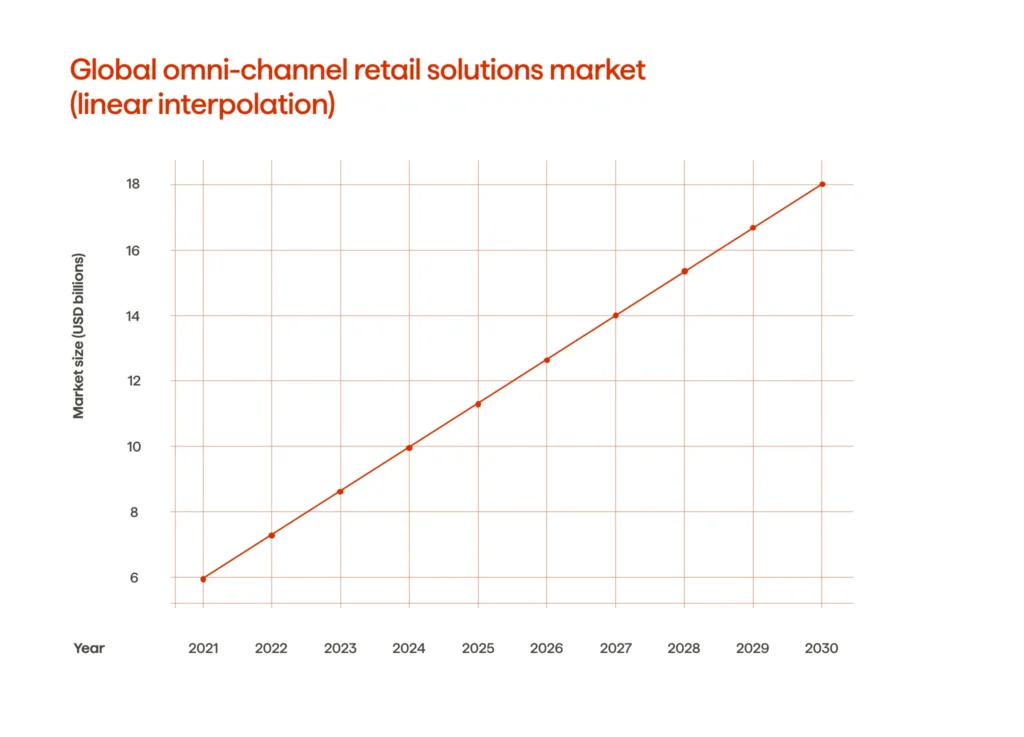
The rapid growth of omnichannel retailing is currently being funded on a massive scale. During 2021, the worldwide omnichannel retail solutions market size was estimated at USD 5.96 billion and is expected to expand to USD 17.92 billion by the end of 2030 at an estimated annual growth rate of approximately 13.6%. This data demonstrates the extent to which many retailers are currently investing in inventory management software that connects or integrates their physical and digital retail offerings.
E-commerce fulfillment was very much a “warehouse ships to home delivery” method 20 years ago. Consumers had lower expectations regarding choices, longer delivery lead times, and little to no visibility once their package left the warehouse. In the back office, supply chain management was managed, and orders were processed in batches. Retailers mostly used in-store fulfillment across multiple platforms, leading to incorrect inventory and issues with customer visibility.
Expectations continued to tighten during the last decade. Two-day delivery has become a widely accepted standard in many markets; mobile tracking has created consistent consumer expectations for status updates on package shipments; and the first generation of omnichannel logistics is emerging through store pickup and shipping from retail locations. However, fragmented data remains a significant challenge in today’s logistics landscape, as inventory differs across e-commerce and traditional retail channels, and “available” does not necessarily equate to “fulfilled.”
Now, customers expect their orders to be delivered on time and in the agreed manner, and to be fulfilled with minimal or no hassle. The omnichannel order fulfillment strategy allows businesses to keep their commitments by connecting software solutions between order management, inventory, and fulfillment, providing continuous visibility of orders as they move from checkout through to arrival at their destination.
u003cspan class=u0022TextRun SCXW185523604 BCX0u0022 lang=u0022UKu0022 xml:lang=u0022UKu0022 data-contrast=u0022autou0022u003eu003cspan class=u0022NormalTextRun SCXW185523604 BCX0u0022u003eRetail IT outsourcing is on the rise. Learn about the best retail industry outsourcing service companies and enjoy high-quality software development, cybersecurity, and data analytics.u003c/spanu003eu003c/spanu003eu003cspan class=u0022EOP Selected SCXW185523604 BCX0u0022 data-ccp-props=u0022{u0026quot;134245417u0026quot;:false,u0026quot;201341983u0026quot;:0,u0026quot;335559740u0026quot;:240,u0026quot;335572071u0026quot;:0,u0026quot;335572072u0026quot;:0,u0026quot;335572073u0026quot;:4278190080,u0026quot;335572075u0026quot;:0,u0026quot;335572076u0026quot;:0,u0026quot;335572077u0026quot;:4278190080,u0026quot;335572079u0026quot;:0,u0026quot;335572080u0026quot;:0,u0026quot;335572081u0026quot;:4278190080,u0026quot;335572083u0026quot;:0,u0026quot;335572084u0026quot;:0,u0026quot;335572085u0026quot;:4278190080,u0026quot;335572087u0026quot;:0,u0026quot;335572088u0026quot;:0,u0026quot;335572089u0026quot;:4278190080,u0026quot;469789798u0026quot;:u0026quot;nilu0026quot;,u0026quot;469789802u0026quot;:u0026quot;nilu0026quot;,u0026quot;469789806u0026quot;:u0026quot;nilu0026quot;,u0026quot;469789810u0026quot;:u0026quot;nilu0026quot;,u0026quot;469789814u0026quot;:u0026quot;nilu0026quot;}u0022u003e u003c/spanu003e
Omnichannel fulfillment explained: models that shape customer experience
An omnichannel fulfillment model is built around one thing: the customer placed an online order through one channel and expects the fulfillment process to be consistent across that channel and the channel from which the customer is purchasing. The growing shift to online commerce only heightens customers’ expectations for the ownership experience.
Long-term projections show that by 2040, online purchases will account for 95% of all purchases, and physical retail will continue to decline. B2B is trending in the same way. Another forecast states that 80% of B2B sales will come through digital channels by 2025, and according to Sana Commerce, 75% of customers would switch from their current supplier to another supplier to get a better online purchasing experience. So, businesses have an opportunity to create a competitive advantage through convenience and dependability.
Below are the core models retailers use, and what they demand operationally.
Buy online, pick up in store (BOPIS) and curbside pickup
BOPIS and curbside pickup really show how omnichannel fulfillment services change the game for customers. When someone orders online for pickup, the closest store becomes a mini-warehouse. Customers like it because they can pick up orders when it suits them, skip the wait and worry of delivery, and, if there’s a problem, sort it out right there. Retailers win too—pickup slashes last-mile costs and better uses store inventory. But here’s the catch: it all falls apart if the inventory data isn’t accurate in real time or if the store team doesn’t have a smooth process for picking, staging, and handing off orders. Just look at Target. In 2024, they filled more than 97% of online orders through their stores. That only works because their store operations run like clockwork, handling fulfillment almost like a small-scale warehouse.
Store-as-fulfillment hub (ship-from-store/same-day delivery)
Store-as-hub deliveries (ship from store, same day, and rapid) are continuing to evolve this model to the next level. The store is no longer just a pickup point; it is now a local distribution center for last-mile deliveries, shortening the distance for high-intent orders and enabling faster deliveries. Walmart is now operating under this model; they reported that in Q3 FY26, roughly 35% of all store-fulfilled orders were delivered in less than 3 hours, with expedited channel sales growing by almost 70%.
The retailer benefits by meeting their customers’ demand for faster delivery options while better utilizing their inventory. The customer also benefits from a lower incidence of “Available but cannot deliver” situations. Operating under this model requires discipline in proper warehouse management within the stores, including: correct pick paths, packing standards, timing of the carrier hand-off, and exception handling for item mispicks and incorrect on-hand inventory.
Distributed order management (DOM) with split fulfillment
Distributed order management (DOM) with split fulfillment changes the game for scaling across different channels. Instead of locking orders into a specific shipping source up front, DOM reacts in real time. It delivers each component of an order to the appropriate location after examining inventory locations, remaining space, cutoff periods, shipping prices, and service levels. This could be a drop-ship partner, a retailer, a DC, a 3PL, or a seller on a marketplace.
Customers see the benefits right away. Promises become more reliable, items are in stock, and orders get filled on time. Retailers cut down on cancellations and keep any one location from getting slammed during busy periods. But there’s a catch: DOM needs clean, synchronized data across stores, warehouse management, and order systems. The rules have to match what’s really possible, not just what looks good on paper. Otherwise, the whole thing falls apart.
Inventory visibility: the backbone of omnichannel strategies
The minute you go omnichannel, “mostly right” inventory just doesn’t cut it anymore. Customers shop everywhere, including online, in-store, and on their phones, and they want straight answers every time. Is this in stock? When can I have it? And if it’s not, what’s next? To keep up, you need up-to-the-second inventory visibility across your whole network. That means stores, distribution centers, what’s on the way, and even returns. Anything less, and you’re already behind.
This is significantly more complex than “sync counts.” There are several states of availability to consider, including on-hand, reserved, allocated for order fulfillment, damaged, in-transit, awaiting put-away, and returns (currently unable to be returned). If, however, you view inventory as a single number in your management software, then you will likely oversell and cancel orders, leading to a loss of customer confidence. If you are managing omnichannel operations at scale, you typically need an inventory ledger, which serves as the official record of inventory and captures POS events from every source (e.g., WMS, ERP, OMS). Similarly, in-house fulfillment also depends on the operational discipline maintained throughout. Examples of this include scanning items at every point of hand-off. Idea two for preventing potential collisions between store pickers and customers would be to conduct cycle counts. Establishing exception workflows for inbound/outbound operations also helps prevent collisions between a customer shopping in your store and a fulfillment center fulfilling their orders at the same time.
Trustworthy inventory enables you to fulfill your omnichannel commitments without performing miracles. Reliable BOPIS, guaranteed success for shipment from store to customer (ship-from-store), and split shipments that you can confidently execute rather than at the last minute.
| Capability | What it means in practice | What it enables |
|---|---|---|
| Real-time inventory updates | Event-driven updates from POS/WMS/OMS | Fewer oversells and cancellations |
| Reservation and allocation logic | Holds stock for pickup/shipping with timeouts | Reliable promises across channels |
| Inventory state tracking | On-hand vs in-transit vs returns vs damaged | Accurate ATP and better routing |
| Single inventory ledger | One source of truth across systems | Consistent availability everywhere |
| Store execution controls | Scans, cycle counts, exception handling | Predictable in-house fulfillment performance |
Synchronizing the stack: connecting ERP, WMS, and OMS in the cloud
The OMS, WMS, and ERP systems must work together as a single system from order placement to fulfillment to provide customers with an integrated, seamless omnichannel fulfillment experience and meet their expectations. When an OMS gives customers a pick-up time that the WMS cannot meet, or when the ERP indicates there is available inventory for an item prior to it being received into the system or put away, both problems will impact the ability to complete an order fulfilled through an omnichannel.
An example of this pattern is to use the OMS as the central ordering system, the WMS as the operational execution engine of the omnichannel warehouse, and the ERP as the financial and master data backbone of the company. The ideal way to connect these systems is through cloud-based, event-driven integration. Events will occur in one of the systems (e.g., an adjustment to inventory levels, an inventory reservation, the shipment of an order, the return of a product, a refund request). They will be published to all integrated systems. All systems will be updated and will maintain an even, consistent level of available product and shipment status. By implementing these event-driven integrations, achievable fulfillment optimization (such as intelligent order routing, split ship, and dynamic allocation when a physical store cannot complete a pick) can be achieved.
The business result of employing an omnichannel, integrated approach is rapid, controlled delivery of goods and services. Due to the speed at which teams can utilize new multichannel fulfillment methods, as well as the ability to grow and manage peak volume safely and maintain inventory accuracy, all of which may be accomplished without creating an unstable point-to-point distribution link.
FAQ
Final words on the omnichannel experience
Omnichannel success happens when retailers unify all aspects of inventory, order promises, and execution so any channel can act as one store. Once systems are connected and inventory can be trusted, customer orders will automatically get routed to the correct location, stores will become reliable micro-fulfillment locations, and exceptions won’t lead to cancellations. That’s what implementing omnichannel should achieve in practice: faster delivery and pickup options that let customers choose what works for them, without the business paying for it through manual work.
Interested to learn more about inventory management and the omnichannel fulfillment approach? Contact Avenga, your trusted expert in retail fulfillment.



Your business results matter
Achieve them with minimized risk through our bespoke innovation capabilities. Fill in the form below.