






Data analytics in insurance claims management: use cases and benefits


July 30, 2026 14 min read 529 views
See how advanced analytics helps insurers optimize claims management with predictive analytics, automation, fraud detection, and actionable insights.
The insurance sector is transforming by integrating advanced analytics into claims management. This shift is driven by the need for efficiency, accuracy, and enhanced customer satisfaction. Adopting analytics in insurance claims management offers a pathway to optimized operations and better customer experiences.
Advanced analytics can help insurers improve claims operations by increasing efficiency, supporting better risk assessment, and enabling more accurate decision-making. Deloitte’s Global Insurance Outlook highlights a similar shift, emphasizing the growing importance of data, analytics, and AI in helping insurers optimize operations, manage risks, and deliver more personalized customer experiences.
In the following sections, we’ll examine how advanced analytics supports every stage of the claims process. You’ll learn about the technologies behind modern claims management and the practical ways insurers use them to improve efficiency, accuracy, and customer satisfaction.
What is analytics in insurance?
Analytics in insurance involves analyzing data to identify patterns, uncover insights, and support better decision-making. By applying analytics to claims data, insurers can detect trends, predict future claim occurrences, and improve claims management processes.
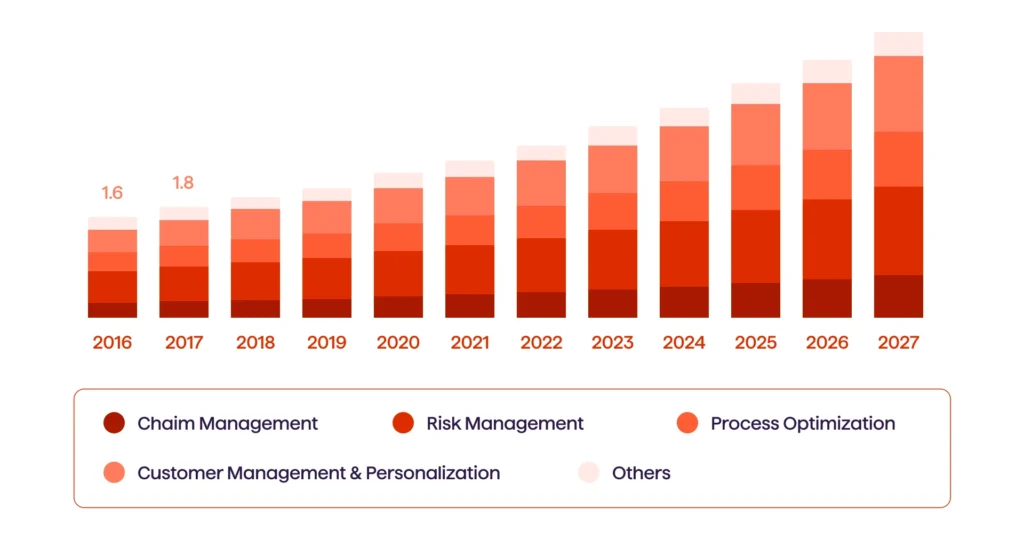
The approach proved successful, which is why the insurance analytics market is booming (see Fig.1).
Why analytics matters in claims management
Analytics improves claims management by making processes more efficient, accurate, and customer-focused. In the insurance industry, it helps insurers reduce costs, detect fraud, and improve overall service quality. For example, insurance companies using predictive analytics have reported a reduction in claim processing times by up to 30%. Additionally, the use of AI and Machine Learning (ML) in claims management has been shown to decrease fraudulent claims by 20%.
Analytics is a strategic asset that enables insurers to enhance their operational efficiency, reduce risks, and provide better customer service. As more data becomes available and analytical techniques become more sophisticated, the role of analytics in insurance claims will only continue to grow.
The role of data in claims management
Data plays a central role in insurance claims management by providing the information insurers need to analyze risks, improve decision-making, and optimize claims processes. By leveraging structured and unstructured data, insurers can uncover patterns, predict claim outcomes, and deliver more accurate and efficient claims handling.
Types of data used in claims analytics
Claims data includes structured data such as claim amounts, dates, and customer details, as well as unstructured data like customer communications and adjuster notes. For example, structured data can reveal patterns in claim amounts over time, while unstructured data might uncover customer sentiments or adjuster observations that are not captured in numerical formats.
Data collection and processing
Efficient data collection and processing are crucial for accurate claims analytics. This involves integrating various data sources and ensuring data quality and consistency. To illustrate, combining data from different channels (e.g., digital claims submissions and phone calls) provides a comprehensive view of each claim, improving analytics’ accuracy.
Three key analytics types
Insurance claims management relies on different types of analytics to improve decision-making, identify risks, and optimize claims processes. The most commonly used approaches include claim analytics, data analytics, and predictive analytics, which help insurers analyze data, detect patterns, and improve operational efficiency.
1. Claim analytics
Claim analytics systematically analyzes claims data to identify patterns and trends. Effective claim analytics leads to more accurate and faster claim resolutions. A report by McKinsey & Company shows that claims analytics can reduce claim processing times by up to 40%.
2. Data analytics
Data analytics encompasses using big data to enhance decision-making processes. In claims management, data analytics helps understand customer behavior, predict claim trends, and improve service delivery. Integrating data analytics into claims processes results in better resource allocation and operational efficiency. A report by KPMG found that insurers using data analytics improved their operational efficiency by 25%.
3. Predictive analytics
Predictive analytics uses historical data to forecast future events. Applying predictive modeling in claims management helps anticipate claims, detect fraud, and reduce costs. Predictive analytics empowers insurers to manage claims and mitigate risks proactively. According to PwC, insurers implementing predictive analytics have seen a 20% reduction in claim costs.
The role of data in claims management cannot be overstated. By leveraging different data types and employing advanced analytics techniques, insurers can significantly enhance their claims processes, improving efficiency, reducing costs, and better customer satisfaction.
The most widespread issues during data migration testing
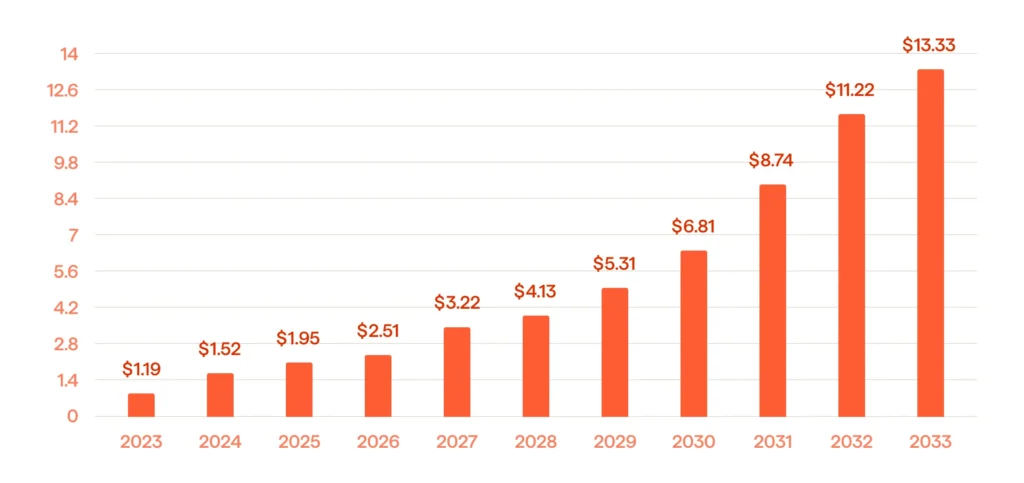
Predictive modeling in insurance uses historical data, statistical techniques, and Machine Learning to forecast future outcomes and support better decision-making. By analyzing patterns in claims data, insurers can predict risks, identify potential fraud, and optimize claims management processes. The growing adoption of predictive analytics is reflected in the market’s expansion, with its current value of $13.94 billion expected to reach $43.5 billion by 2030 (see Fig.2).
How predictive analytics works in claims management
Predictive analytics uses historical data, Machine Learning, and statistical algorithms to forecast future outcomes and support better claims-related decisions. In insurance, insurers apply predictive models to analyze claims data, identify risk patterns, predict claim trends, and detect potential fraud.
For example, an insurer may use ML models to analyze past claims data and predict which new claims were likely fraudulent. This may result in a reduction in fraudulent payouts.
Applications in claims management
Predictive modeling helps identify high-risk claims, optimize resource allocation, and improve customer satisfaction by expediting legitimate claims. An insurance company applying predictive analytics to prioritize high-risk claims can improve their resolution time. Better resolution time equals higher customer satisfaction.
Predictive modeling in claims analytics offers significant advantages, including forecasting trends, detecting fraud, and optimizing resource allocation. By leveraging predictive analytics, insurers can improve efficiency, reduce costs, and enhance customer satisfaction, positioning themselves better to handle future challenges in claims management.
Key benefits of data analytics in insurance claims management
Data analytics in insurance helps companies improve the claims process by increasing efficiency, enabling faster resolutions, and creating more personalized customer interactions. By leveraging insurance analytics and advanced analytics solutions, insurers can streamline claims processing, improve service delivery, and enhance customer satisfaction.
Streamlining the claims process
Analytics helps streamline claims management by automating routine tasks, reducing processing times, and minimizing errors. As mentioned before, there is a direct correlation between lower claims processing time and claims analytics. Respectively, there is a direct path to improve customer satisfaction there.
Improving customer satisfaction
Analytics enhances customer satisfaction and loyalty by providing faster and more accurate claim resolutions. A study by MoldStud found that insurers using advanced analytics saw a 20% increase in customer satisfaction scores due to quicker and more transparent claims processes.
Bettering customer experience
The importance of a seamless and efficient claims process in customer satisfaction. Using analytics to streamline claims processes, personalize customer interactions, and improve service delivery. Research offered by Bain & Company indicates that companies with superior customer experience achieve revenues 4-8% above their market average.
Enhancing customer experience through claims analytics improves satisfaction and loyalty and optimizes operational efficiency. By leveraging advanced analytics, insurers can streamline the claims process, provide faster and more accurate resolutions, and ultimately achieve higher customer retention and reduced costs.
Advanced analytics and automation use cases in insurance claims management
Advanced analytics and automation enable insurers to optimize claims management by improving efficiency, reducing manual effort, and supporting more accurate decision-making. By implementing advanced analytics solutions, insurance companies can automate routine processes, integrate data from multiple sources, and improve operational performance. This section covers automation in claims processing, healthcare data integration, and KPIs.
Automation in claims processing
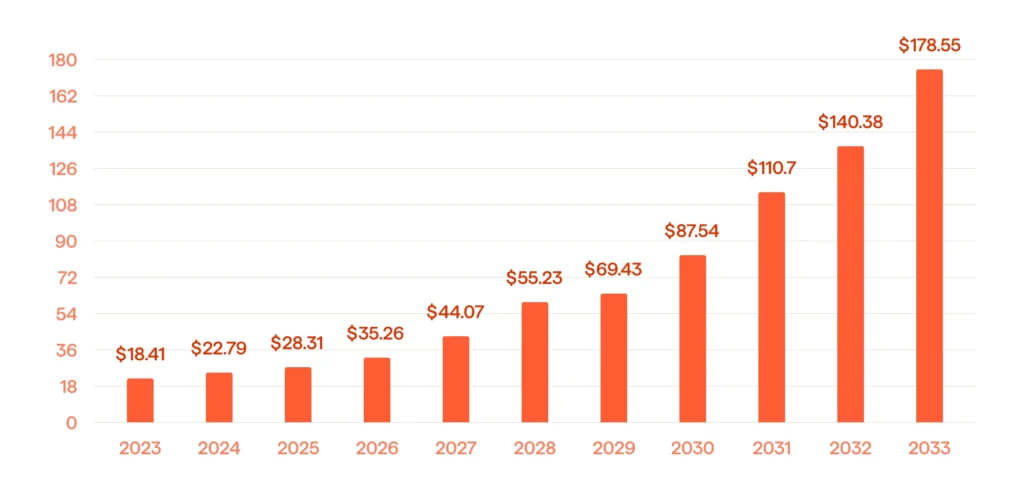
Automation reduces manual intervention in the claims process. Utilizing robotic process automation (RPA) and AI to handle routine tasks and improve accuracy. Evidence shows an insurance company can implement RPA to automate data entry tasks, reducing manual errors by 90%. Besides, everyone should also consider that the RPA market will soon skyrocket (see Fig. 3).
Integration of healthcare data
Integrating healthcare data into insurance claims management provides a comprehensive view of claims. Leveraging healthcare data to improve claims accuracy, detect fraud, and enhance predictive modeling. A study in the National Library of Medicine indicates how healthcare data can be used to identify anomalies in claims, leading to a 25% reduction in fraudulent claims.
Key performance indicators (KPIs)
KPIs are essential for measuring claims management performance and identifying and tracking KPIs such as claim processing time, customer satisfaction, and cost per claim.
Essential KPIs:
- Claim processing time
- Customer satisfaction scores
- Cost per claim
Monitoring KPIs helps insurers to improve their claims processes continuously. Insurers who actively track and manage KPIs can potentially increase operational efficiency.
Technology and automation in claims management significantly improve efficiency, accuracy, and customer satisfaction. By leveraging automation, integrating healthcare data, and monitoring key performance indicators, insurers can enhance their claims processes and achieve better outcomes for the Company and its customers.
Fraud detection and prevention
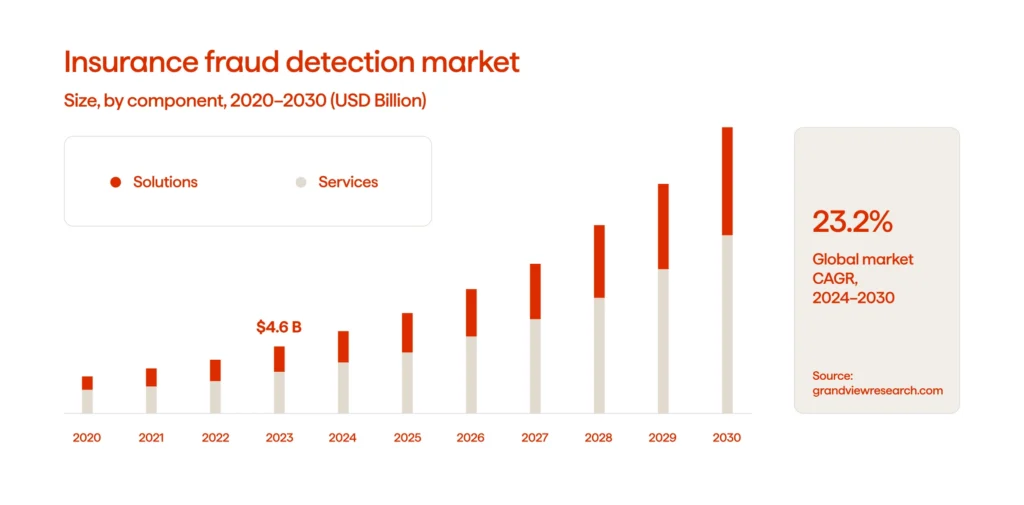
Fraud detection is a major challenge for insurance companies, and advanced analytics helps insurers identify suspicious claims, uncover risk patterns, and improve prevention strategies. By leveraging data analytics and AI, insurers can analyze claims information, detect anomalies, and strengthen fraud management processes. The growing adoption of analytics for insurance fraud detection is reflected in the expanding market (see Fig. 4).
Identifying fraudulent claims
Detecting fraudulent claims is crucial for reducing losses. Here are critical techniques for fraud detection:
- Data mining
- Machine Learning
- Predictive analytics
Advanced analytics tools improve the accuracy of fraud detection and prevention. As per the FBI, the insurance industry loses an estimated $40 billion annually due to fraud. In the banking sector, fraud costs are estimated to be around $31 billion annually.
Understanding subrogation
Subrogation involves the insurance company’s right to recover the claim amount from the party responsible for the loss. In other words, subrogation is when insurers seek to recover costs from third parties responsible for an incident after paying out a claim.
Effective subrogation helps insurers recoup costs and maintain financial stability. A company may improve its subrogation recovery rate through better analytics.
Enhancing subrogation processes
Analytics can optimize subrogation by identifying potential recovery opportunities and automating the process. Using analytics to streamline subrogation involves identifying recovery opportunities and automating follow-up processes. Optimized subrogation processes lead to higher recovery rates and lower operational costs.
Fraud detection and prevention are critical for the insurance industry to minimize losses and enhance financial stability. By leveraging advanced analytics for fraud detection and optimizing subrogation processes, insurers can significantly reduce fraudulent activities and improve recovery rates, ultimately safeguarding their financial health.
Data integration and interoperability in insurance claims management
Data integration and interoperability help insurers connect information from different systems and sources, giving them a more complete view of each claim. By bringing data together, insurance companies can improve risk assessment, make better decisions, and streamline claims management processes. This section looks at why data integration matters and how interoperability supports smoother data exchange between systems.
Importance of data integration
Integrating data from various sources ensures a comprehensive view of claims and improves decision-making. Companies with integrated data systems are more likely to assess claim risks accurately. Furthermore, integrating customer data from various channels can enhance customer satisfaction by 20%, providing a more holistic view of each customer’s interactions and claims history.
Achieving interoperability
Interoperability between different data systems is crucial for seamless data flow and efficient claims processing. Achieving interoperability often involves adopting industry standards and utilizing middleware solutions to ensure different systems can communicate effectively.
Data integration and interoperability enhance claims management by providing comprehensive insights and streamlining processes. By integrating data from various sources and ensuring seamless interoperability, insurers can make more accurate decisions, improve operational efficiency, and enhance customer satisfaction. Investing in these technologies leads to better outcomes and positions insurers to be more agile and responsive in a rapidly changing industry.
The future of claims management with advanced analytics
Ongoing advancements in analytics and technology are shaping the future of claims management, offering new possibilities for efficiency and accuracy.
ML and AI
The role of Machine Learning and AI in transforming claims management. Utilizing these technologies for predictive modeling, fraud detection, and process automation. For example, an insurance company can use AI to automate the initial claims assessment process, thus reducing the time needed to process claims.
ML algorithms can analyze vast amounts of data to identify patterns humans might miss, leading to a 40% improvement in fraud detection rates. Machine learning and AI are set to revolutionize claims management by providing deeper insights and improving efficiencies.
Data-driven decision making
Data-driven decision-making allows insurers to use claims data, analytics, and AI insights to make faster and more accurate decisions. By analyzing historical data, customer information, and claim patterns, insurance companies can improve risk assessment, allocate resources more effectively, and optimize claims strategies.
The impact of data-driven approaches can already be seen in claims operations. For example, McKinsey reported that Aviva used AI-powered solutions to improve claims decision-making, reducing the time needed to assess liability for complex cases by 23 days and improving routing accuracy by 30%.
The future of claims management is bright, with advanced analytics driving significant improvements in efficiency, accuracy, and customer satisfaction. By embracing Machine Learning, AI, and data-driven decision-making, insurers can transform their claims processes, reduce costs, and provide better customer service. These advancements will streamline operations and offer deeper insights and more strategic outcomes in the ever-evolving insurance landscape.
FAQ
Conclusion
Insurance analytics revolutionizes claims management by enhancing efficiency, reducing costs, and improving customer satisfaction. By leveraging data and predictive modeling, insurers can streamline their claims processes, detect fraud, and provide better customer service.
The future of claims management lies in continuous innovation and the integration of advanced technologies. To stay ahead in this rapidly evolving landscape, insurers must embrace and integrate these advancements into their operations.
At Avenga, we specialize in helping insurance companies navigate this transformation. Our analytics and technology integration expertise ensures you can achieve optimized claims management and superior customer experiences.
Contact us to learn how we can help you leverage data and analytics in your claims management processes.



Your business results matter
Achieve them with minimized risk through our bespoke innovation capabilities. Fill in the form below.