






Top AI trends to watch in 2026: what’s changing beyond Generative AI


August 5, 2026 10 min read 668 views
Over the past few years, AI technologies have been adopted at various levels, but many saw them more as a novelty than a practical tool. In 2025, the adoption of AI systems across industries is set to accelerate, marking a significant turning point. Chris Young, Executive Vice President of Business Development at Microsoft, believes that Artificial Intelligence will soon transform every aspect of our lives, given that the use of AI across many organizations has already increased by 20%.
Latest AI trends in 2026
Generative AI is gaining significant momentum, and the figures speak louder than any statement. In 2023, revenues from Generative AI reached $67 billion, accounting for 2% of global IT revenues and a remarkable 378% increase since 2020. The market is projected to generate $1.3 trillion annually by 2032, nearly 20 times the 2023 value, and will account for over 12% of global IT revenues. The industry is expected to triple between 2026 and 2030, demonstrating revolutionary growth.
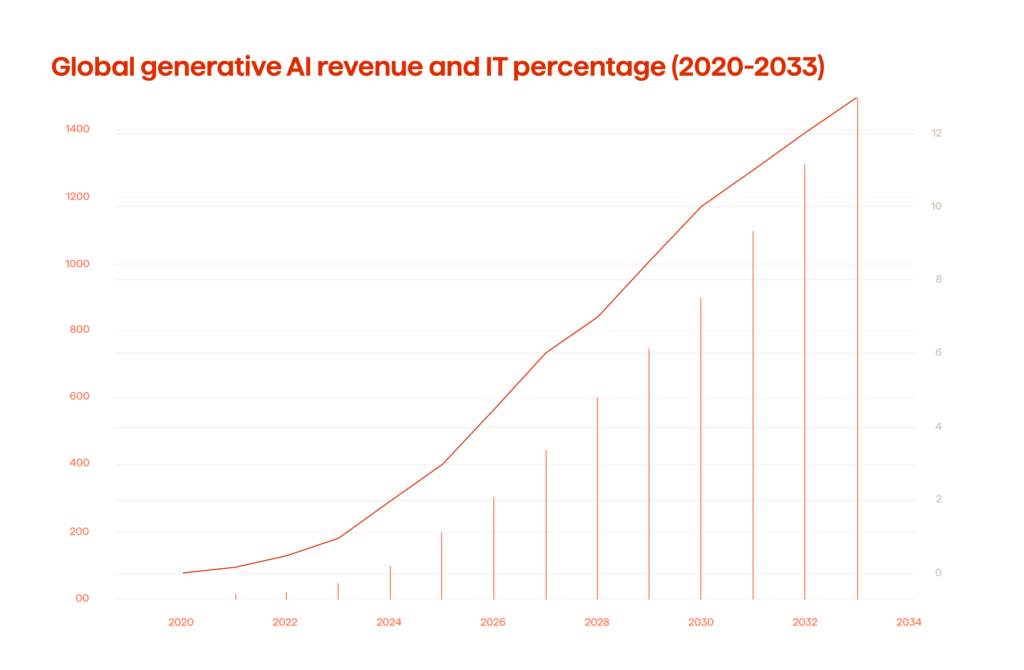
The AI revolution is no longer just a technology trend or limited to chatbots and image generation. Several trends that emerged in 2025 have already become part of everyday tech. Popular AI tools such as ChatGPT, Gemini, Claude, Microsoft Copilot, and Midjourney now support everything from conversational AI, software development and content creation to research, customer service, and enterprise productivity. As multimodal AI and machine learning continue to evolve, businesses have access to AI capabilities that were difficult to imagine only a few years ago.
Agentic AI: the next step beyond Generative AI
One of the key AI trends in 2026 is the rise of Agentic AI systems. Unlike traditional AI models that respond to prompts, AI agents can plan, make decisions, and complete multi-step tasks with limited human intervention. Rather than simply generating information, those agentic AI platforms interact with software, APIs, and business workflows to achieve specific goals.
While Large Language Models generate text, code, or images in response to prompts, AI agents use those capabilities to execute actions. In practice, they combine reasoning with tools, memory, and workflow automation, allowing them to complete tasks rather than simply answer questions.
| AI Agents | Language Models (e.g. GPT-4o, GPT-4, GPT-3.5, etc.) | |
| Function | Carrying out tasks, making decisions, and collaborating in specific processes. | Producing responses in natural language based on prompts. |
| Autonomy | Functions independently and frequently makes choices without engaging the user. | Does not operate on its own; user involvement is necessary to generate responses |
| Task Scope | Limited to particular workflows or domains (e.g., scheduling, monitoring). | A wide variety of creative and conversational tasks (such as writing and scripting). |
| Adaptability | Real-time learning and adaptation to changing conditions. | Does not permanently or independently adapt but learns from prompts. |
| Interaction Type | Performs tasks by interacting directly with systems or APIs. | Uses conversational interfaces to connect with users. |
| Real-World Actions | Carries out real-world tasks, such as placing orders or sending notifications. | Has no real-world implementation; only offers information or simulated outcomes. |
| Integration | Typically integrated with workflows, software, or IoT systems. | Integrated with applications for generating content, insights, or responses. |
| Use Cases | Proactive notifications, task automation, or system monitoring. | Writing, coding, responding to queries. |
Enterprise AI agents are already being used to automate customer support, software development, research, and internal operations. Examples include Microsoft 365 Copilot agents, Salesforce Agentforce, GitHub Copilot coding agents, and OpenAI’s agent capabilities, which help users complete complex workflows across multiple applications.
The next stage of AI development goes beyond individual agents. Industry leaders increasingly expect networks of specialized software agents to collaborate across complex workflows, each responsible for a specific task while sharing information with other systems. As autonomous systems mature, organizations will increasingly shift from using AI to support work toward deploying AI to complete work autonomously under human oversight.
Energy-efficient computing for a sustainable future
As AI adoption grows, so does the demand for computing power. Training and running large AI models requires significant energy, making energy-efficient computing an increasingly important priority for organizations looking to scale AI responsibly.
Improving efficiency requires more than updating hardware. Organizations are combining modern AI infrastructure with optimized software and operational practices to reduce energy consumption while maintaining performance. Common approaches include:
- Use energy-efficient hardware: Specialized processors such as GPUs and FPGAs are designed to handle AI workloads more efficiently than general-purpose hardware.
- Modernize data centers: Renewable energy sources and advanced cooling systems help reduce environmental impact of AI infrastructure.
- Optimize AI models: Techniques such as model pruning, quantization, and lightweight architectures reduce computational requirements without significantly affecting performance.
- Process data closer to where it is created: Edge AI reduces reliance on energy-intensive cloud processing by running AI applications on local devices where appropriate.
As AI capabilities continue to expand, improving efficiency is becoming as important as improving performance. Organizations that invest in scalable infrastructure and energy-efficient AI technologies will be better positioned to balance innovation, operational costs, and sustainability goals.
Explore how we enabled a migration of 300,000 customers to cloud-native banking for Marginalen Bank.
Multimodal AI and computer vision
Multimodal AI is expanding the way Artificial Intelligence understands and generates content. By combining text, images, audio, and video, modern AI assistants can analyze visual information, generate realistic content, and support increasingly sophisticated business applications. Computer vision remains a key part of this evolution, enabling organizations to extract insights from images and video at scale.
Healthcare providers use computer vision to support medical imaging and assist with diagnostics, while retailers rely on AI for virtual try-ons and visual product search. In manufacturing, AI systems inspect products for defects and improve quality control. Autonomous vehicles and advanced driver assistance systems (ADAS) continue to depend on computer vision to recognize roads, traffic signs, pedestrians, and other vehicles in real time.
Organizations are finding new ways to combine visual, textual, and sensor data to improve decision-making. From healthcare and manufacturing to retail and mobility, these AI technologies are expanding the range of practical enterprise AI applications.
Spatial computing expanding enterprise experiences
Spatial computing combines Artificial Intelligence, computer vision, sensors, and extended reality technologies to blend digital content with the physical world. While the concept has existed for decades, advancements in AI solutions and hardware are making spatial computing increasingly practical for enterprise and consumer applications alike. Devices such as Apple Vision Pro have brought renewed attention to spatial computing, encouraging organizations to explore immersive ways of working, learning, and collaborating.
But why is it so revolutionary? With consumers seeking more immersive and unique experiences, spatial computers can provide sophisticated visualization. Gaming is among the industries that have been impacted the most. This AI-generated technology takes gaming experiences to a completely new level, with people completely emerging into the entertainment reality. Beyond gaming, it introduces a brand new level of visualization in healthcare, manufacturing, and retail.
Interestingly, spatial computing can even help empower equal employment opportunities for people with disabilities. The Dan Marino Foundation has used spatial computing to assist neurodivergent students in interview preparation. Instead of relying on outdated slide decks and poorly made films, they employed spatial computing to create more immersive training. Teachers could monitor candidates’ reactions, eye contact, body language, and participation throughout the interview process by simulating both friendly and hostile interviewers. As a result, students gained a better understanding of the interview process and had the opportunity to practice their eye movement and self-presentation skills.
Protecting trust in the age of Artificial Intelligence
As Generative AI becomes more powerful, organizations must also address the risks associated with the growing use of AI. From realistic deepfakes and synthetic media to AI-generated phishing campaigns, the same AI technologies that drive innovation can also be used to deceive. As a result, AI security, identity verification, and content authenticity are becoming essential parts of responsible AI integration.
Disinformation security technology is among the most anticipated generative AI trends. The most recent generative AI tools have broad capabilities, from creating engaging clips and images to “deep-fakes”. Plus, misinformation has also become easier to generate and spread, meaning the demand for disinformation security has never been higher. It boils down to how people can use AI to spread lies and fight against them.
A recent MIT study shows that AI can mimic human decision-making with 85% accuracy by studying our behaviors. Naturally, this precision has its benefits and downsides — it can help you plan for the next trip considering all your preferences, or craft a convincing phishing email that mimics your tone and style to deceive your colleagues or friends. This is where disinformation security comes into play. It can significantly decrease fraud by improving identity validation and identifying fake news, data, or content distributed online. Further, it can also be useful in preventing identity theft and analyzing email content and links to ensure the safety of sensitive information. All these measures will become instrumental in a world where truth becomes the cornerstone of trust.
FAQ
The future of AI is here
2027 will see the continuation of the AI era, yet this technology will become increasingly sophisticated and will manage to execute a wide variety of tasks, even beyond its current capabilities. From safeguarding the truth online to helping people get the job done and taking entertainment to a completely new level — AI will continue to transform our productivity and effectiveness.
Avenga works with enterprise teams to integrate AI into the systems, data, and processes already running inside the business. Start a conversation to map the shortest path to AI-native operations.


Top AI agent development companies in 2026: 10 companies to compare in the USA

Your business results matter
Achieve them with minimized risk through our bespoke innovation capabilities. Fill in the form below.