






Video advertising: what is it and how are video ads served?

July 22, 2026 11 min read 271 views
Online video advertising continues to expand as brands invest more in digital channels, streaming services, and connected TV to reach their audiences. Behind every video ad is a complex ecosystem of AdTech platforms and technical standards that make buying, serving, measuring, and optimizing campaigns possible.
In this guide, you’ll learn how video advertising works, explore the different video ad formats and placements, understand the technologies behind video ad serving, and see why VAST 4.2 has become an important industry standard.
The rise of video advertising
Digital video continues to outpace the broader advertising market as advertisers shift budgets toward streaming, social video, and connected TV (CTV). According to IAB’s Digital Video Ad Spend & Strategy report, U.S. digital video ad spend is projected to surpass $80 billion in 2026, growing 11% year over year — nearly 20% faster than the overall advertising market.
The report also projects that digital video will account for more than 60% of all TV and video advertising spend in 2026 for the first time. Social video is expected to grow by 13%, followed by CTV (11%) and online video (10%), reflecting advertisers’ continued investment in digital video channels.
What is video advertising?
Video advertising is a form of digital advertising that uses video to promote products, services, or brands across websites, mobile apps, social media, streaming platforms, and connected TV (CTV). Video ads can appear before, during, or after video content (pre-roll, mid-roll, and post-roll), as standalone placements, or alongside video content. Most video advertising is bought and served programmatically, using industry standards like VAST and audience targeting to deliver relevant ads across devices.
What are the different video ad formats?
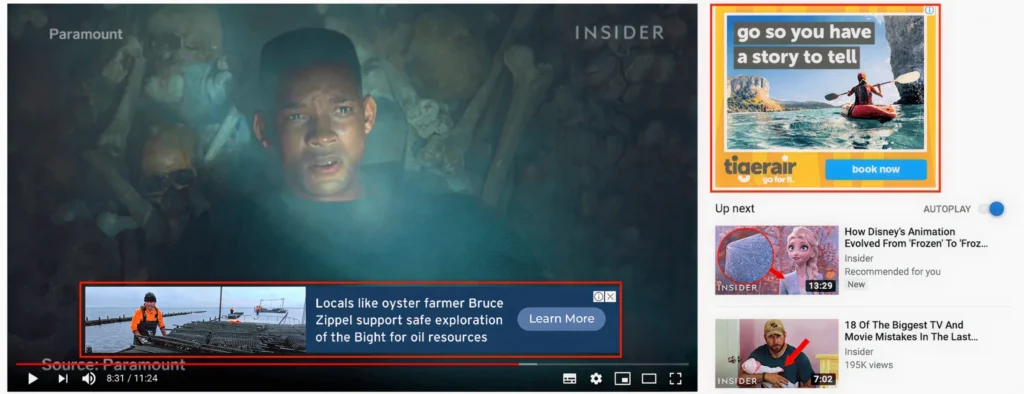
The IAB envisions three main video ad formats:
Linear video ads are displayed before, during or after the video content, much like commercials on TV.

Non-linear video ads run concurrently with video content so users see the ad while viewing the content.
Companion ads include text, images or rich media that don’t interrupt video experience.
Where are video ads shown?
Video ads can be displayed across a number of advertising channels and mediums, including:
- In web browsers on laptops and mobile devices
- In mobile apps (in-app video ads)
- On over-the-top (OTT) devices
What AdTech platforms are involved in serving video ads?
Serving a video ad requires coordination between multiple AdTech platforms that connect advertisers, publishers, and audiences. These platforms handle different parts of the process, from buying and selling video inventory to delivering creatives, tracking performance, and measuring results. The main technologies involved in video ad delivery include:
Video demand-side platforms (DSP): A piece of software used by media buyers (brands, advertisers and agencies) to purchase video inventory from publishers via real-time bidding (RTB) auctions. These video DSPs work in a very similar way to those used to serve display ads.
The main functions of a video DSP usually include bidding- and campaign-optimization algorithms, behavioral targeting based on third- and first-party data, measurement and attribution, and campaign reporting and analytics.
Video supply-side platforms (SSP): A piece of software used by publishers to aggregate, manage and sell video inventory to media buyers via RTB auctions. Many video SSPs include analytics and reporting, yield management and optimization, and inventory management.
Video ad servers: An AdTech platform that provides advertisers with centralized storage, tracking and delivery of video ads. Ad servers also help publishers manage campaign tags from advertisers and make decisions about which video ads to show.
Video ad networks: A piece of software that aggregates advertising space from various publishers and sells it to advertisers. Most ad networks don’t own the media, they just facilitate the buying and selling process between publishers and advertisers. The exceptions here are walled gardens like Facebook (which also owns Instagram) and Google (which owns YouTube, Blogger, etc).
The video ad serving process
At the core, and from the perspective of advertising technologies involved in the process, video advertising is not much different from display advertising, except for what is displayed on the screen. Video ad serving can be a complex process depending on the number of AdTech platforms involved, as each will need to send and receive ad and bid requests.
Below is a basic overview of how video ads can be served. We use the term “video player,” but it is meant as any device capable of displaying video media with ads.
The steps:
- The user visits a site with a video player, which sends a request to the publisher’s web server to retrieve the video content.
The server responds with code that tells the browser where to get the main video content from and how to format it in the player window.
The video player should support HTML5 video and VAST tags for communication with ad servers. - After the video content is fetched, the video player sends a request to the publisher’s ad server to retrieve a video ad (or at least the advertiser’s ad markup). This process requires sending a VAST request. The publisher’s ad server would also count an impression.
The publisher’s ad server programmatically decides which ad to display in the ad space and sends back the chosen ad markup. - The ad markup loads in the video player and sends a request to the advertiser’s ad server to retrieve the video ad.
The advertiser’s ad server counts an impression and sends back a link that directs to the video ad’s location so it can be displayed to the user in the video player. Most of the time, the video ad would be hosted on a content delivery network (CDN). - The video player sends a request to the CDN. The CDN returns the video ad file and the video ad is shown to the user.
There will often be other AdTech platforms involved in the ad serving process, depending on how the video ad space is sold (e.g. via RTB or direct deals).
The player
As seen in the ad serving process above, the central element of video advertising is the player, which serves as an interface between the video and the user.
In order to display video ads, the player must be able to communicate with ad servers, as well with the page or device. But most devices like OTT or advanced TVs don’t necessarily speak the same language.
This is why a common schema is needed to standardize how ads can be served from video ad servers, and then played in video players across a number of websites (publishers) and on numerous devices (e.g. desktop, mobile, connected TV, tablet, etc.).
Enter VAST.
Video ad serving template (VAST)
VAST (Video Ad Serving Template) is an IAB Tech Lab standard that defines how video players and ad servers communicate. It provides a common structure for delivering video ads, including information about creatives, media files, tracking events, verification scripts, and interactive elements.
The latest major version, VAST 4.3, builds on previous releases by improving support for modern video advertising environments, including connected TV (CTV), measurement, verification, and interactive experiences. Earlier VAST 4.x updates introduced important changes such as separating ad verification from creative files and replacing VPAID-based interactivity with more secure standards.
Why is VAST important for the ad industry?
Without a common standard, every video player and ad server would need custom integrations to exchange information about video ads. VAST simplifies this process by creating a shared framework that allows advertisers, publishers, and AdTech platforms to deliver video ads across different devices and environments.
Key benefits of VAST adoption include:
- Simplified ad delivery through standardized communication between video players and ad servers
- Better support for mobile, OTT, and connected TV environments
- Improved measurement and verification through standards such as OMID
- More reliable interactive experiences through SIMID
VAST also helped move the industry away from VPAID, an older standard that created challenges around transparency, security, measurement, and user experience. While VPAID enabled interactive video ads, its limitations led the industry to adopt newer approaches for interactive functionality.
What does VAST include?
Modern VAST implementations combine several standards that handle different parts of the video advertising process:
- VAST controls video ad delivery. It describes the ad, identifies available media files, defines tracking events, and specifies locations for verification and interactive resources.
- OMID (Open Measurement Interface Definition) supports ad measurement and viewability tracking through the Open Measurement SDK.
- SIMID (Secure Interactive Media Interface Definition) enables interactive video ad experiences and provides a more secure alternative to VPAID.
Together, these standards allow video ads to be delivered, measured, and interacted with consistently across browsers, apps, OTT devices, and connected TV platforms.
How does a VAST request work?
In order to play a video ad, the video player must send a VAST request to an ad server for information about:
- The ad that should be played
- How the ad should be played
- What should be tracked as the ad is played
The VAST request is an HTTP address with a query string like:
http://www.example.com/?LR_PUBLISHER_ID=1331&LR_CAMPAIGN_ID=229&LR_SCHEMA=vast2-vpaid
The VAST inline response contains information like:
- Creative type
- Creative ID
- Creative dimensions
- Location of assets
- Tracking URLs
- What happens, for example, when the creative is clicked
Once the specified events have occurred, the video player will fire the tracking pixels to track impressions and other metrics.
FAQ
Video advertising continues to evolve with new technologies
Video advertising has grown into a complex digital ecosystem where advertisers, publishers, and AdTech platforms work together to deliver relevant video experiences across websites, apps, streaming services, and connected TV. Understanding the different video ad formats, the role of platforms like DSPs and SSPs, and the technical standards behind ad delivery is essential for creating effective campaigns.
As the industry continues to evolve, standards like VAST help make video advertising more scalable, measurable, and consistent across devices and platforms. By combining the right formats, technologies, and targeting strategies, businesses can create video ad campaigns that reach audiences and support their broader marketing goals.
If you’d like to explore how video advertising could support your business goals, contact us today — we’ll help you navigate formats, platforms, and the latest standards with ease.



Your business results matter
Achieve them with minimized risk through our bespoke innovation capabilities. Fill in the form below.