



AI in product development: How AI changes product design and the development cycle

October 7, 2026 11 min read 19 views
A product team has 8,000 customer comments, three months of usage analytics, six competing concepts, and a deadline approaching. Traditionally, people would work through those inputs in stages. Research first. Ideation next. Then prototypes, testing, development, launch, and iteration.
AI can change the amount of work teams can process at every stage. AI in product development can analyze customer feedback, generate product concepts, create prototypes, support software development, run tests, compare design alternatives, and detect patterns after launch. Generative AI adds another layer by producing text, code, images, specifications, and design variants from natural-language instructions.
Adoption is already visible. A 2025 survey found that 71% of surveyed organizations regularly used generative AI in at least one business function, with product and service development among the most common areas. Its separate 2025 work on software products describes AI use across the end-to-end product development lifecycle, not only coding. The bigger question is where AI genuinely improves the product development process and where human judgment still matters.
Key takeaways
- AI can support every stage of product development. Research, ideation, product design, prototyping, testing, development, launch, and iteration can all use AI tools.
- Generative AI and predictive AI solve different problems. Gen AI creates or summarizes information, while predictive AI models identify patterns and estimate likely outcomes.
- AI is most useful when connected to real product data. Customer feedback, usage analytics, testing results, requirements, and engineering data give an AI system relevant context.
- Automation should not replace product judgment. Product managers still decide what problem deserves investment and which trade-offs are acceptable.
- Quality controls remain necessary. AI-generated designs, code, tests, and recommendations need validation before they affect users or production systems.
- Measure the development outcome. Cycle time, defect rate, experiment throughput, research time, and product quality are stronger measures than the number of AI tools adopted.
Avenga’s product engineering services cover the design and development of digital products from initial product concepts through engineering, testing, launch, and continued improvement.
What is AI in product development?
AI in product development means using artificial intelligence to support activities across the product development lifecycle. The term covers several AI technologies:
- Generative AI
- Machine learning
- Predictive analytics
- Natural language processing
- Computer vision
- AI agents
- Simulation
- AI-assisted design tools
- Test automation
A 2025 overview notes, companies are applying AI across research, ideation, design, prototyping, testing, building, launch, and iteration. This means AI product development is broader than building products that contain AI. A company may build a conventional software product while using AI to analyze requirements, generate tests, or assist developers. A manufacturer may use AI to compare product designs even when the final physical product contains no AI system at all.
Using AI in product development across the lifecycle
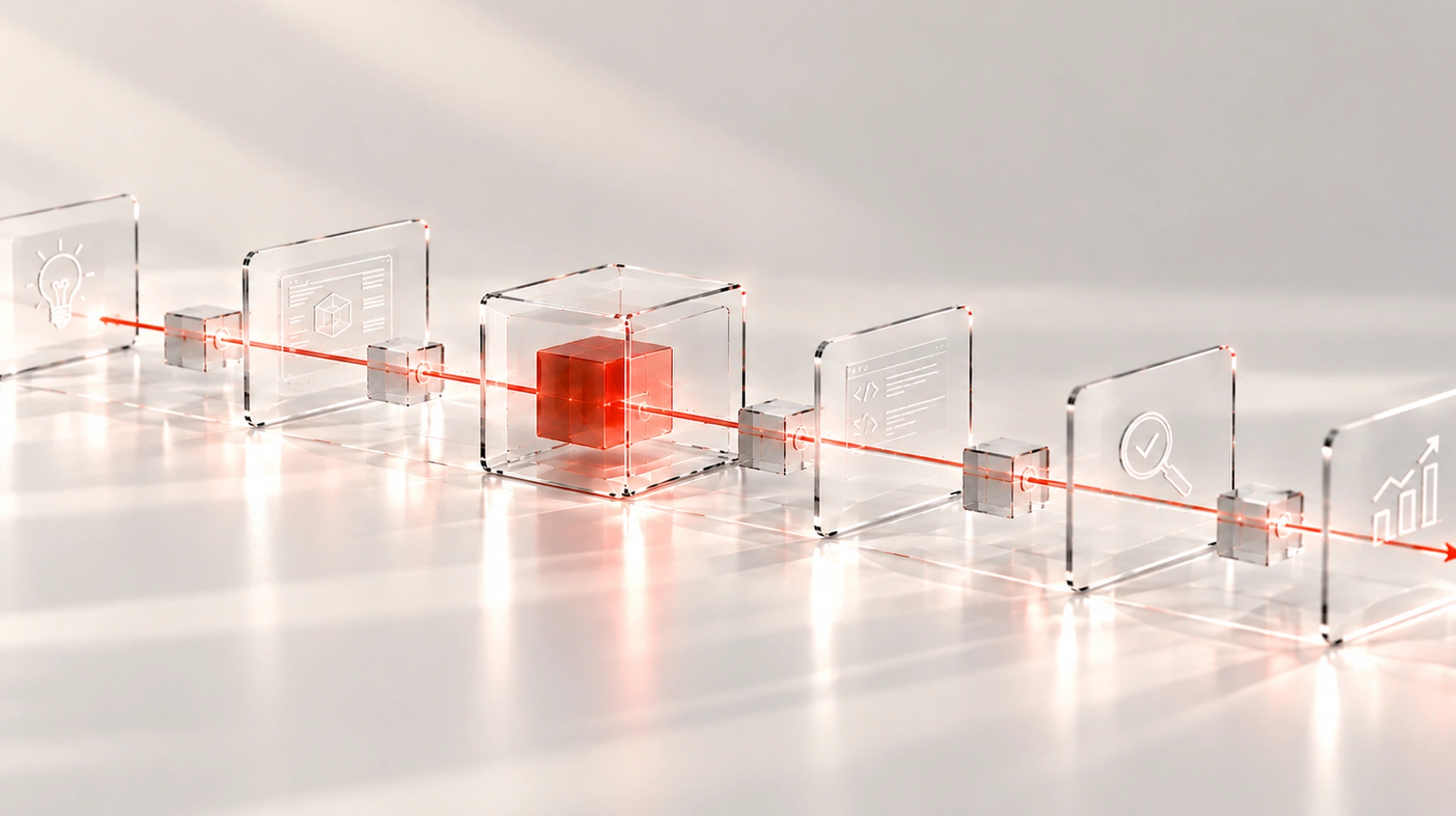
The value of AI changes at every stage of product development.
1. Research and discovery
Product managers often begin with large amounts of qualitative and quantitative information. AI tools can help review:
- Customer interviews
- Support tickets
- Product reviews
- Survey responses
- Market research
- Social media
- Usage analytics
- Competitor information
Generative AI can summarize recurring themes. Machine learning can identify patterns across larger datasets. This can help teams discover new product ideas faster, but the result still needs interpretation. Frequency does not automatically equal importance.
2. Ideation
The ideation stage of product development involves turning research into possible responses. Gen AI can produce alternative concepts, user journeys, feature ideas, value propositions, and early specifications. AI tools help teams create more options quickly. The benefit is not asking AI to choose the winning idea. It is widening the space the development team can examine before deciding what deserves investment.
3. Product design and prototyping
AI is changing product design by reducing the effort required to create and compare alternatives. For digital products, teams can generate:
- Wireframes
- Interface variations
- User flows
- Mockups
- Prototype copy
For physical products, AI-enhanced computer-aided design and simulation can compare geometry, materials, weight, performance, and other design constraints. Current work on AI product design describes AI as supporting both digital and physical design processes, including UX and machine-learning-based evaluation. This is one area where AI enables faster iteration without removing the designer from the process.
4. Software product development
AI has become particularly visible in software development. Teams can use AI for:
- Requirement analysis
- Architecture research
- Code generation
- Refactoring
- Unit tests
- Test data
- Documentation
- Debugging support
- Code review
- Issue summaries
A 2025 analysis of AI-enabled software development argues that the larger opportunity comes from applying AI across the entire software product development lifecycle rather than focusing only on developer productivity. That means AI integration can support product managers, designers, developers, QA engineers, and operations teams within the same development pipeline.
5. Testing and product quality
AI can help teams generate test cases, detect anomalies, prioritize regression testing, and analyze failure patterns. For physical products, simulation can reduce the number of physical iterations required before a design reaches more expensive validation stages. For software, AI testing does not remove conventional QA.
Generated tests can contain the same incorrect assumptions as generated code. Ensuring product quality still requires explicit acceptance criteria, deterministic checks, security testing, and human review. Avenga’s Quality Assurance services support functional, automated, performance, and other testing activities throughout development.
6. Launch and iteration
Product development does not stop at release. After launch, AI can analyze:
- Product usage
- Customer feedback
- Churn signals
- Support issues
- Experiment results
- Conversion behavior
- Performance problems
These inputs can feed the next product development cycle. The use of AI at this stage helps teams distinguish isolated feedback from patterns affecting a larger group of users.
Connect AI with product discovery, engineering, testing, and real development workflows.
Benefits of using AI across the product development process
The benefits of using AI depend on what teams do differently, not simply whether they have access to AI tools.
More research processed in less time
AI can help product teams examine more customer information than people can reasonably review manually. This gives product management a broader evidence base before making decisions.
Faster experimentation
Generating product ideas and prototypes becomes less expensive when initial variants can be produced quickly. Teams can reject weak concepts earlier.
Shorter development cycles
AI can help with documentation, coding, testing, analysis, and repeated engineering work. 2025 research identifies productivity and cycle-time improvement as important AI opportunities within R&D and product development.
Better use of specialist time
Removing repetitive tasks gives designers, engineers, and product managers more time for trade-offs that require context. AI helps with preparation. People remain responsible for deciding what to build.
More continuous feedback
AI can process product signals after launch and connect them back to development workflows. That creates a tighter loop between product use and the next development cycle.
Generative AI, predictive AI, and AI agents in product development
Not every AI tool performs the same role.
| AI approach | Product development use |
| Generative AI | Concepts, specifications, mockups, code, documentation |
| Predictive AI | Demand, behavior, defects, performance, market response |
| Machine learning | Classification, pattern detection, recommendation |
| AI agents | Multi-step research, engineering, testing, or operational tasks |
| Computer vision | Visual inspection, prototypes, manufacturing quality |
The right approach to product development can combine several of these methods. For example, a team might use predictive AI models to estimate product demand, generative AI to create interface concepts, and an AI agent to coordinate a repeated research workflow. Trying to leverage AI for every task usually adds unnecessary complexity.
How to integrate AI into development processes
Incorporating AI in product development should start with the current workflow.
Identify the bottleneckIdentify the bottleneck
Map where product work slows down. Is research taking weeks? Are prototypes expensive? Is testing delaying releases? Do developers spend too much time on repetitive work? That gives AI a defined purpose.
Establish a baseline
Record the current cycle time, defect rate, cost, or another relevant metric. Without a baseline, it is difficult to tell whether AI enhances the process.
Choose the right AI model and tool
An AI model should fit the task. Do not use generative AI where a deterministic algorithm produces a more reliable result.
Protect product and customer data
AI tools may receive requirements, code, intellectual property, research, customer feedback, or proprietary designs. Teams need clear rules for what information can enter external AI systems. Avenga’s cybersecurity services can support security controls around AI-enabled product environments.
Validate AI output
Define which work requires review. A product concept can tolerate experimentation. Production code affecting payments requires much stricter verification.
Measure the outcome
Compare the AI-supported workflow against the original baseline. If the team produces twice as many prototypes but spends longer reviewing weak ones, the new process is not necessarily better.
Risks of AI-powered product development
AI is revolutionizing parts of the development cycle, but the technology introduces its own failure modes.
Incorrect output
Generative AI can produce plausible but inaccurate information. The same problem applies to requirements, product research, generated code, and tests.
Weak differentiation
If every development team uses similar models to generate product ideas, AI can push products toward similar answers. Human research and domain knowledge remain important sources of differentiation.
Intellectual property questions
Teams need policies covering proprietary inputs, generated outputs, training data, and ownership.
Bias
AI algorithms can reproduce bias from training data or historical product information. This matters when products affect people differently according to demographic or behavioral characteristics.
Automation without understanding
AI can help teams move faster in the wrong direction. Poor requirements processed faster remain poor requirements.
AI works best in product development when teams use it to remove repetitive work and examine more options without handing over the product decisions that require context. The goal is not maximum automation. It is giving designers, engineers, and product managers better ways to test assumptions before those assumptions become expensive.
Olena Domanska, AI Engineering Manager at Avenga
How AI is changing the future of product development
AI is being integrated across the product lifecycle rather than remaining a separate specialist tool. 2025 product research points to growing use of GenAI in market research, decision support, and product work, while agentic AI adds systems capable of performing longer sequences of tasks.
The next shift is likely to involve AI across the product development workflow. An agent could collect user feedback, group recurring issues, compare them with product analytics, prepare candidate requirements, and create an initial prototype brief. Another could assist engineers with implementation and testing.
That does not make the development team redundant. It changes where people spend their time. Product teams will need stronger skills in problem definition, evaluation, system thinking, data, AI oversight, and decision-making. The capabilities of AI increase the importance of knowing which decisions should remain human.
FAQ
Conclusion: AI changes the product lifecycle, not the need for product judgment
AI can participate in almost every phase of product development. It can analyze research, propose ideas, generate designs, assist engineers, create tests, simulate behavior, and review product signals after release. That does not mean every stage should be automated. The strongest AI-driven product development model assigns work according to what each participant does best. AI processes large volumes of information and generates alternatives quickly. People define problems, understand context, make trade-offs, and remain accountable for what reaches customers.
Start with one bottleneck in the product development lifecycle. Measure the current process. Apply AI where it can change that metric. Validate the result. Then expand across the product only when the evidence supports it. If your organization is integrating AI into product engineering or redesigning development processes around new AI capabilities, contact Avenga to discuss the engineering work.

Data warehouse architecture: How to design modern data warehouses

Your business results matter
Achieve them with minimized risk through our bespoke innovation capabilities. Fill in the form below.