






Making supply chain digital transformation resilient with AI

August 10, 2026 9 min read 222 views
For most of the past decade, supply chain programs have concentrated on digitizing operations and automating repetitive processes. Those investments remain sound, but they no longer address the newly emerged conditions. Disruption has become a standing feature of the environment rather than an exception to it. The objective has moved from efficiency to resilience. Artificial Intelligence (AI), and increasingly Agentic AI, is what organizations now rely on to close the distance between recognizing a challenge and responding to it. According to the MHI and Deloitte Annual Industry Report, 48% of supply chain executives rated AI’s disruptive impact as significant or greater. We’re entering a new era of challenges and opportunities in supply chain transformation.
Digital transformation is no longer merely a technology project
The definition of digital transformation has expanded beyond mere technology adoption. Not that long ago, transformation efforts were measured by system implementations, cloud migrations, or process automation projects completed on time and within budget. Success was closely tied to modernizing IT infrastructure and replacing manual workflows with digital tools.
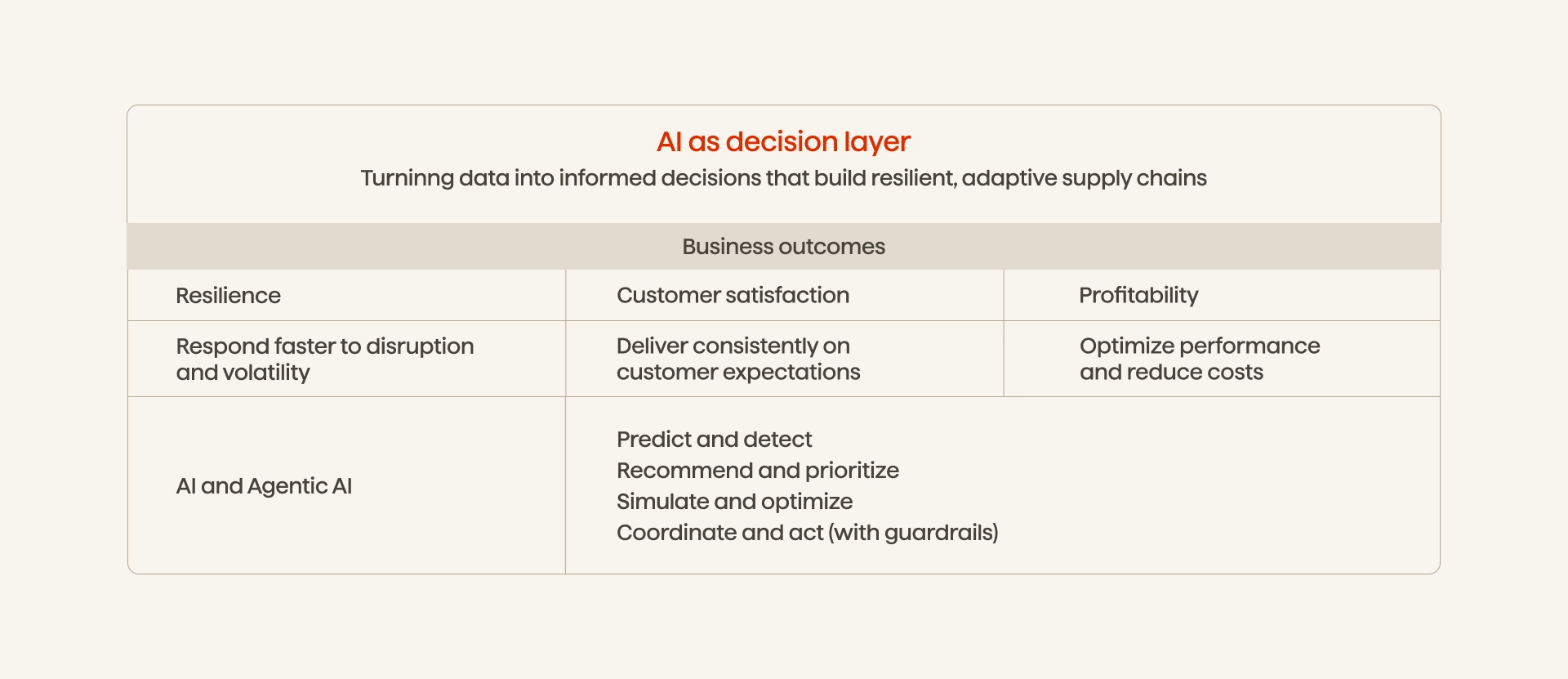
Today, enterprises expect digital technologies to produce tangible business outcomes. Digital transformation is increasingly evaluated by how well an organization adapts to unexpected events and maintains operations during disruptions. Due to an inherently critical connection of supply chains to profitability and customer satisfaction, they now become a central point of attention.
This shift reflects a broader understanding of transformation. Technology alone cannot serve the purpose of elevated resilience. Organizations need to connect the dots in the puzzle where intelligent decision-making and the ability to coordinate actions across the supply chain ecosystem, from procurement and manufacturing to logistics, inventory management, and customer service, play an equally important role. One of the game-changers in this regard is AI, a key enabler of moving from simply collecting data to acting on it.
Modern supply chains face challenges that conventional automation cannot solve
The maze of the global supply chain has become increasingly complex. Global sourcing strategies. Multi-tier supplier networks. Volatile demand. Labor shortages. Environmental events. All introduce uncertainty that traditional planning methods struggle to manage. Even well-established organizations often rely on fragmented data, which is spread across enterprise resource planning (ERP) systems, warehouse management platforms, transportation systems, or supplier portals.
The major challenge in this case is that, in a traditional supply chain, conventional automation performs well when processes follow predictable rules. Solutions can create purchase orders, process invoices, or trigger inventory replenishment based on predefined thresholds. However, these systems become less effective when conditions change unexpectedly. They cannot easily evaluate competing priorities, interpret unstructured information, or recommend the course of action during situations that unfold in an unpredictable way.
Many supply chain teams, therefore, spend considerable time gathering information before they can even begin making decisions. By the time data has been consolidated, the situation may already have changed. This delay increases operational risk and narrows supply chain visibility at the moment it matters most.
AI creates opportunities for next-generation automation
AI changes the role of digital transformation. It redirects attention towards decision quality rather than process automation alone. Instead of replacing individual manual activities within each supply chain process, AI analyzes large volumes of structured and unstructured data to highlight emerging risks that could be hidden in the depth of data from various sources.
Demand forecasting is the most immediate example. Traditional forecasting models are rooted primarily in historical sales data. AI models can incorporate a much wider range of inputs, including market signals, weather conditions, promotional activity, economic indicators, and supplier performance. It results in a more accurate view of supply and demand that creates opportunities to reduce shortages and excess stock, as well as optimize inventory levels.
AI also strengthens supplier risk management. It can gather information from a wide ray of sources (e.g., financial reports, regulatory announcements, shipping disruptions, or geopolitical developments), identifying suppliers and routes that may require closer monitoring. Procurement teams, due to this advantage, gain earlier visibility into potential disruptions and have more time to evaluate alternative sourcing strategies.
Supply chain planning also benefits from AI-driven optimization, particularly in logistics. Rather than relying on static routing plans, AI can recommend adjustments based on changing transportation capacity, delivery priorities, fuel costs, or weather conditions. The effort required to improve efficiency without compromising service reliability falls accordingly.
Agentic AI introduces a new operating model for supply chain management
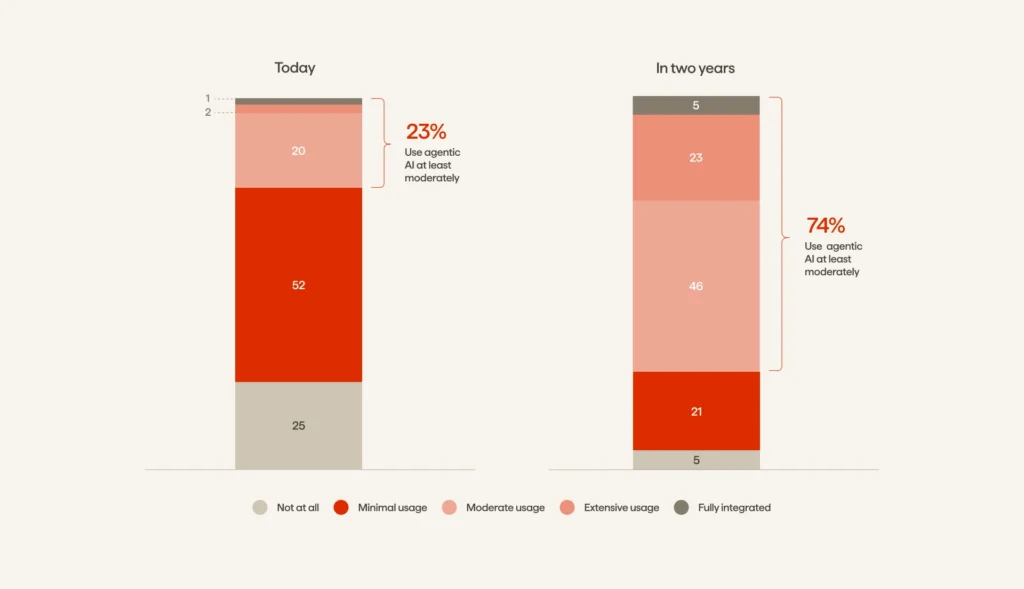
Agentic AI embodies the next stage in the evolution of supply chain technologies. New systems can reason, coordinate multiple activities, and execute approved workflows with limited human intervention. As a Deloitte study highlights, 74% of businesses expect to use Agentic AI at least to a moderate extent in the next two years.
This distinction becomes particularly valuable during supply chain disruptions. For example, during an unexpected supplier outage, a conventional AI system may pinpoint the risk and estimate its impact. An Agentic AI system can go further: evaluate alternative suppliers, review available inventory, assess transportation options, estimate financial implications, and recommend an optimal response based on priorities. Where a digital twin of the network exists, each option can be tested against modeled conditions before one is put forward.
Multiple AI agents can also collaborate across different business functions. One agent may monitor supplier performance, another optimize production schedules, while a third evaluates logistics capacity. They can continuously exchange information and coordinate recommendations that reflect the state of the entire supply chain.
Data quality and governance determine whether AI creates value
In the age of AI, data is the backbone of digital supply chain management. To maintain parity with rapid innovation, organizations prioritize data integration, standardization, and governance to scale AI across supply chain operations. A helicopter view of inventory, suppliers, production, transportation, and customer demand allows AI models to generate more reliable insights.
Governance is equally important. Enterprises establish clear policies for data ownership, model transparency, security, and regulatory compliance. Integrating digital technologies into operational decision-making raises the requirement further: organizations need confidence that recommendations can be explained, validated, and audited when necessary.
Resilience requires measuring different outcomes
Supply chain leaders are rethinking how they measure performance. Traditional KPIs such as transportation costs, inventory turns, and on-time delivery remain important, but they provide only a partial picture of operational health. They primarily measure efficiency under normal operating conditions rather than an organization’s ability to respond to disruption.
Resilient supply chains require additional metrics that reflect adaptability and effectiveness of decisions. These include disruption response time, forecast accuracy, supplier risk exposure, planning cycle duration, scenario readiness, and decision latency. Together, these indicators provide a clearer understanding of how well an organization can anticipate, absorb, and recover from unexpected events.
AI makes these metrics more actionable as it continuously monitors operational conditions and discovers changes as they occur. Instead of relying solely on periodic reporting, organizations gain real-time visibility into emerging risks and performance trends. This allows leaders to intervene earlier, evaluate alternative scenarios, and allocate resources before problems escalate.
Where AI applies across the supply chain
| Area | What AI adds | What Agentic AI adds |
|---|---|---|
| Demand planning | Forecasts from market signals, weather, and promotions alongside sales history | Adjusts replenishment parameters as accuracy shifts by segment |
| Procurement | Scores supplier risk against financial, regulatory, and logistics signals | Qualifies alternatives and prepares the sourcing case before the failure occurs |
| Inventory | Identifies imbalances across locations and slow-moving stock | Rebalances between sites within agreed cost and service thresholds |
| Logistics | Recommends routing changes as capacity, cost, and conditions move | Rebooks and reprioritizes shipments, escalating only exceptions |
| Manufacturing | Predicts equipment failure and quality deviation | Sequences production against material availability and order priority |
The organization sets the thresholds within which these actions occur, and decisions with material financial or contractual consequence remain subject to human approval.
FAQ
Supply chain digital transformation in the age of AI
Supply chain digital transformation is no longer defined by how many processes have been digitized. It tackles the question of “How effectively can we as an organization adapt when conditions change”? AI provides the intelligence needed to improve decisions and ensure instantaneous response to unpredictable conditions. A supply chain strategy that combines these technologies with strong data foundations, responsible governance, and business-focused performance metrics will leave the enterprise better positioned to maintain resilience in an increasingly volatile global environment.
The organizations that respond fastest to disruption are the ones whose data was ready before the disruption arrived. Avenga designs the data and AI foundations that shorten the distance between a signal and a decision: start a conversation.


Your business results matter
Achieve them with minimized risk through our bespoke innovation capabilities. Fill in the form below.