






Subscription billing integration for your enterprise


August 10, 2026 10 min read 205 views
Modernizing the billing system directly influences how telecommunications companies introduce new offers, generate revenue, and interact with customers. A coherent platform allows billing, client relationship management, payments, network information, and financial operations to communicate within a single workflow. Standardized application programming interfaces enable seamless exchange of information, reducing time lost and avoiding duplicate work. Automation helps with charging, issuing invoices, collecting payments, updating accounts, and activating services at every stage of the customer journey.
Subscription billing and payment integration key takeaways
- The modernization of billing enables telecom companies to minimize labor use, billing errors, revenue losses, and operational costs.
- The integrated billing system integrates billing with customer relationship management (CRM), payment information, accounts, and customer details.
- Modern billing systems enable companies to make fixed and variable payments, implement one-off fee structures, use subscriptions, and combine services.
- Long-term ROI comes from process automation, faster product launches, improved revenue generation, and better payment collection.
The legacy billing problem
Legacy billing systems were developed for a simpler telecom environment. They were useful when providers handled fixed plans, consistent usage, one-time fees, and regular monthly bills. For example, a regional broadband provider with affordable prices, annual contracts, and few product changes could have its operations running correctly with such a setup. The billing system was responsible for generating bills and calculating charges.
The problems arise from the complexities inherent in service portfolio management and processing. Telecom operators today face the challenge of managing subscriptions, bundles, prepaid and postpaid plans, usage-based pricing, partner services, IoT connectivity, and digital offerings. Each of these models involves different sets of rating rules, payment processes, discounts, tax, renewal processing, and customer lifecycle events. Although older billing systems can handle invoice processing, they cannot integrate with CRM systems and data related to customer support, payment processing, finance, and service activation.
For a closer look at rating, charging, invoicing, payment gateways, and revenue assurance, see Avenga’s guide to telecom billing software systems.
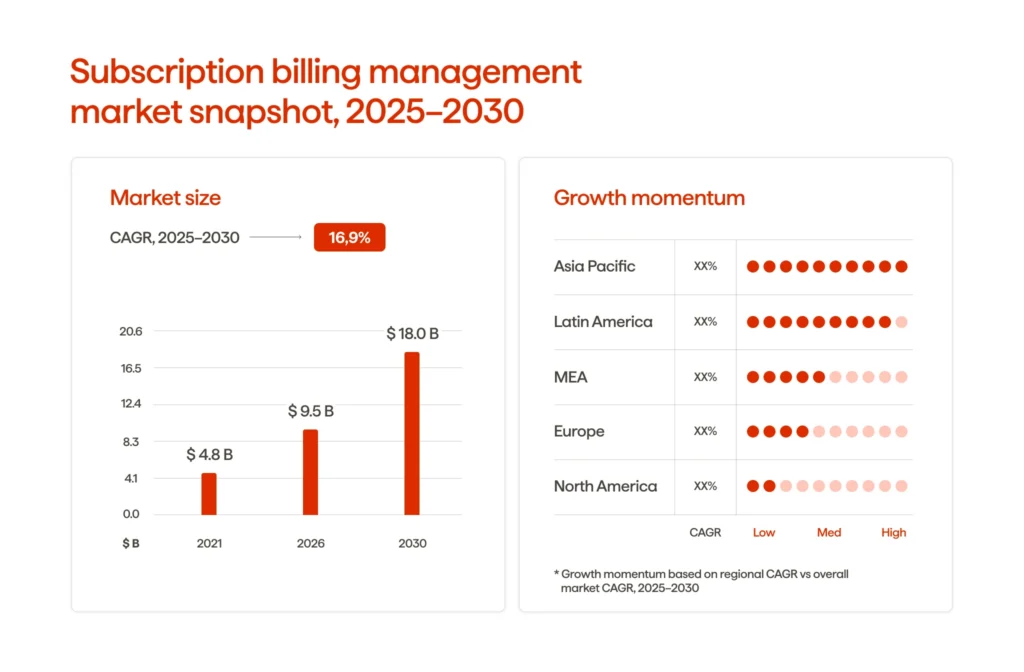
In line with this change, the steep escalation of the subscription billing management market can be understood. The sector’s value was approximately USD 7.2 billion in 2024 and is expected to increase from USD 9.5 billion in 2026 to USD 18.0 billion in 2033, with a CAGR of 16.9% between 2025 and 2033. It is clear from the statistics that billing is transforming into a strategic layer of infrastructure, directly tied to the speed of revenue generation, automation, application integration, and user experience.
Legacy billing vs modern billing solutions
| Parameter | Legacy billing system | Modern integrated billing platform |
|---|---|---|
| Product setup | Requires custom work for new offers | Enables faster configuration through product catalogs |
| Pricing models | Best suited for fixed plans and recurring charges | Supports subscriptions, usage-based pricing, bundles, discounts, and one-time charges |
| CRM connection | Often uses delayed or partial synchronization | Connects customer, billing, and service data seamlessly |
| Payment gateway integration | Limited payment flows and manual follow-up | Supports automated payments, retries, collections, and status updates |
| Workflow | Fragmented across billing, support, finance, and operations | Creates a connected workflow across the customer lifecycle |
| Automation | Depends on manual checks and batch processing | Helps automate rating, invoicing, renewals, collections, and account updates |
| User experience | Can cause billing delays, unclear charges, and support handoffs | Enables faster updates, clearer billing, and smoother service changes |
| Application integration | Relies on costly point-to-point connections | Uses API-based integration with CRM, ERP, OSS/BSS, and partner systems |
The fundamental issue is architectural compatibility. Legacy systems still provide stable operations. However, they act as a brake on return on investment for telecom companies seeking fast launches, flexible pricing, automated workflows, and integrated customer data.
We unify your platforms, data, and operations – driving agility, reliability, and measurable gains across every layer of your telecom ecosystem.
Key components of a TMT integrated billing platform
TMT’s all-in-one billing solution integrates payment processing, invoicing, payments, and client data. The system supports automated billing and sophisticated billing management to process recurring payments and keep customer-related information linked within a single system. The right billing software solution is tailored to the specific characteristics of TMT companies, resulting in faster service launches, reduced leakage, and lower churn rates.
Convergent charging and billing
The concept behind convergent charging is that different types of services can all be charged through a single billing process. Examples include prepaid, postpaid, and hybrid plans; pay-per-use services; subscriptions; bundles; roaming; IoT connections; and one-off charges. TMT companies need this capability because it is common for customers to have multiple services under a single account.
A modern system can calculate charges, apply discounts, compute tax, and enable near-real-time or even real-time charging across all services. The platform provides the ability to automate billing events such as generating invoices, updating accounts, setting up various types of notifications, reminders, and bill payment alerts, and charge notifications.
Product, customer, and subscription management
An effective billing solution must incorporate a dynamic product repository, appropriate customer account configuration, and subscription management infrastructure. Teams need the ability to set up plans, bundles, add-ons, promotions, agreements, and entitlement criteria without extensive development time.
Entitlement management is vital for digital services, online streaming, and SaaS systems, as well as premium telecom services, enabling the definition of the scope of services clients are entitled to, when access starts and stops, and how it affects the billing process. With the ability to connect billing information to the customer relationship management service, support teams can retrieve data on the plan, billing status, services, renewals, and billing scheme directly for the client.
Avenga’s work on a global SMS-enabler platform shows how API connections, account functions, and communication services can support large-scale digital offerings across mobile networks.
Revenue management and financial operations
Revenue management involves billing, recurring payments, collections, refunds, tax calculations, partner settlements, and revenue security. An efficient billing system enables businesses to manage billing activities with minimal manual intervention.
Some features that help preserve cash inflows include automated payment retries, dunning processes, notifications of unsuccessful payments, credit control, and reconciliation. These options help avoid losses from various causes (missed transactions, incorrect discounts, invoicing issues, etc.), which is especially important for TMT companies working with partners, resellers, or content providers.
Real-time analytics and business insights
Using billing data, businesses can gain an overview of their revenue, learn about customer habits and preferences, assess risk, and forecast potential churn. With real-time analytics, businesses can understand their most successful plans, identify where money is being lost, find customers at risk of cancellation, and pinpoint payment issues to address.
Integration and scalability
An integrated billing system should easily integrate with CRM, ERP, OSS/BSS, payment processors, tax engines, customer portals, partner systems, and analytics solutions. API architecture enables moving forward with such a system implementation as the business scales its operations.
Equally important is system scalability. TMT companies need billing systems capable of handling expanding offerings and increasing transaction volumes while launching new digital products and adapting to changes in operational models. Scalable billing systems enable faster time-to-market for new products, automate more processes, and reduce the complexity of billing operations without a proportional increase in costs.
Avenga’s article on modern OSS and BSS architecture explains how billing, product, customer, provisioning, and network information move across the telecom service lifecycle.
Operational cost reduction opportunities
Savings usually arise from reduced error rates, quicker processing times, better integration, and smaller reliance on custom support.
- Automation of manual billing processes
Modern billing systems can automate rating, invoice preparation, tax calculation, renewals, repeated payments, retries, and messaging. All of this helps reduce processing time and minimize human error. - Reducing billing errors and dispute handling
Billing mistakes such as improper charges, late bills, unaccounted-for discounts, and vague compliance terms lead to support requests and bill adjustments. A modern billing system should unify billing policies, apply the same rules consistently, and provide accurate account information to support staff. - Facilitating application integration
Legacy systems depend on customer relations, payment systems, general business resources, and operational support services, which connect them to consumer portals via a point-to-point connection. Using an API-based system makes it less expensive to maintain and easier to modify workflows as the product, pricing, or partners change. - Lowering support workload through a better UX
When customers have an unclear bill, need to update payment information, use services, or check their account status, they turn to customer support. By ensuring that billing is clear, allowing customers to make service changes on their own, and sending proactive alerts, the number of unnecessary support calls can drop significantly. - Improving collections and payment recovery
Dunning automation, payment retries, payment-failure notifications, and real-time payment status updates lead to increased revenue and reduced manual intervention. This is crucial for subscription, prepaid, postpaid, and usage-based services. - Reducing custom development for new offers
Traditional billing methods are built around manual implementation when new pricing schemas are introduced. The advent of configurable products has empowered business units to launch product offerings faster than traditional billing systems. - Preventing revenue leakage through better control
Revenue can be lost due to missing invoices, erroneous discounts, inactive subscriptions, failed payments, or inactive partner settlement logic. Contemporary billing systems enable the identification of these issues much earlier through automated checks, reports, and revenue assurance workflows.
The long-term ROI of a unified financial ecosystem
The long-term benefits of integrated billing include improved profitability through cost savings, revenue recovery, faster payments, and reduced churn. Integrated billing systems link billing to CRM, finance, support, and payment systems, enabling service providers to influence their entire revenue cycle.
A simple calculation will show the effect. Consider a provider with 500,000 subscribers, $20 ARPU, and $120 million in annual revenue. If the company loses 3% of revenue per year due to billing errors, missed payments, and other factors, this would result in total losses of about $3.6 million. If leakage is reduced through integrated billing to 1.5%, the company would restore nearly $1.8 million in revenue annually.
You can also achieve higher ROI with lower business expenses. For instance, if your billing operations cost $2 million per year, and because of automation, you save 25% of that, you will end up spending $500,000 less than before. The saved money can also increase if there are fewer invoice problems, issues are resolved faster, and optional payment options are offered, leading to a 0.5% reduction in billing-related churn. You may save another $600,000 of retained revenue each year.
The annual financial effect in this case is around $2.9 million. If the modernization efforts cost $4 million, the amount gained over three years will be $8.7 million, resulting in a net return of $4.7 million and an ROI of about 117%.
FAQ
Billing application is a cornerstone for a better customer experience
Telecommunication companies benefit from billing innovation by optimizing revenue management, reducing workload, and enhancing financial oversight. With greater API compatibility and less reliance on custom integration, operators can offer their services sooner while synchronizing the billing, CRM, payments, and finance departments. Companies also gain long-term advantages from automation, cleaner data, fewer leaks, and more reliable revenue recognition through partnerships with telecommunications companies that are developing service portfolios.
Want to learn more about how to streamline and manage billing for your business? Contact Avenga, your trusted technology partner.



Your business results matter
Achieve them with minimized risk through our bespoke innovation capabilities. Fill in the form below.