




Retail customer experience in 2026: Differentiate wisely with Avenga

June 5, 2026 12 min read 176 views
Retail is highly competitive, so stores can’t just lean on low prices or a lot of choices to win people over anymore.
What really makes a difference now?
Giving customers a smooth, personal, and unforgettable experience every step of the way. That’s what keeps shoppers coming back. With 86% of consumers indicating they are willing to pay higher prices if they have a better experience, and customers who rate their experiences as 10/10 spending 140% more and being loyal for up to 6 times longer than those who rate their experience lower; this elevates the importance of customer satisfaction, customer feedback, and a singular view of the customer beyond just service metrics.
In this retail customer experience guide, we’ll review ways retailers can turn their experience innovation into a measurable competitive differentiator.
Customer expectations key takeaways
- Connecting your customers’ digital and physical journeys is essential to delivering a holistic customer experience program as part of a strong retail CX model.
- Creating a personalized customer experience, improving accessibility through chatbots, and building connected stores are now the cornerstones of retail success. These tools increase relevance and reduce friction, improving customer retention for retailers.
- Retailers must gather customer insights from both online and offline channels to stay competitive.
- To truly unlock the value of your CX efforts, retailers must measure customer experience against satisfaction, loyalty, conversion, and repeat purchasing. Retailers can then utilize these results as they build on their CX program moving forward.
Why retail customer experience is now the real competitive edge
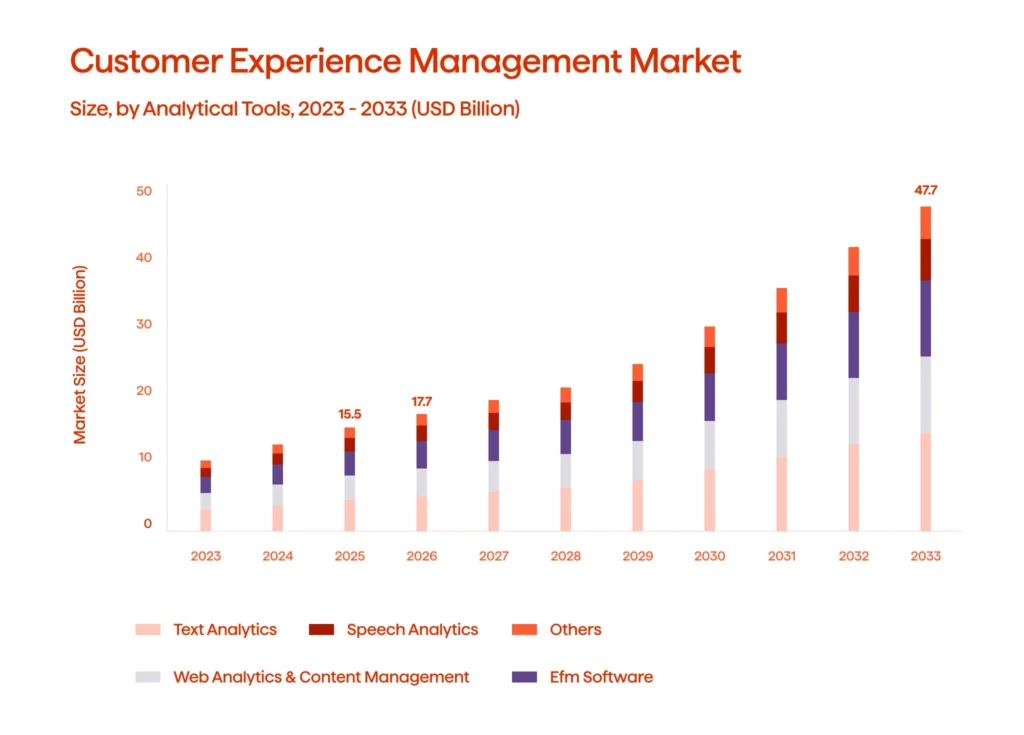
Statistics suggest a strong shift in consumer purchasing behavior. The Customer Experience Management market was valued at $15.55 Billion USD in 2025. It will increase to $47.72 Billion USD by 2033, growing at a compounded annual growth rate (CAGR) of 15.2% from 2026 to 2033, as more businesses realize that providing great customer experiences gives them a competitive edge in highly competitive, digitally mature environments.
Today’s customers navigate through all kinds of channels with no concern for which channel they are currently using. Customers will search for items on mobile devices, shop on marketplaces, read reviews, check whether items are in stock at a retail location, and then expect a seamless transfer of their activity when entering a store or speaking with support representatives. Thus, in the context of retail, experience has shifted from being simply the branding layer that creates a unique identity to an operational discipline. A positive experience is measured through multiple sets of performance metrics that evaluate customer convenience, personalization, fulfillment speed, product discovery, and post-purchase service to determine whether an interaction is positive or negative.
Increasing competitive pressure leads to new benchmarks for customer experiences across all industries, not just those directly related to retail. Nowadays, customers objectively evaluate retailers based on how they interact with businesses digitally, compared to other digital companies they’ve interacted with. As a result, retail brands that do not take customer needs into account will have difficulty increasing customer loyalty because retailers continue to operate stores, apps, services, and loyalty programs as individual silos.
The rise of phygital retail: blending digital retail with the in-store experience
The speed and relevance of a digital experience are brought to the store floor by phygital retail. Retailers used to keep e-commerce and physical stores apart. They believed that e-commerce was merely a convenience feature, while physical storefronts were the traditional means of showcasing goods and closing deals. Things are now different. Customers now demand that retailers combine the two. No matter where they purchase, consumers want easy-to-use customer service, personalized bargains that appear on their phones, and real-time information. Customers only want a seamless experience from their initial engagement to checkout; they don’t give a damn about the channels.
This change has completely transformed the store’s purpose. No longer is it strictly for sales; now it serves as an order fulfillment center, a service environment, a source of data, and a brand touchpoint, all aimed at enhancing and increasing customer interactions/engagements with the brand.
Common phygital technologies include:
- Cashier-less shopping
- Augmented and virtual reality
- Location-based push notifications
- Live chat and assisted selling
- Personalized content and ads
Phygital retail and omnichannel are not the same, though they are closely connected. Omnichannel retail experience aims to maintain continuity across touchpoints, whereas phygital focuses on enhancing the physical store experience by integrating technology.
How AI-driven personalization turns customer data into better retail CX
The use of AI-powered personalization is most effective when it interacts with customer activity in real time rather than reacting to customers who have been walking around for 2 hours or to customers in broad customer segments. This is what makes AI personalization a valuable benefit for retailers – allowing them to respond to a customer’s intent, timing, and context in ways that make their shopping experience easier and more relevant.
One of the best examples of using AI for real-time triggers is using predictive sending times. A customer who leaves their shopping cart unattended, looks for products in one area at least twice, checks to see if the item is in stock, or stops the checkout process, will trigger the next email or push notification to be sent to them by AI based on their last activity. Retailers will also be able to use AI to predict when the customer is most likely to view an email or click on a push notification to return to the site.
Retailers often use this for:
- cart recovery
- replenishment reminders
- back-in-stock alerts
- browse abandonment messages
- store visit prompts tied to local inventory
This kind of timing improves customer engagement because it feels helpful rather than random.
Similar to hyper-personalization at an individual level, AI can analyze a consumer’s purchase history and browsing behavior to build content based on loyalty data, price sensitivity, and channel influences. A consumer might see a product bundle based on style, whereas another customer could receive styling suggestions. Instead of a discount, a high-value customer may get early access.
u003cspan class=u0022TextRun SCXW255375523 BCX0u0022 lang=u0022UKu0022 xml:lang=u0022UKu0022 data-contrast=u0022autou0022u003eu003cspan class=u0022NormalTextRun SCXW255375523 BCX0u0022u003eTransform operational challenges into strategic advantages with practical, action-ready programs backed by clear reporting and hands-on support from day one.u003c/spanu003eu003c/spanu003eu003cspan class=u0022EOP Selected SCXW255375523 BCX0u0022 data-ccp-props=u0022{u0026quot;134245417u0026quot;:false,u0026quot;201341983u0026quot;:0,u0026quot;335551550u0026quot;:6,u0026quot;335551620u0026quot;:6,u0026quot;335559740u0026quot;:240,u0026quot;335572071u0026quot;:0,u0026quot;335572072u0026quot;:0,u0026quot;335572073u0026quot;:4278190080,u0026quot;335572075u0026quot;:0,u0026quot;335572076u0026quot;:0,u0026quot;335572077u0026quot;:4278190080,u0026quot;335572079u0026quot;:0,u0026quot;335572080u0026quot;:0,u0026quot;335572081u0026quot;:4278190080,u0026quot;335572083u0026quot;:0,u0026quot;335572084u0026quot;:0,u0026quot;335572085u0026quot;:4278190080,u0026quot;335572087u0026quot;:0,u0026quot;335572088u0026quot;:0,u0026quot;335572089u0026quot;:4278190080,u0026quot;469789798u0026quot;:u0026quot;nilu0026quot;,u0026quot;469789802u0026quot;:u0026quot;nilu0026quot;,u0026quot;469789806u0026quot;:u0026quot;nilu0026quot;,u0026quot;469789810u0026quot;:u0026quot;nilu0026quot;,u0026quot;469789814u0026quot;:u0026quot;nilu0026quot;}u0022u003e u003c/spanu003e
Conversational commerce, AI assistants, and real-time customer support
Conversational commerce is focused on helping customers get the assistance they need when they want it. On the other hand, AI-powered shopping helps retailers to show each customer relevant products based on their profile and create a better shopping experience. In addition to receiving relevant services, customers expect timely and effective support throughout their customer journey.
With the help of digital assistants, chatbots, and messaging, retailers can assist customers in finding items, providing delivery updates, and completing purchases in-store and online. By being responsive to their customers, whether online or in-store, retailers offer a hassle-free shopping experience.
The numbers don’t lie: 96% of consumers say good service decides whether they stick with a brand. It’s not enough to just offer round-the-clock support—retailers have to use it as a tool to build loyalty and create an experience that keeps people coming back year after year.
Rethinking the physical store with modular design, AR, and connected journeys
Modular design really changes the game for retailers. There has been a shift in retailing away from a fixed store design toward the ability to create a dynamic, changing retail environment. In addition to having mobile merchandising displays, various display zone categories are now also available as digital signs or can be used with plug-and-play merchandising systems. The fluidity of these systems allows retailers to create new and exciting product assortments for their customers to experience, support the introduction of seasonal products, and enable them to change their store formats based on customer behavior.
AR changes how we shop. Now, you can try on that jacket without leaving your sofa or check if that lamp actually fits in your living room, without guesswork. Lost in a store? AR helps you find your way. Standing in the aisle, you scan a product, and all the info you need pops up. Sales staff aren’t just pointing you to products anymore—they grab their tablets and walk you through options on the spot. Everything feels seamless. You see exactly what you’re getting, you decide faster, and the process just flows, almost like shopping online but with a real-world touch.
To really connect those experiences, shared identity and coordinated journeys are key. Say a customer browses online—when they walk into the shop, the system knows who they are. That means they get personalized recommendations, sales help, or targeted offers right on their phone, all based on their past activity. This is how retail businesses turn scattered moments into exceptional customer service, with results they can actually measure.
| Approach | Technical role | Business value |
|---|---|---|
| Modular store design | Flexible fixture systems, dynamic zoning | Faster format updates |
| AR experiences | 3D visualization, virtual try-on, guided selling | Higher purchase confidence |
| Connected journeys | Identity resolution, journey orchestration, CRM integration | More consistent cross-channel experience |
A practical path to differentiation with experience-led retail innovation
As soon as the shop becomes an extended section of the customer’s journey, differentiated brands transition from being a branding effort to functioning under an operating model. Retailers that will be successful are those who make incremental changes to specific aspects of their retail experience, using a structured, measurable process rather than making all changes at once.
1. Map the highest-friction moments in the journey
Look for spots in your customers’ journeys where they’re running into trouble, track every high-friction moment you can find, whether it’s during search, browsing products, checking out, waiting on fulfillment, or dealing with customer service. Once you know where people get stuck, you can set better expectations and focus on fixing interactions that really need a redesign.
2. Unify customer and operational data
Combine loyalty with e-commerce, point-of-sale (POS), service, and in-store behavior into an integrated view. Personalization has become an almost standard expectation for customers; if they do not receive good personalized service, they will choose to do business with competing companies. A common foundation will enable retail personnel to trigger more appropriate recommendations and service activities, and to make better decisions about the operation of their retail outlet.
3. Redesign one priority journey end-to-end
Pick one customer journey, such as click-and-collect, aided selling, or returns, and create an experience around it. Identify the owners and work to eliminate any gaps in channels. By providing a clear proof point, this approach will often yield better results than a series of disjointed improvements.
4. Equip frontline teams with live context
Service levels will improve if the ability of the associate and support teams to check order history, preferences, and intent signals for customers is made available to those teams. Customers can be better served, problems can be resolved more quickly, recommendations can be more tailored, objections can be addressed with more assurance, and customer service representatives can stay in constant contact with customers through both digital and physical channels when they have access to information about past purchases.
5. Measure business impact, not only activity
Then, measure customer satisfaction, conversion, repurchase rate, and retention to drive successful retail. The most common indicator of an organization’s successful foundation for repeat business is a favorable customer experience. An excellent customer experience can increase customer satisfaction by20%, customer conversion by 10-15%, and employee engagement by 20-30% within an organization.
FAQ
Improve the retail customer experience with Avenga
Differentiation in the real world is achieved by excelling at the fundamentals, then expanding on anything with proven value. The formula for success is quite straightforward: more precise data, less friction, and more usable experiences where it counts.
Want to learn more about the future of retail CX and evolving customer expectations? Contact Avenga, your strong retail CX partner.

Salesforce for healthcare: Health Cloud use cases and implementation
Your business results matter
Achieve them with minimized risk through our bespoke innovation capabilities. Fill in the form below.