






Artificial intelligence in the energy sector: Key applications


June 5, 2026 11 min read 186 views
How much additional demand will AI technologies create? In the US, for instance, AI-centered data center servers are projected to consume 53-76 terawatt-hours of electricity in 2024 and reach 165-326 terawatt-hours by 2028. As compute demand increases, so does the pressure on energy companies to not only generate power for AI technologies but also do so as efficiently and responsibly as possible.
Energy firms are investigating strategies to generate additional value by implementing artificial intelligence, including using AI to improve operational performance and develop new methods for forecasting, balancing, selling, and controlling energy resources. As AI is adopted across clean energy planning, asset management, and grid operations, energy firms can now create new ways to generate value across the energy industry.
Energy industry key takeaways
- The use of AI is no longer just an experimental trend in the energy industry. It is fast becoming a real tool for organizations looking to improve their forecasting capabilities, optimize their operations, and respond more effectively to the increasing complexity of their systems.
- Currently, the biggest opportunities lie in renewable forecasting, grid balancing, virtual power plants, and oil/gas asset performance. In these areas, AI can help to reduce waste and improve business decisions.
- Generative AI will add value to business teams who work with unstructured data such as maintenance logs, inspection reports, and compliance documentation, rather than only structured operational signals.
- AI will eventually give businesses a competitive edge when applied to real-world infrastructural and commercial problems. AI will boost productivity, support sustainability initiatives, and open new markets for companies.
Why AI in the energy sector matters now
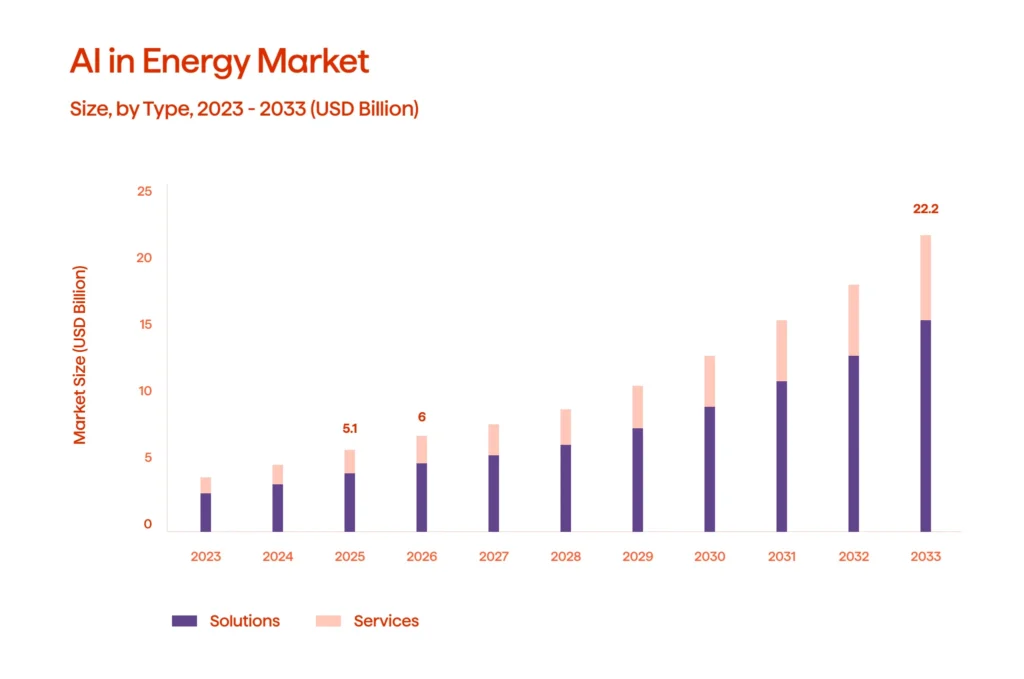
The energy industry is facing double pressure: the increased complexity of systems and the growing power demands on the electrical grid from digital infrastructure, which makes AI a subject of great interest. The global artificial intelligence in energy market was valued at USD 5.1 billion in 2025, and it is anticipated to reach USD 22.2 billion by 2033, with a compound annual growth rate (CAGR) of 20.4%. This level of growth indicates that it’s not just hype but that energy companies are now treating AI as part of the infrastructure rather than an experiment.
Data centers, where AI workloads are transforming how we use electricity, have faced an urgent need to meet new demand. About 60% of electricity is consumed by servers, while storage and networking equipment consume about 5%; additionally, cooling systems consume about 7%, but can account for as much as 30% of total usage in less energy-efficient enterprise facilities. The operation of AI models relies on the energy infrastructure already in place. It requires a base level of reliability and far greater efficiency in resource management than has historically been achieved.
AI may soon be our most important tool in this sector. With AI, we’ll be able to predict how much electricity will be produced, increase the efficiency of the equipment we use, decrease the amount of waste we create, and make faster, more effective decisions for complex energy projects. This discussion is no longer limited to supplying electricity to AI; it is becoming more focused on how we can use AI to make energy systems better equipped for reactive, efficient, and commercially sustainable operations.
Renewable energy forecasting and grid optimization with AI-driven systems
Operators are looking for faster ways to maintain reliability in the electricity supply, as both electricity consumption continues to rise and variable generation becomes a larger share of the supply. This is why they are interested in using AI to increase both the reliability and availability of electric supply systems. In addition, renewable forecasting and grid optimization are the most immediate examples of how operators are using AI to meet this challenge.
Grid optimization with AI
Historically, traditional power grid management relied on past patterns, the judgment of grid operators, and fixed assumptions about how many resources would be available to meet future demand. A traditional approach does not perform well in the face of sudden demand changes, aged assets, or unreliable supply. The use of AI represents a shift from this model, enabling grids to be more responsive.
AI-driven optimization helps utilities:
- forecast demand more accurately
- improve dispatch decisions
- reduce unnecessary reserve capacity
- detect equipment issues before failure
- balance loads across constrained networks
This is crucial for aging transmission and distribution infrastructure. AI can analyze key sensor data from transformers, breakers, cables, and substations to detect abnormal trends early and support predictive maintenance. As a result, there are fewer service interruptions, better use of assets, and decreased burden on field personnel.
Renewable energy forecasting
A great deal of practical value lies in using AI to forecast renewable energy generation. Solar and wind energy don’t make things easy for operators—they’re unpredictable, and that throws a wrench into scheduling compared to more reliable sources like coal, gas, or nuclear. But AI changes the game. Machine learning tools let operators spot shifts in solar and wind output in real time, enabling them to adjust schedules and keep everything balanced.
By leveraging various datasets (e.g., historical weather data), machine learning can achieve greater accuracy in predicting solar production than current methodologies. The use of deep learning and reinforcement learning for wind energy producers has enabled operators to predict turbine production better and adjust turbine configurations in real time to maximize wind generation output under all weather conditions.
These advanced capabilities will allow operators of renewable energy systems to more easily manage their portfolio of renewable resources, minimize lost power from renewables, and gain greater confidence in their decisions about operating their facilities. In addition, capturing more clean energy from sources such as wind and solar will enable energy companies to offer customers the same level of reliability currently provided by conventional energy sources.
u003cspan style=u0022font-weight: 400u0022u003eWe solve operational challenges with practical, action-ready programs backed by clear reporting and hands-on support from start to finish. u003c/spanu003e
Virtual power plants and distributed energy orchestration
After forecasting and grid optimization, the next step is coordinating energy that no longer comes from one central source. That is where virtual power plants become important.
What is a virtual power plant?
Cloud-based software is used to create a virtual power plant (VPP) that combines many distributed energy resources (DERs) into a single, flexible network. Solar panels, batteries, electric vehicle (EV) chargers, smart thermostats, water heaters, and commercial demand response systems are all examples of DERs. A VPP pulls together ERVs from multiple locations to deliver energy, storage, and other forms of flexibility for consumption, while a traditional power plant generates Electricity at a single site. VPPs can also respond to grid requests for energy when needed and enhance efficiency by avoiding reliance on a single power plant during peak load.
How distributed energy orchestration works
The operational logic that supports distributed energy orchestration is the model itself. It uses real-time conditions, such as current market pricing and asset availability, to determine when to charge, discharge, curtail, or respond to grid signals. The process of distributed energy orchestration involves combining forecasting, dispatch, demand response, and edge control into a single integrated control system.
Artificial intelligence will be a positive contributor to energy market operations through its ability to forecast demand, predict renewable output, optimize storage, and determine the optimal dispatch sequence across thousands of distributed resources. Therefore, AI will stabilize variable resources by increasing accuracy and speed in decentralized systems.
For utility companies, aggregators, and energy retailers, this will allow energy services to operate with greater flexibility and efficiency, reduce their balancing costs, and develop a more resilient energy model. The main value of deploying AI in this environment is not just automating processes but also transforming disparate energy assets into an easily dispatchable, commercially viable resource.
Exploration, production, and asset performance in oil and gas
Companies are now using AI tools for real-world applications in oil and gas operations that are traditionally high-value and high-risk. Using AI has been shown to increase operational efficiency by improving subsurface evaluation, production optimization, and asset reliability. Both Deloitte and SLB note that there are many practical applications of AI in oil and gas, including predictive maintenance, drilling risk analysis, and production.
AI-powered tools are changing the way geological teams work. Now, they can quickly dig through seismic data, well logs, and production histories to pinpoint reservoir details and identify optimal drilling locations. When it comes to drilling and production, AI helps teams fine-tune parameters, forecast rates, adjust artificial lift systems, and manage chokes. That’s huge, especially when energy demand is unpredictable—operators need to keep output steady and costs in check. For asset management, it’s all about keeping things running without interruptions. Models trained on data from SCADA systems, historians, and sensors flag unusual patterns—such as vibration issues, pressure changes, signs of corrosion, or compressor wear—so teams can step in before something breaks and production grinds to a halt.
| Area | What AI does | Operational value |
|---|---|---|
| Exploration | Seismic interpretation, reservoir characterization, and well targeting | Better drilling decisions |
| Production | Parameter optimization, rate control, and artificial lift tuning | Higher output, lower waste |
| Asset performance | Predictive maintenance, failure mode analysis, and integrity monitoring | Less downtime, safer operations |
Deployment, not interest, is the true challenge: AI only functions when data pipelines, engineering procedures, and field operations are sufficiently interconnected to translate predictions into action.
Generative AI, sustainability, and new opportunities to accelerate energy efficiency
The application of generative AI in the energy sector is at its most effective when it has to leave behind its predictive capabilities and focus on interpreting and acting upon unstructured operational data, such as maintenance logs, inspection notes, health, safety, and environment (HSE) reports, equipment manuals, grid event records, and permit documentation.
In practice, energy companies use it to:
- Quickly summarize asset problems by consolidating thousands of work orders and sensor-related notes into a clear fault history for turbines, transformers, pumps, or substations.
- Develop maintenance actions based on prior repairs, OEM manuals, and operating conditions to help technicians minimize troubleshooting time.
- Accelerate ESG and emissions reporting by accessing relevant data from multiple systems and consolidating that data into audit-ready narratives.
- Assist with retrofit decision-making by benchmarking alternative upgrade scenarios against inefficient assets and providing engineering teams with easily understood recommendations.
- Enhance field response by providing operators with a conversational interface to procedures, outage histories, and compliance requirements.
The direct benefits of sustainability include less energy waste, fewer preventable outages, improved asset utilization, and quicker detection of inefficiencies.
However, there is still an opportunity to grow within three primary areas—first, the development of common data architectures. Second, providing adequate reviews for AI-generated outputs (i.e., human oversight) in safety-critical situations. Third, implementing domain-specific pilot tools rather than general-purpose chat tools (e.g., using AI support capabilities tailored to a specific operational workflow definition).
FAQ
Optimize energy consumption with Avenga
The true opportunity with the intelligent application of AI is twofold: enhancing decision accuracy, reducing costs associated with inefficient resource usage, and producing measurable business outcomes. Energy service companies (ESCOs) that successfully leverage this technology will not only transition to the future of energy but also help shape its future direction.
Want to learn more about AI applications used in the energy market? Contact Avenga, your trusted expert in AI development.

What are the best practices to make your AI Proof of Concept (PoC) succeed?

Your business results matter
Achieve them with minimized risk through our bespoke innovation capabilities. Fill in the form below.