






Salesforce marketing strategies: building a data-driven framework


August 4, 2026 17 min read 360 views
About 4.39 billion Internet users generate 2 billion gigabytes of data every second. For businesses, the challenge is not simply collecting this data but using it to understand customer needs, strengthen customer engagement, and build more effective marketing strategies.
Salesforce has evolved from a customer relationship management (CRM) tool into an integrated platform that supports data-driven marketing. Its expanding ecosystem connects customer data, digital marketing, analytics, and AI, giving organizations more ways to manage and personalize customer interactions.
The combination of Salesforce Marketing Cloud, Data Cloud, and AI can improve productivity and campaign performance. Together, these technologies create a connected data environment where marketing teams can use detailed customer insights to deliver more relevant, automated, and personalized experiences. AI can also process and analyze large data sets in real time, supporting faster decisions and more responsive marketing campaigns.
Let’s take a closer look at how these Salesforce technologies work together.
How does the Salesforce product suite support a connected marketing framework?
The Salesforce product suite brings together CRM, cloud computing, AI, and marketing tools to support a connected marketing framework designed around customer engagement, automation, and data-driven decision-making.
- The robust Sales Cloud acts as a complete sales enablement tool.
- The Service Cloud platform is designed to streamline customer service workflows.
- Sales Cloud leverages Einstein’sAI to predict customer behavior by recommending actions and automating routine tasks.
All of these drive sales efficiency and effectiveness.
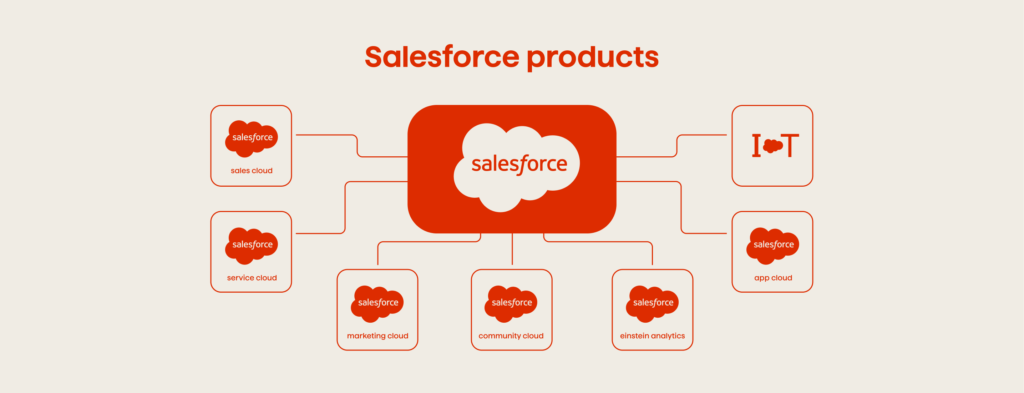
Customer 360 highlights Salesforce’s commitment to creating a unified customer profile. It connects every interaction with your customer across sales, service, marketing, and beyond.
Imagine you run a business, and with Salesforce’s Customer 360, you can see every interaction a customer has had with your company — from sales to customer service — all in one place. This helps you offer more personalized experiences, making your customers feel valued and deepening their loyalty to your brand.
Salesforce demonstrates its dedication to innovation and also shows its commitment to empowering businesses with the tools they need to thrive in a data-driven, customer-centric world.
With each update, Salesforce products gain depth and versatility by boosting customer engagement as a part of the company’s evolutionary journey.
For example, Marketing Cloud has evolved from email marketing. Now, it is a tool that manages customer journeys across many touchpoints, engaging customers at every step. The recent integration of Marketing Cloud Intelligence into Marketing Cloud shows Salesforce’s commitment to real-time analytics.
Each upgrade or new release within the Salesforce ecosystem is a strategic move toward simplifying complex business processes. Introducing Hyperforce has been a game-changer, rearchitecting the Salesforce marketing platform to deliver enhanced scalability and performance across public clouds globally.
To illustrate, a company might use Hyperforce to scale its Salesforce solutions. This helps the company to respond to varying demands, such as during high-traffic periods like tax season or financial year-ends. And it also ensures that the CRM system remains responsive and efficient.
How does data support Salesforce marketing strategies?
Salesforce provides a powerful CRM and cloud platform, but the success of its marketing technologies depends on the quality, accessibility, and integration of the data behind them. To maximize Salesforce marketing capabilities, organizations need to focus on these key elements:
- Data quality management. Implementing robust practices to ensure data accuracy, completeness, and timeliness. High data quality is essential for precise targeting and personalization in marketing strategies.
- Data migration processes. Streamlining existing customer data transfer into Salesforce, minimizing disruptions and data loss. Smooth data migration is crucial for maintaining continuity and integrity in customer information.
- Effective integration. Utilizing tools like Mulesoft for seamless integration of Salesforce with other systems guarantees a unified customer view across all touchpoints, enhancing consistency and success of marketing efforts.
These steps are foundational in leveraging Salesforce’s marketing technologies to their fullest extent. They enable enhanced campaign viability and maximize return on investment (ROI).
The pivotal role of Mulesoft, Tableau, and Salesforce Data Cloud
In the digital orchestra of Salesforce’s offerings, three tools are seen as principal instruments, each playing a vital role in the symphony of data management and analysis.
- Mulesoft acts as the core for data connectivity. It grants administrative teams direct access to Salesforce data. This empowers them with autonomy over their management.
- Tableau elevates Salesforce’s analytical capabilities by delivering advanced visualization tools. These tools transform data interpretation, enabling insightful decision-making based on complex datasets. Tableau’s integration into the Salesforce suite enriches the analytics landscape by enabling users to unlock actionable insights from their data.
- Salesforce Data Cloud emerges as the central figure in this updated narrative. The tool is a comprehensive hub for all data-related activities within the Salesforce platform. A Data Cloud is a versatile data warehouse that feeds into specific tools like the Customer Data Platform (CDP) for marketing segmentation.
The Salesforce Data Cloud is designed to unify and activate customer data, enriching every facet of the ecosystem. Salesforce Data Cloud centralizes data management and analysis. This enables a more integrated approach to customer engagement, marketing strategies, and business intelligence (BI). Focusing on a unified data environment underscores Salesforce’s commitment to data-driven decision-making and personalized customer experiences.
Mulesoft, Tableau, and Salesforce Data Cloud are powerful foundations for any organization’s data-driven strategies. This combination ensures that insights are harvested and leveraged, providing businesses a competitive edge in the digital age.ding businesses a competitive edge in the digital age.
Which Salesforce marketing tools support personalization, automation, and analytics?
Salesforce provides a range of marketing tools that help organizations manage customer data, automate communications, analyze campaign performance, and create more personalized experiences across multiple channels.
- Marketing Cloud. The unified customer view enables personalized engagement across various channels. It helps marketers deliver a targeted content creation process that resonates with each audience segment.
- Marketing Cloud Engagement. It facilitates dynamic customer interactions across email, mobile, social, and digital channels. Marketing Cloud Engagement empowers organizations to create more engaging and meaningful customer experiences. By leveraging real-time data, marketers can automate and personalize communications at scale. This substantiates that every touchpoint is optimized for maximum engagement.
- Einstein Discovery. Marketing teams can use AI to generate predictive insights. This allows them to foresee customer behaviors and trends. As a result, they can craft proactive and personalized marketing strategies.
- Marketing Cloud Personalization. This tool enables brands to tailor digital experiences individually, using real-time data and AI-driven insights. Marketing Cloud Personalization helps businesses understand each customer’s preferences and behaviors. It allows for delivering bespoke content and offers across the web, mobile, email, and other digital platforms.
- Marketing Cloud Customer Data Platform. The platform gathers, unifies, and segments customer data from multiple sources in real time. This provides a deeper and more actionable view of the customer’s journey. Also, the tool enables highly targeted and timely marketing campaigns.
- Marketing Cloud Advertising. This provides tools that extend marketing campaigns to advertising platforms. Advertisers can create targeted and personalized ads across social, search, and display networks by leveraging customer data from Marketing Cloud. This ensures a consistent and unified messaging strategy. It also enhances brand visibility and accelerates customer acquisition.
- Marketing Cloud Account Engagement. Formerly known as Pardot, this tool specializes in B2B marketing automation. It bridges the gap between marketing and sales teams, fostering alignment and driving growth through targeted campaigns and insightful analytics.
- Marketing Cloud Intelligence. Offering marketing intelligence and analytics, this tool helps teams measure, optimize, and report across multiple channels. Additionally, this tool provides a centralized platform to understand performance and ROI. It drives smarter investment decisions.
Salesforce’s extended suite of tools offers a comprehensive solution for overcoming the myriads of challenges marketing teams face within insights-driven marketing. By leveraging these tools, marketers can achieve a deeper understanding of their customers, enhance personalization, and improve the agility and effectiveness of their campaigns.
Salesforce Marketing Cloud: the data conductor
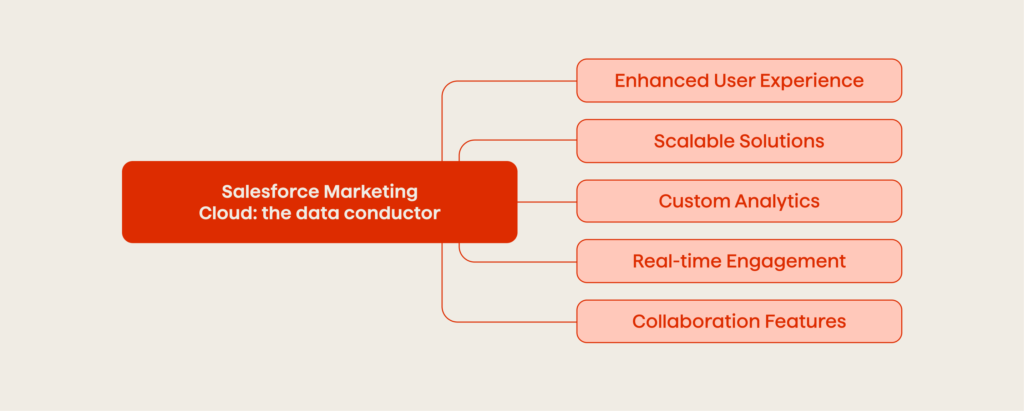
The evolution of marketing data within Salesforce reflects a significant shift from restricted and costly data management to a more accessible and user-centered approach. This section examines the transformative changes that have enhanced how marketers specify, integrate, and autonomously manage their data. It showcases Salesforce’s commitment to adaptability and user empowerment within digital marketing.
- Enhanced user experience. Salesforce has significantly improved the user experience by making the platform more intuitive and user-friendly. A marketer can quickly find and analyze customer data in Salesforce without extensive training, making their job easier and faster.
- Scalable solutions. The scalability of solutions within Salesforce has been a game-changer for marketing. A small startup begins using Salesforce for basic marketing needs and effortlessly adds more advanced features as it grows without any disruption.
- Custom analytics. The ability to create custom analytics and reports has empowered marketers to derive specific insights tailored to their unique business needs. A marketing team creates a custom report in Salesforce that shows how a specific ad campaign performs, allowing them to adjust their strategy in real time.
- Real-time engagement. With the current tools, Salesforce facilitates real-time customer engagement. A marketer uses Salesforce to instantly send a personalized offer to a customer based on their recent browsing behavior, increasing the chances of a sale.
- Collaboration features. Improved collaboration features within Salesforce enable marketing teams to work more cohesively. A marketing team uses Salesforce to share campaign results and insights with each other in real time, ensuring everyone is aligned and working towards the same goals.
Salesforce’s shift to a more flexible, user-focused approach shows its commitment to evolving with users’ needs. It shows that Salesforce is committed to a strong platform for managing marketing data.
Learn more about how we utilized the power of the Salesforce Marketing Cloud to redefine ecommerce intelligence. Stylepit
Data Cloud and Mulesoft: providing integration, accessibility, and scalability
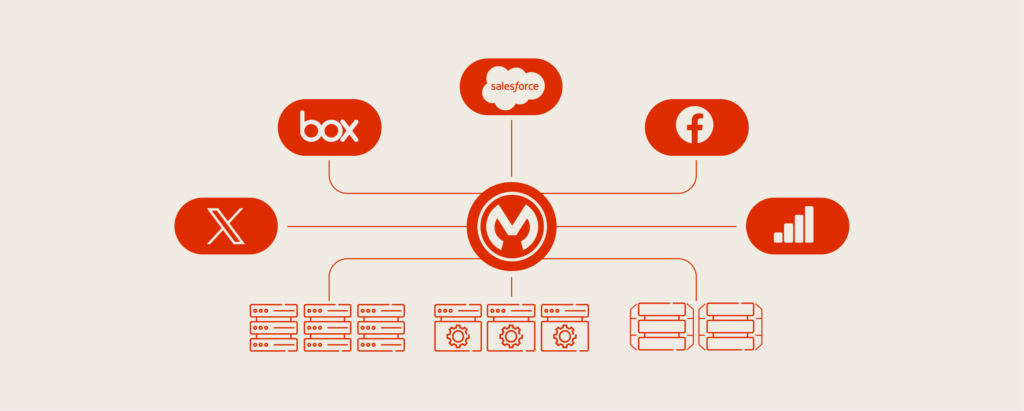
The melding of Salesforce’s Data Cloud with Mulesoft heralds a breakthrough in how businesses approach data integration. Mulesoft’s Anypoint Platform not only enhances Data Cloud’s native capabilities but also introduces an API-led connectivity strategy that’s revolutionizing data management practices.
“This duo gives organizations new agility. It enables them to combine data from various sources with unmatched efficiency. Mulesoft helps companies see their entire data landscape and turn complex data into clear, actionable insights.”
Data Cloud and AI: orchestrating integration and insight in Salesforce

Salesforce’s Data Cloud and AI are at the forefront of a new marketing data management and use approach. The Data Cloud provides a unified data integration, storage, and analysis platform. It lets organizations combine customer data from within Salesforce and external apps. This extensive data consolidation makes a 360-degree view of the customer possible. It improves targeted marketing and delivers personalized customer experiences.
Also, Salesforce’s AI analyzes the mix of internal and external data. It uses predictive analytics, Machine Learning (ML), and natural language processing (NLP). As a result, it gives actionable insights.
The key aspect is the tandem tools noted above that forecast customer behaviors and automate personalized marketing actions. This increases the proficiency and productivity of marketing campaigns.
The integration with external applications means that Salesforce can offer an even more robust data ecosystem. Such an ecosystem supports real-time data-driven decision-making and personalized customer engagement at an unprecedented scale, ensuring that marketers can leverage data from a variety of sources to create a comprehensive marketing strategy.
Such a synergy brings the following benefits:
- Enhanced data management. Data Cloud simplifies data integration and management complexity, offering a streamlined approach to handling diverse data sources.
- Predictive insights. AI’s predictive analytics capabilities enable marketers to anticipate customer needs and preferences, tailoring their strategies for maximum impact.
- Personalization at scale. Leveraging AI, Salesforce can deliver personalized customer experiences across various channels, improving engagement and loyalty.
- Operational efficiency. Automating routine tasks with AI allows marketing teams to focus on strategic initiatives, which optimizes resource allocation.
Integrating Data Cloud and AI into Salesforce’s ecosystem underscores the platform’s commitment to leading the charge in data-driven marketing. It also demonstrates their focus on customer-centric marketing. And it showcases Salesforce’s ability to keep pace with the evolving digital landscape.
How does Salesforce support connected customer experiences across industries?
Salesforce supports connected customer experiences by unifying customer data, AI, analytics, and automation across its ecosystem. The platform’s transformative journey is marked by the launch of trailblazing features like Customer 360, which delivers a panoramic view of customer interactions.
Moreover, Salesforce’s growing AI and data ecosystem demonstrates the platform’s expanding role in connected customer experiences. In FY26, Data 360 ingested 112 trillion records, while Agentforce and Data 360 generated more than $2.9 billion in annual recurring revenue, highlighting the increasing adoption of AI-powered customer engagement and automation capabilities.
Now, let’s take a look at how Salesforce might help redefine specific industries:
- Retail enhancement. A retail chain can integrate Salesforce Customer 360 to unify in-store, online, and mobile customer interactions. This integration allows personalized promotions based upon past purchases to increase customer loyalty and sales significantly.
- Financial services personalization. A bank could use Einstein AI to analyze spending habits and offer customized financial advice or product recommendations, enhancing customer satisfaction and engagement.
- Healthcare patient engagement. A healthcare provider might leverage Marketing Cloud to send targeted health tips and check-up reminders based on a patient’s history, improving patient health outcomes and service satisfaction.
Einstein AI injects intelligence into every data point, paving the way for automated insight-rich marketing strategies. Meanwhile, Tableau’s integration redefines the realm of possibilities with its advanced analytics, providing marketers with a powerful lens to view and understand their data. Together, these tools form the cornerstone of what makes Salesforce the epitome of marketing ingenuity.
What expertise is needed to maximize Salesforce CRM capabilities?
Salesforce CRM is a powerful platform, but organizations need specialized expertise in implementation, data management, integration, analytics, and governance to use Salesforce effectively and adapt the platform to changing business needs.
- In-depth training and enablement. As new features and products are introduced, organizations must invest in comprehensive training to ensure their teams can leverage Salesforce to its full potential.
- Data migration and management. Experts in data management are needed to navigate the complexities of migrating data to Salesforce while safeguarding its integrity and usability.
- Ongoing support and evolution. Salesforce environments are not static. They require continuous support and evolution to adapt to changing business needs and emerging technologies.
- Integration mastery. Mastery in integrating Salesforce with other systems and platforms is critical, as it can significantly enhance functionality and streamline operations.
- Advanced analytics proficiency. With tools like Tableau becoming part of the Salesforce family, proficiency in advanced analytics is essential for extracting and interpreting complex data insights.
- Governance and structure. Implementing a robust governance framework is vital for the success of any Salesforce project. This involves establishing clear guidelines, documentation, and a steering committee to oversee project execution and affirm aligning with business objectives. A lack of structure and governance can lead to project failures.
Salesforce’s innovation journey demands an equally adept and forward-thinking partner ecosystem. This ensures that as Salesforce breaks new ground in data management, businesses are not just keeping pace but are at the vanguard, fully equipped to capitalize on the suite’s advancements.
FAQ
How Salesforce supports the future of digital marketing
Salesforce continues to add innovative technologies to its portfolio, ensuring marketing professionals can design and deliver compelling propositions that drive the competitive edge.
Data Cloud is a perfect example, offering unparalleled efficiency in handling and segmenting data. Add to this Salesforce’s AI platform, and the client will have the ultimate integrated marketing solution, driving real-time predictive analytics and personalized customer engagement at scale.
If disconnected data, complex integrations, or underused Salesforce capabilities are holding your sales and marketing efforts back, Avenga can help you turn them into opportunities for stronger customer engagement and growth.



Digital transformation in telecom: A complete guide
Your business results matter
Achieve them with minimized risk through our bespoke innovation capabilities. Fill in the form below.