






The future of satellite technology in 2026 and beyond: Bringing satellite in the palm of the hand

June 5, 2026 14 min read 535 views
There are now more than 10,000 active satellites orbiting Earth, and that number is set to triple by 2030. The quiet infrastructure revolution happening 500 km above your head is reshaping how the world connects, communicates, and coordinates. What began in the 1960s as a government-led race for dominance has evolved into a commercial battleground where constellation operators, cloud providers, and device makers are all competing for a slice of a market the Satellite Industry Association valued at $293 billion in 2025.
According to Avenga’s telecom experts, the most significant shift is not the hardware in orbit, but the software intelligence governing it. The satellite services business is accelerating fast. And the organizations that understand that software-defined networks are the real differentiator will be the ones that lead. In recent years, humanity has tremendously evolved. Technologies like artificial intelligence have moved beyond science fiction, they’re now woven into nearly every aspect of our daily lives. Yet the issue of orbital congestion remains obscure and complex, even considering all the latest agile advancements humanity has developed and utilized. But the narrative is evolving.
From the days of large geostationary satellites transmitting television signals across continents, satellite communications have advanced significantly. What started as specialized technology used in defence and television has developed into a crucial component of global infrastructure. Avenga’s satellite network operator solutions reflect this shift, from bespoke enterprise contracts to scalable, cloud-native systems serving operators across every orbit class. Long linked to broadcasting and specialized research applications, satellite industry innovation has made major operators’ pivotal participants in the face of the world’s most urgent problems. Cloud services, IoT devices and remote working have all contributed to the rapid growth of digital demands, highlighting the shortcomings of ground-based networks, particularly in underserved or difficult-to-reach areas.
Satellite technology in 2026 and beyond: Key takeaways
- Non-terrestrial networks (NTNs) are no longer experimental. They are now a core component of global 5G architecture, standardized under 3GPP Release 17 and 18.
- LEO constellations are driving latency down to 20-40 ms, making satellite connectivity viable for real-time cloud applications, video, and IoT at scale.
- Space debris is a critical and growing risk. ESA’s 2025 Space Environment Report now counts over 54,000 objects larger than 10 cm in orbit, up significantly from earlier estimates.
- The future of satellite lies in autonomous operations, on-orbit servicing, and AI-driven resource management, not just bigger antenna arrays.
- Small satellites are the fastest-growing segment, with a projected CAGR of 23.8% through 2031, making space access faster and more commercially viable than ever.
Understanding non-terrestrial networks (NTNs)
Non-terrestrial networks are a revolutionary departure from the traditional view of connection. NTNs employ satellites that orbit the world to deliver coverage straight from the sky, whereas traditional systems have long relied largely on cable and towers on the ground. As a result, there is now the possibility of delivering high-speed, low-latency internet and data services in locations that are far beyond the reach of terrestrial infrastructure, including open waterways, rural villages, mountains, and disaster areas.
Expanded coverage is only one aspect of NTNs’ expansion; another is its vision for the future of international communication. Satellite operators are creating reliable, scalable, and borderless systems that eliminate the need for ground infrastructure, enabling everything from national logistics to emergency response.
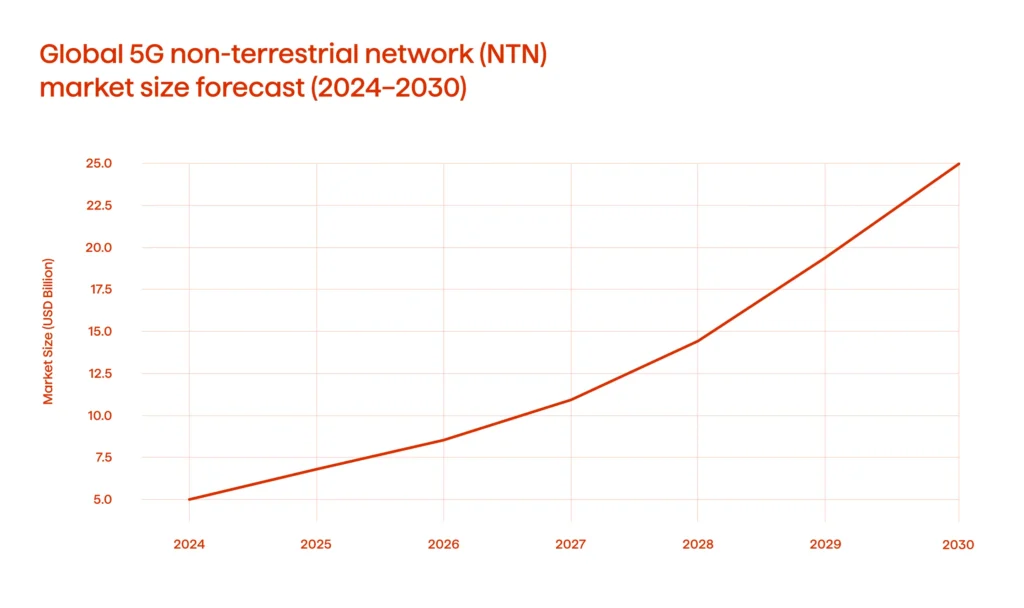
This graph illustrates that the global NTN market size is gaining momentum. The growth is driven by a number of factors, such as the growing 5G infrastructure, the increasing demand from consumers in urban, suburban areas and remote areas for high-speedlow-latency connectivity, the rise in mobile data traffic, and the growing government initiatives to expand 5G’s customer reach.
NTNs provide connectivity from above, as opposed to conventional ground-based networks, which necessitate high-density ground infrastructure and are either costly or impractical to deploy in remote or hostile areas. It puts them in a prime position to help underserved communities across all political and geographic borders.

In addition to filling coverage gaps, NTNs are valuable for connecting people and engaging applications at previously unheard-of levels, which highlights their role in achieving broadband expansion, supporting the Internet of Things, and keeping vital communications open during crisis response. This is especially true given the growing demands for real-time data and robust networks. NTNs continue to function even in the event of natural disasters, infrastructure breakdown, or situations where installing physical networks would be logistically or financially impractical due to their independence from terrestrial infrastructure.
u003cspan class=u0022TextRun SCXW167135913 BCX0u0022 lang=u0022UKu0022 xml:lang=u0022UKu0022 data-contrast=u0022autou0022u003eu003cspan class=u0022NormalTextRun SCXW167135913 BCX0u0022u003eAvenga provides custom software consulting and engineering solutions for satellite network operators trusted by the world’s leading u003c/spanu003eu003cspan class=u0022NormalTextRun SCXW167135913 BCX0u0022u003etelecom companies.u003c/spanu003eu003c/spanu003eu003cspan class=u0022EOP SCXW167135913 BCX0u0022 data-ccp-props=u0022{u0026quot;134233117u0026quot;:false,u0026quot;134233118u0026quot;:false,u0026quot;134245417u0026quot;:false,u0026quot;201341983u0026quot;:0,u0026quot;335551550u0026quot;:1,u0026quot;335551620u0026quot;:1,u0026quot;335559685u0026quot;:0,u0026quot;335559737u0026quot;:0,u0026quot;335559738u0026quot;:0,u0026quot;335559739u0026quot;:0,u0026quot;335559740u0026quot;:240,u0026quot;335572071u0026quot;:0,u0026quot;335572072u0026quot;:0,u0026quot;335572073u0026quot;:0,u0026quot;335572075u0026quot;:0,u0026quot;335572076u0026quot;:0,u0026quot;335572077u0026quot;:0,u0026quot;335572079u0026quot;:0,u0026quot;335572080u0026quot;:0,u0026quot;335572081u0026quot;:0,u0026quot;335572083u0026quot;:0,u0026quot;335572084u0026quot;:0,u0026quot;335572085u0026quot;:0,u0026quot;335572087u0026quot;:0,u0026quot;335572088u0026quot;:0,u0026quot;335572089u0026quot;:0,u0026quot;469789798u0026quot;:u0026quot;nilu0026quot;,u0026quot;469789802u0026quot;:u0026quot;nilu0026quot;,u0026quot;469789806u0026quot;:u0026quot;nilu0026quot;,u0026quot;469789810u0026quot;:u0026quot;nilu0026quot;,u0026quot;469789814u0026quot;:u0026quot;nilu0026quot;}u0022u003e u003c/spanu003e
The growing role of satellite constellations
The core of contemporary non-terrestrial networks are the satellite constellations, which are collections of synchronized spacecraft orbiting in shared orbits. To provide worldwide coverage with lower latency and higher throughput, constellations are mostly built on low Earth orbit (LEO) and medium Earth orbit (MEO), as opposed to earlier systems that relied on a small number of massive geostationary (GEO) satellites at an altitude of 35,786 kilometers above the Earth.
LEO constellations, like those offered by Globalstar, OneWeb, Starlink, and Amazon’s Project Kuiper, are made up of hundreds or thousands of tiny satellites in the 500–2,000 km range. Their proximity to Earth’s surface allows for latency as low as 20–40 ms, which is comparable to fiber-based systems on Earth and appropriate for cloud applications, video conferences, and broadband internet. In addition to optical inter-satellite links (ISLs), which allow direct satellite-to-satellite communication and eliminate the need for ground relay stations, these satellites are usually equipped with phased-array antennas and steerable beams for dynamic user link management.
NASA ongoing Earth observation and commercial partnership programs, including its investments in SmallSat technology since 2022, have accelerated the miniaturization of satellite hardware and lowered the barrier to entry for commercial operators.
Compared to LEO systems, MEO constellations like O3b and SES offer faster throughput and wider coverage per satellite, though at the expense of somewhat higher latency (~100–150 ms). These are best suited for backhaul solutions in areas without terrestrial infrastructure, enterprise connectivity, and maritime and aviation use cases.
Redundancy and mesh routing features are built into satellite constellations to improve network resilience and reduce single points of failure. Constellations are expanding coverage and propelling the transition to adaptive network designs when paired with AI-based traffic routing and autonomous aircraft operations.
AI’s role in satellite systems mirrors its broader transformation of the telecom industry. For a deeper look at how AI is reshaping network operations and service delivery, read Avenga’s guide to AI in telecommunications.
Product engineering behind the satellite revolution
Modern satellite systems require cutting-edge software, hardware, and system integration product engineering. Miniaturized, lightweight, radiation-hardened components with improved power efficiency and thermal management are essential for satellites, particularly those in low-Earth orbit constellations. When possible, engineers mix specialized RF systems, phased-array antennas, onboard data processors, and COTS components to construct modular designs. Other in-orbit performance enhancers include AI-driven resource allocation and optical inter-satellite links (ISLs). In 2026, 71% of organizations plan to increase AI spending, and the satellite industry is no exception, AI-driven resource allocation has become a core differentiator for constellation operators.
According to Avenga’s product engineering experts, the critical challenge in satellite hardware development is not raw performance but power-to-intelligence ratio, getting AI inference capabilities into radiation-hardened chips small enough to fly on a SmallSat bus without exceeding thermal or mass budgets.
Ground user terminals must facilitate smooth satellite handoffs, adaptive modulation, and beam tracking. Low-latency signal processing, multi-band antennas, and precision mechanical construction are necessary. To decrease reliance on central nodes and speed up response times, edge computing is being increasingly integrated into space and ground systems.
To verify system integrity, rigorous test beds recreate the severe launch, orbit, and re-entry environments. Delivering scalable, reliable NTN infrastructure that can function within real-world restrictions is the ultimate goal of product engineering.
See how Avenga has delivered product engineering for global telecom operators, from OSS/BSS modernization to embedded network solutions: explore our telecom case studies.
Ground devices and terminals: Bridging user access
Ground equipment converts signals from orbit into accessible connections, serving as the interface between end users and NTNs. From dynamic mobile terminals in aviation, maritime, and defense to stationary rural deployments, next-generation user terminals are tailored for a broad spectrum of uses, including integration with mobile phones, enabling satellite communication capabilities in everyday devices.
By using electronically steerable phased-array antennas, these terminals can track fast LEO satellites without the need for mechanical components. This feature guarantees uninterrupted communication even when satellites are switched over. Additionally, terminals use adaptive modulation techniques, multi-band support (such as Ka-, Ku-, and S-bands), and sophisticated RF front-ends to provide reliable links in a range of signal and atmospheric conditions.
The majority of ground terminals provide local caching and embedded edge processing to support low-latency data and real-time services, reducing the need for backhaul. Additionally, they offer auto-beam switching and intelligent routing, which are very important in high-interference or mobile scenarios. Handover management, link-layer retransmission, and Doppler shift compensation are very important engineering factors, particularly in mobile contexts. End-user devices must be more compact, power-conscious, and interoperable with terrestrial 5G systems to fully implement hybrid patterns of connectivity as NTNs expand. The ground gear has evolved into intelligent adaptive nodes that complete the satellite loop rather than merely sitting there.
A particularly exciting frontier in this evolution is the integration of solar-powered IoT devices. These self-sustaining devices can harness solar energy to maintain their functionality, ensuring that remote and off-grid applications can operate autonomously, without relying on traditional power sources.
Challenges and the path forward
NTNs have advanced quickly, but there are still many operational, legal, and technical obstacles to overcome. Perhaps the most urgent of them is spectrum management. Radio frequency band competition is growing due to the increase in satellite launches, with over 2,800 LEO satellites launched in 2023 alone. To prevent signal interference and guarantee service quality, operators and regulatory organizations such as the ITU must effectively coordinate their spectrum.
Space debris is another growing threat. The chance of a collision increases with the number of satellite constellations, especially in low Earth orbit. According to the European Space Agency (ESA), there are over 54,000 objects in orbit that are larger than 10 cm. To ensure long-term sustainability, operators must invest in debris mitigation technology, responsible de-orbiting procedures, and collision avoidance systems.
Another issue is interoperability with ground networks. The performance of a hybrid network requires synchronization of satellite 5G equipment, shared protocols, and seamless handovers. Since the completion of Release 18 and the rollout of its features, attention has turned to 3GPP Release 19, frozen in late 2025, is now entering its commercial implementation phase. It directly addresses the interoperability gap between satellite and terrestrial networks, further expanding NTN capabilities for 5G and laying technical groundwork for 6G hybrid architectures. The forthcoming update will solve the present interoperability issues between the satellite and ground networks and further enhance NTN capabilities.
Avenga’s telecom specialists working on satellite OSS/BSS modernization note that spectrum coordination is increasingly becoming a software problem: Real-time interference detection, dynamic allocation, and regulatory compliance checks that once required manual coordination are now being automated through AI-driven network management platforms.
Additionally, in underdeveloped markets, end users continue to face obstacles related to pricing and availability. Although the cost of satellite terminals is decreasing, it will still take a few years before they are affordable globally. AI-orchestrated traffic, more software-defined architecture, and international cooperation on standards and space governance are the ways of the future satellites. Overcoming these obstacles will determine the next stage of inclusive, scalable, and resilient global connectivity, both on Earth and in space. NTNs do not exist in isolation. They are converging with the full spectrum of telecom transformation, from Open RAN to private 5G and AIOps. For a complete picture, see Avenga’s analysis of the key telecom industry trends shaping 2026.
FAQ
Final thoughts: reimagining the connected future
Space exploration technology is evolving at a rapid pace, so the next decade is going to be an exciting chapter of breakthroughs, from scalable non-terrestrial networks and intelligent satellite constellations to real-time Earth observation and autonomous in-orbit operations.
The technical complexity of satellite systems demands an engineering partner who understands both the orbit and the stack. Avenga’s product engineering team delivers end-to-end solutions for satellite network operators, from cloud-native OSS/BSS modernization and AI-driven capacity planning to IoT integration and embedded ground terminal engineering.
Talk to our satellite experts to see what’s possible for your network.


Salesforce for healthcare: Health Cloud use cases and implementation

Your business results matter
Achieve them with minimized risk through our bespoke innovation capabilities. Fill in the form below.