






What is a data management platform (DMP) and how does it work?


July 17, 2026 12 min read 615 views
Data management platforms (DMPs) help advertisers collect, organize, and activate audience data to optimize ad targeting, personalization, and campaign performance. As billions of people browse websites, watch videos, and use social media every day, they generate enormous amounts of data that fuel today’s digital advertising ecosystem.
Around 6.12 billion people worldwide use the internet today, creating an enormous pool of audience data for brands and advertisers. With users spending more than 33 hours per week consuming online media, browsing websites, watching videos, and engaging on social platforms, every interaction generates valuable insights into user behavior, interests, and preferences.
For online advertisers, this user data is the equivalent of gold when it comes to creating advertising campaigns, as it allows them to target specific users based on their behavior, interests, location, and more. To collect, analyze, and use this vast amount of user data across the interconnected online advertising landscape, advertisers, agencies, and publishers rely on software known as a data management platform (DMP).
What is a data management platform (DMP)?
A data management platform (DMP) is a piece of software that collects, stores, and organizes data collected from a range of sources, such as websites, mobile apps, and advertising campaigns. Advertisers, agencies, and publishers use a DMP to improve ad targeting, conduct advanced analytics, look-alike modeling, and audience extension.
The types of data DMPs collect include:
First-party data
First-party party data refers to information gathered straight from a user or customer and is considered to be the most valuable form of data as the advertiser or publisher has a direct relationship with the user (e.g. the user has already engaged and interacted with the advertiser).
First-party data is typically collected from:
- Web and mobile analytics tools
- Customer relationship management (CRM) systems
- Transactional systems
Second-party data
Second-party data is essentially first-party data from a different company and much less common than first- or even third-party data, and the information is initially collected in the form of 1st-party data, and then passed on to another advertiser through a partnership agreement, which then becomes second-party data.
For example, a website that sells sporting equipment (let’s call them All Sports) may partner up with a website that promotes sporting events (we’ll call them Half Time). When a user visits All Sports, a cookie is created. This cookie is then given to Half Time and is used to target ads to the user.
Third-party data
3rd-party data is collected from a range of different sources and sold on to advertisers and used for audience targeting. For example, a publisher may add a DMP’s pixel to their website, allowing the DMP to collect data about the visitors. Because this data is collected by a third party (i.e. the DMP), it’s classed as third-party data.
Over the years, 3rd-party data has received a pretty bad rap, mainly due to the number of privacy concerns it raises. However, this type of data is still regularly used by marketers to help reach and target their desired audience — even though it isn’t considered as valuable as 1st- or 2nd-party data.
How do DMPs work?
A data management platform (DMP) works by collecting audience data from multiple sources, organizing it into meaningful segments, and activating those segments across advertising platforms. To do this, a DMP integrates with AdTech and MarTech platforms, such as a demand-side platform (DSP), an ad exchange, or a supply-side platform (SSP), and a customer relationship management (CRM) system, as well as collects data through website tags, such as JavaScript snippets or HTML pixels.
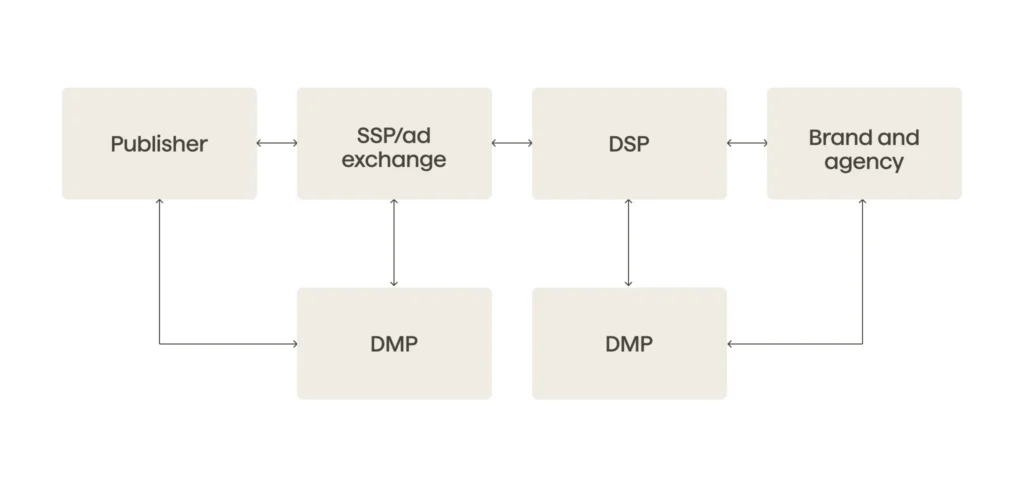
From there, it pushes the data through a series of processes.
How does a data management platform process data?
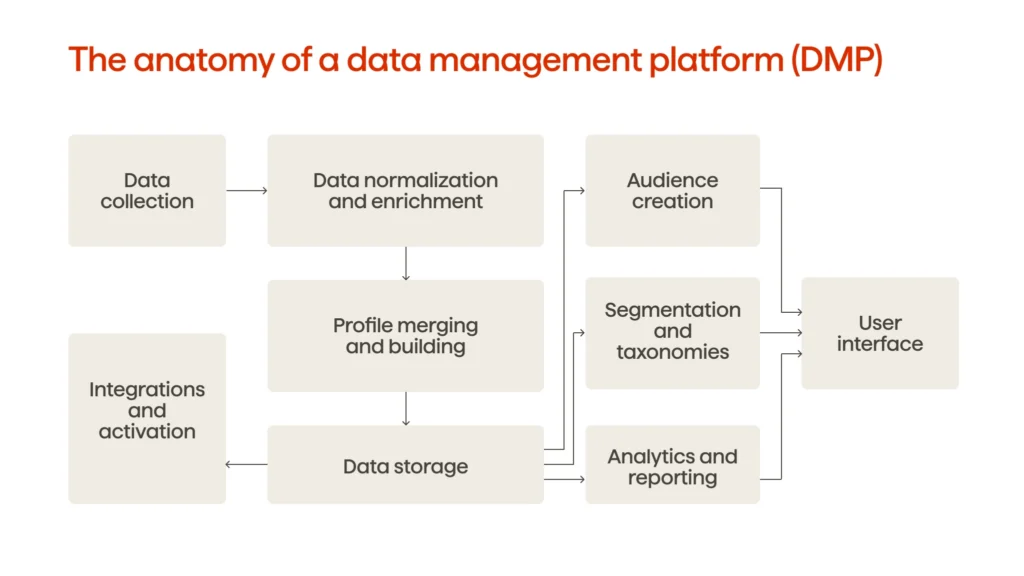
After collecting data from multiple sources, a DMP transforms it into actionable audience insights through a series of processing steps. While the exact workflow varies by platform, most DMPs follow the same core processes to prepare data for audience creation, targeting, and activation.
Data normalization and enrichment
Before the collected data can be used, it needs to be organized into a common format. This is done via data normalization.
Data normalization includes collecting IDs from cookies, removing redundant or unnecessary data, and changing the source’s data schema to the DMP’s data schema. The next step is to improve data quality by enriching the data with additional data points, such as device type, location, browser type and version, and operating system.
Data segmentation (aka classification and taxonomies)
When 1st-, 2nd-, and 3rd-party data is collected in a DMP, it undergoes a process called data segmentation. Each piece of user data is analyzed and put into different categories (also called data taxonomies) in order to build distinct user profiles. An example of a segment would be users with an attribute like “country = USA”.
The goal of data classification and creating taxonomies in a DMP is to:
- Organize data into groups based on their similarities and relationships between one another.
- Create a hierarchy of the data.
- Make it easy to search for and use individual entries and groups (e.g. for audience creation).
Profile merging
The profile merging operation in a DMP converts all profiles containing a common identifier (e.g. email address or cookie ID) into one profile. The goal of profile merging is to ensure there are no duplicate profiles (i.e. profiles that contain the same IDs) or duplicate identifiers within a given profile.
Audience creation (aka segmentation)
An audience is basically a group of user profiles that share common user identifiers. For example, an advertiser might create an audience in its DMP called “Android users in the USA” The audience would then contain profiles that have attributes such as “device = android” and “country = USA”.
Creating audiences is by far the most important function of a DMP and is key to performing the next step — data activation.
Data activation
Purely and simply, data activation means putting the audience segments to work. These audience segments can be used for a whole range of use cases.
DMP vs CDP vs CRM: What’s the difference?
DMPs, customer data platforms (CDPs), and customer relationship management (CRM) systems all manage customer and audience data, but they serve different purposes. A DMP primarily works with anonymized audience data for advertising, while CDPs and CRMs focus on known customers and personally identifiable information (PII).
| DMP | CDP | CRM | |
|---|---|---|---|
| Primary purpose | Audience targeting and digital advertising | Creating unified customer profiles | Managing customer relationships |
| Main users | Advertisers, publishers, marketing teams | Marketing and customer experience teams | Sales, marketing, and customer support teams |
| Data type | Mostly anonymized audience data | First-party customer data | Known customer data |
| Data sources | Websites, mobile apps, advertising platforms, third-party sources | Websites, apps, CRM systems, transactional systems, offline sources | Sales interactions, customer records, support activity |
| Main use cases | Audience segmentation, targeted advertising, programmatic campaigns | Personalization, customer journeys, analytics | Sales management, customer communication, relationship building |
| Typical identifiers | Cookies, device IDs, advertising IDs | Email addresses, customer IDs, account information | Names, emails, phone numbers, account details |
In practice, these platforms often work together as part of a broader MarTech stack. For example, a CRM may store customer information, a CDP can unify customer profiles from multiple sources, and a DMP can activate audience segments across advertising channels.
What are the main use cases of a DMP in advertising?
A DMP acts as a centralized system for organizing audience data and activating it across programmatic advertising and other digital marketing campaigns. Once data from various sources has been unified into audience segments, advertisers and publishers can use it to improve targeting, personalization, and campaign performance across multiple channels.
Improve targeting for online media campaigns
One of the main use cases of a DMP is to help advertisers improve the performance of their online media campaigns. The way they do this is by integrating with a DSP. Then, the DSP and DMP sync cookies together, allowing the DMP and DSP to identify users across different websites and mobile apps.
Advertisers using DSPs to purchase impressions (ad space) on websites and mobile apps can use their audiences created in a DMP for targeting. The data contained in a DMP can help improve the targeting of these campaigns as it contains data that isn’t passed in the bid request, such as behavioral data.
A lot of people often confuse DSPs with DMPs, as in most cases, an advertiser can create simple audiences for targeting and retargeting within the DSP, but only a DMP lets an advertiser build complete user profiles by connecting the data from various data sources.
Audience extension
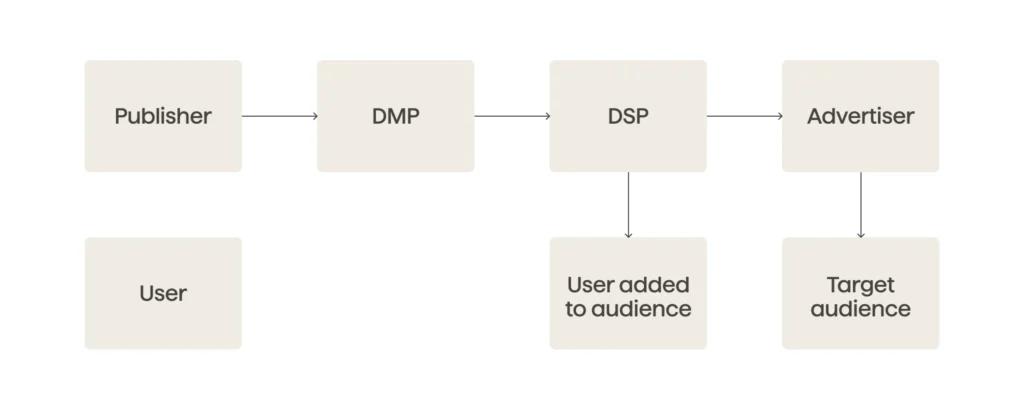
Audience extension is a process that allows advertisers to reach a publisher’s audience across many different websites. By carrying out audience extension, publishers can increase revenue from their audience without having to increase their amount of inventory (aka ad space).
For advertisers, audience extension allows them to reach the same audience across many different websites. DMPs allows publishers to create audiences, which can then be synced with SSPs and DSPs. Then, advertisers can target those audiences via their DSP.
Onsite personalization and content and product recommendations
Showing the right product to a visitor on an ecommerce store can mean the difference between a sale and a missed opportunity. By using a DMP, website owners can create profiles containing information about what products visitors have purchased in the past and which content they’ve read, allowing them to increase purchases and conversions.
These are just a few of the many use cases of a DMP. Others include advanced analytics, look-alike modeling, deterministic and probabilistic matching, and cross-device attribution.
Why are DMPs important?
Data management platforms (DMPs) allow advertisers to make better use of audience data by organizing it into actionable audience segments for targeted advertising. This improves campaign performance, reduces wasted ad spend, and allows marketers to deliver more relevant ads across digital channels.
In digital advertising, reaching the right audience is just as important as the creative itself. By centralizing data from multiple sources, DMPs give advertisers deeper audience insights and support more informed targeting decisions. Without a DMP, campaigns often rely on fragmented data, making it harder to identify and reach the right users at the right time.
DMPs are not only for advertisers
Typically, data management platforms are used by advertisers (and/or agencies representing a brand) for audience targeting and campaign optimization. However, DMPs can also be utilized by publishers.
By using a DMP linked to their supply-side platform, a publisher can get a better and more in-depth understanding of their users. This information can be used by the publisher when selling inventory (available ad space on their website) to an advertiser — either by a direct sell (premium deals), or via one of the technology platforms (e.g. ad networks and ad exchanges).
These user insights allow the publisher to increase the cost of their inventory and can provide a better user experience. For example, if a publisher who owns a travel website knows that most of their users are female, between the ages of 30-35, and live in the New York area, then they can sell their inventory to a brand who is advertising beauty products. In this case, not only will the ad be targeting the right audience, but there is a good chance that the users will be interested in the product and will engage with the ads.
FAQ
The future of DMPs
Over the past decade, DMPs have emerged to become a key component of the online advertising and marketing industries. However, they, like many other AdTech platforms, face strong headwinds. Privacy and data protection laws like the GDPR require media buyers and sellers to obtain consent from users to collect their data, which has reduced the availability of third-party data.
Also, privacy features in browsers, such as Apple’s Intelligent Tracking Prevention and Firefox’s Enhanced Tracking Prevention, block third-party cookies from being created, meaning DMPs can now longer collect third-party data from websites.
It’s clear that the future of DMPs, and of AdTech in general, will focus on the collection and utilization of first-party data.
Got a question or comment? Join us on Facebook, Twitter, and LinkedIn.



Your business results matter
Achieve them with minimized risk through our bespoke innovation capabilities. Fill in the form below.