






Reading the signs: What cybersecurity risk assessment service can reveal about your company


August 26, 2026 7 min read 12 views
Digital transformation has fundamentally changed how enterprises create value, but it has also made technology environments significantly more interconnected and more difficult to oversee. Cloud platforms, AI-powered applications, connected supply chains, and increasingly distributed operations have expanded the number of systems, identities, and business processes that organizations rely on every day. In this environment, cybersecurity risk assessment is a way to understand how technology supports business objectives, where operational dependencies have accumulated, and how well governance has kept pace with organizational change. Research from Gartner shows that 85% of CEOs see cybersecurity as fundamental to business growth. Cybersecurity risk assessment is the main gate to that realm.
Risk is an organizational characteristic
Cybersecurity risks rarely originate from technology alone. They emerge as organizations grow, modernize, adopt new platforms, integrate acquisitions, or introduce new digital services. Every strategic decision that expands business capabilities also changes the organization’s risk profile, often in ways that are not immediately visible. Risk management works best when it moves at the same pace as the business.
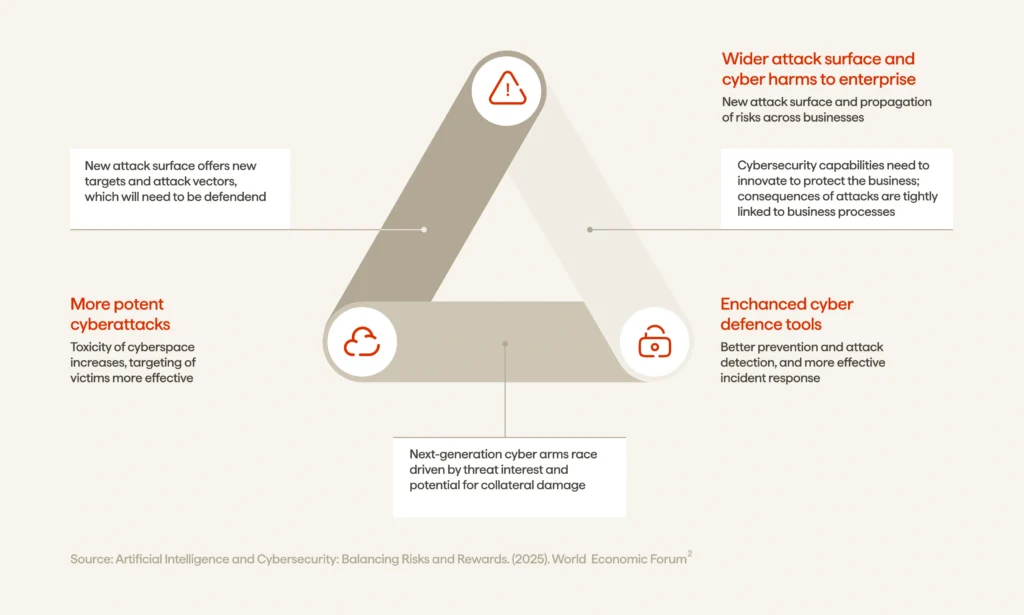
A manufacturer implementing connected production systems may gain greater operational visibility while increasing exposure across operational technology networks. AI-enabled workflows may accelerate decision-making but also create new questions around data security and model governance (74% of cybersecurity professionals report that AI-enabled cybersecurity threats are already affecting their organization, and 90% expect to face them within one to two years). Here is a closer look at new cybersecurity challenges imposed by AI:
None of these developments are inherently problematic. They simply illustrate that business transformation and cybersecurity have become inseparable.
A cybersecurity risk assessment provides a structured view of these relationships. It examines how systems, processes, and governance interact. The bird’s eye view picture often reveals whether security practices have evolved alongside the business or whether complexity has gradually outpaced oversight. It covers:
- Business initiatives that have introduced new technology dependencies, including cloud security responsibilities that shift between provider and enterprise.
- Governance processes that no longer reflect the current operating model.
- Critical assets that have become concentrated around a small number of systems or providers.
- Security measures that have evolved inconsistently across business units.
- Operational assumptions that remain unchanged despite architectural transformation.
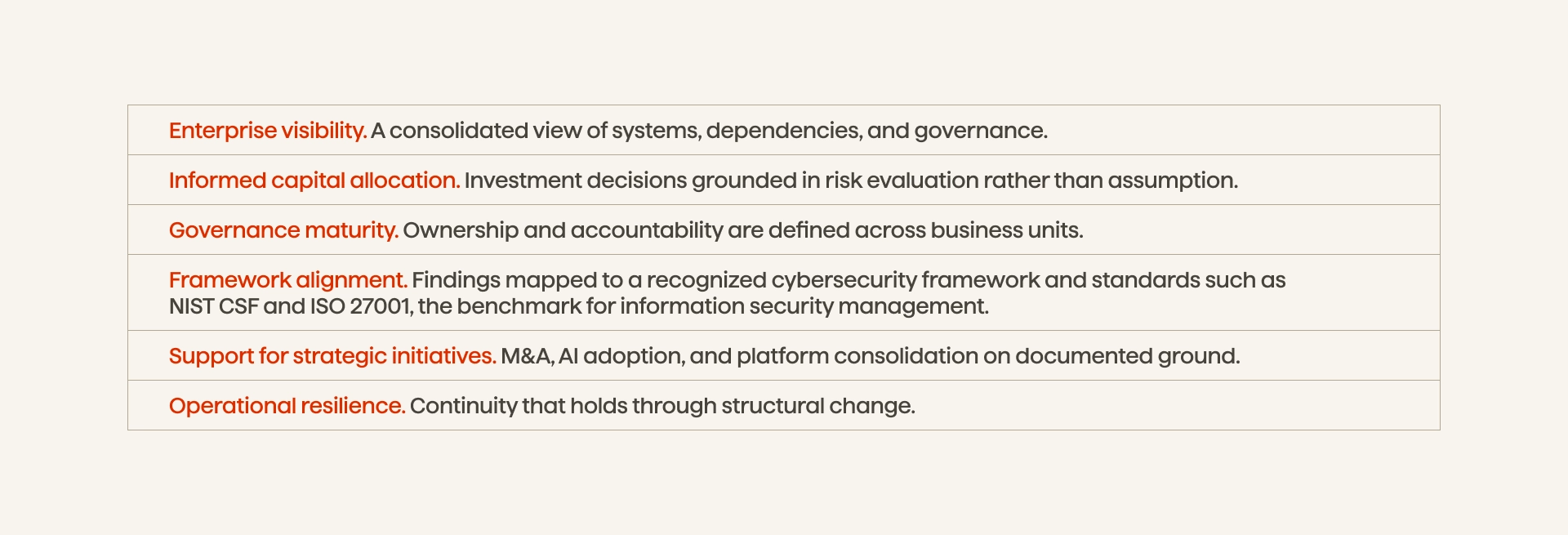
This broader perspective helps organizations understand not only where risks exist, but why they have developed. It connects technical findings with operational realities, allowing leadership teams to evaluate their cybersecurity posture within the wider context of enterprise resilience, business continuity, and strategic growth. A list of common benefits include:
Key findings in the cybersecurity risk assessment are often systemic
One of the greatest values of a mature cybersecurity risk assessment is its ability to identify recurring organizational patterns instead of isolated technical issues. While individual vulnerabilities require attention, they often represent symptoms rather than root causes. A vulnerability assessment answers what is exposed. A broader review answers why exposure exists.
Assessments frequently reveal inconsistencies in identity governance, uneven security controls across business units, fragmented asset ownership, or unclear accountability for critical systems. Administrative privileges may have expanded over time without corresponding oversight. Information security policies may exist at an enterprise level but be implemented differently across regions or business functions. Application security practices may be mature in one product team and informal in another. Vendor management processes may vary depending on procurement history rather than organizational standards.
Individually, these issues may appear manageable. Collectively, they describe a security risk profile that grows quietly alongside the organization.
This distinction is important because systemic findings influence strategic decision-making more effectively than lists of technical deficiencies. Organizations can prioritize initiatives that improve governance, standardize security practices, simplify operational complexity, or clarify ownership across the enterprise. Risk analysis at this level reduces exposure in multiple areas simultaneously rather than addressing vulnerabilities one by one.
Systemic observations also help organizations allocate resources more effectively. Security investments produce greater long-term value when they strengthen underlying capabilities and security operations among them, instead of responding only to immediate technical findings.
As enterprise environments continue to grow more interconnected, identifying organizational patterns and the risk scenarios they enable becomes increasingly important for maintaining resilience across technology, operations, and governance.
Cybersecurity assessments strengthen business decision-making
Few enterprise decisions are purely technological. Whether an organization consolidates platforms, expands into new markets, adopts AI, acquires another company, or restructures its supply chain, every initiative introduces new dependencies. The challenge lies in understanding which risks are acceptable, which can be reduced, and which fundamentally alter the assumptions behind the investment. A risk-based view of each initiative makes that judgment possible.
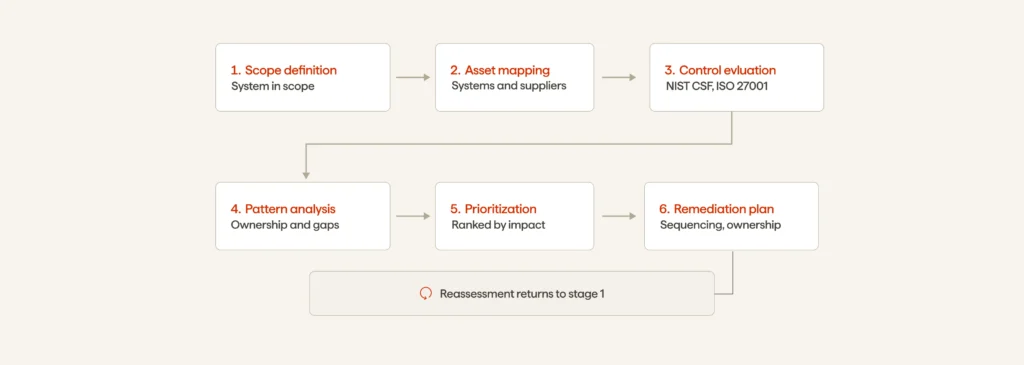
A cybersecurity risk assessment helps make these trade-offs visible. It reveals where resilience depends on a single supplier, where business continuity relies on undocumented processes, or where a planned modernization may remove one source of risk while creating another. In many cases, the most valuable finding is not a vulnerability but an operational dependency that had never been formally recognized. Setting the scope of the assessment around business processes rather than individual systems is what brings dependencies of this kind into view.
This perspective changes how organizations prioritize investment. Rather than evaluating initiatives solely by implementation cost, delivery timelines, or expected return, leadership gains insight into how individual projects affect the organization’s overall risk profile. Two modernization programs with similar business cases may produce very different levels of operational resilience. Risk mitigation through reduced technical debt may also have a greater long-term effect than deploying additional security controls. Expressing findings in financial terms through risk quantification gives the board a common language for weighing those options.
- Which dependencies would have the greatest operational impact if they failed?
- Where has architectural complexity begun to outpace governance?
- Which investments reduce long-term organizational risk rather than isolated technical issues?
- Which legacy decisions continue to shape today’s security posture?
- Where would simplifying the technology environment create greater resilience ?
The assessment, therefore, contributes a dimension that traditional business planning often struggles to quantify: the resilience implications of strategic decisions. Instead of treating cybersecurity as a separate discipline, organizations gain a clearer understanding of how governance, architecture, operational complexity, and business objectives reinforce (or undermine) one another over time.
FAQ
Exploring the complexity behind a security assessment of your company
Complexity in enterprise architecture is cumulative. A platform adopted in one year, a company acquired in the next, a regulation that arrives mid-cycle and reshapes how data is handled. Most projects examine one piece of that inheritance at a time. A security assessment takes the whole of it as its subject.
What emerges is a picture of the organization as much as its security controls. Where authority for a system has quietly gone unclaimed. Where a process still works because two people remember how it was built. These findings sit outside the usual reporting lines, which is why they tend to surface only when someone looks across the environment rather than down into it.
Tap into a structured review of your tech environment, mapped against NIST CSF and ISO 27001: start a conversation.



Your business results matter
Achieve them with minimized risk through our bespoke innovation capabilities. Fill in the form below.