





AI-augmented software engineering: A practical guide to enterprise adoption


July 2, 2026 9 min read 400 views
Two years after Generative AI coding tools moved from novelty to default, the question is no longer whether engineers are using AI. In fact, 71% of those who write code said they used AI for code generation in September 2025, according to a Google survey, and that number has been rising. The conclusion that follows is tempting and, on its face, obvious: AI has already rewritten how software gets built. The harder, more interesting question is whether enterprises, with their legacy code, their auditors, their compliance officers, can capture that gain at scale. The early evidence, gathered from boardroom surveys and engineering telemetry alike, says it is a tricky endeavor.
A productivity paradox of AI-augmented software engineering
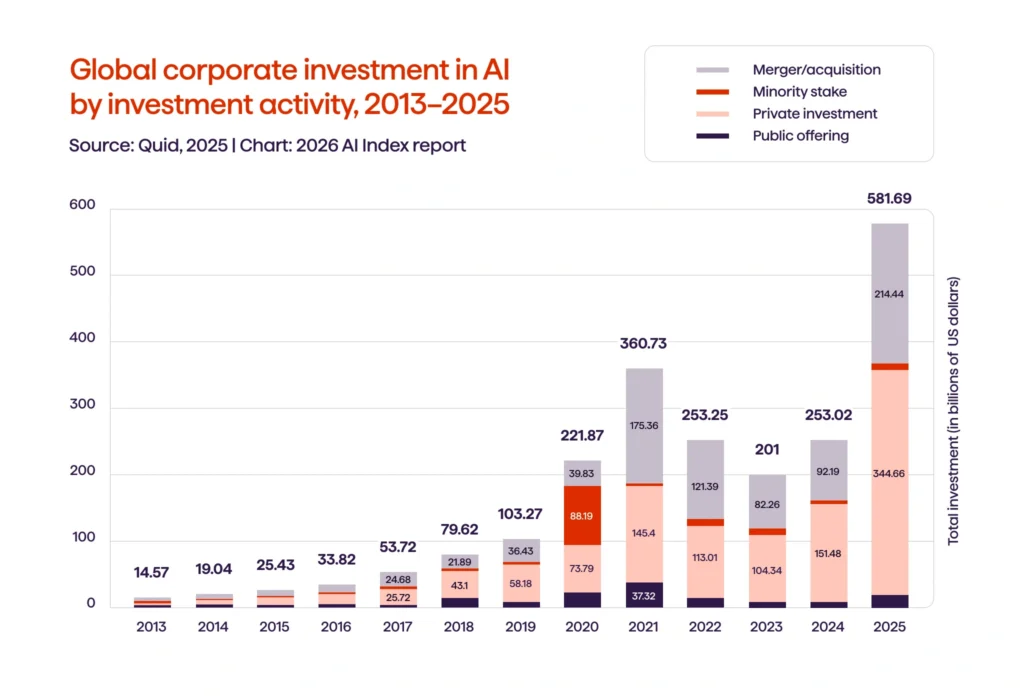
The capital flowing into AI adoption, and specifically AI in software engineering, is increasing. Stanford’s Human-Centered AI Institute reported in its 2026 AI Index that global corporate AI investment more than doubled in 2025, with private investment alone growing 127.5% (see Figure 1).
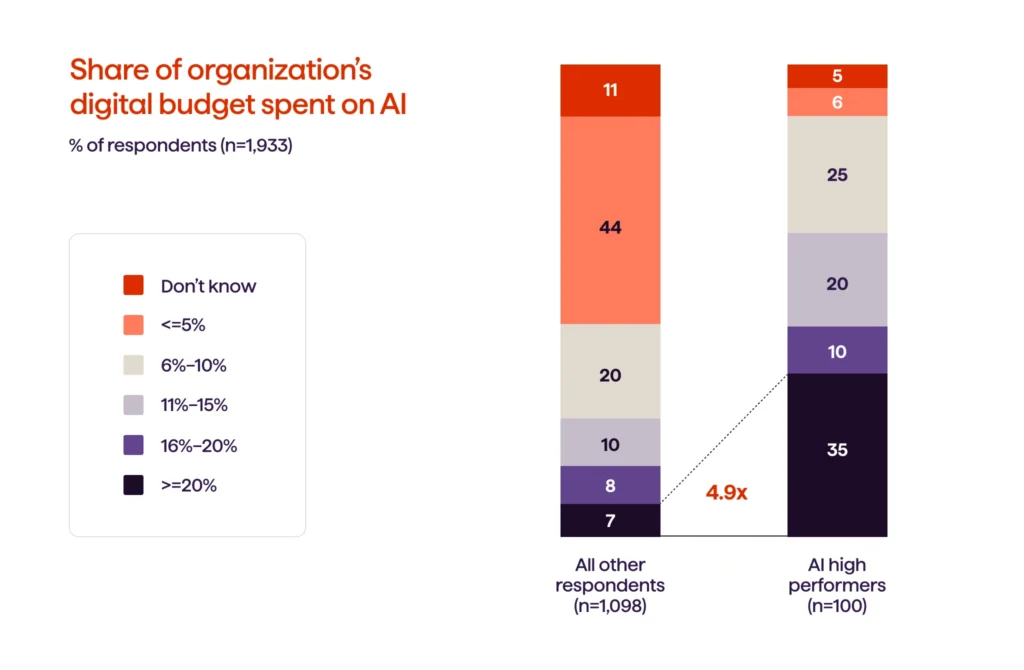
McKinsey’s annual State of AI survey, drawn from 1,993 respondents across 105 countries, finds 88% of organizations now augment AI in at least one function. High-performing companies are prioritizing AI in their financial planning. 35% of them report that AI technologies lean on more than 20% of their digital transformation budgets (see Figure 2).
Inside large organizations, the picture is one of saturation at the desk and turbulence in the system. Google Cloud’s DORA team, the research group behind nearly a decade of widely cited benchmarks on software delivery performance, has recently published its ROI of AI-Assisted Software Development report. Its central finding is captured in a single image: a J-Curve of value realization, in which most organizations experience a measurable productivity dip before any long-term gain materializes (see Figure 3).
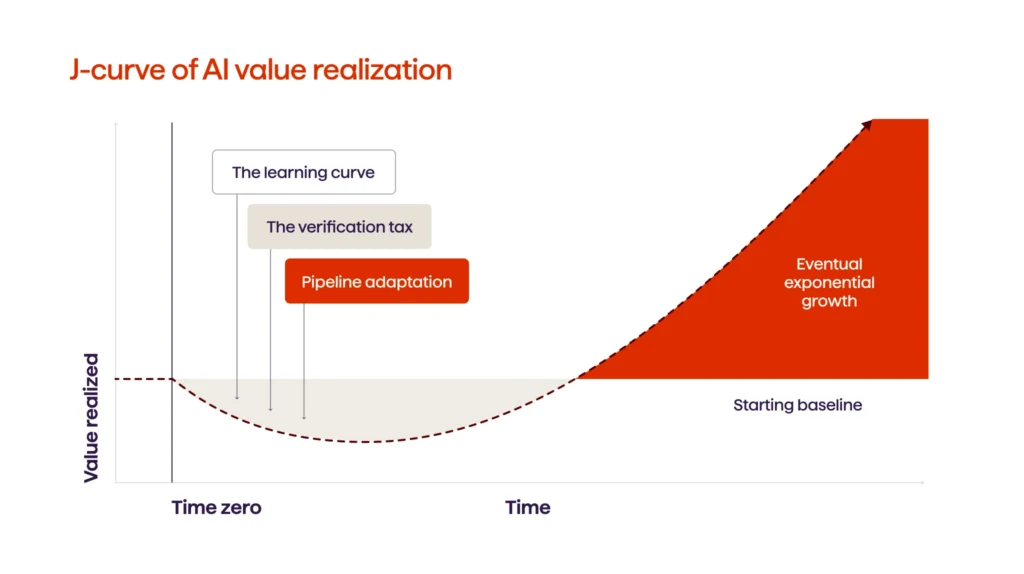
The dip, DORA writes, has three sources: the learning curve as teams adapt, the “verification tax” of reviewing AI-generated code, and the strain placed on software testing and release pipelines built for human throughput. In organizations where the software development process has not been redesigned around AI, this strain may compound.
The most uncomfortable data sits in the gap between what individuals feel and what controlled experiments measure. In July 2025, AI research nonprofit METR, published a randomized controlled trial of 16 experienced open-source developers completing 246 real development tasks in repositories where they averaged five years of prior experience. The developers expected AI to make them 24% faster. After the study, they estimated it had made them 20% faster. The data showed the opposite: with AI-powered tools, they took 19% longer. METR’s authors had predicted a speedup. So had outside experts in economics and Machine Learning (ML). None of them were right. The result has held up under unusual scrutiny partly because, as METR has since acknowledged, it has become genuinely difficult to recruit experienced developers willing to work without AI for a follow-up study.
Stanford’s 2026 AI Index puts the same paradox in the spotlight. Productivity gains in software development land at roughly 26% on average, the Index reports. The largest gains accrue to structured, measurable work where outputs are easy to verify. The DORA report sharpens that point with research from Stanford’s Software Engineering Productivity programme: AI yields a 35% to 40% productivity gain on simple, greenfield tasks, but its impact on complex legacy code is often smaller. Most enterprise code, by definition, is of the second kind.
Even Anthropic, whose engineers built one of the tools for AI coding now in widespread use, has published first-party research on the gap between perception and reality. In a December 2025 study summarized at Anthropic Research, the company surveyed 132 of its engineers and researchers and analyzed 200,000 internal Claude Code transcripts. Employees reported using Claude in roughly 60% of their work and self-reported a 50% productivity boost, which is a two- to threefold increase in a single year (see a detailed list of tasks in Figure 4). Yet more than half said they could “fully delegate” only between 0 and 20% of their work to the model. The tool is everywhere, and the benefits of AI are self-evident, but automation still needs to be integrated end-to-end.
That gap explains why broader business impact remains so concentrated. McKinsey’s survey found that only 6% of organizations qualify as AI high performers. They attribute more than 5% of EBIT to AI and report significant enterprise-level value. The rest see AI as a function-level efficiency tool. In software engineering, IT, and manufacturing use cases, businesses report 10% to 20% cost reductions, but those gains rarely cross the boundary into enterprise-wide financial impact. The DORA team’s framing has resonated precisely because it explains the pattern: AI does not, on its own, fix a slow software delivery system. It accelerates the parts that were already fast and exposes, in unforgiving detail, the parts that were not.
What makes enterprise-scale AI software development challenging
The challenges of AI-augmented software engineering at enterprise scale come into focus on three fronts.
The first challenge is the codebase itself. AI tools perform best on software engineering tasks with clear inputs and verifiable outputs. The typical enterprise system is the opposite because of decades of overlapping logic, undocumented dependencies, regional variants, and compliance workarounds. Large language models (LLMs) powering today’s coding assistants, including GitHub Copilot, Cursor, and Claude Caude, translate natural language prompts into code with impressive fluency but struggle to respect constraints they cannot see in the prompt window. As for the finding of the Software Engineering Productivity programme cited above, 10% or less productivity gain on complex legacy code is not an abstraction. It is the daily reality of companies whose competitive position depends on systems written long before leveraging AI in engineering became commonplace.
The second challenge is what DORA calls the instability tax. More code, written faster, moves into deployment pipelines that were not built for the volume. The DORA model’s sample calculator assumes the change-failure rate rises from 5% to 6% in the first year of AI development adoption. It indicates that the same investment that lifts engineering productivity can, without compensating changes to testing and release engineering, also lift incident frequency. Test case generation, debug workflows, and bug fixing loops all need to scale in parallel. DevOps maturity is the discipline that absorbs this pressure. Add cybersecurity into the equation, as every AI-generated change should be scanned and validated before it ships.
The third challenge is governance. McKinsey’s data show that nearly two-thirds of organizations remain in pilot or experiment mode despite the headline 88% adoption number. High performers are roughly three times more likely than the rest to have fundamentally redesigned workflows around AI-augmented software development rather than adding Copilot-style tools onto existing project management and delivery processes. This redesign requires close coordination with every stakeholder in the delivery chain, including security, legal, architecture, and business owners.
Augment your full engineering lifecycle with Intelligent Flow
Our response to this is Avenga Intelligent Flow. This is a framework designed to streamline AI integration across the software development lifecycle. We approach AI as a coordinated set of specialized agents embedded at the points where enterprise delivery might be tricky. The framework is built on the results of the DORA’s research that confirms productivity gained in coding evaporates if review, testing, and incident response cannot keep pace. The gains do not become enterprise value until the workflows themselves are redesigned around the agents doing the work.
Here is what it looks like from the engineering perspective (learn more about our development practices in AI-driven software development lifecycle):
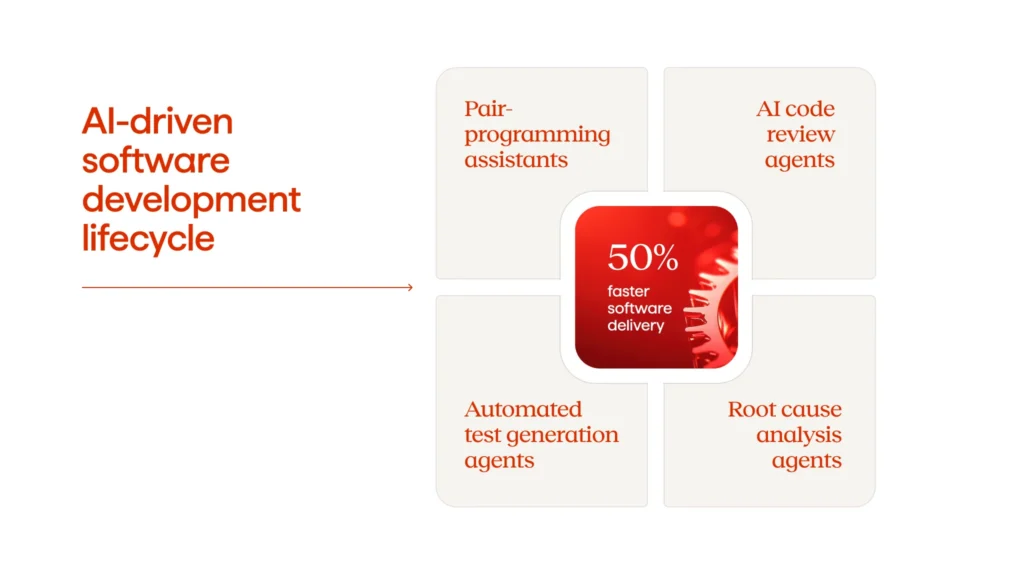
At the front of the lifecycle, pair-programming assistants work alongside engineers, grounded in your repositories, coding standards, and architectural patterns rather than generic public training data. They generate code that fits the system it is being written into, a direct response to the METR finding that off-the-shelf assistants slow experienced developers down in mature codebases. Behind them, AI code review agents apply the organization’s security policies, style rules, and architectural constraints to every pull request, addressing the verification tax that DORA identifies as the single largest hidden cost of AI-augmented development’s best practices. This is collaborative development in its latest form.
Further down the chain, automated test generation agents convert specifications and changed code into coverage that engineers rarely have time to write by hand, narrowing the gap between the volume of AI-generated code and the volume of trustworthy tests behind it. And when production incidents occur, root cause analysis agents correlate logs, telemetry, recent commits, and runtime behavior to compress diagnosis from hours to minutes. That comes as a direct mitigation of the instability that otherwise accumulates as delivery accelerates.
Each agent operates within explicit boundaries, with human approval on high-stakes actions, audit trails on every change, and the ability for team members to pause or roll back. That structure allows the framework to be deployed in regulated industries like banking, life sciences, telecom, where the alternative, a constellation of unvetted assistants running on personal accounts, is not the best practice.
FAQ
Lessons from AI-augmented development
Artificial Intelligence has, beyond any reasonable doubt, changed how code is written. For most enterprises, it is going to change how software is delivered. Closing the gap between the keystroke and the release, between the productive developer and the productive company, requires more than better AI models. It is rooted in embedding AI at every stage of the lifecycle, the governance to make that embedding safe, and the willingness to redesign the work itself. Enterprises that leverage AI tools with the purpose to change their workflows and ultimately expand human expertise are the ones turning individual productivity into enterprise outcomes.
Avenga’s Intelligent Flow framework enables global enterprises to move from AI experimentation to operating models that deliver at scale. To discuss AI-based automation in your organization, contact our team.


Your business results matter
Achieve them with minimized risk through our bespoke innovation capabilities. Fill in the form below.