







Automotive digital services monetization: unlock success with Avenga


June 4, 2026 11 min read 326 views
The auto industry has now entered a new era. The auto industry now includes both software and any associated services that add value to an automobile, as new products have been developed and auto manufacturers seek multiple revenue streams through their products. One example in the electric vehicle space is the capacity for software to impact an EV’s performance, features, and consumer interaction with the vehicle.
This article explains how modern automotive technologies and digital solutions enable recurring revenue through usage-based invoicing, on-demand feature access, and subscriptions. It focuses on how to provide subscription services and scalable payment infrastructure to support the automobile industry’s digital transformation, helping automakers realize the long-term potential of software-defined vehicles.
Automobile digital services and new developments: key takeaways
- The automotive industry has shifted from hardware to software. With each car now being connected and acting as a platform capable of generating ongoing revenues through evolving digital services, the automotive industry will continue to witness significant change in how it operates.
- Successful monetization requires a variety of flexible models that can adapt to how consumers actually use vehicles. Models such as subscription, pay-per-use, and on-demand mobility services can and will be applied to create new revenue streams and expand the automotive business beyond traditional service models.
- Data plays a central role in optimizing vehicle performance, pricing strategies, and user engagement, enabling more targeted and scalable digital experiences.
- As the automotive digital services market size continues to grow, companies that invest in integrated platforms for payments, billing, and analytics will be better positioned to capture long-term value.
Driving the automotive digital services: discover how they work
Digital services in the automotive sector are features, applications, and experiences enabled by software operating within an automobile’s connected-car ecosystem. Instead of relying solely on the vehicle’s built-in hardware, automobile manufacturers can now enhance, update, activate, or customize their vehicles via cloud technology, embedded software, and real-time connectivity.
This evolution of the vehicle from being a one-time item to a permanent digital platform is primarily facilitated by the adoption of digital services.
Examples of digital services include:
- navigation,
- entertainment,
- remote diagnostics of your vehicle,
- predicting when to maintain or repair your vehicle,
- driver assistance,
- sharing data with your insurance company,
- charging your electric vehicle, or
- managing your fleet.
The goal is to provide the customer with a seamless experience—whether they are opening an app, activating a new feature, renewing their subscription, updating the service they use, or accessing a connected service.
These services rely on a variety of interdependent layers working together behind the scenes. The data collected from vehicle sensors and onboard digital systems is transferred in real-time via connectivity modules, stored and processed in a cloud environment, and managed through business cycles to manage payment, subscriptions, entitlement, and customer access.
u003cspan class=u0022TextRun SCXW130802667 BCX0u0022 lang=u0022UKu0022 xml:lang=u0022UKu0022 data-contrast=u0022autou0022u003eu003cspan class=u0022NormalTextRun SCXW130802667 BCX0u0022u003eEmbrace the growth of the automotive landscape and embrace autonomous vehicles today with Aveng.u003c/spanu003eu003c/spanu003eu003cspan class=u0022EOP Selected SCXW130802667 BCX0u0022 data-ccp-props=u0022{u0026quot;335551550u0026quot;:6,u0026quot;335551620u0026quot;:6}u0022u003e u003c/spanu003e
Monetization models for automotive digital services
The key industry developments are changing the business model. Increasingly, companies rely on providing services rather than just selling vehicles (e.g., insurance, payments, financing). Substantial increases in demand over time will primarily drive this transition. Given the market is expected to grow, both Ford and General Motors expect to earn over $20 billion and $25 billion, respectively, from subscription and software-based services by 2030.
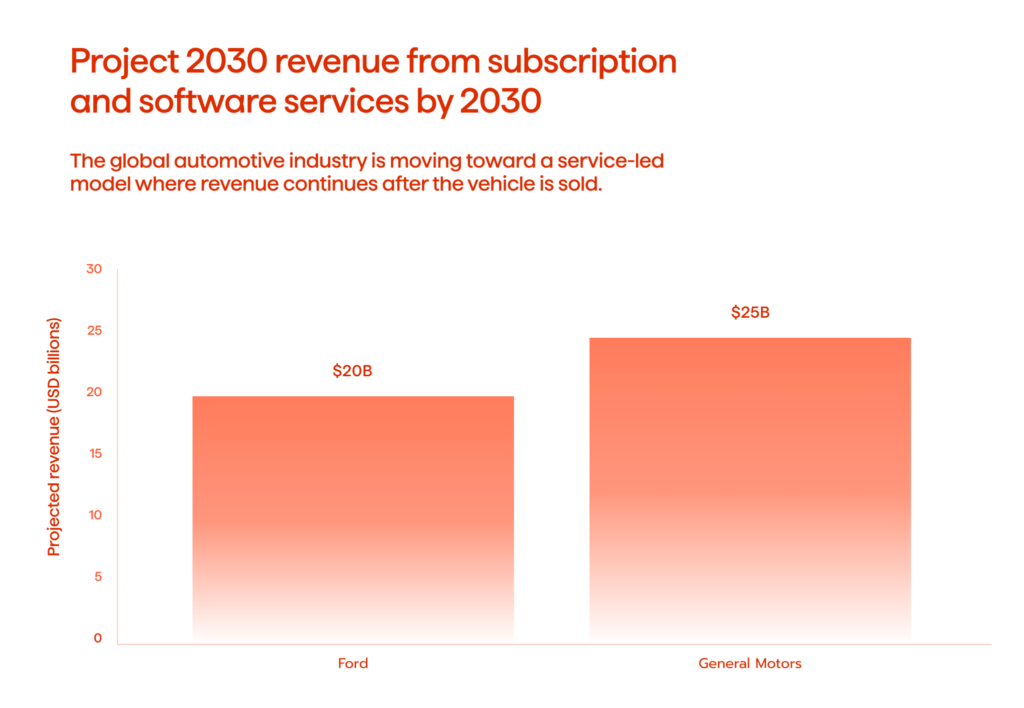
This revenue forecast makes clear the importance of monetization models. For Ford and GM to achieve tens of billions of dollars in software and subscription revenues by 2030, auto manufacturers cannot continue to rely on isolated paid features. Rather, they will require a flexible monetization infrastructure that supports diverse customer behavior, service types, and partner ecosystems.
Subscription-based models provide ongoing, continuous revenue. However, they also expose automakers to greater market risk by requiring ongoing updates and improvements to ensure customers continue to find value in each subscription. If consumers perceive a new digital offering as static, untrustworthy, unsupported, or unnecessary, they are likely to cancel their subscription.
DaaS (Data-as-a-Service) enables car manufacturers to profit from anonymized, consent-driven data collected from the interconnected vehicles they produce. For example, this could be used to provide automotive companies with insights into usage and charging patterns, overall fleet performance, and how their vehicles have performed during adverse weather.
For logistics companies, insurance providers, smart city platforms, and maintenance networks, DaaS provides an opportunity to make more informed decisions based on real-time data. This creates a new revenue opportunity for automotive manufacturers by partnering with third parties to monetize consumers’ data rather than charging consumers directly.
The pay-per-use model allows drivers to pay only for a temporary performance boost, rather than always paying for the additional capabilities of features such as advanced parking support or superior route optimization.
The overall revenue from a pay-per-use strategy may be less predictable than that from a subscription-based model, despite the model’s perceived fairness and flexibility, and despite customers only paying for items that offer instant value. To help prevent billing conflicts, the platform must provide precise, real-time usage tracking.
An automotive manufacturer can utilize partnership agreements to expand their digital platform without having to build each service from the ground up. For example, the automotive player can include charging networks, insurance options, entertainment options, or maintenance services into the vehicle experience, enabling revenue to be generated and shared with the partners. This may reduce an automaker’s time-to-market, increase the usefulness of a vehicle’s digital ecosystem, and create new dependencies on third-party providers, new revenue-sharing dynamics, and more complex integration.
Payment processing in connected vehicles
When drivers purchase or renew digital features via an infotainment system, an OEM app, a web portal, or their fleet’s dashboard, payment processing begins. The request is sent to the commerce backend for verification against the customer account, Vehicle ID/VIN, payment method, region, price rules, taxes, and eligibility for the selected service. Once a valid payment is received from a gateway or payment service provider, the billing platform posts that transaction to the entitlement layer and provides a status notification that the purchased feature can be enabled in the vehicle.
To enable subscription-based digital services through automotive companies, the infrastructure must do much more than manage simple card payments. Subscription-based digital automobile services will require recurring billing, proration, retries for failed or declined payment attempts, refunds, upgrades/downgrades, and renewal notifications. Additionally, the same infrastructure must also provide near real-time transaction rating and confirmation for services paid for at the time of use, such as electric vehicle charging, parking, tolls, and temporary feature activations.
The value is operational and commercial. Industry participants can reduce back-office manual work, bring new offers to market quickly, and provide drivers with a seamless purchase experience across the connected service industry by leveraging digital technologies to connect payments and billing with vehicle entitlements.
Entitlement management and feature activation
Entitlement management refers to the system that controls user/vehicle access rights by defining which features they can use, under what conditions, and for how long. In the automotive operating environment (OE), entitlement management links billing, identity, and vehicle systems so that when a purchase is made, the right feature is provisioned and activated without delay.
After someone purchases or subscribes to a service, the entitlement system will check its validity before assigning access rights to users/vehicles/benches. Once verified, these services enable their features via either over-the-air updates or secure vehicle-to-vehicle communication methods directly connected to that vehicle.
The ability to provide large-scale personalized service is the primary benefit. Automotive firms can offer trial usage periods, upgrades, or limited-time access to vehicle features while maintaining complete control over the lifecycle management of those features. As a result, they can offer customers a more configurable, enhanced automotive experience without making any physical changes to the vehicle.
Challenges in automotive digital services monetization
Although the global automotive digital services market is growing rapidly, monetizing these services remains difficult due to fragmentation, evolving consumer expectations, and regulatory challenges. Most automakers continue to operate on outdated systems that weren’t built for recurring revenue or instantaneous service delivery. Because of this, companies attempting to scale in-vehicle digital services across regions, vehicle types, and user segments face challenges integrating their billing, payment processing, CRM, and vehicle platforms.
An additional significant challenge is delivering consistent value. Customers expect seamless, continuous digital automotive experiences; however, they often lack confidence in paying for service features they believe are inconsistent or underdeveloped. This creates conflict between user trust and monetization objectives. If a service cannot deliver reliable performance, it will be difficult to either convert or retain users, even with strong pricing strategies.
As data continues to grow rapidly, so does the complexity of managing it. The use of artificial intelligence systems and predictive analytics technologies can improve product customization and pricing, and make recommendations for new features based on previous customer purchases.
Developing an effective implementation plan for these technologies depends on having a mature data pipeline design, effective data governance programs, and methods to ensure compliance with privacy regulations. Without frameworks that support all three components, analytics-based monetization strategies will yield poor outcome measures and may violate relevant laws.
Another challenge relates to coordinating across multiple entities within an ecosystem. Monetization will rely more heavily on partnerships (e.g., between insurers, content providers, charging networks, transportation management company platforms, etc.) than in the past.
The addition of each partner creates technical dependencies, revenue-sharing agreements, and operational risks. A situation in which multiple providers can offer bundled services (e.g., an EV charging service or a mobility subscription) will require precise coordination among providers based on each provider’s unique systems and service-level agreements (SLAs).
FAQ
How Avenga enables automotive digital services monetization
The shift toward monetizing automotive digital services reflects a broader response to rising consumer demand for flexible, on-demand experiences. As digital services in the automotive market evolve, success will depend on how effectively companies combine payments, entitlements, analytics, and digital tools into a unified ecosystem.
Want to learn more about connected cars, mobility on demand service, and logistic fleet management services in the automotive industry? Contact Avenga, your reliable partner in automotive technology advancements.



Your business results matter
Achieve them with minimized risk through our bespoke innovation capabilities. Fill in the form below.