





What’s the difference between AdTech vs MarTech?


June 12, 2026 11 min read 342 views
AdTech and MarTech now sit on a market worth hundreds of billions, and the line between them keeps fading. The global AdTech market reached roughly $987 billion in 2025, according to Fortune Business Insights, while MarTech is set to grow from about $176 billion in 2025 to $297 billion by 2030. The confusion is natural. Recent technology has blurred a once-clear distinction.
If you build in this space, our advertising software development team works across both sides every day. In this post we trace AdTech and MarTech separately to see how the overlap came about.
Difference between MarTech and AdTech explained: Key takeaways
- AdTech runs paid advertising. It helps advertisers and publishers buy and sell ad inventory at scale.
- MarTech runs owned and earned marketing. Think email, social, SEO, CRM, and personalization.
- They differ on five axes: role, platforms, billing, target, and media.
- AdTech leans on third-party data and one-to-many reach. MarTech leans on first-party data and one-to-one nurturing.
- The two are converging into “MadTech,” driven by the need for a single view of the customer.
Why is there AdTech and MarTech confusion in the first place
To delineate the division between AdTech and MarTech is, on the most basic level, much like telling the difference between marketing and advertising, but because it depends on a variety of factors, it may not be that easy. Advertising is to marketing what AdTech is to MarTech, whereas the common denominator is technology. Both sit under the wider umbrella of digital marketing.
Let’s look at the five areas that highlight the key differences between AdTech and MarTech.
1. The role
At the heart of AdTech is the campaign, ads, and all relevant data and metrics (impressions, acquisitions, views, and unique users). AdTech is the engine behind modern digital advertising.
Advertising technology is designed to help advertisers and ad agencies create, run, measure, and manage online advertising campaigns across a number of websites or apps. It allows publishers (websites and apps) to sell their available ad space, also known as inventory, to a large number of advertisers. This can be done via display ads or search-engine marketing (SEM). Specialized AdTech platforms deal with attribution, verification, and viewability.
MarTech, on the other hand, is more about “pruning your own trees.” It allows marketers to create, run, and manage online marketing campaigns and conduct onsite marketing—e.g. email marketing, social-media management, A/B testing, personalization, user-feedback surveys, web analytics, etc.
2. The platforms
Both online advertising and marketing ecosystems are comprised of dozens of different platforms, and while there are a couple that exist in both industries, data-management platforms (DMPs) are a classic example, most are unique and specific to their respective field.
For example, demand-side platforms would solely be used by advertisers to run online media campaigns, whereas email-automation tools would be operated by marketers. Together, these marketing technologies span everything from ad buying to email, analytics, and CRM.
AdTech-specific platforms
Demand-side platform (DSP)
A DSP is a technology platform that allows media buyers to run advertising campaigns and buy inventory from various ad exchanges and SSPs through one user interface. DSPs are a key component of the real-time bidding process, which allows advertisers to buy media on an impression-by-impression basis. To help improve targeting and enhance media buys, DSPs often utilize data from data-management platforms (DMPs) and data brokers.
Most of this buying now happens programmatic, in milliseconds, through automated auctions. For the buy side, see how to integrate a DSP with ad exchanges and SSPs
Supply-side platform (SSP)
The supply-side platform helps publishers sell their inventory on a number of different ad exchanges in an automated, secure, and efficient way. Even though publishers don’t need to use an SSP in order to sell their inventory on the ad exchange, the technology used with SSPs provides them with many benefits that allow them to receive the most yield from their inventory and gain clearer insights into their audience.
We explain this fully in what is a supply-side platform.
Ad Exchange
An ad exchange is a dynamic technological platform that facilitates the buying and selling process of impressions between the advertisers (buyers who place their offers via DSPs) and the publishers (sellers who put up their inventory for sale via SSPs), very much like the way stock exchanges manage the buying and selling of stock between investors and companies.
This real-time bidding is the foundation of programmatic advertising. This is the heart of programmatic advertising.
Ad Network
Ad networks buy unsold (“remnant”) inventory from publishers, run the inventory through their technology, package it all up, and sell it to advertisers.
Ad Server
An ad server is a web-based technology platform responsible for making decisions about which ads to show on a website, serving them, and collecting and reporting the data (such as impressions, clicks, etc.). Ad servers are to ads what WordPress is to content.
SEM platforms
Search-engine marketing (SEM) involve the promotion of websites to ensure their good visibility in search-engine-results pages (SERPs), which primarily includes paid advertising. SEM platforms are strictly connected to buying ads, and thus must be considered AdTech. AdTech also fuels paid placements on every major search engine.
MarTech-specific platforms
MarTech tools cover analytics, social, SEO, CRM, and personalization.
Web analytics
This is the process of collection and analysis of data collected on the web, as well as later generation of reports allowing marketers to understand and optimize web usage. Web analytics are used for business and market research and to assess and improve the effectiveness of a website. Web analytics can include traditional platforms like Piwik PRO, and those that provide more features, such as heats maps. A good analytics tool turns raw web data into decisions.
Social-media-management platforms
This includes social-media-management platforms like Hootsuite, Sprout Social or Buffer; influencer management tools like TapFusion and Webfluential; and social-media-listening tools such as Reputology and Hootsuite. This category can also include visitor feedback/live-chat software. Strong social media management keeps brand conversations consistent across channels.
SEO and content-optimization tools
Customer-relationship management (CRM) is an approach to managing a company’s interaction with current and potential customers.
CRM
Customer-relationship management (CRM) is an approach to managing a company’s interaction with current and potential customers. Customer relationship management (CRM) sits at the core of most MarTech stacks.
Personalization
Personalization, also known as customization, involves tailoring a service or a product to accommodate specific individuals, sometimes tied to groups or segments of individuals.
Marketing automation
Marketing automation is the umbrella term including a range of different MarTech platforms (like the ones listed above). A typical MarTech stack connects these tools into one workflow.
Building or scaling an AdTech or MarTech platform? Talk to Avenga’s advertising software team about SSPs, DSPs, and full-stack integration
3. The billing model
Some marketing pundits vastly simplify the bifurcation by arguing that the difference between AdTech and MarTech boils down billing method. AdTech solutions are based on the idea of automating the process of buying and targeting of ads. The typical billing model for this is to charge a commission or fixed fee on top of CPM.
Examples:
- 10% markup on top of media spend
- or $0.10 CPM ad-serving fee
- or $0.50 CPM for data usage
The increasing popularity of the SaaS model across the industry, however, has given birth to an array of more predictable billing methods. Considering the relative impossibility to anticipate the result of the AdTech performance-based marketing efforts, a growing number of vendors decide on pay-per-month pricing models (much like MarTech).
The commission/CPM model predominant in AdTech often includes a minimum monthly fee. For example, DSPs charge 10% commission on your spend, with a minimum of $2,000 a month. This means that if you spend $18,000 in media, you will still have to pay $2,000 to the DSP, rather than just $1,800. Similarly, if you spend $25,000, the fee is $2,500.
There are some exceptions of course, but as a general rule we could describe it this way. Still, there is more than meets the eye, and the difference does not simply come down to the billing method.
4. The target
Inherently, advertising usually involves pitching to unknown prospects based on certain targeting parameters (location, browser history, behavior, etc.) while marketing is more about nurturing a specific group of people who have explicitly expressed interest in your products or services. MarTech is built to deepen customer relationships over time. All of this depends on clean, well-governed customer data.
Likewise, a large majority of AdTech solutions are based on third-party data (e.g. third-party cookies), whereas MarTech solutions can tap into a combination of first-party cookies and various personal data (or personally identifiable information) like emails and names that are typically provided by the users themselves when they download a free ebook or whitepaper. This is a more personal and direct method to nurturing the existing customer base.
Bottom line: Marketing (or MarTech) is more about communicating directly to customers who have already interacted with a brand, as the company knows their name, address, age, and location.
Granted, this is a sweeping generalization, but good for starters. In this understanding, MarTech is focused on a specific, known group of customers, while AdTech often takes the more creative spray-and-pray method and image-building approach using only anonymous data about their customers, like browser cookies. AdTech platforms primarily operate in a one-to-many environment.
MarTech platforms operate in a one-to-one environment. In this way, MarTech deals with the next steps in the customer journey by reaching existing audiences and ultimately converting them into satisfied clients. It puts the customers at the center of attention when they have become aware of the brand—once they have interacted with the brand via a display ad or entered the marketing funnel by downloading an ebook or subscribing to a newsletter, for instance.
5. The media and intermediaries
Another simple distinction between the two is the kind of media each focuses on. While AdTech is all about paid media, MarTech focuses on free channels (social media networks, email, and SEO) and methods applicable to nurturing an existing customer base.
Advertising agencies and partners are part of the AdTech orbit, whereas the MarTech world is pretty straightforward and allows brands to work directly with vendors. AdTech companies can sell their software to agencies or to advertisers directly, depending on the size of the company; big brands or advertisers are more likely to contact an agency.
For example, we helped FatTail build AdBookPSP, the first SSP for deal-based programmatic transactions.
While ad agencies have always been a key element to advertising campaigns, their role has been threatened by the growing popularity of AdTech. To secure their profit, AdTech vendors try to sell directly to brands, very often combining elements of MarTech into their AdTech platforms.
Synchronizing the stack: connecting ERP, WMS, and OMS in the cloudo all integrated systems. All systems will be updated and will maintain an even, consistent level of available product and shipment status. By implementing these event-driven integrations, achievable fulfillment optimization (such as intelligent order routing, split ship, and dynamic allocation when a physical store cannot complete a pick) can be achieved.The business result of employing an omnichannel, integrated approach is rapid, controlled delivery of goods and services. Due to the speed at which teams can utilize new multichannel fulfillment methods, as well as the ability to grow and manage peak volume safely and maintain inventory accuracy, all of which may be accomplished without creating an unstable point-to-point distribution link.
FAQ
MarTech vs AdTech: What is the verdict?
The strongest marketing strategies now blend paid acquisition with owned nurturing. There is a growing need to provide a holistic approach to digital strategy. Moving and syncing data between the two silos is inherent to successful advertising and marketing. As a result, the process of AdTech and MarTech’s seamless integration is underway. This convergence has a name, and we cover it in what is MadTech.
The resulting tool may be the holy grail of every marketer, giving brands the power to know exactly what a customer wants before they even realize it themselves. Wishful thinking, or the future?
Our AdTech vs MarTech comparison table
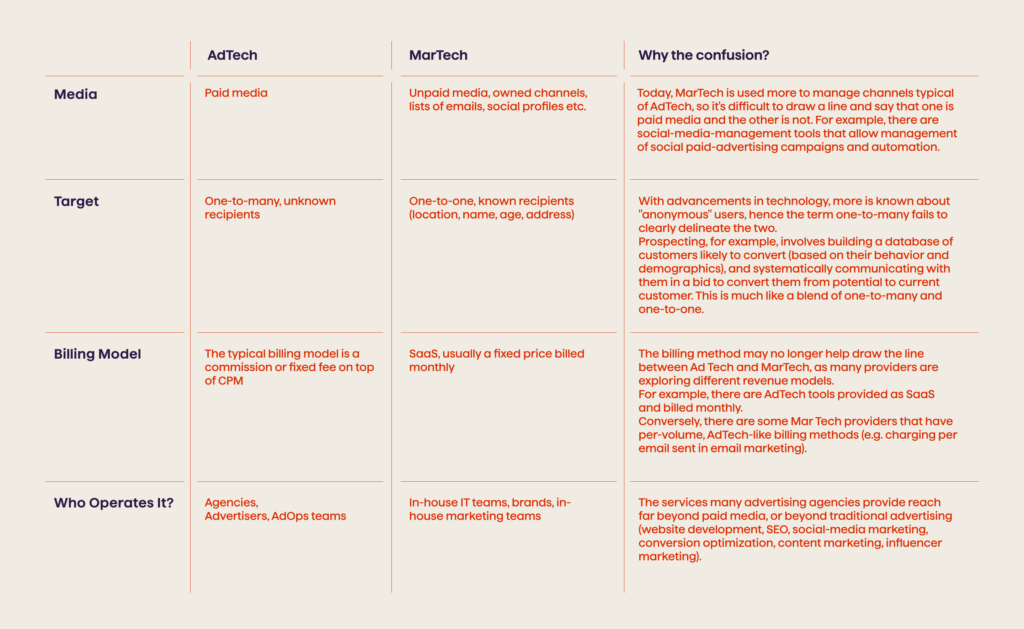
Get in touch with us to bridge the gap between AdTech and MarTech and turn data into meaningful customer connections.



Your business results matter
Achieve them with minimized risk through our bespoke innovation capabilities. Fill in the form below.