





How to generate value with data monetization in telecom


June 18, 2026 13 min read 83 views
Telecom operators are increasingly turning network and customer data into a core source of revenue and business value. “Data really powers everything we do,” said Jeff Weiner, and this statement resonates clearly across today’s telecom industry. High-frequency data streams and powerful analytics are combining to create a new era of data monetization as passive data assets become dynamic sources of revenue and strategic growth.
Research from McKinsey highlights that telecom operators are increasingly evolving into data-driven organizations, where real-time access to structured network and customer data plays a central role in enabling new digital revenue streams and improving customer value creation. This shift makes data more than a byproduct of connectivity; it becomes a primary driver of value creation. For telecommunications providers, this is not about meeting demand for faster connections, which is the nature of the market opportunity; it is about strategically monetizing data in multiple ways. From personalized plans based on usage behavior to providing anonymized insights to third parties, data itself is the product and the platform. In a market of commoditized connectivity, the value that can be obtained from data is rapidly becoming a key differentiator and a powerful growth engine.
Want to learn more about data monetization strategies and how you can obtain the most value from data as a telecom service provider? Read more in our comprehensive blog
Data monetization in telecom: meaning, strategies, and key use cases
Data monetization in telecom describes the process of creating a tangible economic benefit from telecom data assets. Telecom service providers leverage telecom data and data analytics to generate new revenue streams, improve operational effectiveness, and enhance customer experience.
Monetization can take the form of direct revenues, such as selling data-related products, or indirect benefits, such as improved operational effectiveness, reduced churn, or better decision making. Data monetization elevates data from a passive by-product to a “Data as a Product” concept, making it a strategic business asset. In the telecom industry, data monetization assumes a more complex role. Telcos aggregate a vast volume of real-time data from network traffic, which describes subscriber behavior, geolocation, device usage, content, and network performance. The real benefit of telco data comes from its granularity across very large datasets, its velocity, or how fast it updates, and the high frequency at which it derives insights in industries like retail, advertising, mobility, and financial services.
Data monetization can include use cases such as:
- Building data-as-a-service (DaaS) platforms targeted toward third parties
- Delivering precision marketing through audience segmentation and behavioral analytics
- Enabling smart city infrastructure through location intelligence
- Increasing smart infrastructure resource allocation through predictive demand modeling
The rationale for telecom data monetization investments is gaining momentum. The Data Monetization Market is projected to grow at a CAGR of 16.70% through 2031, reaching USD 7.8 billion.
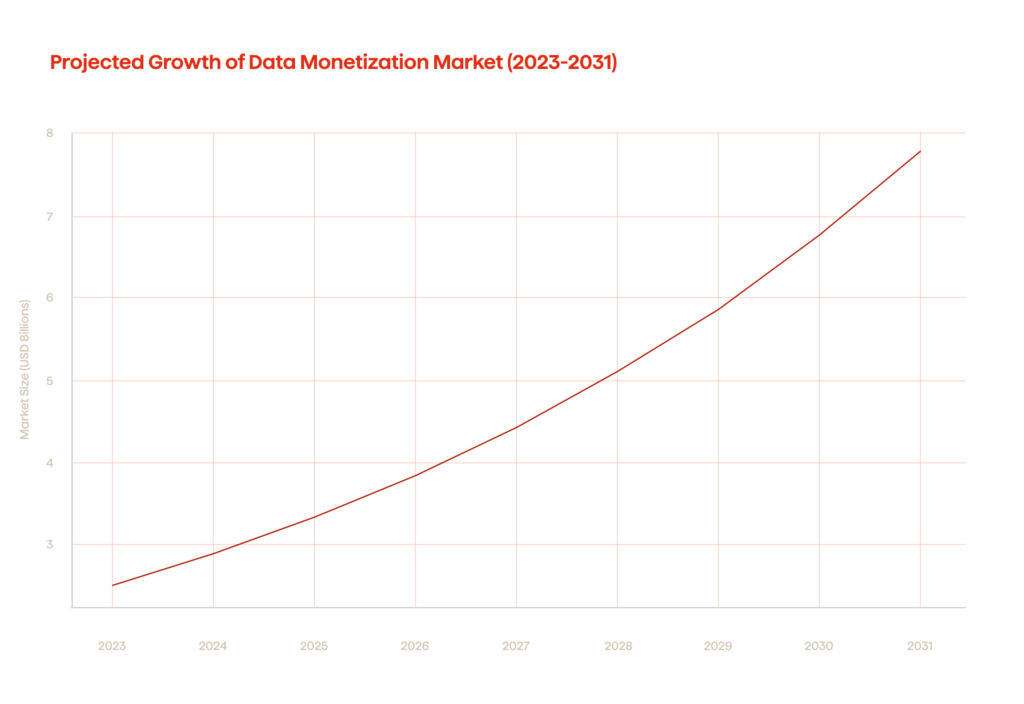
This growth trajectory indicates a strategic shift in the data monetization in telecom market: telecom service providers are transitioning away from their role as connectivity providers and evolving towards platform players and cross-industry innovation enablers. This evolution is driven by growing urgency for revenue diversification, as ARPU growth is limited due to market saturation, regulatory pressures, and competition from OTT services. To stay competitive, telecom operators are accelerating monetization initiatives across telecom data ecosystems, including data platforms, APIs for data access, and enterprise partnerships requiring scalable and compliant access to data. Additionally, investment in data privacy and security frameworks, as well as customer consent management aligned with the General Data Protection Regulation (GDPR), remains a key priority to safeguard trust and compliance.
How data analytics enables monetization in telecom
Data analytics turns high-volume telecom data into monetizable insights that support revenue growth, operational efficiency, and improved customer experience. It serves as the technical layer that converts raw network and customer data into actionable intelligence for decision-making.
While data holds value on its own, advanced analytics models—descriptive, predictive, and prescriptive—unlock its full economic potential. Modern telecom networks generate petabytes of data from systems such as Call Detail Records (CDRs), OSS/BSS platforms, Deep Packet Inspection (DPI) tools, location systems, and subscriber management environments.
These data streams are often complex and siloed, requiring structured data ingestion, transformation, and storage pipelines to support scalable analytics. Once processed, big data platforms such as Apache Hadoop, Apache Spark, AWS Glue, Google BigQuery, or Snowflake are used to analyze telecom data sets. Machine learning and AI models then identify patterns, forecast behavior, and support real-time decision-making across telecom operations.
Key ways data analytics supports monetization:
- Customer micro-segmentation and targeting. Sophisticated clustering algorithms (such as k-means, DBSCAN) process behavioral, demographic, and location data to discover high-value cohorts. Direct monetization improvements include next-best-action or targeted marketing, up-selling with personalized bundles, or retail and media partnerships for audience extension monetization.
- Churn prediction, retention optimization. Models trained on data such as usage frequency, complaints, payment patterns, renewals and external metrics from social sentiment parameters can predict customer churn (disengagement) at a high accuracy level. This data can build triggers into real-time automated decision engines, facilitating retention marketing campaigns primarily to preserve the customer’s value to the organization and reduce the cost of attracting new customers.
- Dynamic pricing and real-time offer management. By overlaying usage analytics, network loading, and external parameters (such as events or location), telcos can begin to take advantage of AI-based tariff creation. This means real-time offers within certain frameworks, or day-optimized plans that offer flexible data volumes based on typical weekday or weekend usage.
- Network optimization and cost reduction. Predictive analytics plays a role in forecasting demand spikes, thereby providing a basis for optimizing the allocation of spectrum, bandwidth, and energy consumption. ML models are illustrative of predictive maintenance that can detect incipient congestion or hardware outages before impacting performance to inform network management. Therefore, cost efficiencies become indirect monetization opportunities.
By operationalizing these use cases through scalable data pipelines and integrating them into decision engines and orchestration layers, telecom operators can move from reactive to proactive monetization strategies. The key lies in aligning analytics outputs with real-time systems – such as campaign management, charging platforms, and network orchestration – to enable closed-loop automation and measurable revenue impact.
Real-world examples of data monetization in the telecom market
Vodafone demonstrates telecom data monetization through an analytics platform based on anonymized, aggregated location data from its subscribers to gain insights on footfall patterns, crowd movements, and consumer segments. Known as Vodafone Analytics, the solution is accessible to retailers, event organizers, and city planners who want to optimize store locations, manage transport flows, and enhance public safety. By packaging and selling the insights, Vodafone has created a proven new revenue stream while offering stringent privacy protections.
Another exceptional effort is the partnership with Google Cloud and Quantexa to build a single data system, allowing for a complete, 360-degree view of its customers. Quantexa’s contextual decision intelligence platform collects and analyzes distinct data sources, including billing systems, network usage logs, and CRM database records, while Google Cloud provides the scalable infrastructure for meaningful real-time processing of large data sets. The single system supports advanced analytics like customer segmentation, churn prediction, and fraud detection, which enables Vodafone to deliver hyper-personalized offers and more reliably identify anomalies. Additionally, Vodafone has the option to monetize these new data products by packaging them as anonymized data solutions with partners, extending its role much beyond a mobile service operator.
Orange, one of Europe’s foremost telecommunications providers, has enlarged and diversified its service offerings from basic connectivity to a suite of data-driven services that provide new sources of revenue. The company anonymizes location and uses data from its large subscriber base and offers location-based analytics services to municipal authorities, retailers, and other organizations to help improve footfall analytics and traffic management, as well as inventory auditing. For instance, local governments may use the data to optimize public transport routes, while retailers may improve store locations or staff scheduling during peak periods.
Data-centric services are further enhanced through Orange Business, a subsidiary that offers big data consulting and AI-based solutions to customers in finance, health care, logistics, and other industries. Orange Business pulls together large-scale data ingestion, predictive modeling, and machine learning solutions to help organizations operationalize improvements, forecast demand, and improve customer experience. Collectively, these initiatives position Orange as an all-in digital solutions provider, extending its reach much beyond a traditional telecom operator.
Exploring new revenue streams through different business models
Telecom operators are increasingly exploring new revenue streams through data monetization business models that extend beyond traditional connectivity services. Orange’s journey toward becoming a complete digital solutions business highlights a common trend across the sector: telecom operators around the globe are looking beyond standard connectivity to take advantage of their data assets. Using some of the vast amount of data generated each day, operators are finding creative ways to create new business models and monetization opportunities.
One major strategy is a Data-as-a-Service (DaaS) model, where operators package insights that have been anonymized and aggregated–everything from location insights to patterns of behavior, and sell or license that data to third parties in advertising, retail, and transportation. This data as a service strategy allows telecoms to generate revenue from data that would otherwise sit unused and enables contribution to revenue growth.
Also, many telecoms are using a platform strategy. By exposing their data for use via secure APIs, they allow developers and other external businesses to create applications that leverage existing network and customer data. In those engagements, revenue-sharing arrangements can provide ongoing value. Every time the new service generates revenue from a data service, a share comes back to the telecom. This drives an ecosystem effect that extends the telecoms’ reach far beyond their customer base.
An emerging model involves insight-driven consulting and solutions. Similar to Orange Business Services, telecommunications companies with capabilities for advanced analytics can position themselves as trusted advisors to organizations aiming to improve operations or user experience. These consulting engagements combine AI products and managed services, creating differentiation in a competitive telecom market.
Lastly, partnerships and joint ventures with technology suppliers, OTT platforms, and content developers remain an important consideration. By leveraging subscriber analytics with digital tools or proprietary content, telcos can create shared branded services — whether dynamic pricing schemes or AI-generated content bundles — that drive subscriber engagement and incremental revenue.
Balancing data value with privacy and compliance
For telecom operators, balancing telecom data monetization with strict privacy, governance, and compliance requirements remains both critical and complex. Monetizing subscriber data requires careful handling of sensitive information while maintaining transparency and adherence to regulatory standards.
Since telcos handle sensitive data such as call detail records (CDRs), location data, and billing transaction history, regulatory scrutiny is common. Frameworks such as GDPR (General Data Protection Regulation) in the EU, CCPA (California Consumer Privacy Act) in the U.S., and other regional communication data regulations reinforce the need for strong data protection and transparent data practices.
A key risk mitigation practice is data anonymization, where sensitive identifiers such as phone numbers or IP addresses are removed or pseudonymized before analytics or sharing with third parties. However, due to the richness of telecom datasets, the risk of re-identification remains. To address this, techniques such as differential privacy—adding statistical noise to prevent identification—and advanced encryption methods are increasingly used.
Many operators also apply privacy-by-design principles across the entire data lifecycle, integrating privacy controls and monitoring from data ingestion through to reporting and analytics.
Data governance plays a central role in ensuring controlled and compliant use of data. This framework defines how data is collected, processed, stored, and accessed across the organization.
Telecoms rely on tools such as metadata management, data lineage tracking, and role-based access controls (RBAC) to maintain an auditable record of data usage. Regular audits, along with risk assessments such as Data Protection Impact Assessments (DPIAs), help identify vulnerabilities and ensure compliance across global operations.
In addition to technical safeguards, building customer trust remains essential. Operators increasingly implement granular consent management systems that allow subscribers to opt in or out of specific data uses, such as targeted advertising or third-party data sharing. Clear privacy policies and transparent consent flows help reduce legal risk while strengthening long-term customer trust.
FAQ
Final thoughts on turning data into long-term value
Telecom operators manage one of the most valuable assets in the digital economy, which is real-time, high-frequency, and highly contextual data. But raw data alone is not the endgame. The real opportunity is in building the infrastructure, partnerships, and governance models that can convert that data into sustainable value, over and over again. Telco data monetization is not a one-off special project or a short-lived revenue initiative. It is a long-term strategic repositioning of telcos’ role in the digital economy. The winners will not simply collect the most data, but understand how to activate data responsibly, enrich data with analytics, and embed it into ecosystems where data does not merely inform the business—it is the business.



Your business results matter
Achieve them with minimized risk through our bespoke innovation capabilities. Fill in the form below.