






Enterprise cloud transformation: How to get from strategy to measurable outcomes


August 11, 2026 11 min read 224 views
Cloud transformation delivers its greatest returns when strategy is tied to business outcomes and then built backward into architecture, ownership, and measurement. McKinsey states only 10% of cloud transformations achieve their full value. What separates that 10% is a clear approach. Defining business outcomes before architecture. Establishing an operating model with real decision rights. Treating a modernized cloud as the launchpad for enterprise AI. In the end, cloud investment becomes cloud value when every decision traces to a named outcome and a named owner.
Key components of a cloud transformation strategy
Cloud transformation has shifted from an infrastructure exercise into the groundwork for enterprise intelligence. For most of the past decade, moving to the cloud meant retiring data centers, lowering fixed costs, and gaining elasticity, success measured by workloads migrated and infrastructure retired. AI has changed that reality. The value of cloud computing now lies in what it makes possible next: governed data pipelines that feed models and elastic compute that absorbs inference. A migration that lowers costs but leaves data trapped in silos no longer counts as a success, because it forecloses the very capability that matters most. In the AI age, cloud transformation is judged by the intelligence it is built to support.
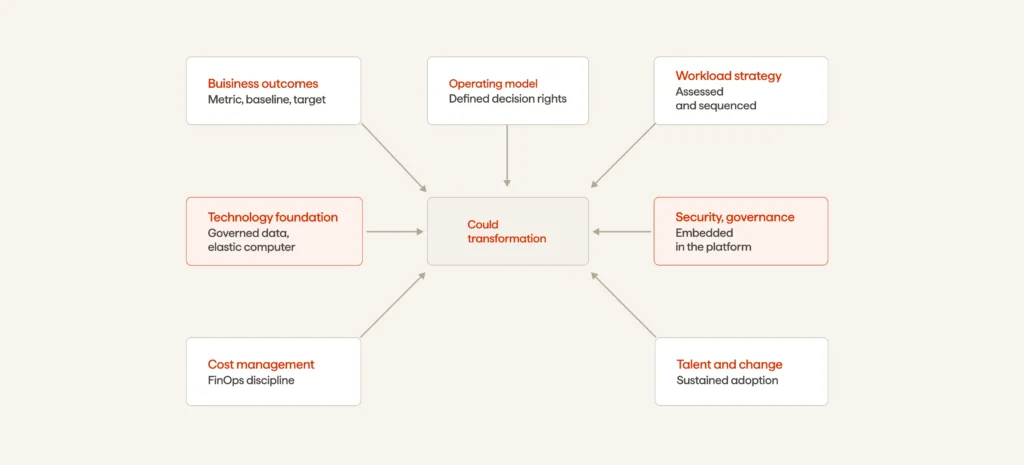
A cloud transformation strategy rests upon a defined set of components. Established early and maintained in alignment, they give the project a clear and durable structure. Together, they convert ambition into a plan the organization can execute with confidence. The strongest cloud strategies integrate these principles into their core.
Explore how Avenga created a secure, cloud-based solution to simplify workflows for Hunt Mortgage Group.
Business outcomes and success metrics
The strategy begins with the results: faster time to market, lower cost to serve, higher availability, and new revenue from data products. Each result carries a metric, a baseline, and a target. Cost per transaction, release frequency, and mean time to recovery serve as reliable anchors. Clear business objectives give these metrics their meaning, since a figure matters only against the outcome it was chosen to measure. Recording the starting position before the first workload moves gives every subsequent gain a firm point of reference and a clear account to present at board level.
Operating model and decision rights
Cloud invites a considered view of who decides what, and the strategy sets this out in explicit terms. Ownership is assigned for architecture standards, security policy, and spending limits. A platform team provides the paved paths, product teams own their services in production, and a governance function establishes the guardrails while sustaining the pace of work. Clearly defined decision rights keep expenditure purposeful and accountability firm from the outset, and they set the objectives for your cloud transformation against which every choice can be weighed.
Application and workload strategy
Each application is placed in its optimal position, and its optimal form, within the cloud environment. The portfolio is assessed, and each workload is assigned to a certain course: rehost, replatform, refactor, replace, or retire. Sound migration strategies follow business value and technical readiness rather than convenience. The workloads that offer the greatest value at the least risk proceed first, and they fund the more ambitious undertakings that follow. Moving the right workloads to the cloud in the right order is what keeps the sequence purposeful.
Architecture and technology foundation
Security, compliance, and governance. Controls belong within the platform, established from the outset. Identity and access management, encryption standards, and continuous compliance verification reside in the paved paths that every team relies upon. Strong data security is designed into the cloud infrastructure rather than added after the fact.
In regulated sectors, controls map to the applicable frameworks, whether DORA, HIPAA, or PCI DSS, and adherence is demonstrated through automated evidence rather than manual audit. A hybrid cloud arrangement, where certain workloads remain on on-premises infrastructure, is accommodated within the same governance model rather than treated as an exception. This attention to security and compliance carries through every layer of the platform, and dependable cloud security is the result rather than an afterthought.
Cost management and FinOps
Cloud transfers expenditure from capital to operating cost, and from central control to distributed teams. That shift renders visibility a genuine source of value, and it is how organizations reduce costs without losing the pace that cloud affords. Resources are tagged, cloud costs are allocated to the teams that incur them, and budgets rest with accountable owners. Meticulous optimization keeps cloud spending aligned with the value it produces. FinOps provides finance and engineering with a shared language for the tradeoffs among speed, resilience, and cost, and gives leaders a dependable way to manage cloud economics as the estate grows.
From strategy to a successful cloud transformation
Strategy proves its worth in delivery. The distance between a well-formed plan and a measurable result is covered in sequence, one deliberate phase at a time, with each phase producing evidence that the value defined at the outset is being realized. A clear roadmap turns intent into an ordered set of moves.
The work begins with a foundation. The landing zone, identity model, security guardrails, and cost controls are established before any workload scales, since these determine the conditions under which everything that follows will operate. A foundation built with attention to detail sets ground for the entire project, and it draws on established best practices rather than invention at every turn. Choosing the right cloud provider and the right cloud platform at this stage shapes what the cloud deployment can later achieve.
Migration then proceeds in waves, grouped by business capability rather than by technical similarity. This grouping keeps each wave tied to a result the business recognizes, delivered to an owner who was promised it. Measured cloud adoption, one capability at a time, lets the organization accelerate without outrunning its own readiness. Because the platform is scalable by design, each wave can grow with demand rather than against it. The value defined at the outset stays visible throughout, rather than dissolving into a schedule of technical tasks. The broader cloud transformation journey is understood as a series of proven steps rather than a single leap.
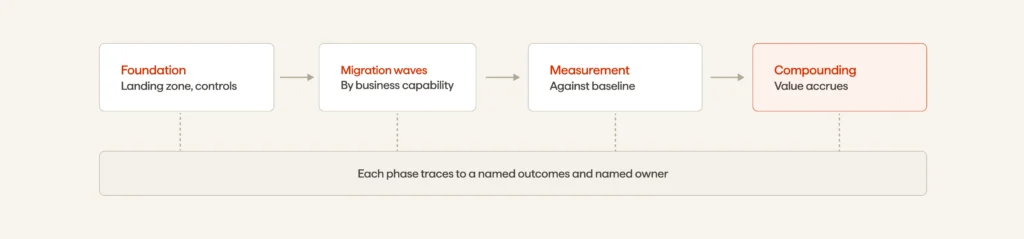
Measurement is what holds this together. Each outcome carries the baseline recorded before the transformation began, and every wave is assessed against it. The comparison is direct: the metric before, the metric after, and the difference attributable to the work. Real-time visibility into each workload makes that comparison immediate rather than retrospective, and analytics turn the raw figures into a picture you can act upon. Because ownership was assigned early, the result belongs to someone. Progress is reported in the language of the business, not the language of infrastructure, and the case for continued investment is made on evidence already in hand.
Momentum comes from this rhythm of delivery and review. Each completed wave confirms what the strategy proposed, refines the approach for the wave that follows, and adds to a record of outcomes achieved. That record compounds, and the benefits of cloud accumulate with it. Early results fund and inform later ones, operational efficiencies emerge as teams settle into the new model, confidence builds across the organization, and the project carries its own weight forward rather than depending on the enthusiasm that launched it.
This evidence-led approach is what industry research associates with the transformations that reach their full value. The scalability the platform was built for now serves growth rather than merely absorbing it.
The measurable outcome, in the end, is the sum of these results. When each decision connects to a named metric and a named owner, and each wave settles against a baseline set in advance, cloud investment resolves into cloud value as a matter of record rather than assertion. This is how an organization reaches the full potential of cloud rather than a fraction of it. The transformation is judged by what changed, expressed in figures the board recognizes, and the value it sets out to deliver is present in the ledger rather than promised in the plan.
Cloud as the foundation of enterprise AI journey
Enterprise AI runs on the cloud, and the quality of that foundation defines what AI can achieve for your organization. The connection is direct. Models require data that is governed and accessible, compute that scales on demand, and platforms on which they can be deployed and monitored in production. These are the very cloud capabilities a well-executed transformation puts in place. Modern cloud technologies make this practical at a scale earlier estate could not support. A project that modernized data architecture, established elastic compute, and built security into the platform has, in the same effort, assembled the conditions under which AI becomes practical at scale.
The impact on the organization stems from this interconnection. AI draws its value from data, and data delivers that value only when it is clean, governed, and reachable across the business. Well-designed cloud services make that data reachable across every team that needs it. A cloud foundation that consolidated fragmented sources into governed pipelines gives models material they can learn from and act upon. Where that groundwork exists, the path from a promising use case to a deployed capability is short, and mature cloud solutions shorten it further. The right foundation can optimize how quickly models move from experiment to production. The data is ready, the compute is available, and the controls that satisfy regulators are already in force.
There is a compounding effect worth naming. The cloud investment made to modernize the estate returns a second time when AI is deployed on top of it. This is the deeper reason to migrate to the cloud with intelligence in view. Governed data pipelines that were built to improve reporting now feed models. Elastic infrastructure provisioned for existing workloads now leverages the same capacity to carry training and inference. Security controls established for the platform now extend to AI without redesign.
Organizations that treat cloud as an AI initiative from the outset find this second return waiting for them, and considered cloud consulting can help chart the sequence in advance. The foundation was built once, and it serves both the transformation that justified it and the intelligence that follows. Well-planned cloud technologies and disciplined governance are what enable organizations to realize both returns from a single investment.
FAQ
Making cloud investment measurable
Cloud transformation rewards the organizations that start with outcomes in view. When business results are defined before architecture, when an operating model assigns real decision rights, and when every wave settles against a baseline set in advance, the cloud ceases to be a line of expenditure and becomes a source of measurable value. That approach prepares the foundation for what follows, since the modernized cloud is also the baseline on which enterprise AI is built. This is what distinguishes the transformations that realize their full value: each decision traces to a named outcome and a named owner, results are expressed in figures the board recognizes, and the value is present in the ledger rather than promised in the plan.
Today’s cloud is tomorrow’s AI launchpad. Avenga supports the development of both. Start a conversation.



Your business results matter
Achieve them with minimized risk through our bespoke innovation capabilities. Fill in the form below.