







Lithium battery management system (BMS): What it is and how it works


June 10, 2026 10 min read 428 views
A lithium battery management system integrates hardware and software to ensure an electric vehicle’s battery pack operates smoothly. It controls where energy goes, keeping the cells balanced. When something goes wrong, the BMS reacts fast. It steps in to prevent overcharging, deep discharges, or overheating. It works quietly in the background, but it’s the reason the whole system stays safe and steady.
And it’s not just for car companies or battery manufacturers. These systems keep evolving as electric vehicle technology advances. We’re heading toward smarter BMS designs that can offer more detailed diagnostics, boost energy efficiency, and even make switching to new energy storage types easier.
Energy storage systems key takeaways
- A BMS protects the EV battery pack by monitoring voltage, current, and temperature.
- Accurate SOC and SOH estimation helps improve range, battery capacity, and lifespan.
- Cell balancing and thermal management are essential for safety and long-term performance.
- Future BMS technologies will rely more on AI, cloud analytics, and support for solid-state batteries.
The critical role of BMS in EV success
The Electric Vehicle Battery Management Systems (BMS) industry will expand to USD 19.51 billion by 2026, up from approximately USD 16.17 billion in 2025. As vehicles become increasingly reliant on complex battery systems, battery monitoring systems cannot be considered optional. They are becoming integral components of EVs.
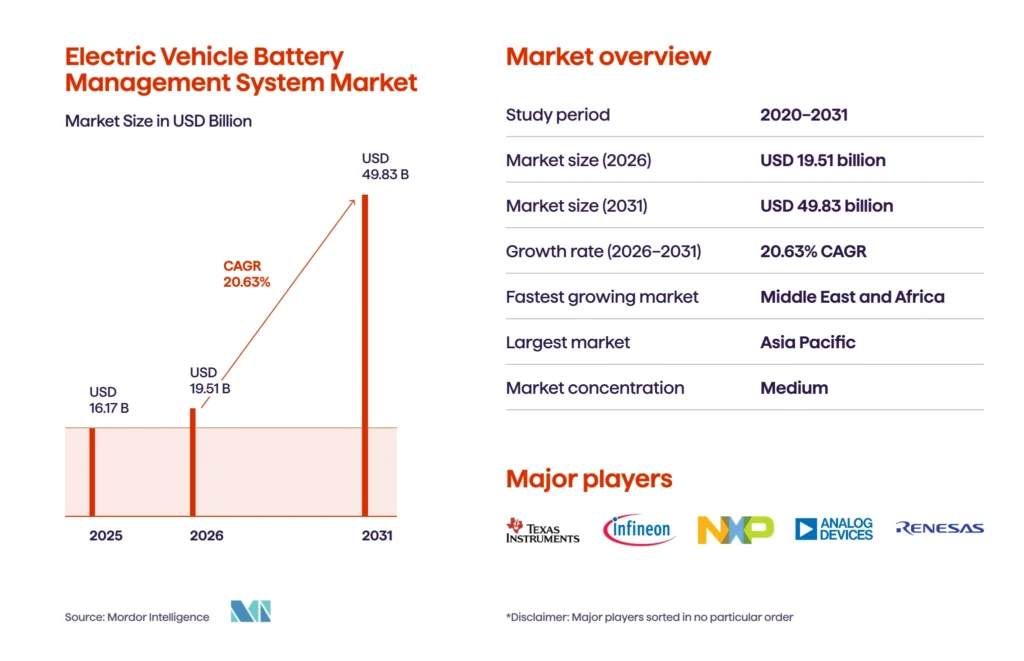
A battery management system monitors every cell in the battery pack. They aren’t optional with lithium-ion batteries. If one stops working right, the cells can become unbalanced, and the whole battery is more likely to fail.
When the battery pack isn’t balanced right, its performance drops. The battery overheats, raising the chances of thermal runaway. If you keep pushing it with high voltage or let it drain too far, you’ll see its capacity fade faster. Without the BMS keeping things in check, the entire battery can fail, posing a serious risk to anyone relying on it.
The battery management system ensures consistent performance of electric vehicles while also protecting one of the electric vehicle’s most critical components by managing fluctuations in energy flow to and from the battery pack, thereby preventing system instability during operation.
Battery management system architecture and components
The battery management system for modern batteries has a multi-layer architecture that allows the physical battery components to interface with the control logic and vehicle systems. When an EV is in operation, the BMS serves as the central Intelligence layer of the battery pack, ensuring safe and efficient use of the entire battery pack.
| Component | Role in the system | Why it matters |
| Battery pack (cells) | Contains multiple cells (Cell 1 … Cell n) forming the entire battery | Determines total capacity, voltage, and performance |
| Measurement module | Collects voltage (V1…Vn), current, and temperature data | Enables real-time visibility into battery conditions |
| Cell balancing | Equalizes charge across cells | Prevents imbalance and extends battery life |
| State estimation (SOC, SOH) | Calculates State of Charge and State of Health | Helps optimize usage and predict degradation |
| Thermal management | Monitors and regulates temperature | Keeps the battery safe and prevents overheating |
| CAN bus controller | Communicates with vehicle systems | Integrates the BMS into the smart battery ecosystem |
The process starts at the battery pack; the grouping of cells produces raw readings (voltage, current, and temperature). Those readings are sent to the BMS logic layer via the measurement unit.
Once at this point, BMS performs basic calculations, such as charge level estimation and battery health assessment, as well as temperature monitoring. BMS also performs cell balancing to ensure no cell is overcharged or underutilized.
Finally, all the data processed by BMS will be sent via CAN bus controller to the main vehicle system. This enables real-time updates to EV performance, charging characteristics, and safety mechanisms.
SOC and SOH estimation
The two primary indicators of a battery’s capacity to deliver electricity for a given period are the State of Charge (SOC) and the State of Health (SOH). Usually expressed as a percentage of the battery’s maximum capacity, the SOC indicates how much charge remains in the battery cell.
The current flowing through the cell, the voltage it generates, and the battery’s previous usage must all be considered when calculating the SOC to determine how much power is still available for driving with that battery.
SOH, on the other hand, demonstrates the battery’s overall health and functional longevity. SOH reflects how much the battery has lost in terms of both capacity and performance compared to its new capabilities. Charge cycles, ambient temperature, and usage intensity are just a few factors that determine SOH.
When used together, SOC and SOH allow the BMS to balance performance and safety/functionality. Providing accurate estimates enables proper energy use, avoids overcharging and/or deep discharging, and ultimately indicates when the battery will require maintenance/replacement.
Power your digital transformation with Avenga’s engineering prowess.
Cell balancing strategies: Active vs. passive
Battery packs should be balanced so that all cells function equally well. Because no two cells age or function in the same way, over time, they develop an imbalance due to their differences, leading to lower efficiency and possible safety issues. Therefore, to ensure the batteries are protected and the overall life of the battery cells, modern BMS employs two primary battery cell-balancing techniques.
With passive balancing, any excess energy in higher-voltage cells is dissipated through resistors. When a single cell has more charge than the other cells, the system can remove the excess energy from that cell via resistors. Passive methods are simple to implement, inexpensive, and widely used, but waste energy and may not be as efficient during multiple charge cycles.
Redistributing energy through active balancing differs from passive balancing in that energy from a stronger cell can be transferred to a weaker cell rather than being wasted. Active balancing provides better control over the battery, especially in high-performance electric vehicles, and requires more complex hardware and control logic.
Fast charging without degradation
Rapid charging makes electric vehicles much more appealing to a broader audience, but there’s a catch. Dumping too much energy into the battery too quickly can significantly shorten its lifespan.
That’s why BMS systems are so important. They monitor how energy flows during charging, letting you charge your car quickly while keeping the battery healthy for the long term.
The system continuously monitors cell temperature, battery voltage, and current throughout the entire fast charge process. Using this information, BMS will dynamically adjust charging speed, limit peak loads, and prevent scenarios such as overheating or overvoltage. It is this adaptive control that enables fast charging without affecting battery lifespan.
Real-life use of BMSs includes controlling charge phases, which slow charging as the battery nears full charge to keep batteries stable, reduce stress on individual cell(s), and extend overall longevity. In the absence of this control, batteries would have much shorter cycle lives and greater safety risks associated with rapid charging.
AI and machine learning for predictive maintenance
BMS has traditionally provided only real-time control of the battery system. Now, however, AI and machine learning enable the BMS to go beyond that and provide predictive maintenance. Rather than simply reacting to failures, the BMS can analyze both historical and real-time data to identify warning signs of cell/pack degradation before they become obvious and significant.
ML algorithms enable BMS to monitor the batteries. By running machine learning algorithms on factors such as temperature, charge cycles, voltage shifts, and usage patterns, the BMS steps in. It catches batteries that are about to fail, keeps tabs on them to figure out how much longer they’ll last, and tells you what to do to keep them working as well as possible.
Thermal management and safety in battery systems
All thermal management of Li-ion batteries is monitored and provided by the BMS. Battery performance, safety, and cycle life all depend directly on battery temperature. Li-ion cells have a very small safe operating range. As such, a very small and immediate deviation from this operating range may negatively affect performance and pose a safety hazard.
A BMS continuously monitors the battery pack’s temperature to maintain optimal performance. It manages temperature using several types of temperature control methods, including:
- liquid-cooled,
- air-cooled, and
- integrated thermal control systems that respond to real-time variable loads and ambient conditions.
Effective temperature regulation is necessary to safeguard batteries. Thermal runaway may occur when batteries get too hot, while cold temperatures may reduce efficiency and charging capacity. BMS keeps batteries within an ideal temperature range, ensuring reliable performance during driving and charging.
Typically, thermal management is combined with voltage and current measurements to provide appropriate operating conditions for all battery cells. Therefore, when battery cells operate in a coordinated manner, the BMS can respond quickly to anomalies, preventing damage and keeping every cell working properly over time.
Future BMS technologies and solid-state batteries
Batteries are also seeing advancements in the design of their management solutions and in how they interact with new batteries, mobility, and connected systems. With EVs continuing to evolve toward higher-energy-density lithium-ion variants and new architectures, the design of BMS has transitioned from fully embedded control to more distributed, data-centric systems.
Semi-solid-state BMS brings a whole new set of challenges for battery management systems. They are safer and have a higher energy capacity than standard lithium-ion cells, but that doesn’t mean you can leave them alone. The system must monitor the temperature, charge balance, and any indications of aging. To handle their specific chemistry, you must update the algorithms while maintaining the battery management system’s reliability.
The expansion of the energy ecosystem will take place through V2X (vehicle-to-everything) and battery swapping. V2X enables vehicles to exchange energy with other devices. BMS manages this bidirectional energy transfer between the vehicle, the grid, and other devices through more precise coordination and advanced control logic. Regardless of usage history, fast identification, verification, and calibration of multiple battery packs will be required to ensure their safe use during battery changes.
Cloud-based analytics for battery reliability will continue to grow as a major differentiator in the marketplace. By delivering operational data to the cloud, manufacturers will be able to perform fleet-wide performance analysis, enabling early degradation detection and improved algorithm development. This will help predict lifecycle and drive proactive maintenance. System reliability will increase over time.
FAQ
Charging electric cars: Final words
Right now, battery management systems are getting a lot smarter and more flexible, all because tech keeps moving forward—think cloud platforms, solid-state batteries, that kind of thing.
For EV manufacturers and operators, investing in smart BMSs means their fleets (and regular drivers, too) get more range, better efficiency, and cars that hold their value longer. Basically, every EV lasts longer and performs better.
Want to learn more about energy management systems? Contact Avenga, your trusted technology partner.



Your business results matter
Achieve them with minimized risk through our bespoke innovation capabilities. Fill in the form below.