






What are the best practices to make your AI Proof of Concept (PoC) succeed?


September 9, 2026 10 min read 170 views
AI experimentation has become commonplace across enterprises, but turning a promising AI capability into something that creates measurable business value remains a demanding challenge. This makes the way an organization approaches a Proof of Concept (PoC) increasingly important. The fundamental purpose of an AI Proof of Concept (PoC) is not to demonstrate that AI works. That has been settled. The purpose of a PoC is to prove that AI works here, inside this business, on this particular problem, with these processes and people. Once that is the framing, most of the conventional advice rearranges itself. The questions shift from “Which AI model should we use?” to “Which problem is worth solving, who needs to own it, and what would convince us to stop?” The practices below show that shift.
Key takeaways:
- A PoC is about fit, not feasibility. An AI PoC typically is no longer meant to prove the technology works. It should test whether an AI solution fits your challenge, workflow, and team, which reframes AI adoption as a question of business fit rather than technical capability.
- Early AI value is often concentrated in GBS functions. Global Business Services (GBS) functions offer significant potential for AI-driven returns, with high-volume, repeatable processes creating clear opportunities for quick wins. These use cases can demonstrate measurable business value early and establish a strong foundation for broader AI adoption.
- The hard part is what comes after the demo. AI development most often stalls not because of model performance, but because AI implementation runs into unclear KPIs, siloed data, and AI tools bolted onto legacy workflows. Make sure every PoC provides a clear go, no-go, or pivot decision before it leaves the lab.
- Treat the next two years as a time-bound window. 60% of CIOs expect AI-driven decision-making to dominate within five years, and 91% of organizations are planning to increase AI investment. Whether the solution scales or stalls will shape your competitive position. The leaders pulling ahead are the ones finishing the right PoCs, not running the most experiments before committing to a full-scale rollout.
How to maximize the success of an AI PoC development
| Anchor in transformation | Create a focused PoC portfolio |
| Design around end users | Start with low-risk use cases |
- Anchor the PoC in high-value back-end functions
The strongest AI PoCs do not necessarily begin in the most visible or strategically transformative areas of the business. Back-end functions can offer greater potential for measurable returns, with lower implementation risk and fewer dependencies on customer-facing processes.
Functions such as finance, procurement, HR, IT operations, and shared services often contain high-volume, repeatable workflows where manual effort and process inefficiencies are concentrated. This creates a clear basis for testing whether AI can reduce processing time, improve productivity, lower operating costs, or increase process consistency.
Starting in these areas also limits the exposure associated with early AI adoption. Organizations can test data readiness, integration requirements, governance controls, and human oversight within a more contained environment before extending AI into customer-facing or business-critical processes.
- Design the PoC around end users and engage stakeholders early
A PoC gains durability when it is shaped by the people who will live with the system day to day. End users understand the texture of the work in ways that no requirements document fully captures: the edge cases that surface twice a month, the manual workarounds that exist for good reasons, the points in the workflow where trust in the output matters as much as raw accuracy.
Bringing them in from the beginning is one of the most effective forms of risk reduction available. A claims adjuster can tell you within ten minutes whether a triage model’s confidence threshold is set somewhere usable. A procurement lead will know immediately whether a recommendation engine’s outputs can survive a conversation with a supplier. The same principle extends to the wider stakeholder group that includes legal, compliance, or IT security, because each holds a perspective that, when incorporated early, becomes a valuable input.
Engaging stakeholders from the outset strengthens both the practical relevance and organizational viability of the PoC. Direct participation in the development process also builds end-user ownership, increasing the likelihood that users will support the solution, advocate for its adoption, and contribute to its successful integration into established ways of working.
- Concentrate financial and human resources on a focused portfolio
PoCs reach production far more reliably when they are properly resourced. The right approach calls for concentrated effort: people who can think about the problem in depth rather than in fragments of time, infrastructure that is provisioned with care, and senior attention available when meaningful trade-offs need to be made.
This is a question of portfolio management as much as project execution. The most effective organizations are deliberate about which ideas to advance and which to defer, concentrating resources on use cases that combine meaningful business potential with a realistic path to implementation. Our proprietary AI readiness accelerator brings structure to this decision by assessing potential use cases against business value and technical complexity. It enables organizations to discover opportunities where AI can generate significant returns with a manageable implementation effort. This provides a stronger basis for directing PoC investment toward initiatives with a credible path to measurable business impact.
4. Prioritize AI use cases by business value and feasibility
AI PoC investment should focus on use cases with the strongest potential to generate measurable business value and a viable route to implementation. A structured assessment enables organizations to compare opportunities consistently and direct resources toward initiatives where the expected return justifies the required investment and technical effort.
As part of this process, Avenga applies a structured assessment framework that evaluates use cases across financial value, revenue opportunity, customer and employee experience, brand impact, sustainability and ethical considerations, and compliance and risk. These dimensions are incorporated into a weighted scoring model and assessed against technical complexity, providing an objective basis for prioritization. Our approach enables opportunities to be evaluated consistently on a large scale.
The assessment provides organizations with a comprehensive report covering the procedures evaluated, their scores across relevant business drivers, and their level of technical complexity. More importantly, it translates these findings into a clear direction for AI adoption: which opportunities to prioritize, where to begin, and how to progress from identified use cases toward implementation. This gives decision-makers a structured basis for directing AI investment toward initiatives with the strongest combination of business potential and technical feasibility.
Common challenges in AI PoC development
The most common challenge in AI PoC development is closing the gap between a successful prototype and full production deployment, a step where many organizations are still building experience. Standing up a compelling demo is now routine. Turning that demo into a durable, value-generating system requires a different level of technical, operational, and governance maturity.
Avenga AI Lab is designed to address this transition. It provides a structured environment to take AI beyond disconnected pilots and embed it into core business operations. It brings development, governance, and scalability into a single framework, enabling organizations to progress from validated concepts to production-ready AI solutions that operate reliably at enterprise scale. This creates a more direct route from experimentation to sustained business value and broader AI adoption.
The table below brings together the most common obstacles teams run into when moving an AI PoC forward.
| Production transition gap | PoCs perform well in controlled settings but stall when moved into live workflows, where robust governance, continuous monitoring, and effective change management become critical to reliable operation. |
| Scaling beyond isolated pilots | AI runs in pockets of the business rather than across the enterprise |
| Workflow design and operating-model alignment | AI is bolted onto legacy processes instead of being designed into redesigned workflows |
| KPI and success-metric definition | Programs lack clear business KPIs, making it hard to justify scale-up investment |
| Data quality and architecture | Data is siloed or inconsistent |
The challenges outlined above are persistent, but they are also solvable. And the urgency to solve them is growing. With more than 60% of CIOs expecting AI-driven decision-making to dominate within the next five years, AI is shifting from a support function into a core component of how business strategy is set. That shift creates a narrow but real window for action: for organizations willing to invest in the foundations, the next couple of years represent a genuine and time-bound opportunity.
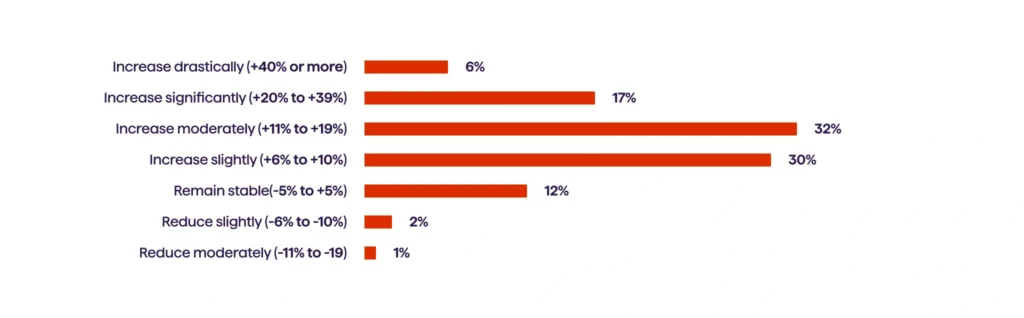
This conviction is already showing up in budgets: Deloitte’s 2025 survey of more than 1,800 executives across Europe and the Middle East found that 85% of organizations increased their AI investment in the past 12 months, and 91% plan to increase it in 2026 (see Figure 1).
The questions below are designed to be worked through before development begins, while the project is still easy to shape. Each one surfaces a decision that gives the team a clearer path forward.
| Is the problem worth solving? How will success deliver measurable business value (revenue, cost, time saved)? |
| Do end users know this is coming, and are they involved? |
| Do you have a clear success metric defined upfront? |
| What data is available today, and is it sufficient to test the hypothesis rather than to perfect it? |
| How many PoCs are you running in parallel? |
FAQ
What sets a successful AI Proof of Concept apart
The patterns that distinguish successful AI PoCs from the rest are mostly organizational rather than technical. AI models can be swapped, infrastructure can be rebuilt, and data can be improved, but a PoC pointed at the wrong problem is unlikely to recover. The practices discussed here turn a PoC from an exploratory exercise into a credible basis for the next investment. In the end, the organizations that will lead the AI era are not the ones running the most experiments. They are the ones finishing the right ones.Establish the foundation for AI that scales beyond individual PoCs. Engage our AI advisory team to define a structured approach to production deployment and enterprise-wide adoption.



Your business results matter
Achieve them with minimized risk through our bespoke innovation capabilities. Fill in the form below.