






What is an Order Management System (OMS) and how does it work?


June 17, 2026 9 min read 488 views
Customer requests, campaign creation and management, billing reconciliation — when it comes to selling ad space, all these elements matter. Advertisers want quick responses with accurate offers, while sales representatives want to close deals fast. An order management system (OMS) is software that connects the sale, delivery, and settlement of digital advertising campaigns through a centralized system. By bringing together inventory, campaign, and order data, an order management system helps teams streamline the order management process and improve operational efficiency.
What is an order management system?
In practice, an OMS serves as the operational hub for digital advertising sales. A modern OMS connects inventory and order management, campaign execution, reporting, invoicing, and billing workflows within a single platform. Thanks to its integrated tools and OMS capabilities, publishers can:
- Monitor the availability of your ad inventory.
- Create programmatic advertising campaigns across digital channels.
- Optimize advertising campaigns.
- Answer requests for proposals (RFPs).
- Create reports.
- Generate invoices.
- Conduct billing reconciliation.
You can connect your OMS with first- and third-party ad servers, ERP and CRM systems, BI platforms, SSPs, ad exchanges, and DSPs via APIs. By doing that, you create a sales and information hub for your company’s marketing and advertising activities. Also, you can facilitate a seamless data flow between the systems, forecast orders and initiate deals with the click of a button.
How does an order management system work?
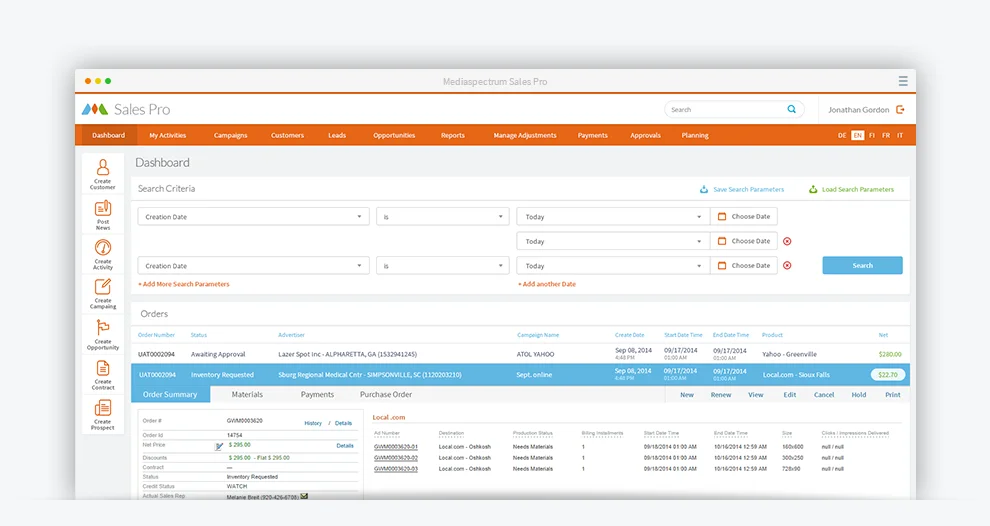
The order management process typically begins when an advertiser wants to book a campaign. A sales representative creates a sales order and enters the campaign details, including ad placements, campaign dates, pricing, and targeting criteria. They can also check inventory availability, review rates, and request internal approval if needed. Throughout the process, the OMS keeps all stakeholders informed by automatically notifying team members about pending actions and approvals.
Once the proposal is ready, the OMS generates a formal document for the advertiser based on a predefined template. This speeds up contract preparation and helps reduce manual errors. Before the document is sent, teams can review the details, make adjustments, and ensure all campaign requirements are accurately reflected.
After the agreement is approved, the order moves through the rest of the campaign workflow. Depending on the platform and its integrations, the OMS can transfer order information to ad servers, SSPs, DSPs, CRM systems, and financial tools. This allows teams to manage campaigns, track performance, generate invoices, and reconcile billings using the same set of data, reducing administrative work and improving operational efficiency.
Who uses order management systems?
The most basic users of order management systems are sales representatives and AdOps teams working at publishers. But an OMS can also be used by the executive management team and finance departments, e.g. to generate and view invoices and reconcile billings. By automating the various processes carried out in digital media transactions and working on the same datasets, companies increase their efficiency and eliminate bottlenecks.
Sales representatives
With an OMS, sales reps can create new ad-revenue opportunities submitted by advertisers, formulate quotes, and close deals much faster than they would be able to use a bunch of different systems. They are also able to use dedicated features to forecast upcoming orders.
Advertising and revenue management agencies
Advertising and revenue management agencies help their publisher clients manage, run, and optimize their ad inventory. Depending on the OMS provider, they can help their clients run digital advertising campaigns across various channels, such as display, in-app, DOOH, and CTV.
AdOps
AdOps teams handle the ad trafficking and reporting of digital advertising campaigns, managing the details of each campaign and improving its performance.
Financial department
By using an OMS, finance departments can better manage cash flows, invoices, and the billing reconciliation process.
What features should an advertising OMS include?
An order management system streamlines many of the processes involved in selling, delivering, and managing digital advertising campaigns. Publishers and agencies use OMS software to manage direct deals, guaranteed inventory, and open RTB auctions while keeping campaign, inventory, and financial data within a centralized system. By bringing these activities together, a modern OMS helps teams manage the entire order lifecycle, improve order accuracy, and reduce manual work.
While OMS capabilities vary by provider, most platforms include the following features:
- New order and campaign creation
Sales teams can easily create new opportunities for advertisers and quickly respond to RFIs and close sales or change existing contracts faster. Sellers easily classify the ad inventory they trade and create flexible offers. - Automated workflows
The process of turning an opportunity into an advertising campaign can be automated, providing a seamless transition from the sales team to the AdOps team. Visible advertising inventory, thanks to the integrated DSP and SSP platforms, allows you to plan campaigns in various channels. Ad management and optimization tools create space to improve your campaign’s performance. - Campaign analytics and reports
Publishers can view the performance of the advertising campaigns running across their digital properties via one user interface, making it easier to identify which campaigns are generating the most revenue.
- Invoice creation and billing reconciliation
An OMS makes it much easier for the finance team to generate invoices without manual preparation and conduct billing reconciliation, significantly speeds up the revenue management process
The benefits of an order management system
There are numerous benefits to using an OMS for various groups of users. The most fundamental and common for all of them is streamlining the order fulfillment process.
- Integrations with tools in the AdTech ecosystem: Integrations with ad exchanges, ad servers, DSPs, SSPs, ERPs, BIs, and CRMs (for example FreeWheel, Facebook Ads, Google Ads, Google Ad Manager, Yieldex) makes it possible to run top-notch programmatic advertising campaigns across different channels.
- Real-time business tracking: An OMS combines and presents data about accounting, ad inventory, and customer information on one dashboard, making it easy to track business performance and ad sales.
- AdOps automation: The whole digital advertising process is automated, from forming initial contact with advertisers to generating the invoice, and everything in between. Everyone using an OMS can save several man-hours and reduce labor costs by creating workflows and automatically generating reports and invoices.
- Order forecasting: With an OMS, forecasting sales is possible with greater accuracy thanks to the data an OMS collects about the performance of historical and current campaigns.
Which companies provide an order management system?
Several OMS platforms are used in the advertising industry to manage the full order lifecycle, from order capture to campaign execution and billing.
Here are some of the best order management system providers:
FatTail

At the heart of FatTail’s business is AdBook+, an OMS focused on monetization, control, and scale. FatTail integrates CRMs, BI platforms, financial systems, ad servers, and buying systems to provide a comprehensive platform for publishers.
Founded: 2001
Headquarters: Calabasas, California
Placements.io

Placements.io is a modern revenue management platform for sellers of digital advertising. Its platform manages orders, inventory, billing, and integrations for direct and programmatic channels.
Founded: 2014
Headquarters: Seattle, Washington
Operavite

Operative created a cloud-based order management system for ad revenue. With Operative.One, users get advanced OMS capabilities, such as creating Premium Marketplaces, Open API, or custom reporting and analytics suite.
Founded: 2000
Headquarters: New York, New York
TapClicks

TapClicks, Inc. is a leading marketing technology company for agencies, media companies, brands, and enterprises. Its integrated Marketing Operations Platform includes sales enablement, workflow and order management, analytics, and automated reporting — all within a single intuitive user interface available on demand in the cloud.
Founded: 2009
Headquarters: San Jose, California
Lineup

Lineup Systems is a company from the US. They developed Adpoint, a solution for media businesses used by more than 6,800 media brands and entities.
Founded: 2009
Headquarters: Broomfield, Colorado
Cloudsense

Cloudsense built an end-to-end Media Order Management System (OMS) on Salesforce. They employ over 350 people across the globe and serve the most recognizable companies, such as Spotify, Newsday or News Corp Australia.
Founded: 2009
Headquarters: London
Mediaspectrum

Mediaspectrum focuses on delivering Sales Pro, a cloud-based solution for companies that need complex media advertising services. They employ 150 people worldwide.
Founded: 2001
Headquarters: Miami Beach, Florida
The future of order management system
Order management systems in 2026 are moving toward more automated and intelligent platforms that manage the entire order lifecycle in real time. Instead of focusing only on order entry and invoicing, modern OMS solutions are becoming centralized systems that connect inventory, campaign execution, and financial workflows across AdTech environments.
The main shift is toward automation and AI-driven decision-making. Industry research highlights that OMS platforms are increasingly adopting AI and workflow automation to improve order accuracy, reduce manual processing, and support more complex distributed order management across integrated systems such as ERP, CRM, DSP, and SSP tools. This reflects a broader move toward connected and data-driven order management processes.
Another key direction is consolidation. Organizations are gradually replacing fragmented tools with unified OMS platforms that provide a single view of inventory and order management. This improves visibility, reduces operational complexity, and helps teams manage increasing advertising order volumes more consistently.
FAQ
Quick recap
The automation of manual processes not only increases productivity and efficiency but also grows revenue. An order management system in the AdTech world is used by publishers, ad and revenue management agencies, and AdOps teams. By using an OMS, companies can automate the sale and creation of advertising campaigns, workflows, invoice generation, and billing reconciliation.



Your business results matter
Achieve them with minimized risk through our bespoke innovation capabilities. Fill in the form below.