






AI in industrial automation: Use cases transforming manufacturing and factory floor

October 9, 2026 12 min read 10 views
Traditional automation works well when the rules are known.
A programmable logic controller can stop a machine when a sensor crosses a fixed threshold. A robot can repeat the same movement thousands of times. A production line can follow a predefined control sequence.
AI adds another layer. It can identify patterns across sensor data, recognize defects from images, predict equipment failures, compare production scenarios, and respond to conditions that were not explicitly coded into every automation rule.
That distinction is pushing AI in industrial automation further into manufacturing operations.
Deloitte’s 2026 manufacturing research found that 80% of surveyed manufacturing executives planned to invest at least 20% of their improvement budgets in smart manufacturing initiatives, including automation hardware, sensors, analytics, and cloud computing. The same research points to agentic AI and physical AI as areas manufacturers are starting to examine alongside established automation technologies.
The goal is not to replace every deterministic control loop with AI. Industrial environments demand reliability. The stronger model combines conventional automation with AI where prediction, perception, or adaptive decision-making can improve the process.
Avenga’s AI services cover AI engineering, machine learning, data, governance, and production systems across industrial environments.
AI in manufacturing and automation solutions: Key takeaways
- AI extends industrial automation beyond fixed rules. Machine learning, computer vision, and predictive models can respond to patterns in operational data.
- Predictive maintenance is one of the clearest use cases. AI can examine sensor data and identify early signs of equipment failure.
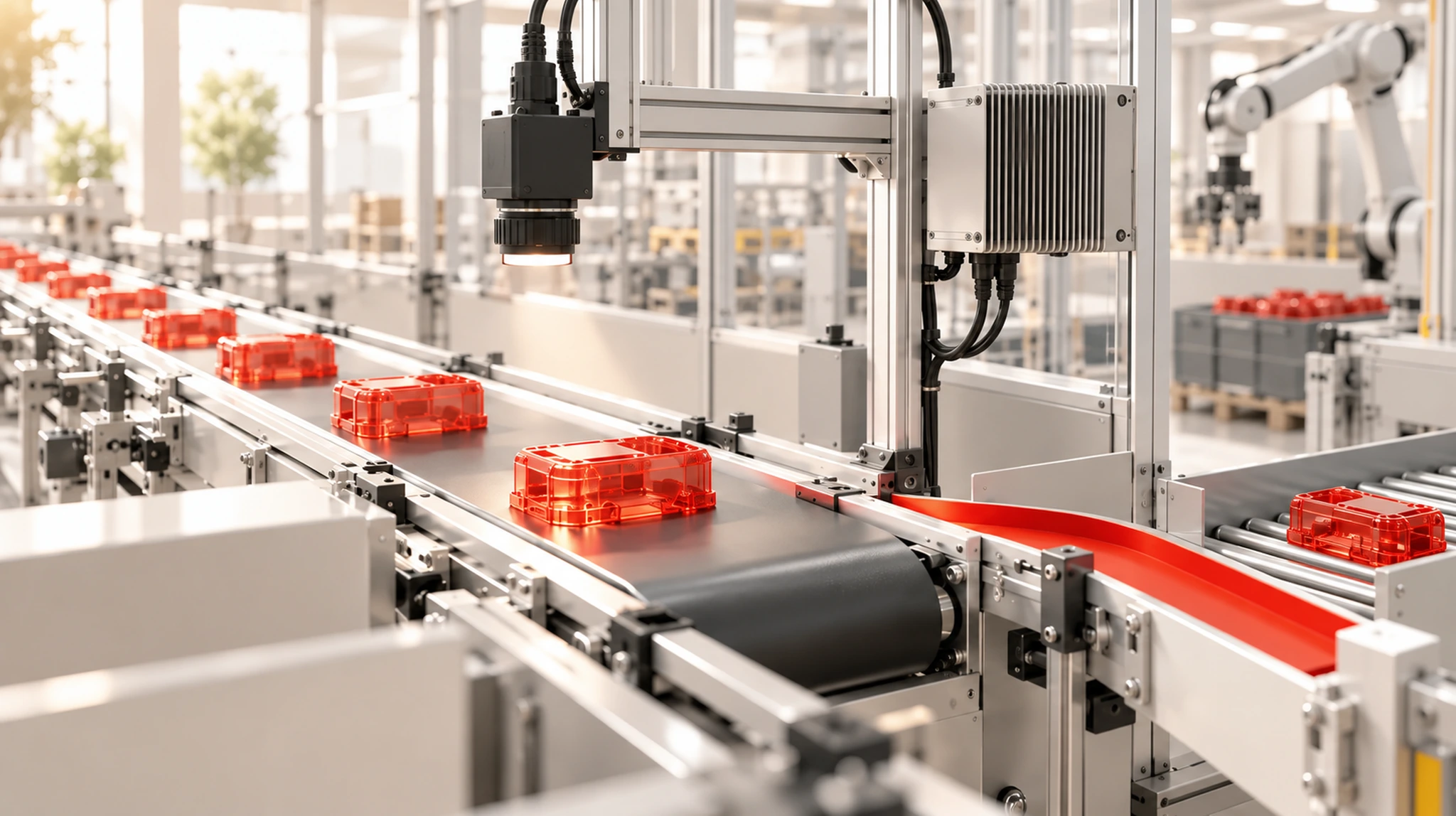
- Computer vision supports automated inspection. Models can detect defects, missing components, and process anomalies on a production line.
- Digital twins give AI a place to test decisions. Simulated assets and processes can support prediction, engineering, and optimization before changes reach physical systems.
- Edge AI matters where latency is low. Some industrial AI workloads need to run near machines rather than wait for a remote cloud service.
- AI should complement deterministic automation. Safety-critical control should remain predictable and testable.
What is AI in industrial automation?
AI in industrial automation means applying artificial intelligence to industrial systems, physical equipment, production processes, and operational workflows.
IBM defines industrial AI as the application of AI technologies to manufacturing, infrastructure, and other physical operations. These systems commonly combine AI with operational technology, industrial IoT, robotics, sensors, digital twins, and edge computing.
Common AI technologies include:
- Machine learning
- Computer vision
- Anomaly detection
- Predictive analytics
- Generative AI
- AI agents
- Optimization algorithms
Traditional automation typically follows predefined instructions. An AI-driven system can instead analyze changing conditions and estimate what is likely to happen next.
For example, traditional automation may trigger an alarm when vibration exceeds a fixed limit. AI can examine vibration, temperature, load, operating history, and other sensor signals together to estimate whether the machine is moving toward failure.
How AI differs from traditional automation
The distinction matters because AI is not automatically better for every industrial task.
| Traditional automation | AI-driven automation |
| Uses predefined rules | Learns patterns from data |
| Produces predictable responses | Can handle variable conditions |
| Strong for fixed control logic | Strong for prediction and perception |
| Usually deterministic | Often probabilistic |
| Changes through engineering updates | Can change through model retraining |
A production line still needs deterministic automation systems for many actions. AI adds value where the problem involves uncertainty, patterns, images, prediction, or many variables. Gartner’s 2026 work on AI-enabled automation makes the same distinction between deterministic workflows and systems where AI agents can perceive, decide, and act under less predictable conditions.
AI use cases in industrial automation
Predictive maintenance
Predictive maintenance uses AI to estimate when equipment is likely to fail.
The model can analyze:
- Vibration
- Temperature
- Pressure
- Energy consumption
- Runtime
- Error codes
- Maintenance history
Machine learning identifies combinations of signals associated with deterioration.
Maintenance teams can then inspect or repair equipment before unplanned downtime interrupts production.
IBM’s 2026 work on AI-based predictive maintenance describes manufacturing as one of the main applications, with models monitoring assembly lines in real time for developing faults.
The advantage over fixed maintenance schedules is timing.
A healthy component does not need replacement simply because six months have passed. A deteriorating component does not need to wait for the next scheduled inspection.
Computer vision for quality control
Computer vision can inspect products, components, labels, welds, packaging, and surfaces.
An AI system can identify:
- Cracks
- Incorrect dimensions
- Missing parts
- Surface defects
- Assembly errors
- Packaging problems
Machine vision has existed for decades. AI models allow inspection systems to recognize more complicated patterns that are difficult to express through fixed image-processing rules.
The production line can then reject defective items or route them for human review.
This can support product quality while reducing the amount of repetitive visual inspection performed manually.
Production optimization
Factories produce large volumes of operational data.
AI algorithms can compare variables such as:
- Machine speed
- Temperature
- Raw material properties
- Energy use
- Production schedule
- Quality results
- Equipment condition
The goal is to optimize the operating point without relying only on static setpoints.
AI can recommend adjustments rather than making them autonomously.
This distinction is useful in complex industrial processes where people need to validate decisions before control parameters change.
Digital twins
Digital twins represent physical equipment, production cells, or larger industrial processes in software.
They can combine engineering models with real-time data.
AI can use a digital twin to:
- Simulate equipment behavior
- Compare production scenarios
- Test parameter changes
- Estimate wear
- Predict bottlenecks
- Evaluate maintenance timing
Digital twins are particularly useful when testing a change on the physical asset would be expensive or disruptive.
Gartner expects closed-loop digital twins and semi-autonomous AI agents to become more prominent in manufacturing toward 2030.
Industrial robots and cobots
AI can make industrial robots more adaptive.
Traditional industrial robots excel at controlled, repeatable movements.
AI can add:
- Object recognition
- Path planning
- Visual inspection
- Adaptive gripping
- Anomaly detection
- Human interaction
Cobots are designed to work more closely with people, while physical AI is pushing robots toward greater autonomy.
Deloitte’s 2026 manufacturing outlook reports that 22% of surveyed manufacturers expected to use physical AI within two years, compared with 9% at the time of the survey.
Supply chain and production planning
Industrial AI can also connect factory operations with supply chain conditions.
AI can analyze:
- Materials availability
- Supplier delays
- Production capacity
- Inventory
- Demand
- Equipment condition
An AI agent could identify a delayed component, check alternative suppliers, compare production schedules, and prepare a response for a planner.
This moves intelligent automation beyond one machine.
AI in factory automation and edge computing
Not every AI workload belongs in the cloud.
Some industrial systems need millisecond-level responses or must continue operating when external connectivity is unavailable.
Edge AI runs models close to the equipment.
This can support:
- Vision inspection
- Safety monitoring
- Machine condition analysis
- Robotics
- Local anomaly detection
Cloud systems can still handle model training, fleet analytics, long-term data storage, and centralized monitoring.
The result is often a distributed architecture.
Sensors collect real-time data. Edge systems process time-sensitive information. Central systems combine data across manufacturing facilities for broader analytics.
Smart manufacturing and Industry 4.0
Smart manufacturing connects automation equipment, industrial IoT, analytics, software, and operational data.
AI builds on that base.
Deloitte’s 2025 smart manufacturing survey found that 29% of respondents had deployed AI or machine learning at facility or network level, while another 23% were piloting it. Generative AI adoption was also still developing, with 24% deployed and 38% piloting.
This explains why data infrastructure remains important.
A factory cannot use sophisticated AI models if equipment data remains isolated in incompatible systems.
Industry 4.0 therefore remains relevant to AI adoption because it established much of the connectivity AI now depends on.
Generative AI in industrial operations
Generative AI is less likely to sit directly inside a millisecond control loop.
Its stronger applications are around the people operating industrial systems.
Examples include:
- Maintenance instructions
- Shift handover summaries
- Engineering documentation
- Troubleshooting assistance
- Knowledge retrieval
- Work order preparation
- Root-cause analysis support
Generative AI can turn scattered technical information into a conversational interface.
An engineer might ask why a machine stopped, and the system could retrieve maintenance history, alarms, documentation, and recent operating data.
AI still needs access controls and source validation because incorrect guidance can have physical consequences.
Benefits of AI-powered automation
Reduced downtime
Predictive models can identify equipment deterioration before failure.
More consistent quality
Computer vision can inspect every product rather than only a sample.
Faster decision-making
Real-time analytics can identify operating changes sooner than manual analysis.
Better use of maintenance resources
Teams can prioritize equipment showing actual signs of deterioration.
More adaptive production
AI systems can analyze changing demand, equipment conditions, and material availability.
Better engineering feedback
Digital twins and operational analytics can connect real factory behavior with product and process engineering.
Apply AI to industrial data, assets, and factory workflows without separating it from the engineering around them.
Challenges of using AI in industrial automation
Poor industrial data
AI models need enough representative operating data.
Older factories may have missing sensors, inconsistent tags, disconnected SCADA systems, or incomplete maintenance records.
IT and OT integration
Factory technology and enterprise IT often use different architectures, protocols, priorities, and update cycles.
Connecting them requires careful architecture and security design.
Model reliability
A recommendation that is 95% accurate may sound impressive.
In a safety-sensitive industrial process, the remaining 5% can be unacceptable.
The required accuracy depends on what the model controls and what happens when it is wrong.
Cybersecurity
Connecting machines, sensors, edge devices, and AI applications expands the attack surface.
Avenga’s cybersecurity services cover security across connected industrial and enterprise environments.
Skills
Industrial AI requires a combination of:
- Automation engineering
- Data engineering
- Machine learning
- Software engineering
- Operational knowledge
- Cybersecurity
The strongest team often combines plant experts with AI engineers rather than treating AI as a separate software project.
Why industrial AI projects fail
The frequently repeated claim that “85% of AI projects fail” should not be treated as a universal current statistic. Failure rates vary according to project type, definition, industry, and source.
In manufacturing, more useful warning signs are specific.
Deloitte’s 2026 manufacturing study found that 84% of surveyed manufacturers reported measurable value from AI, yet only 20% of use cases had reached scale. The gap points to industrialization rather than experimentation as a major problem.
Projects often stall because:
- The use case has no measurable operational target
- Sensor data is incomplete
- The model cannot integrate with industrial systems
- Nobody owns production support
- Operators do not trust the recommendation
- Security blocks deployment
- The pilot architecture cannot run across multiple plants
A working model is only one part of an industrial AI system.
How to start integrating AI into industrial automation
1. Pick one operational problem
Start with measurable issues such as downtime, scrap, inspection time, or energy consumption.
2. Check available data
Identify sensors, PLCs, SCADA, manufacturing execution systems, maintenance systems, and other relevant sources.
3. Establish a baseline
Measure current performance before introducing AI.
4. Decide where the model runs
Determine whether the workload needs cloud, edge, or on-premises compute.
5. Keep human review where needed
The system may recommend a maintenance action before it is trusted to trigger one automatically.
6. Connect AI with the workflow
A prediction is not useful if nobody receives it or knows what action to take.
7. Scale only after proving the result
A successful pilot in one machine or factory does not automatically work across every site.
Different equipment, processes, sensors, and operating conditions can change model performance.
Industrial AI works best when it starts with the process, not the model. Manufacturing teams already have automation, equipment data, maintenance practices, and operational constraints. AI has to fit into those systems and produce a result operators can measure and trust.
Olena Hutak, Technology Researcher at Avenga
What is the 30% rule for AI?
There is no widely accepted industrial automation principle formally known as the “30% rule for AI.”
The phrase appears in different discussions with different meanings, so it should not be treated as a standard engineering rule.
For industrial projects, teams should use actual operating metrics such as downtime, defect rate, throughput, maintenance cost, energy use, or mean time between failures.
Which jobs will survive AI in industrial automation?
There is no credible list of exactly three jobs that will “survive AI.”
Industrial work is more likely to change by task.
Roles involving equipment responsibility, safety, engineering judgment, physical maintenance, process knowledge, and accountability remain difficult to reduce to autonomous software.
Automation engineers, maintenance specialists, manufacturing engineers, technicians, and operators may increasingly work with AI tools rather than simply disappear.
FAQ
Conclusion
AI is transforming industrial automation where traditional rules reach their limits.
Predictive maintenance can identify equipment problems earlier. Computer vision can inspect production continuously. Digital twins can test changes before they reach physical assets. AI models can help operators interpret real-time data and adjust production decisions.
The engineering boundary still matters.
Factories do not need AI in every control loop. They need it where prediction, perception, or adaptive decision-making improves a measurable operational result.
Start with one process. Check the data. Keep deterministic automation where reliability demands it. Connect AI with the people and systems responsible for acting on its output.
That is how AI-driven automation moves from a demonstration into manufacturing operations.
For manufacturers planning industrial AI, predictive systems, digital twins, or AI integration with existing automation, contact Avenga to discuss the engineering scope.


Your business results matter
Achieve them with minimized risk through our bespoke innovation capabilities. Fill in the form below.