






Digital transformation in telecom: A complete guide


August 12, 2026 11 min read 267 views
Telecommunications companies undergo digital transformation initiatives due to a rapid rise in customer demand, the emergence of new, complex systems, and the need to make quick decisions. Many telecom providers are investing massively in modernizing their infrastructures and automating their processes. They are also adopting a range of digital telecommunications products.
Over the next 12 months, the telecommunications sector is expected to invest $56.8 billion in IT. Out of this amount, 46% will be spent on IT services, 29% on software, 17% on hardware, and 8% on communications.
A modern digital platform can assist telecom companies in gaining a better overview of operations, providing services quickly, and conducting successful field operations. This article will provide an overview of the latest technologies, current trends, and agile processes driving this shift.
Keep in mind, Avenga works with telecommunications companies on network software, data, AI, cloud, OSS/BSS, and other engineering programs tied to telecom modernization.
Telco digital transformation key takeaways
- Cloud-native infrastructure gives telecom operators greater scalability, resilience, and service flexibility.
- AI supports predictive maintenance, network optimization, customer service, and automated decision-making.
- Self-healing networks reduce downtime by detecting faults and applying corrective actions automatically.
- Sustainable transformation depends on intelligent energy management, especially across energy-intensive RAN infrastructure.
The state of telecom digital transformation
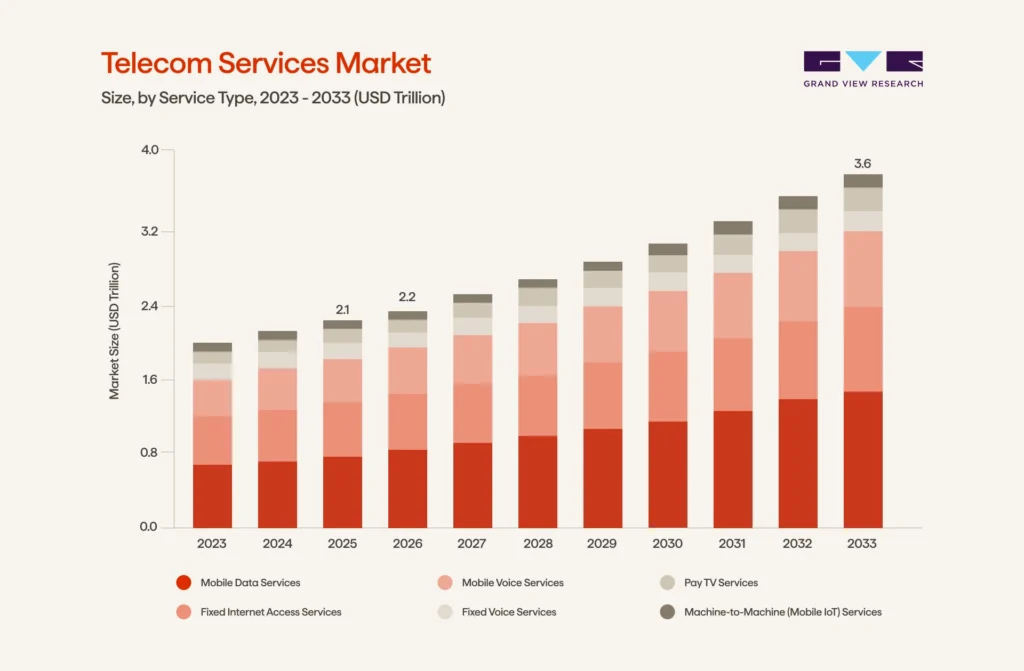
The telecommunications industry is growing, but this growth now depends on the extent to which operators modernize their technology. The global telecom digital services market was worth $2,095.7 billion as of 2025. By 2026, this is expected to grow to $2,224.0 billion and reach $3,584 billion in 2033, resulting in a CAGR of 7.1%. The growing demand for 5G, fast connectivity, and managed telecom digital services is driving investment in modern telecommunications infrastructure.
Central to this transformation is the adoption of the cloud. Operators are transferring programs, network capabilities, data servers, and customer interactions from the old and dispersed in-house systems. While public clouds provide speed of scale-up, private clouds offer strong management of confidential work. Several telecommunications service providers opt for either hybrid or multicloud solutions.
The next step is to shift from cloud-hosted applications to cloud-native services built around containers, microservices, automation, and open APIs. This new technology allows an operator to launch services quickly, carry out updates of individual components in the system, and automate every part of the process from billing and network management to sales and support at the same time. IaaS, PaaS, and SaaS models reduce the need for maintaining every system in-house.
Another key priority is data. A centralized platform is used to organize data collected from networks, devices, consumer interactions, and business activities. Predictive maintenance, fraud detection, tailored offers, and traffic predictions are a few instances of applications. Additionally, when combined, 360-degree client profiling and omnichannel customer service management enhance the customer experience.
How leading telecom operators are responding
- Vodafone, in partnership with Google Cloud, has developed an international data platform and introduced a cloud-based performance network system that leverages data analytics and artificial intelligence to improve network performance and management.
- Telefónica collaborated with IBM, AWS, Nokia, and Ericsson to conduct various trials of cloud-native full 5G core and Cloud RAN technologies in its projects aimed at creating more automated, scalable networks.
- Deutsche Telekom implemented Kubernetes for cloud-based 5G service operations and experimented on 5G network design in tandem with Google Cloud and Ericsson.
- AT&T implemented Open RAN, cloud-based orchestration, and Cloud RAN technologies, which are being integrated with artificial intelligence.
Core pillars of telecom digital transformation
Now, let’s talk in greater detail about the core drivers of digital transformation for telecom infrastructure.
Cloud-native architecture and network virtualization
Network virtualization separates telecom software from the hardware that it runs on. Through network function virtualization (NFV), operators can control packet core elements, firewalls, gateways, and routing services via virtualized network functions running on standardized servers. This means there will be reduced infrastructure requirements, easier hardware utilization, and improved capacity management.
But often, the virtualized functions still have monolithic architectures designed for physical devices, which may rely on manual provisioning, fixed capacity allocation, and lengthy scaling. Hence, while virtualization increases infrastructure efficiency, it does not provide sufficient elasticity.
Cloud-native architecture takes the telecom industry further by rebuilding network functions as containerized, modular services. A typical architecture includes three layers:
- A distributed load balancer manages traffic to various service instances and prevents any component from becoming a potential bottleneck.
- Distributed databases make data available in replica nodes, offering resilience, geographic redundancy, and high availability.
- Stateless processing units store session data separately from the application logic. This is how services can scale horizontally within seconds without dropping any active connections.
Automated orchestration handles service deployment, resource allocation, failure recovery, and scaling for companies, whether they operate a private, public, or hybrid cloud. It enables the reduction of manual workflows through programmable technologies and rapid development methods.
Avenga’s cloud services support telecom companies moving applications, network workloads, and data to cloud environments while addressing architecture, security, and ongoing operations.
For operators pursuing digitalization, cloud-native telecommunications infrastructure enables rapid service launches, predictable performance, and efficient resource utilization. Moreover, it provides opportunities to implement flexible solutions for advanced concepts such as 5G, edge computing, network slicing, and automated service assurance.
From generative AI to agentic AI
The use of artificial intelligence in telecommunications has been gradually expanding, encompassing not just content generation and prediction but also planning, coordination, and execution of various tasks. In this way, all telecom businesses approach the idea of zero-touch network management, but they still depend on human resources for goals, policies, and verification.
| Capability | Traditional AI | Generative AI | Agentic AI |
| Primary role | Predicts outcomes and detects patterns | Creates text, code, summaries, and recommendations | Pursues goals through autonomous, multi-step actions |
| Telecom examples | Churn prediction, anomaly detection, traffic forecasting, fraud scoring | Support assistants, network report summaries, configuration guidance, code generation | Fault investigation, resource optimization, service provisioning, and incident resolution |
| How it works | Processes defined inputs through trained models | Produces new output from prompts and operational context | Observes conditions, selects tools, creates a plan, executes actions, and checks results |
| Level of autonomy | Low: produces scores or alerts | Medium: supports employee decisions | High; operates within predefined permissions and policies |
| Network impact | Improves isolated decisions | Accelerates analysis and knowledge access | Coordinates workflows across network domains and business systems |
| Human role | Reviews predictions and takes action | Verifies generated output | Defines intent, constraints, approval rules, and escalation paths |
| Infrastructure needs | Centralized data and model access | Secure access to enterprise and network knowledge | Distributed data, computing resources, APIs, orchestration, and continuous monitoring |
Agentic AI can operate across the radio access network, core, transport, edge, OSS, and BSS layers. Agents can recognize performance degradation, correlate alarms, probe potential causes, make adjustments, and confirm whether service quality has been restored. The TM Forum guidelines have established standards that are being adhered to in developing interfaces and functional domains for these agents to connect to the telecom network.
Avenga’s AI services can help telecom operators build AI into network, operational, and customer-facing processes while keeping governance and human accountability in place. Besides, For operators moving beyond isolated AI models, our agentic AI services cover multi-agent systems, workflow orchestration, system connections, and controlled human approval.
5G technology is already capable of transporting data created by end-user AI agents. In contrast, 6G is expected to create new opportunities for distributed intelligence and to make more network features accessible to external agents.
The rise of autonomous, self-healing networks
A self-healing telecommunications network can readily detect problems, identify likely causes, and implement solutions without human intervention. Such networks monitor their systems’ conditions and self-correct through highly developed automated procedures.
Today’s telecommunications infrastructures comprise thousands of distributed hardware components and software processes. While manual monitoring tries to respond in time when failures, congestion, configuration errors, or service degradations occur, timely resolution is impossible.
The ability to self-heal helps telecommunications firms enhance their service standards when operating in more complex environments related to 5G, edge, and cloud-native technologies. They also help streamline processes through online troubleshooting, allowing engineers to focus more on network development. In this manner, as businesses embrace digital service delivery, the use of automated resilience will be crucial to maintaining connectivity in the digital environment.
How self-healing works in the telecom sector
Normally, this process goes on in a closed operational loop:
- Observe: with the help of network telemetry, logs, alarms, and performance metrics, one can have full visibility in real time;
- Analyze: by using AI models, it can correlate signals, spot anomalies, and find the probable cause;
- Decide: policy engines will choose the response according to the level of service priority and operational rules;
- Act: orchestration systems will route the traffic, restart services, change capacity, or refund wrong configurations;
- Verify: the network will monitor performance and, in the event of an automation failure, escalate the issue.
Human teams are still responsible for policies, risk limits, and high-impact decisions. Companies must use dependable data, observability, orchestration, and governance to safely enable telecom autonomy. Operators who make gradual moves to adopt new technologies can progress from the self-healing solutions of isolated use cases to widespread, intent-based network management.
Enterprise-grade, AI-enabled services that keep your critical systems secure, stable, and continuously modernized.
Sustainable transformation and AI energy management
Energy efficiency has become an operational priority due to 5G densification, increasing traffic, and growing data centers, all of which are driving up electricity consumption. The radio access network accounts for more than 80% of the total mobile network energy, compared to only 12% in core networking. Hence, RAN needs AI-driven optimization.
Power consumption may change as networks transition from 5G to 6 G. More RAN components are likely to be deployed on centralized and cloud-based infrastructures, thus increasing power consumption in data centers. It may be possible for operators to use AI in telecom to optimize not only the network’s physical equipment but also its virtual operations.
Key approaches include:
- Dynamic transmission-power control: AI and machine learning analyze real-time traffic, coverage, and service KPIs. Radio power can be reduced during quieter periods and restored as demand rises.
- Intelligent traffic steering: Traffic is consolidated across selected cells, bands, or network layers before equipment that is underused enters sleep mode. This reduces energy use while protecting capacity and customer experience.
- Automated configuration: Orchestration layers activate sleep modes, modify power settings, monitor results, and reverse changes when performance declines. This removes manual configuration overhead from digital processes.
- Vendor-agnostic optimization: Companies can use centralized software to coordinate energy policies across equipment from multiple vendors and technology generations. Nokia reports that its multi-vendor energy-management software can reduce radio network energy consumption by up to 30%.
- Proactive waste detection: AI compares power use with traffic, cooling demand, equipment condition, and historical baselines. It can identify faulty hardware, inefficient cooling, or active resources carrying little traffic.
- Continuous learning: Models evaluate previous actions and refine recommendations over time. They learn when cells can safely enter sleep mode and which configurations deliver the best balance between efficiency and network performance.
Practical applications yield evident outcomes. For example, the Saudi operator stc observed an average 6% decrease in its 4G network energy usage after implementing AI energy management solutions, while its network performance indicators remained unaffected. Another operator in Europe, O2 Telefónica Germany, uses AI and automation to monitor traffic and dynamically deactivate unused RAN elements.
Since telecommunications is subject to stringent regulations, automation must comply with strict requirements regarding availability, safety, and reporting. Digital transformation in telecommunications helps operators reduce operational inefficiencies while maintaining some degree of human control.
FAQ
Digital transformation process changes telecom operations
Telecom companies must upgrade their networks, operations, and customer services to compete in a rapidly evolving field. Cloud-native architecture, artificial intelligence, automated technology, and new digital solutions are all aspects of digital transformation in telecommunications. Its advantages include improving customer service, managing energy, and enhancing network reliability. The success of this approach is dependent on a clear focus on goals, an expandable infrastructure, and a gradual approach.
Want to learn more about digital transformation in the telecom market? Contact Avenga, your trusted digital adoption partner.



Your business results matter
Achieve them with minimized risk through our bespoke innovation capabilities. Fill in the form below.