






Mobility as a Service (MaaS): The future of mobility service is here


May 22, 2026 10 min read 282 views
The mobility issue is the lack of a single interface connecting many transportation methods, including the trip planner app, the fare app, the train ticket, together with a zero-dollar ride-hailing receipt that doesn’t match your actual use. Mobility as a Service (MaaS) aims to address this by providing an integrated solution that lets users plan, book, and pay for multiple modes in a single seamless “one-stop” shop. This means that after signing up, the user has only one perfect account across many service providers — no more juggling accounts or policy documents.
Picture this: you hop on a bus, switch to the metro, and grab a shared bike for the last leg, all tracked in real time and billed straight to one account. That’s seamless mobility, and transit providers are chasing it. But to actually pull this off, they need to sync up. Data, payments, service quality, they all have to line up, and that’s not something most city or private transport services usually manage. In this manual, you’ll see what Mobility as a Service (MaaS) needs to run smoothly, and how those pieces shape its future growth.
Mobility-as-a-Service key takeaways
- MaaS brings together all kinds of transportation, including buses, trains, and taxis, into a seamless experience. You plan your route, pay once, and off you go.
- To make this work, everyone involved needs real-time data. Without it, riders and operators can’t make smart choices on the fly.
- The MaaS operator runs the show. They handle payments, keep operations on track, make sure everyone follows the rules, and support every provider in the system.
- When cities use MaaS, they can tap into travel data to shape better urban plans. And they can do this without sacrificing anyone’s privacy.
What is MaaS and why does it matter for urban mobility
MaaS (Mobility as a Service) is an all-encompassing web-based platform that allows users to easily coordinate their entire travel journey across various modes of transportation. Users will be able to manage their travel from a single account, planning, booking, and paying for their entire trip using all possible modes of transportation (e.g., from bicycle to air travel). Multiple public and private transportation service providers are combined into one convenient interface/user experience. This shift in mobility from “owning a mode of transport” to “accessing what you need right now,” combined with the convergence of public transportation and new services like ride-sharing, car-sharing, and bike/scooter-sharing, makes MaaS beneficial.
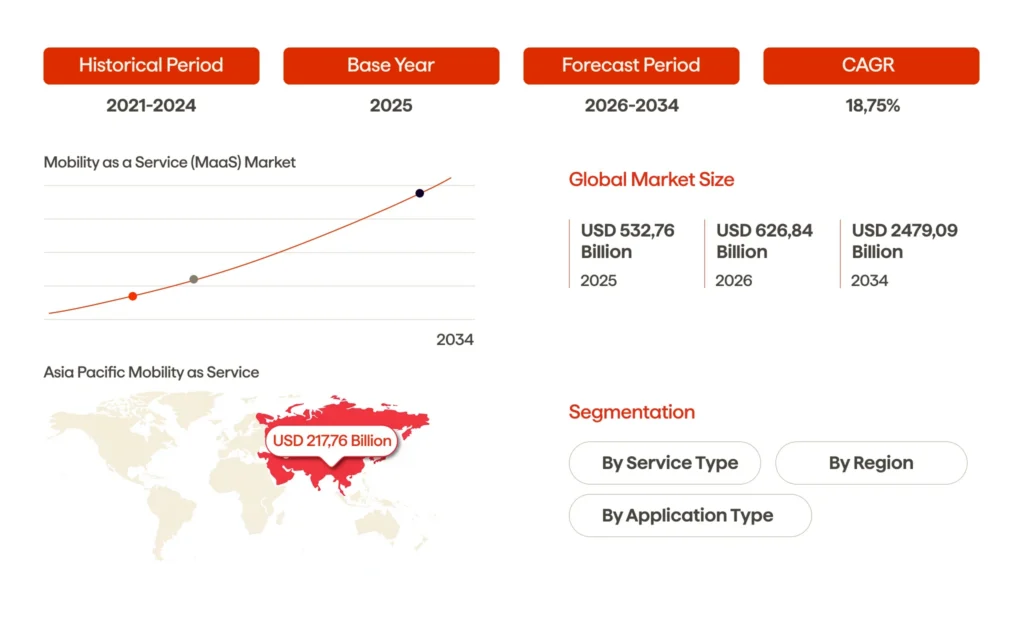
The industry is rapidly expanding, with one projection estimating that the worldwide mobility-as-a-service market will reach USD 532.76 billion by 2025, USD 626.84 billion in 2026, and USD 2,479.09 billion by 2034 (approximately 18.75% CAGR). Large cities are looking to reduce congestion and create more efficient transportation systems; additionally, riders expect the same level of seamlessness they experience when using other digital service channels.
MaaS platforms bring cohesion to multimodal travel in urban areas. A user may ride the train to the metro stop and then use a shared bike to complete their trip to their destination, all with the benefits of a single ticket, real-time tracking of service disruptions, and a single point of transaction for payment.
Convert raw data into actionable knowledge, supporting proactive fleet management, optimized scheduling, and predictive maintenance.
Multi-modal integration architecture and real-time routing
The purpose of a MaaS Platform is to serve as an integration and decision-making tool that combines many different (but connected) transportation services into a single, integrated journey. However, in urban areas, this is very difficult to accomplish because each mode of transportation behaves quite differently: transit operates on fixed schedules with limited interruption and disruption, while micromobility relies on having available vehicles/assets; ride-hailing relies on the availability and traffic of drivers; and parking or charging at the time of the trip may change from one minute to the next. To create a successful MaaS network, all of these modes need to be standardized into consistent options for completing a trip.
There are four levels of multi-modal integration in terms of architecture. The first level is receiving incoming transit data from: service provider operators and other third parties; development schedules and real-time feeds; buses, vans, taxis, and train vehicles; alerts for service interruptions; the average cost of particular transit modes; and whether there is space for the user’s vehicle at their departure or destination location.
The second layer converts data from various transport providers into a common format (e.g., departure stops, routes, prices, and restrictions) so that an application can use multi-provider data.
The routing engine is the third layer and provides tools for generating a complete and accurate set of door-to-door travel options for all combinations of available transit modes, and allows for continuous real-time routing of the same trip as events occur. Therefore, real-time routing will enable users to rank the value of using alternate transit modes available to them again and to view changes in the estimated travel time without changing their initiated trip.
The final layer is for booking and payment orchestrators, which will interface with transit MaaS providers to provide users with tickets, reservations, and receipts for booked transactions.
This architecture provides control and reliability for the city and the operator. It provides an opportunity for mobility solutions to be stronger than singular application solutions. It allows the MaaS network to direct travel needs to the optimal open capacity, rather than sending all users through congested paths.
The role of the MaaS operator: orchestration, payments, and service governance
MaaS operators sit between end-users and multiple forms of transport. The role combines multiple providers into a single seamless, dependable service. While MaaS appears to offer a simpler solution to mobility, it will only succeed if someone owns and manages the mechanics of delivering services across providers (who is displayed to the customer, who is paid for the fare, and who is accountable for failed rides).
The operating layer is called orchestration. The various modes of transportation (public transit, ride-hailing, cars, micro-mobility, and parking) that the operator uses will all be found in one place, or catalog. The operator will normalize the rules and constraints for all modes of transportation and provide real-time routing and rerouting of trips when necessary, based on current trip details and changing conditions. The operator will also have exception-handling capabilities for missed connections, cancelled rides, unavailable scooters, and service alerts, as well as handoffs to customer support when a customer’s service transitions from one provider to another.
Payments mark the point at which MaaS is a product rather than just a directory. The majority of payment activity initiated by an operator will occur within the operator’s application and/or system for fare calculation, booking, voucher issuance, digital wallets, refunds, and dispute processes. Furthermore, payments will capture clearing and settlement between transaction participants, ensuring that all transport service providers are compensated accurately for services provided to end-users, including for bundled pass/subscription products. Without this layer of oversight, users will have to manage multiple applications, receipts, and payment policies across many different mobility service providers.
Service governance maintains stability in an ecosystem by establishing consistent onboarding requirements, defining data requirements and standards, defining SLAs, incident response, and reputation management, and establishing rules to control fraudulent activities and ensure compliance, so the platform can be trusted as integrations continue to scale.
Key operator responsibilities (operational view):
- Standardization of provider APIs, data quality, and the onboarding of new providers.
- Running the trip planning, booking, and disruption workflow between the various modes of transport.
- Settlement, payment, and refund processing of transactions across multiple providers.
- Defining SLAs, escalation, and performance incentive systems.
| Area | What the operator owns | Typical outputs | KPIs that matter |
|---|---|---|---|
| Orchestration | Catalog, routing, availability, and disruption handling | Unified trip options, re-routing, support workflows | Journey success rate, ETA accuracy, and disruption recovery time |
| Payments | Fare logic, ticketing, refunds, settlement | Single checkout, passes/bundles, provider payouts | Payment success rate, refund cycle time, settlement accuracy |
| Service governance | SLAs, standards, compliance, and incident management | Provider contracts, audits, performance reporting | SLA adherence, data quality score, incident frequency/severity |
Data as a city asset: planning, sharing, and privacy considerations
The concept of Mobility-as-a-Service combines different modes of transport into an integrated network, measured by a single system, resulting in improved integration of services and trips within the public transport network. Municipalities can collect data through a single point for all trip-related issues (planning, bookings, and disruptions), enabling them to track citizen movements in real time and identify failures in the transport network. The collected data can support future planning decisions (e.g., road capacity limitations; first- and last-mile elements that prevent mode choice; and new services that provide congestion relief rather than simply diverting traffic).
The opportunity only works if data is managed like public infrastructure. Specific privacy and data practices that cities and MaaS operators use include:
- Data minimization by design: Collect only the data needed for routing, processing payments, and creating reports. Do not save actual location trails any longer than is necessary.
- Pseudonymization and aggregation: Pseudonymize or aggregate trip data by removing any identifiable information about each trip, but publishing only aggregate trip statistics, e.g., volume of trips, number of trips in each area, reliability indicators, etc.
- Purpose limitation and consent: Information should be disclosed on how it will be used to support business operations, rather than for planning its use, and the user must accept that they will receive personalized features.
- Role-based access and audit logs: Access to identifiable trip data must be strictly controlled and monitored continuously to detect unauthorized access or misuse.
- Data sharing standards: There must be standardisation of the following between the transportation operator and the city: a common data schema, signature APIs, rate limiting, and data retention policies.
When cities build successful, effective mobility networks without increasing surveillance, they develop a continuous improvement cycle in which the network learns from actual passenger behavior, improves service quality, and enables passengers to experience more dependable mobility options while maintaining privacy.
FAQ
The future of transportation through the MaaS ecosystem
MaaS wants to pull everything together so you get one simple app for planning your trip, paying once, tracking your ride in real time, and getting help when you need it, all without bouncing between different companies. Just teaming up isn’t enough, though. You need everyone using the same data standards, clear rules for payments and refunds, and a solid framework to keep the service reliable for everyone involved. That’s how you build an experience that actually works.
Want to learn more about the development of MaaS and efficient urban mobility? Contact Avenga, your trusted MaaS system partner.


Salesforce for healthcare: Health Cloud use cases and implementation

Your business results matter
Achieve them with minimized risk through our bespoke innovation capabilities. Fill in the form below.