






Over-the-Air (OTA) update: Everything you need to know


May 7, 2026 10 min read 630 views
Today’s mobility relies on software just as much as on the hardware itself. The introduction of connected systems into the automotive industry has led to an ever-increasing number of vehicles depending on them for performance and reliability. Manufacturers must improve, secure, and maintain their products through OTA updates after delivery. The commitment by automotive manufacturers to conduct frequent, safe OTA updates for their connected vehicle technologies will ensure customers receive safe, reliable service and ultimately lead to higher sales.
The need to act now is obvious. More than 13 million vehicle recalls occurred in the U.S. last year due to software problems; as a result, having to perform updates in person is costing OEMs millions of dollars each year. OTA updates enable automakers to fix bugs, improve performance, add new features, and respond more quickly to field issues. OTA updates are also an effective solution to improve vehicle quality, reduce recall costs, and help manufacturers maintain product quality throughout the entire ownership experience.
OTA software key takeaways
- Auto manufacturers use over-the-air updates as an important means of continuing to develop and upgrade their vehicles after they have been built.
- The main types of over-the-air updates either update low-level firmware and control units in the car or manage higher-level applications and user-facing systems.
- Reliable update deployment depends on secure architecture, staged rollout control, rollback protection, and strong validation across different software layers.
- OTA is not only about shipping new software. It is also about protecting software performance, resolving issues faster, and keeping vehicles commercially relevant over time.
What does OTA mean in modern vehicle development
Over-the-air updates (OTA) are sent to vehicles via a wireless connection, eliminating the need to take the vehicle to a service center for an update. With modern vehicle design processes, vehicle manufacturers can monitor, enhance, and update a vehicle’s connectivity systems after it has been sold. A clear indication of the market trend is that the global OTA testing market was USD 2.68 billion in 2023 and is expected to reach USD 5.06 billion by 2030, with a compound annual growth rate (CAGR) of 9.8%.
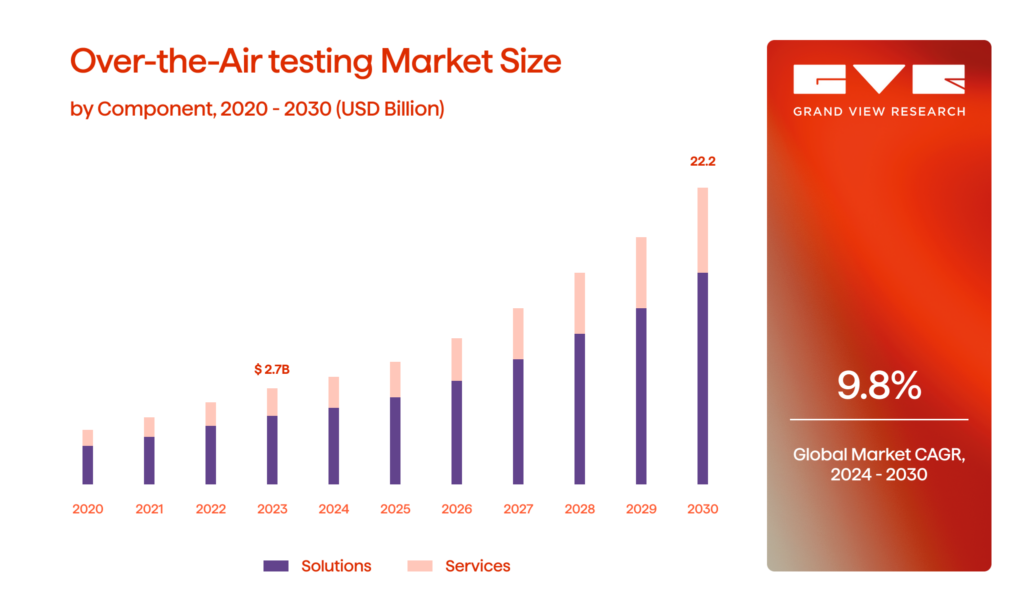
Today, OTA technology is part of the broader trend toward software-defined mobility. Vehicles are increasingly reliant on complex code across multiple domains, including infotainment, connectivity, advanced driver-assistance systems (ADAS), battery management, and other control systems. Because of this reliance, the ability to deploy new updates after production is no longer optional. When there are bugs in the software, need to make adjustments to the vehicle’s performance, or add new functionality via software, regular updates can now occur remotely and on a large scale.
OTA enables continued software development, supports regulatory compliance, and improves fleet management for large fleets. Essentially, OTA enables you to create an “enhanced digital platform” for your vehicles rather than a traditional (fixed) product. This will provide you with a significant operational and business benefit in the future.
Gain a competitive edge with our transportation and logistics software expertise.
OTA fundamentals: firmware update vs. SOTA update
Of all the over-the-air delivery methods, FOTA and SOTA are the major types. Both use the air to deliver their content, but each updates different layers of the vehicle’s stack.
Many hardware components are also programmed to use Firmware over-the-air (FOTA) updates as low-level software, including powertrain control modules, Electronic Control Units (ECUs), Battery Management Systems (BMS), and braking modules. Many professionals believe that the updated software for the supporting system (to FOTA) may have an impact upon the safety, reliability, and/or performance; therefore, there is typically a greater degree of validation, rollback logic, and stricter controls over the rollout of these applications than would ordinarily apply to the SOTA software update process.
Software over-the-air (SOTA) is a type of update for higher-level application and system software. It often includes updates to other apps such as navigation and voice assistants, user interface enhancements, and connectivity features, as well as updates to the operating system. Companies will use SOTA when they would like to add a service or release a feature that doesn’t require mechanical modifications to the product.
| Type | What it updates | Typical use cases | Main considerations |
| FOTA | Firmware in ECUs and embedded controllers | Battery tuning, ADAS calibration, telematics fixes, safety-related logic | Higher risk, stricter testing, secure rollback |
| SOTA | Applications and system-level software | Infotainment changes, UX improvements, service features, app updates | Faster release cycles, lower operational risk |
In practice, both of these strategies are needed. A manufacturer can use SOTA to load a new interface for its infotainment system and, at the same time, use FOTA to send an over-the-air update to the battery controller or brake unit. Therefore, OTA is not just a type of functionality; it is also a formalized strategy for updating all software layers using these two methods.
Why OTA matters across the vehicle lifecycle
OTA is important, as today’s vehicles are no longer completed during production and are treated as connected IoT devices, with their software constantly updated after they are produced. The OTA update process is therefore applicable to every phase of the vehicle’s lifecycle.
In both development and testing, OTA enables engineers to verify how software images are created, sent, installed, and uninstalled. This helps reduce the overall friction in the hardware and software update process, thereby accelerating the readiness of update pipelines for production-ready updates before vehicles become operational.
OTA software updates during the launch/early deployment phase enable manufacturers to manage calibration gaps, update manufacturer-defect software, and address software-related issues without returning vehicles to service centers for corrections or repairs. When electric vehicles are involved, it is critically important that the software logic for batteries, the charging methods and timing, and the energy monitoring systems are frequently revised based on actual usage data from real-world driving conditions.
Across the lifecycle, OTA helps manufacturers:
- remotely download fixes and improvements
- maintain software consistency across fleets
- respond faster to defects and vulnerabilities
- deliver updates to devices from a trusted source
- extend product value after launch
Once vehicles are in operation, OTA acts as an ongoing support method. Brands can enhance their vehicles’ performance, integrate new features, and maintain the security of their vehicle systems, all without interrupting their customers’ ownership experience. In addition, toward the end of the product’s life cycle, OTA continues to ensure vehicle compliance, maintain vehicle features, and ensure long-term stability of the vehicle platforms.
Business drivers behind OTA adoption: cost, speed, compliance, and reliability
With increased vehicle connectivity, OTAs will evolve from a very good way to run a business to a vital part of running a successful one. With software-defined vehicles, car makers need to manage their software across multiple layers, including infotainment, ADAS, battery systems, connectivity, and other electronic domains, in a scalable manner. OTA allows that to occur regardless of whether the car needs to be taken to a service center for an update or change.
The most important factor is cost. OTA updates help reduce the costs associated with recall services, reduce downtime, and respond more quickly to field issues. In addition, the ability to deploy operating system updates remotely increases the speed at which OEMs can roll out different software fixes, performance enhancements, and new features, compared to traditional service campaign processes.
OTA also strengthens device management across large fleets by helping manufacturers track versions, control rollout waves, and maintain consistency across regions and models. Just as importantly, regular OTA updates support compliance and reliability by making it easier to patch vulnerabilities, maintain system integrity, and keep vehicles aligned with evolving technical and regulatory requirements.
Cybersecurity patching, risk control, and secure update management
OTA security entails a lot more than simply delivering new code faster. OEMs must demonstrate that the delivered OTA update has been authenticated, confirmed to be whole, is permitted to be downloaded by the intended target electronic control unit, and will be installed on that electronic control unit while not rendering the vehicle unsafe; thus, secure OTA programs typically consist of a combination of verifiable (signed) metadata for each update, use of encrypted communications during transport of the update, protecting the cryptographic keys with hardware, maintaining version control for each update, and protecting the previous version against installation of the new version.
The UNECE and NHTSA regulations address the initial construction of this process by establishing a specific software update management system. At the same time, frameworks like Uptane focus on securing the OTA update chain and limiting the impact of compromised components within that chain. The NHTSA also provides guidance on protecting the update servers, update transmission paths, and the installation process against server compromise, insider threats, man-in-the-middle attacks, and downgrade attacks.
The operations side is equally important; an OTA client in the vehicle must authenticate the OTA package, ensure that the OTA package is compatible with and not create any issues with power or storage limitations, install the OTA package atomically (all or none), and ensure a safe recovery if the OTA package fails to install correctly. A lack of operational support for OTA capabilities may create new risks when correcting software bugs, rather than reducing risk.
The core best practices are consistent:
- validate signatures and source trust before install
- prevent version rollback and unauthorized package reuse
- separate critical and non-critical update domains
- use staged rollouts, health checks, and fail-safe recovery
- keep audit trails for compliance and incident response
OTA is transformed from a convenience into a reliable vehicle cybersecurity capability through secure update management.
FAQ
Enjoy the benefits of OTA updates with Avenga
Using software in modern transportation is inseparable from mobility. Once produced, vehicles continue to connect via software for the duration of their lifespans—that’s why embedded software updates closely align with new product strategy. A well-built OTA process enables manufacturers to respond more quickly to software updates, enhance vehicle performance, and support their vehicles after launch without requiring continuous service at a service center.
That matters across everything from infotainment to safety-critical embedded software running on a microcontroller or other control unit. As vehicles become more connected and more embedded devices depend on stable remote management, OTA stops being a technical add-on and becomes a core business capability. In practical terms, it is what allows modern mobility platforms to stay secure, adaptable, and commercially relevant over time. Want to learn more about OTA updates in cars? Contact Avenga, your software and hardware partner.


Your business results matter
Achieve them with minimized risk through our bespoke innovation capabilities. Fill in the form below.