






AI forecasting: Techniques and demand forecasting tools


May 20, 2026 11 min read 201 views
Financial forecasting is always playing catch-up with the economy. Things shift fast: demand swings, new data floods in every second, and everything just gets more complex. Old-school forecasting methods can’t really handle all this in real time or adapt quickly when something unexpected happens. That’s where AI-based forecasting comes in. It takes massive amounts of data and processes it on the fly, so forecasting stays useful, and decision-makers aren’t stuck guessing.
According to new research by McKinsey & Company, using an AI-based model for supply chain management can reduce forecasting errors by up to 50% and stockouts by up to 65%. Switching to an AI-driven forecasting model lets organizations shift gears. They stop just reacting to results and start anticipating what’s coming. With this approach, they can spot risks and opportunities before they occur and plan for them. In the end, that means faster, more accurate insights. And better financial planning and performance follow naturally.
AI demand forecasting key takeaways
- AI is changing how finance approaches forecasting. Instead of looking back and relying on old reports and static models, teams use AI to make decisions that keep up with reality. These systems don’t just run on fixed rules. They keep learning and adjusting as new data comes in.
- Time series forecasting is still the go-to method, but AI really takes it to the next level. Now, you can pull in data from all over. Multiple systems, different formats, and AI handles the heavy lifting. Tasks that took people hours or days are now automated.
- Of course, none of this works if you’re feeding the system junk data. Organizations need clean, well-organized information and clear rules for managing it. Good forecasting just isn’t possible without solid inputs.
- But the real power of AI is what it unlocks. Finance teams can quickly run through what-if scenarios, estimate demand in real time, and proactively address risks. That means they’re not just reacting to problems; they’re catching them before they ever show up on the bottom line.
Limitations of traditional forecast accuracy
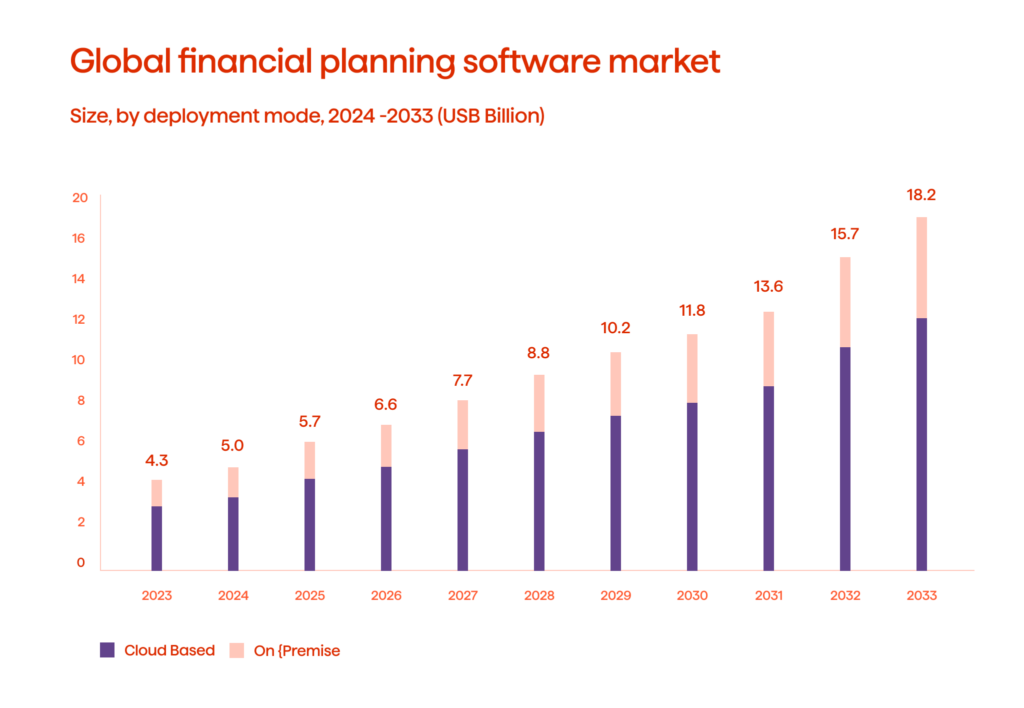
The market is experiencing increased demand for more effective planning systems. According to the World Financial Planning Software Market, it is projected to grow to $18.2 billion by 2033, up from $4.3 billion in 2023, with a compound annual growth rate of 15.5% between 2024 and 2033. The data shows a definite need for improved methods to handle rapid change, including faster, more flexible forecasting software that better manages sudden demand fluctuations and protects budgets.
Traditional forecasting methods are falling short because they often:
- rely too heavily on historical data, even when market conditions have already changed;
- struggle to detect complex patterns and trends across large, fragmented datasets;
- require manual updates, which slows down planning cycles;
- treat forecasts as fixed outputs rather than dynamic models;
- fail to deliver accurate demand forecasts when external signals shift quickly.
Generative AI forecasting provides a more solid basis for planning because, rather than relying on static spreadsheets or backward-looking reports, AI algorithms can analyze real-time data, identify anomalies, and adjust forecasts as new signals emerge.
AI models can use both internal finance data and market indicators, including customer behavior, seasonality, and operational inputs, to achieve greater accuracy. This equates to much shorter lead time for finance teams, with faster scenario development, better visibility into risks, and the confidence that comes from seeing risks before they develop too much and making an informed decision.
The AI-powered forecasting opportunity in BFSI
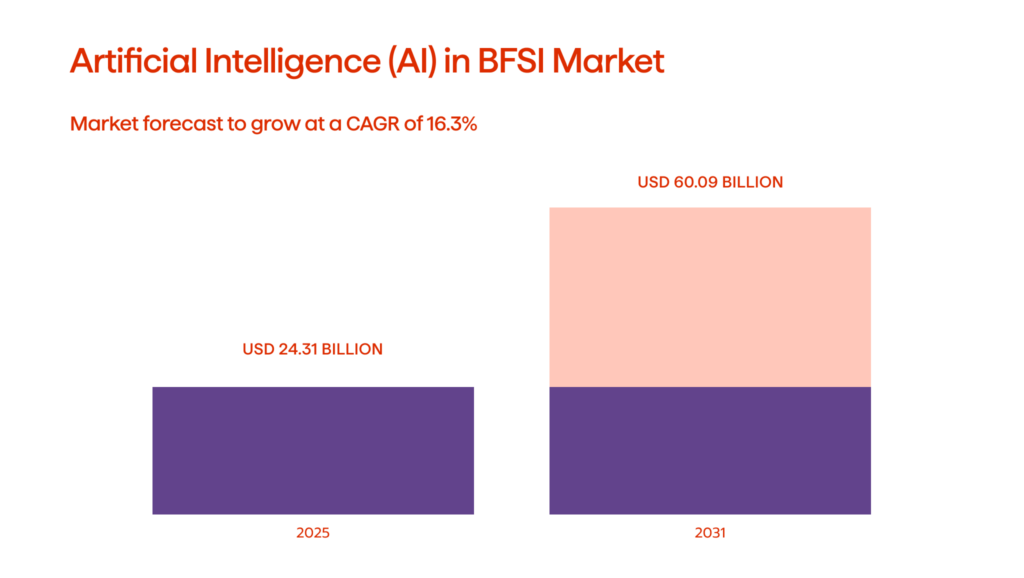
The Global Artificial Intelligence (AI) in Banking, Financial Services, and Insurance (BFSI) market is projected to increase to USD 60.09 billion from 2025 to 2031 with a CAGR of 16.28%. The increase in spending on financial forecasting will result from financial institutions transitioning from static models to a more dynamic, data-driven approach.
AI-driven forecasting applications bring together reportable internal fiscal data, external signals (market movements, behavioral patterns, macroeconomic indicators) to provide forecasting solutions. By continuously processing these inputs, AI systems generate valuable insights, enabling teams to respond to actual changes.
With the help of an AI model, demand planners will have a better understanding of changing consumer demand patterns, liquidity requirements, and portfolio risk exposures. In addition to supporting seasonal forecasts and identifying anomalies, an AI planning model can accurately forecast product and segment demand. The true benefit of AI-driven planning is its greater responsiveness and adaptability compared to traditional methods.
The team can run scenarios on the fly, modify their assumptions about how the market will behave, and make real-time decisions based on those assumptions rather than waiting for a static forecast that may or may not come true.
Core AI forecasting techniques and approaches
Today’s planning and forecasting tools can integrate traditional time-series techniques with modern algorithmic models to improve reliability and responsiveness. The purpose of doing this is not to substitute existing techniques but rather to support the overall forecasting function through additional analysis and automation.
ARIMA (AutoRegressive Integrated Moving Average) is one of the most common statistical models used for this purpose. It works well with stable univariate time series, enabling the use of historical patterns to project future product needs. However, ARIMA works best with limited or no trends and no seasonal behavior.
The ETS (Error, Trend, Seasonality) model breaks down the three components of a time series (error, trend, and seasonality) in an explicit manner. This allows them to be used effectively for sales forecasting and customer needs, as there are often recurring patterns in both areas, along with growth trends that need to be captured more precisely over time.
In addition, the STL (Seasonal-Trend decomposition using LOESS) method is optimal for analyzing more complex data types, accounting for all major seasonal variations and nonlinear trends. Consequently, it is an appropriate method for use in dynamic environments where pattern distributions change over time.
To conclude, machine learning and regression-based modeling techniques offer much greater flexibility. These AI forecasting models can accommodate many different inputs, including, but not limited to: price, external market signals, and/or behavioral data, and will produce AI insights. The use of these solid forecasting and planning techniques that adapt to real-world complexities, rather than relying solely on fixed assumptions, improves forecasting.
At Avenga, we deliver fintech cybersecurity solutions that empower banks and financial institutions to operate securely and efficiently in the digital era.
AI-powered demand forecasting use cases
BFSI companies can now transition from reactive, back-looking reporting to forward-looking decision-making with the help of AI-powered forecasting. Plus, unlike traditional seasonal demand planning methods, AI enables automated forecasting while remaining flexible enough to adapt to changing market conditions, customer preferences, and risk indicators.
Credit risk prediction with AI-based forecasting
AI can predict the likelihood of credit loss with higher accuracy than other methods due to the ability to assess historical and current:
- loan performance,
- borrower repayment behavior,
- employment and income trends,
- economic conditions, and
- the borrower’s overall level of activity.
Unlike traditional methods, which rely solely on static credit reports or credit scores, AI-based credit risk modeling creates dynamic credit risk profiles and real-time demand forecasts that help lenders improve credit limits, pricing, and the timing of credit approvals.
Portfolio optimization using AI tools
Financial institutions utilize AI capabilities to manage their risk and return profile by constantly monitoring asset performance, volatility, exposure, and overall market trends. Using this technology, portfolio managers can test different allocation scenarios more quickly than before and adjust their strategy accordingly based on their clients’ liquidity needs, customer requirements, and changing economic conditions.
Liquidity forecasting helps predict demand for capital
Banks and other financial institutions can better anticipate fluctuations in their capital needs, particularly in liquidity forecasting. AI models can create accurate liquidity gap projections much sooner by analyzing payment flow/activity, deposit activity, withdrawal activity, loan activity, and seasonal behavior.
Market risk modeling with AI technology
Using AI to improve market risk modeling involves processing vast amounts of financial, economic, and behavioral data. Generative AI will support scenario design by allowing teams to investigate potential market conditions through “what-if” scenarios. In contrast, critical predictive models will allow estimation of exposure across all asset classes (e.g., interest rates, currencies, commodities).
How leveraging AI supports fraud detection
Using AI in fraud detection allows for the identification of anomalies across transactions, logins, payment trends, and account activity. The ability to learn from both historical and real-time signals means AI models can rapidly identify anomalous behavior, compared to rule-based systems, and continually reduce the incidence of false positives.
Revenue planning: Use AI to forecast demand
With the help of AI for demand forecasting over product, channel, and customer segment lines, organizations can achieve a much greater level of precision with respect to their revenue planning process. The ability of AI to link usage and sales data with changes in pricing and external factors to predict future revenue is very useful when making decisions about how to adjust existing programs, budgets, and product offerings.
Customer behavior forecasting with AI techniques
By forecasting customer behavior, financial institutions can prepare for customer churn, product interest, service usage, and engagement. AI enables deeper personalization by recognizing which customers are likely to need a product, enabling more relevant offers based on customer demand rather than broad segmentation.
Data quality and governance frameworks
To utilize AI for financial forecasting, data governance must be established before developing a forecasting process, rather than afterward. AI relies on trustworthy data. The input data must always be filled with clean historical information and include clear, consistent definitions. The appropriate stakeholder will be assigned an owner for each piece of data (or a manager), and controlled access to the input data.
A practical framework should include:
Data quality management. Define rules for completeness, accuracy, freshness, duplication, and consistency. This ensures that AI to analyze financial signals does not rely on outdated or conflicting records.
Data lineage and traceability. Teams should know where each dataset comes from, how it was transformed, and which model was used for it. This is essential for auditability and regulatory confidence.
Master data management. Customer, product, account, transaction, and market data should follow shared definitions across systems. Without this, demand predictions may vary between finance, risk, and operations teams.
Model governance. Every forecasting model should have documented assumptions, validation methods, monitoring rules, and retraining triggers. This supports better forecasting and reduces the risk of model drift.
Access and compliance controls. Sensitive BFSI data must be protected through role-based access, encryption, anonymization, and consent management.
In AI in demand forecasting, governance is what turns raw data into reliable intelligence. It allows teams to build AI-driven demand models that are explainable, repeatable, and trusted by decision-makers.
FAQ
Artificial intelligence in demand forecasting systems: Future outlook
Forecasting cannot rely solely on past reports and fixed assumptions. When demand shifts fast, finance teams need tools that help them see what’s coming and make decisions quickly. Modern demand forecasting does just that. It pulls together historical data, real-time market updates, and automation to keep companies ahead of the curve.
But the most advanced AI forecasting tools raise the bar. With machine learning, these tools spot patterns even sharp analysts might overlook. They turn messy, complicated data into straightforward forecasts that teams can actually use. Looking ahead, AI forecasting is only getting sharper—more real-time, easier to understand, and woven right into daily financial choices. For companies in banking, finance, or insurance, it’s a huge leap from just reacting to actually predicting the future with confidence.
Want to learn more about the benefits of AI in demand forecasting? Contact Avenga, your trusted historical financial data partner.

What are the best practices to make your AI Proof of Concept (PoC) succeed?


Your business results matter
Achieve them with minimized risk through our bespoke innovation capabilities. Fill in the form below.