



How to improve customer experience (CX) at every touchpoint with AI


November 27, 2025 9 min read
Far from a new concept, yet more pertinent than ever, artificial intelligence (AI) fundamentally is changing how businesses think about customer experience. With the advent of automated chatbots and predictive analytics that foresee client needs, AI is now used in everyday customer interactions, not merely experimental pilots in a lab. The momentum is clear: the AI customer service market is expected to reach $47.82 billion by 2030, while 95% of customer interactions will be AI-powered by 2025. Organizations know this isn’t only about efficiency, but also about delivering hyper-personalized experiences that deepen loyalty and drive growth. Who wouldn’t want answers immediately at any time?
Shopify Inbox, for example, automatically responds to queries about order status updates, return policy, product questions, and more when the question is received, even at 2 a.m. And this is just one example. Continue reading to learn more ways AI increases customer satisfaction across all touchpoints.
The evolving role of artificial intelligence in customer experience
Early AI tools were focused on making things easier: automating FAQs and routing service requests. Today, AI shapes strategy, develops new products, and incites emotions — traditionally human domains.
Modern AI systems can predict intent before the customer states it. For example, telecoms can now predict churn based on small behavior changes (e.g., limited logins through their app or negative customer sentiment in support chats) and take preemptive action with personalized retention offers. Airlines can leverage AI to detect travel delays and proactively rebook customers before they have a negative experience.
At the same time, generative AI takes personalization further than the simple “people who bought X also bought Y” approach. It can create dynamic content across the whole customer journey, such as product descriptions based on previous purchasing behavior, tone, or mood based on voice and text recognition.
Luxury retail brands, for example, are already creating AI-powered digital stylists that can curate an entire outfit based on a customer’s style profile and local weather. Brunello Cucinelli launched Solomei AI, a digital assistant that serves as a personal stylist: it curates complete outfits based on a customer’s style profile or a specific context (for example, ‘What do I wear to my daughter’s wedding?’). It can help suggest pieces that complement an existing purchase and complete outfit looks for you, based on the occasion and your style profile.
However, the most significant evolution is AI’s increasing emotional intelligence. Sentiment analysis, combined with voice biometrics, allows call centers to assess a customer’s frustration level in moments and direct the customer to the most empathetic agent. These systems do not simply react; they learn, in almost real time, and will evolve product and experience strategies.
How AI transforms customer interaction at every touchpoint
The advent of artificial intelligence enables businesses to go beyond reactive communication. They can use AI to evaluate datasets related to customers when those engage with the business in real time, anticipate the customer’s behavior, and effectively adjust to changing client needs. AI can connect the dots of touchpoints into a seamless service experience.
Digital and self-service channels
Chatbots and virtual assistants powered by artificial intelligence don’t just provide FAQ responses. They learn from their previous experiences and behavioral cues. For example, when a customer checks a return policy with AI, they can get chat-based driven recommendations for substitute products, relevant promotions, instructions related to their purchase history, etc. This degree of automation allows businesses to assist 24/7. Human agents can therefore dedicate time to more emotionally complex or valuable cases. In general, AI solutions increase the quality of the service and anticipate customer needs.
In-store and physical interactions
AI adds value to the physical journey, integrating customer data, behavioral signals, and possible context (e.g., local weather) to create a highly personalized and seamless user experience. Sephora’s AR-enabled smart mirrors are one stellar example, and they have been deployed at flagship stores and beauty counters worldwide. By leveraging facial recognition and computer vision to analyze the user’s features, including gender, age, style, and clothing, these mirrors produce real-time makeup, skincare, and fragrance recommendations based on customer needs.
When the shopper engages with the mirror:
- It recommends products based on previous selections and current appearance.
- It considers surrounding context, like currently trending looks, or seasonally-specific ‘what’s happening with the weather’, to refine recommendations.
- It allows for frictionless movement: the user can scan a QR code to find the recommended items or move their items into a mobile cart for in-store purchase.
This strategy greatly enhances customer experience, decreasing everyday styling tasks for a human agent and allowing beauty advisors to focus on high-touch, consultative work. The results show that users who engage with the AR technology see conversion rates 90% higher and an estimated 30% lift in product-category sales.
Proactive and predictive support
AI models can pinpoint subtle behavioral shifts to identify customers they suspect are disengaging or dissatisfied. This allows businesses to start the remediation process before customers voice complaints through programmed outreach or escalation to a retention-trained person.
AI for different business models: B2B vs. B2C
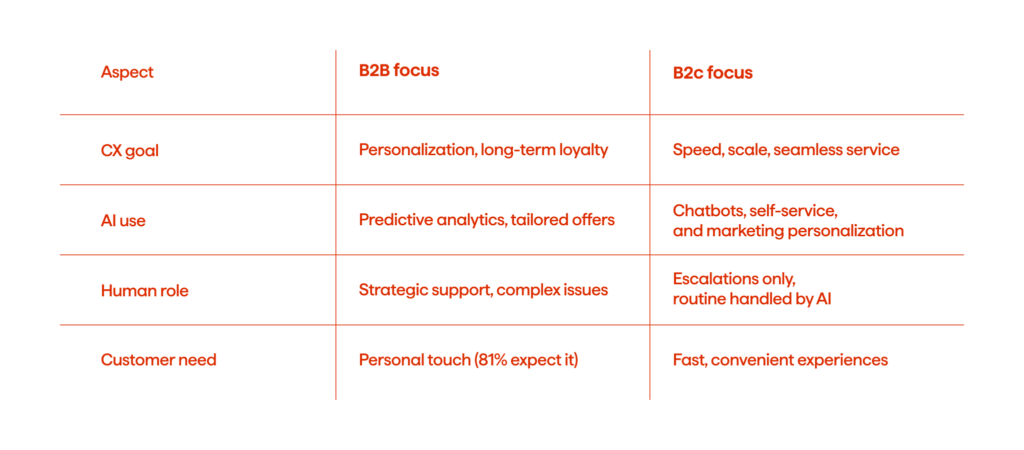
AI enhances customer experience differently depending on the business model because customer expectations and engagement differ.
In the B2B world, there is no choice but to personalize. Salesforce research indicates that 81% of service professionals strongly believe customers expect a personal touch more than ever. AI helps personalize customer experience by aggregating complicated customer data from multiple touchpoints: purchase history, contract details, etc.
AI technologies produce valuable insights. For instance, AI-driven account dashboards can alert service teams when a customer’s purchasing behavior changes, enabling proactive intervention before customers switch to another option. Predictive analytics and recommendation engines help customer service representatives build trust, which is essential for B2B models. In contrast, B2C businesses seek operational efficiency and scalability in interactions. AI automation makes it possible to tackle large volumes of data accurately and quickly. AI empowers businesses to dynamically adapt website experiences, product recommendations, and marketing content to customer behavior, providing a sense of personal attention with less human involvement.
Overcoming challenges in AI-driven customer experience
AI adoption is a complex undertaking that will fundamentally reshape internal processes, customer expectations, and the social contract of trust in the organization. Companies tend to make a critical mistake: they overestimate what AI technology can do and underestimate the scope of change it will trigger across the business. Addressing these common challenges is essential to truly improve customer experience.
Interpreting and acting on customer feedback with AI
AI algorithms do not have contextual awareness. For example, a sentiment model could have flagged a statement like, “thanks a lot for nothing,” as having a positive sentiment. This issue can be remedied by continuous model improvements. Still, you cannot complete this well without having high-quality, domain-specific datasets and customer feedback loops. Companies are currently implementing hybrid models where AI highlights uncertain cases so that customer service agents can review and validate them, and the model can then be retrained with the correct information.
Reconfiguring human roles in AI-powered support
AI isn’t here to replace service professionals, but rather to redefine their roles. For example, customer service professionals are evolving into “exception handlers” and relationship builders (at the same time, mature AI adopters that integrated AI into their customer service experience a 17% increase in customer satisfaction according to IBM). This shift requires a robust reskilling initiative — training employees to understand, manage AI-driven workflows, apply AI results, and offer empathy at friction points.
Tackling AI bias and transparency head-on
Customer data might be the source of bias. If this bias results from under- or overrepresentation of certain demographic groups, automated choices (such as credit approvals or ticket routing priority) will also inadvertently be prejudiced. Prominent businesses can employ explainable AI dashboards and bias audits to demonstrate to clients how they formulate suggestions. Customers will benefit from the process’s constant clarity and increased trust, especially in regulated sectors like healthcare or banking.
Continuous learning and feedback-driven improvement
AI will decay without updates, so a model trained on an entire year’s worth of purchasing behavior would misapply predictive beliefs to the current market condition. Organizations can consider real-time customer feedback pipelines to realign models as customer expectations shift. Also, there is an option to test “shadow models,” alternate AI systems that operate in parallel to existing ones.
Key steps for businesses adopting AI in customer experience
Automation is valuable in repetitive, predictable-type tasks such as order tracking, searches of knowledge bases, or initial troubleshooting. The AI-driven workflows in this case reduce costs, shorten response times, generate instant customer engagement, and create insights that illuminate customer understanding.
Yet, customer loyalty is often built during high-stakes, nuanced interactions. When customers face urgent problems, feel frustrated, or need help with complex decisions, they require human judgment and empathy. These moments shape long-term customer relationships.
Practical approach to balancing AI automation with human input
Rather than choosing between integrating AI and hiring people, the answer is to use both optimally. For example:
- Supported tiering. AI can deal with repetitive inquiries and pass complicated questions directly to a human.
- Contextual escalation. AI can recognize customers’ annoyance through sentiment analysis and trigger human assistance.
- Augmented agents. Employees can apply AI-driven recommendations and predictive analytics to improve response speeds and add personalization options.
The loyalty impact
This balanced model creates trust and encourages loyalty and customer retention. Customers feel valued because they can get help quickly while receiving thoughtful, human-centered service when needed.
American Express (Amex) provides a robust example of this. Their AI customer experience systems identify spending patterns that look unusual and alert customers quickly, avoiding potential fraud. However, rather than placing all resolutions on automation, high-risk fraud cases are smoothly handed over to a human specialist to resolve more complex questions and to look after the customer personally. This combination of fast and empathetic customer service has helped keep Amex at the top of the financial industry for years.
Final words
The future of customer engagement sits at the intersection of intelligent and adaptive experiences in which human empathy meets machine efficiency. AI is changing how businesses make sense of behavior, think about needs, and personalize interactions on scale. The benefits of AI reach beyond cost savings; its power creates trust and accelerates resolution, and brings entirely different ways to connect with customers.
Interested in learning more about customer experience and the future of AI? Contact Avenga, your trusted technology partner.

Generative AI for retail: The top examples and use cases changing CX

AI for credit risk management: Embrace banking innovation in 2026

Telecom billing software systems: A comprehensive guide
Your business results matter
Achieve them with minimized risk through our bespoke innovation capabilities. Fill in the form below.