



Generative AI for retail: The top examples and use cases changing CX


February 27, 2026 12 min read
Retail’s changing fast. Generative AI is starting to show up in the day-to-day, shaping how things actually get done. Deloitte found that about 42% of retail and consumer products (RCP) leaders are still just getting started with GenAI, but the excitement’s already there. Companies expect GenAI to boost their ROI by almost three times. Half of them are ready to put at least 10% more into their GenAI budgets. So, even though it’s early days for many folks, the momentum is real.
If you’re a retailer chasing speed and loyalty, listen up. AI lets shoppers track down what they want in no time, serves up help before they even ask, and smooths out all those little headaches across every channel. Behind the curtain, the same tech turns tangled data into real insights for inventory, merchandising, and daily routines. In this article, I’ll show you how generative AI can transform the shopping experience and totally change the way you run things.
Generative AI in retail: Key takeaways
- Generative AI helps retail businesses connect customers with what they actually want, faster.
- It digs through reviews, chats, and support tickets, turning all that messy info into fundamental changes that make shopping better.
- With AI, retailers can tweak what they offer, how they price things, and which deals they run. The result? More sales and less wasted stock.
- AI projects function best when they are integrated into workflows with transparent governance and operational efficiency measures.
Governance, workflow integration, and operational efficiency
Generative AI delivers real value only when it’s part of how teams actually work. A pilot that lives in a dashboard no one checks isn’t progress. For retail leaders, the goal is AI that fits into existing tools, informs real decisions, and is held to a clear standard.
That means three things need to be in place.
- Workflow integration. AI insights should reach people where they already operate. Whether it’s a replenishment alert in a store management system or a suggested reply in a support tool, the closer AI is to the point of action, the more useful it becomes.
- Transparent governance. Every recommendation an AI system makes should be traceable. Teams need to know what data was used, how confident the model is, and where to check the source. This matters for audits, compliance, and simply building trust with the people using the tools day to day.
- Operational efficiency measures. Track what’s actually changing. Conversion rates, return volumes, time saved on manual tasks, stock accuracy. Without clear metrics, it’s hard to tell whether an AI initiative is working or just adding noise.
Retailers who get this right don’t just deploy AI. They embed it in a way that scales, stays accountable, and keeps getting better over time.
The opportunities of AI in retail today
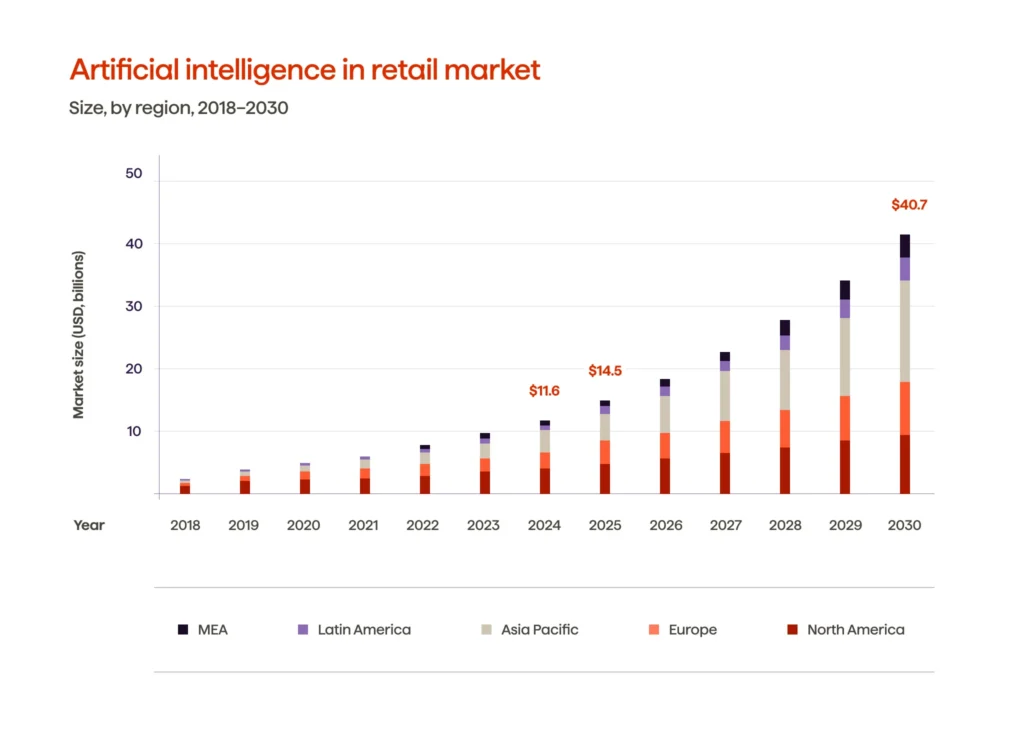
AI is taking off in retail, and it’s not hard to see why. Stores are juggling slimmer margins, pickier customers, and way more sales channels than before. Right now, experts say the global AI-in-retail market reached about $14.5 billion in 2025 and expect it to soar to nearly $41 billion by 2030—that’s around 23% annual growth from 2025 to 2030. What’s behind the surge? More people are using smartphones and the internet; retailers need better ways to monitor what’s happening in their stores, and governments are pushing for digital upgrades.
So, where’s the real upside?
- Personalized customer experience, but for everyone. With AI, retailers can match search results, recommendations, and content to what people actually want, right when they want it, plus fit it to their budget. Shoppers get to what they’re looking for, fast. Fewer abandoned carts, more happy customers.
- Pricing and promos that actually keep up. AI spots shifts in inventory, competitors’ moves, and seasonal changes. Retailers can respond in real time, not after weeks of spreadsheet chaos.
- Smarter stores and digital setups. Computer vision steps in to keep shelves stocked, shrink down, and layouts in check. Suddenly, all those physical details become measurable and manageable.
- Stronger decisions from a mess of data. Retail is rife with messy data, such as reviews, chat logs, photos, return notes, and more. Generative AI doesn’t just sift through the chaos; it spots the patterns and hands teams real steps they can run with, right now.
But here’s the thing: AI works best when it’s integrated into the technologies people are currently using. Whether it’s adjusting prices, replenishing shelves, or reacting to customers, that’s when insights truly become actionable. If not, you simply wind up with insights trapped in a remote pilot that don’t actually benefit anyone.
Turning unstructured data into retail intelligence
Retail companies are sitting on a goldmine of data, but most of it’s out of reach. Around 80 to 90 percent of new enterprise data comes in messy formats such as emails, PDFs, product photos, reviews, call transcripts, chat logs, and social media posts. It’s everywhere. The problem? This stuff usually gets dumped into separate silos, labeled in a hundred different ways, and is almost impossible to search. So, teams just go with gut instinct and spreadsheets instead. That chaos isn’t cheap.Gartner estimates that poor data quality costs the average company $12.9 million per year. Plus, there’s a serious security risk. About one in three data breaches occur because of shadow data: files that nobody’s tracking or managing, sitting outside official systems. And when that happens, the average breach costs nearly $4.9 million worldwide.
Collecting more data isn’t the answer. If you want to turn messy, unstructured stuff into something you can act on, here’s a more innovative way to do it:
- Pull everything together, even if it’s stored all over the place. Hook up emails, docs, reviews, chats, tickets, you name it, so that teams can search and dig through everything from one spot.
- Set some ground rules for how you label things. Build clear, consistent ways to tag products, customers, and issues.
- Let AI do the heavy lifting. Use models to automatically extract essential details such as product names, customer intent, feelings, reasons for returns, and defect types from text and images.
- Always tie the findings back to real sources. Link every summary or recommendation to the original content, so people can check the facts and audits go faster.
- Make insights part of everyday work. Get those findings into the tools teams already use, whether it’s support macros, merchandising calls, or content tweaks. This helps people move quickly and keeps customers happy.
- And don’t stop there. Use everything you’ve learned to personalize shopping. More intelligent search, better recommendations, improved follow-up after a sale. As you roll out more generative AI, this kind of workflow makes it all scale.
When this is done, unstructured data ceases to be “noise” and becomes a trustworthy input for decisions that genuinely affect consumers.
Unlock the transformative power of AI with Avenga’s profound expertise. We build, optimize, and scale AI solutions that drive tangible business results.
Personalized product recommendations and discovery
Most retail wins and losses happen right at the discovery stage. If shoppers can’t find what they want fast, or if everything looks the same, they get annoyed and leave. Generative AI changes the game here. It’s less about bland “people who bought this also bought that” suggestions, and more like having a sharp store associate who actually gets what you’re looking for.
With generative AI solutions, retailers dig deeper. They pull signals from how people browse, what they’ve bought before, reviews, even those messy, real-life searches like “I want something like this, but lighter and machine-washable.” Instead of trapping people with rigid filters, AI models take what shoppers really mean, curate smarter product sets, explain the reasoning, and suggest great alternatives if something’s out of stock.
For retail executives, the benefits stack up on both sides. Shoppers get better recommendations, meaning they’re happier, less overwhelmed, and way less likely to return their purchases. Behind the scenes, teams move faster. AI systems help them build custom collections, sharpen up search results, and keep site content fresh, all without tagging every little detail by hand.
Dynamic pricing and promotional optimization
Price changes can influence the shopping journey, but if you get it wrong, customers quit trusting you. Dynamic pricing is all about knowing when to act using real demand, what competitors are doing, and the truth about your own stock, like if you’ve got too much on hand or something’s about to expire. That’s what makes it work.
Retailers are already adopting the strategy. Amazon is widely associated with frequent, scale-wide price changes, underscoring both the power and the need for guardrails when automation drives pricing decisions. Over in grocery, Albert Heijn uses AI products to mark down fresh food before it expires. They back it up with electronic shelf labels, so workers can move quickly and reduce waste. Carrefour’s been at it too, rolling out dynamic pricing and targeted promotions as part of a bigger strategy to make their stores run smarter.
Retailers can really put generative AI to work in promotions. Think about it: AI can whip up different versions of offer copy, break down what actually worked for various customer groups, and help teams test out new scenarios way faster than before. When you do this right, you boost productivity across retail operations and keep your pricing steady so customers stick around and trust you.
AI-powered visual merchandising and store layout
In the retail industry, the little things make or break you. For example, sometimes a display looks amazing in the mock-ups, but on the floor? People just walk right by. That’s where AI steps in. It gives retailers a real-time view of what’s happening in their stores and helps them keep things running smoothly.
Let’s talk about how this works in the real world.
- First up: planogram compliance. With computer vision, you don’t have to guess if shelves match the plan. The system checks everything in minutes and flags issues right away.
- Then there’s product placement. AI analyzes where shoppers actually walk and what they buy, so teams can see which spots really grab attention. Forget just following some old plan—now they can put high-margin or premium items right where people will notice them. It’s all about setting up the store to match how people actually shop, not just how someone thought it would go.
- Then there’s display effectiveness. AI has the potential to observe shoppers’ reactions to displays in real time and connect those reactions to actual sales. Teams see fast which setups grab attention and which ones people just walk past, so they can swap out what doesn’t work.
- Finally, inventory monitoring. Shelf-scanning tools spot out-of-stocks, low inventory, and even so-called “phantom inventory” before they become problems. That means fewer missed sales and smarter restocking.
You can turn these insights into actions more quickly by adding generative AI-powered layers on top, such as recommendations that scale AI over hundreds of locations, auto-generated tasks for store teams, and clearer summaries for managers.
Conversational commerce and virtual shopping assistants
Search bars just don’t cut it anymore. Shoppers show up with a dozen questions swirling around, and they want answers, fast—no fuss.
A solid assistant does three things right. First, it picks up on what you really want. Next, it helps cut down the options. And, most importantly, it explains its reasoning. With generative AI technologies, retailers can handle questions like, “Which vacuum is best for pet hair under $200?” They’ll compare models, pull together reviews, and even point out handy extras. Amazon’s shopping assistant, Rufus, is made for this kind of thing. You can ask product questions straight in the Amazon app or on their website. Walmart’s getting in on it, too. They’ve added generative AI features to their shopping tools and assistants, all part of a bigger push to make shopping more thoughtful and more personal.
AI helps store teams out on the floor, too. Instead of flipping through product sheets or searching for info, staff just ask the assistant for details, other options, or what’s available right now. They don’t have to break away from the customer or lose the flow of the conversation.
FAQ
Building a better shopping experience with responsible artificial intelligence
GenAI in retail is transitioning from novelty to utility. AI makes shopping a lot smarter for everyone. It helps people build better lists, find what they need faster, and shop with more confidence because it’s working off real data, not just guesses.
Want to learn more about the future of retail? Contact Avenga and unlock the latest insights on implementing generative AI into the dynamic world of retail.

AI for credit risk management: Embrace banking innovation in 2026

Telecom billing software systems: A comprehensive guide

Your business results matter
Achieve them with minimized risk through our bespoke innovation capabilities. Fill in the form below.