



Cloud implementation strategy for businesses: What to know in 2026


March 31, 2026 11 min read
Cloud is no longer a single destination. Instead, it has become an evolving ecosystem within which the large majority of enterprises operate in multiple locations simultaneously. Statista reports that 70% of cybersecurity professionals sampled globally in 2024 stated that their companies utilized two or more of the available public cloud platforms. Another Statista study indicated that 73% of decision-makers involved in an organization’s enterprise cloud strategy were engaged in implementing a hybrid cloud strategy in 2024. This suggests that the notion of “One cloud for everything” has passed.
By 2026, a successful strategy for leveraging the cloud will center on creating a cohesive plan that integrates cloud architecture with security and cost control to achieve measurable business outcomes. In other words, a company’s objective is not merely to implement technology; it should focus on selecting the appropriate workloads, establishing maximum limits of acceptable service levels (guardrails), and implementing consistent methods for utilizing the cloud.
Key takeaways
- A cloud strategy only works if it actually drives business results. Every workload you move to the cloud needs a purpose, someone responsible, and a way to measure success.
- These days, hybrid and multi-cloud setups are the norm. That means you can’t just focus on finding the “best” provider; you need to get serious about governance, security, and setting clear standards.
- When you roll out cloud adoption, build an operating model so everyone knows their role—who’s building, who’s running things, who gives the green light, and how you keep everything under control when changes happen.
- FinOps helps you estimate, optimize, and reinvest savings into modernization by turning cloud spending into a managed system.
What is a cloud strategy?
To turn the goal of “moving to the cloud” into a clearly defined set of actions relative to the planned migration of applications or other workloads, the cloud strategy must include the following elements:
- a detailed description of the target cloud environment;
- a list of security and compliance requirements that must be met for the cloud to be considered an acceptable cloud solution;
- a description of how the workload(s) will be operated day to day; and
- information on how the economics of each workload will be managed.
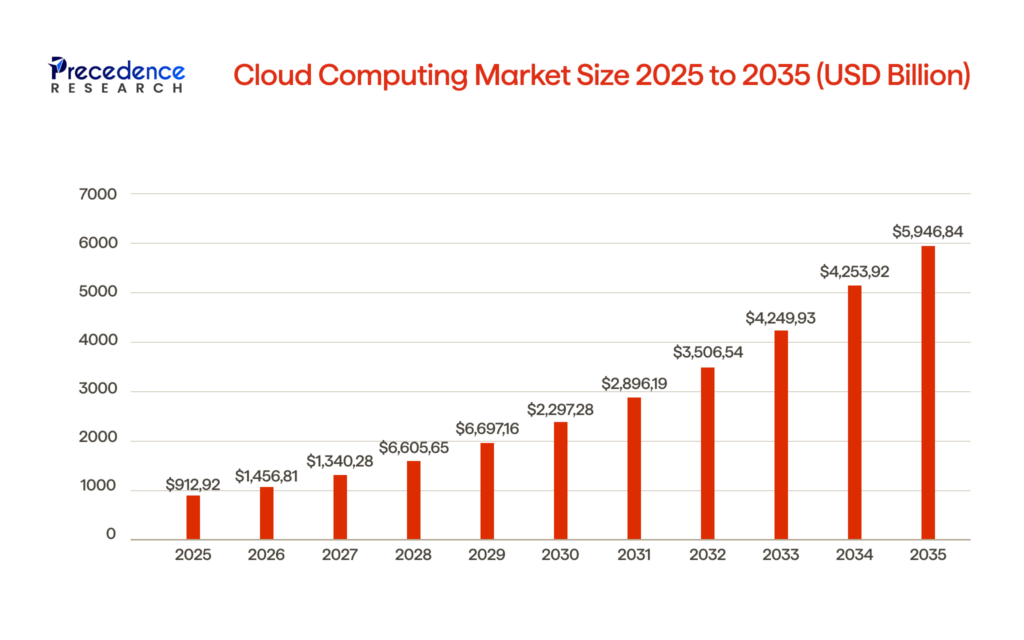
Planning for the cloud is essential because it is no longer a “side wager.” The estimated global market size for the cloud industry is projected to be usd 912.77B in 2025 and is estimated to reach usd 5,946.84B by 2035, with a tactical investment of an approximate 20.61% growth rate per year in all segments, from health care, financial services, manufacturing, and education; to mention a few.
Cloud strategy for business goals
The first step in developing a cloud strategy for corporate objectives is to ask, “What are we buying with the cloud?” Your cloud adoption will stray if the response is ambiguous (such as “modernization”). It is simpler to plan, measure, and defend your business cloud strategy if it is explicit (e.g., “cut release cycles in half,” “improve resilience,” “launch in two new regions,” “unlock AI-ready data”).
To align your business goals with a cloud-computing strategy, consider the following five practical ways:
1. Translate your business objectives into quantifiable metrics. Key performance indicators (KPIs) to ensure alignment include: uptime, deployment frequency, time to restore service, cost per transaction, data latency, and security posture. The “So what” of cloud strategy is a way to assess your performance against these KPIs.
2. Identify and prioritize workloads for their impact on business value. Identify the applications and data products that add significant business value and prioritize them within your cloud adoption strategy, starting with the low-hanging fruit and eventually targeting larger platforms with higher business value.
3. Map the migration path for every workload based on risk, roi, and timeline. The strategy for cloud implementation for every workload should include varying migration paths, using rehosting, replatforming, refactoring, or rebuilding, based on risk, ROI, and timeline, rather than preference.
4. Build governance that allows for speed of execution. Establishing guardrails for identity, security, and FinOps will enable teams to continue adopting cloud technologies without creating chaos.
5. Determine how to execute cloud migration and adoption strategies. Many teams have found benefit in utilizing cloud adoption services to establish landing zones, security baselines, and migration factories quickly and scale their cloud adoption solutions over time.
Business value assessment and use case prioritization
Identifying the actual value of B2B cloud computing and determining which applications should be migrated are two critical components in developing an effective B2B cloud computing strategy. By focusing on both business value and use cases, organizations will have a clear path to a successful B2B cloud computing strategy. Most importantly, using a measurable outcome, such as increased speed of release or reduced total cost of ownership, will give the organization a clear path for the next series of projects that can leverage B2B cloud computing technology.
| Step | What to do | Practical output |
|---|---|---|
| 1. Define business outcomes | Pick 3–5 targets (time-to-market, uptime, cost per transaction, audit readiness) | Success metrics for your cloud strategy for business |
| 2. Inventory + classify apps | Group by criticality, data sensitivity, dependencies | Modernization map for cloud adoption solutions |
| 3. Score and rank use cases | Value vs effort, risk, time-to-value, compliance fit | Prioritized backlog for cloud adoption strategy |
| 4. Choose migration path | Rehost, replatform, refactor, SaaS, retire | Clear cloud implementation strategy per workload |
| 5. Prove value fast | Start with low-risk wins (dev/test, DR, monitoring) | Momentum + funding for the broader enterprise cloud strategy |
| 6. Govern and measure | FinOps unit economics, security guardrails, tagging | Sustainable cloud computing strategy and spend control |
When you have ranked and scored your lists, it becomes easier to accomplish the work because you are following a sequence of events rather than going back and forth on whether to use cloud technologies. The first slice you will do has a shorter time to achieve value, and also presents less operational risk. After you have completed that first slice, you use the success you achieved as a way to pay for more complicated migration efforts and modernization efforts. Remember to go over your scores each quarter. Your business priorities can change, so a good cloud adoption strategy should always remain flexible enough to respond to changes in capital, risk, and customer impact.
Turn your cloud strategy into a business force multiplier with Avenga’s cloud migration services.
Cloud adoption solutions and operating model
Implementing a cloud adoption strategy is where strategy and cloud computing intersect, influencing daily operations and shaping how we work daily. The objective of a cloud adoption solution is to create a repeatable process for all teams, including defining who is accountable for what, providing guidance and advice from others, and a method for expeditiously delivering cloud-based solutions from concept to production.
Typically, a cloud adoption operating model begins with a small cloud center of excellence (COE), which develops the standards and governance elements that support the delivery teams and provide a structured approach to ensure compliance with the enterprise cloud strategy. Each delivery team will leverage the same foundational platform resources (landing zones, IAM, networking, logging, CI/CD) so that new workloads do not have to re-create legacy technical requirements. The foundational components outlined above are the basis for the most successful cloud adoption solutions.
When exploring solutions, you must think about capability and not vendor:
- Migration factory for moving apps in waves (rehost, refactor, replatform)
- Cloud security with policy-as-code, identity-first access, and continuous monitoring
- FinOps to track unit costs, budgets, and optimization opportunities
- Data and integration to connect systems safely and avoid new silos
The organisations with the most effective services for adopting the cloud will also define how the team operates, i.e., an iterative process, a continual cycle of change, processes to assist escalation, and Measurable Key Performance Indicators (MKPIs), such as availability, frequency of deployment, and cost per transaction. This is how to create an ongoing cloud implementation plan after you go live.
FinOps and cloud cost optimization
Cost visibility reveals where cloud spend is occurring, allowing you to optimize opportunities for improvement through automation rather than ad-hoc methods or manual tracking. Visibility should be based on actual costs that can be correlated to specific environments and products.
Create tagging standards, and then provide complete and accurate chargeback or showback data to identify each responsible party for each environment. Once that is done, optimization will follow naturally through the routine activities of appropriately sizing compute resources, shutting down non-production environments on a regular schedule, and optimizing database provisioning, as well as utilizing autoscaling based on real-time capacity needs.
A solid FinOps mindset changes the way you build things. Teams set budgets for each service, keep an eye on unit costs—such as what you pay per user or API call—and examine how every release impacts the bottom line. Tools like reserved instances or savings plans are particularly beneficial for steady workloads, but you truly reap the benefits once your usage becomes more consistent and predictable.
The real goal isn’t just slashing costs. It’s spending with intention: protecting your margins, steering clear of unpleasant surprises, and ensuring the money goes toward the work that actually drives the business forward.
Migration and modernization roadmap
Ensuring your cloud program isn’t operating on yesterday’s architecture is the next logical step after implementing FinOps guardrails.
Both speed and safety must be given equal weight in a successful plan. To gain momentum, many businesses begin with low-risk workloads before modernizing the systems that have the most significant impact on their performance and revenue. The goal of this approach is to modernize gradually, or in stages that your team members can handle, while also carrying out the migration process effectively so that you don’t introduce any of the old problems into your new environment.
Combining the two tracks is a sensible strategy:
- migration to unlock cloud adoption and lessen reliance on data centers.
- modernization to increase release speed, scalability, and robustness as the workload stabilizes.
| Phase | What you do | Typical deliverables | Success signals |
|---|---|---|---|
| 1. Discover and plan | Inventory apps, map dependencies, and pick migration waves | App portfolio map, risk register, target architecture | Clear scope, owners, and sequencing |
| 2. Foundation and security | Landing zone, IAM, networking, logging, baseline controls | Guardrails, connectivity, security baselines | Secure-by-default setup, audit readiness |
| 3. Migrate quick wins | Rehost or replatform low-risk apps first | First workloads, live, runbooks, monitoring | Early wins, stable performance |
| 4. Modernize core systems | Refactor key services, break monoliths,and add CI/CD | Containerization, APIs, pipelines | Faster releases, fewer incidents |
| 5. Optimize and scale | Improve cost, reliability, and ops maturity | SLOs, autoscaling, FinOps routines | Lower waste, consistent service levels |
FAQ
Final words: Adopting a cloud strategy in 2026
In 2026, the enterprise cloud strategy will transition from being a “one-off” migration strategy to a “living” operational system for business. According to Gartner, 90% of organizations will implement at least some hybrid cloud strategy by 2027, indicating the direction the market is heading.
Winning teams will treat the adoption of cloud technology as a disciplined planning process, with the backbone of adoption consisting of well-defined guardrails, repeatable delivery models, and FinOps included from day one. “Measure twice, cut once” applies here as well—having a comprehensive cloud implementation strategy, along with cloud adoption solutions designed to support that strategy, will allow you to convert your cloud spend into resilience, speed, and genuine business outcomes.


Automotive industry trends 2026: Full speed ahead

Top retail IT outsourcing service companies to work with in 2026
Your business results matter
Achieve them with minimized risk through our bespoke innovation capabilities. Fill in the form below.