



How to automate clinical trial budget: Modern clinical research management


February 23, 2026 11 min read
Clinical trials depend on numbers as much as they depend on scientific principles. Each research site faces similar pressures, including closely controlling budget planning, assisting with recruitment efforts, maintaining an audit-ready state through compliance with regulatory agencies, and providing regular updates to stakeholders. That’s a lot of responsibility!
Automating financial management is crucial for accurately determining the return on investment (ROI) for clinical trials, enabling a comparison between the expense of collecting and analyzing data and the productivity of the clinical trial in terms of return on value or the impact of that data. The results of the study will ultimately determine the ROI; however, ROI cannot be accurately assessed before the beginning of the clinical trial because the results cannot be guaranteed. However, you can control how well you manage costs.
Automation enables teams to allocate spending more accurately, identify variances earlier, and apply best practices without relying on spreadsheets to accomplish these tasks. The budgeting process in life sciences remains steady and consistent, thanks to the use of automation and the ability to manage clinical trials with enhanced tracking capabilities.
Key takeaways
- Automating financial workflows reduces costs associated with manual tracking, missed invoices, and late site payments.
- Having a single source of truth enables an organization to continue budgeting effectively when protocols are changed on the fly during trials.
- Predictive analysis of variance helps identify issues before they occur, allowing the team to make adjustments quickly and thereby eliminate costs associated with delays.
- Strong controls with good reporting capabilities enable an organization to effectively govern its budget, remain compliant with all regulatory requirements, and deliver on time.
Why clinical trial financial management is non-negotiable
The financial management of clinical trials cannot be viewed simply as a “good thing to have”. It is the central command station of a highly regulated project, and small mis-speaks can quickly lead to significant issues. When financial data is stored in separate spreadsheets, emails, and unintegrated software applications, inefficiencies occur over time without anyone recognizing them. This is generally where unexpected costs happen, including:
- duplication of vendor efforts,
- untracked pass-through fees,
- delayed payments to investigators,
- rushed amendments, and
- rework that was not budgeted for
The financial cost of saying “we’ll deal with it later” on a clinical trial is typically not small.
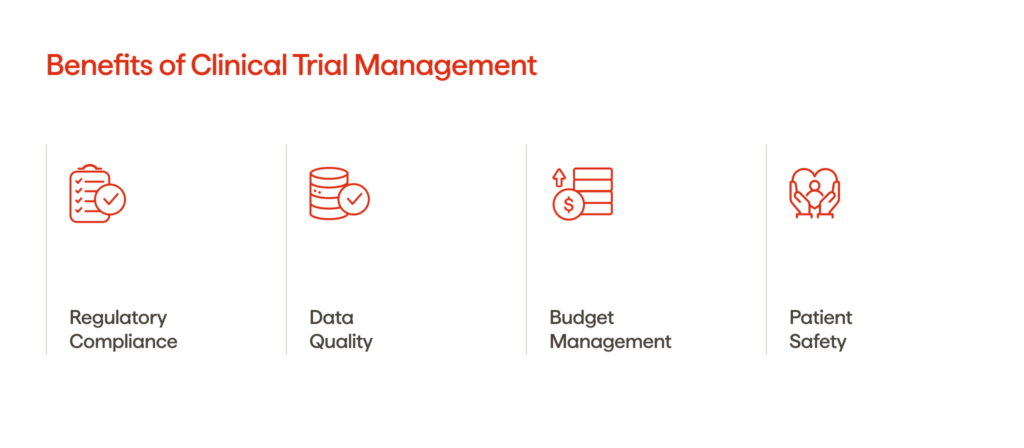
Strong oversight of clinical trial finances provides the following benefits:
- Regulatory compliance. Adding up all your expenses in a transparent and auditable fashion allows an audit to be successful. In contrast, if you cannot track where all your money went, you will have difficulty justifying how you conducted your clinical trial.
- Improved data quality. Strict adherence to budgets creates clarity on what, who, and when data is collected, which reduces corner-cutting, rushing, and varying execution across sites, thereby minimizing the potential for skewed results.
- Budget management. By monitoring expenditures on a current basis, you can anticipate expenses vs income, identify any variance early on, and avoid going over budget before delays, scope cuts, or under-recruitment occur.
- Patient safety. Funding and scheduling for site services (including payment to vendor(s), monitoring, and supplies) enable sites to avoid “make do,” thereby maintaining safe operating practices and reducing potential process gaps.
Solid financial oversight reduces uncertainty, identifies waste early, and ensures the trial remains compliant, credible, and safe.
Clinical trial budgeting and project management challenges
Clinical trial budgeting is usually problematic. This is due to the workload being on three different levels: scientific, operational, and financial. It is very difficult to establish fixed costs; timelines for completion do not always occur as planned due to unforeseen events in the field, and every change request made to a trial will impact everything. The result is that more time is spent analyzing numbers than performing the clinical trial.
Protocol modifications lead to ongoing budget fluctuations; each modification alters a study’s visit schedule, procedures, and vendor assignments. As a result, every modification makes successful trial outcome forecasting a moving target, as study timelines are constantly changing.
While recruitment estimates for patient enrollment may appear accurate in reports, the actual patient enrollment process is often much slower than anticipated. Delays in patient enrollment result in increased costs to the site, longer vendor engagement timelines, and higher costs per patient.
The cost for the following items is broken down by different participants, i.e., clinical research organizations (CROs), sponsors, laboratories, imaging facilities, electronic clinical outcome assessment (eCOA) providers, and clinical sites. This fragmentation leads to multiple tracking of costs without an accurate source of truth; therefore, costs may be duplicated, misplaced, or not approved promptly, which reduces the site’s operational efficiency.
When inflated costs occur due to variances, teams often fail to recognize these overruns until after they have already happened. Without quality analytics, it is challenging to identify changes in the burn rate before they become necessary to adjust.
Additionally, the way pass-throughs and milestone billing occur does not clearly align with the work being performed, nor does it align with when it is completed; thus, billing misalignment can cause challenges in streamlining approvals and providing consistent cash flow.
When multiple development programs are underway simultaneously, conflicts can arise due to shared vendors and overlapping development timelines. Consequently, these factors create resource competition within the development budget among clinical programs, which can negatively impact the completion of these programs.
The right pharmaceutical software accelerates development and simplifies product handling. We align technology to meet your specific requirements and goals.
Where automation pays off first
Automation yields the most significant benefits when money is lost through duplicated tasks or delayed execution. Begin automating your data entry and reconciliation. Pulling data collection signals directly from your EDC/eCOA into your budget model automatically eliminates human error when manually entering that data. It enables you to maintain accurate and updated pricing across site visits, lab fees, and vendor payments.
Next, automate the process of standardizing FMV Validation, eliminating the need for back-and-forth communication between the site and the sponsor. By using an automated system to validate each site’s FMV against your approved FMV framework, the risk of audit findings is reduced substantially.
After establishing a workflow for routing approvals, automate the process of routing invoices, change orders, and investigator payments through your clinical trial management system. This will expedite the approval process, ensuring that both invoicing and investigator payments align with milestone-based payment schedules.
Additionally, automate your research billing mapping process by identifying item(s) that fall into both the sponsor-billable and insurer-billable categories before claim submission, rather than after an insurer has rejected the claim.
AI for budget forecasting and variance analysis
AI assists finance teams in identifying budget drift before it becomes a storm of modification orders. Forecasts are updated when reality changes thanks to tools like Fast Data Science’s Clinical Trial Risk Tool, which can quantify cost risk using protocol complexity, country mix, enrollment velocity, and vendor timeframes. Scenario planning and variation tracking across sites, vendors, and pass-throughs are supported in execution by Medidata Clinical Trial Financial Management (CTFM) and IQVIA Clinical Trial Financial Suite (CTFS). Budgets are frequently linked to operational milestones using Strategikon Clinical Maestro, ensuring that projected assumptions remain connected to the trial’s actual performance.
Real-time financial reporting and visibility
Having real-time visibility into the status of study conduct reduces unpleasant surprises at the end of the month. A real-time view provides a single infrastructure for monitoring burn rates, commitments, accounts payable, and receivable for study conduct, enrollment, and visit activity. Greenphire provides tools for managing site and participant payments in a timely and accurate manner, thereby minimizing delays that may undercut site recruitment and morale. Strategikon Clinical Maestro provides executives with faster access to study-level performance data, enabling them to redistribute funds promptly without waiting for months of accrued or rolled-up data to accumulate.
Compliance, controls, and governance in a regulated environment
Automation is effective when audit-ready data and processes are in place. Clinical trial financial governance aligns with ICH GCP, FDA 21 CFR Part 11, HIPAA in the USA, and GDPR in the EU, regarding patient data in economic processes. Standardization of approval processes and employee role-based access levels can be achieved through Medidata CTFM, IQVIA CTFS, and Greenphire software systems. In addition, implementing controls around fair market value, payment provisions, and vendor onboarding, based on established policies, can decrease compliance risk while maintaining the timely delivery of clinical trials.
Implementation roadmap for financial automation
Successful financial automation occurs when you use a phased approach to implementing financial automation, avoiding a “big bang” implementation. Identify areas where hidden costs currently exist, such as slow payment processes, duplicate billing, manual reconciliation processes, and unexpected budget changes resulting from reactionary actions (e.g., amendments to existing drug protocols or unanticipated adverse events). Use this information to determine a baseline for your company’s financial health, to include measures such as the average cycle time for the payment of sites, the amount of variance (i.e., the percentage of overage vs. the percentage of underage) you can tolerate before taking corrective actions, and how long it takes your organization to close the books each month.
The next step is to prioritize the implementation of automation in the highest-friction points of your workflow, including budget versioning, site payments, invoice validation, and variance alerts. Create automated rules that will help you allocate resources more effectively and with greater certainty. For example, create an automatic flagging system (i.e., based on burn-rate increases) at either the country or vendor level so your teams can intervene earlier in the process. Once your automated workflows are established, you can add top predictive models for risk mitigation, identification, and monitoring of heightened AE-related expense trends.
| Phase | What you implement | Outcome |
|---|---|---|
| 1. Assess | Cost mapping, baseline KPIs, risk points (AEs, amendments) | Visibility into hidden costs |
| 2. Standardize | Budget templates, approval flows, payment policies | Consistent governance |
| 3. Automate | Invoicing checks, site/participant payments, alerts | Faster cycle times |
| 4. Predict | Forecasting + variance drivers, AE cost impact | Early mitigation |
| 5. Scale | Rollout across portfolio, reusable configurations | Strong financial health |
FAQ
Final words: Clinical financial planning in 2026
When budgetary and management aspects of clinical trials are executed effectively, they continue to progress toward completion as long as the reality does not deviate too much from the proposed budget and plan. Successfully budgeting for clinical trials enables greater visibility across all aspects of the trial, rather than just a larger dollar amount.
An integrated data and payment management system enables users to track their budgets more effectively and identify variances more quickly, providing the ability to utilize reliable forecasting to protect schedules and mitigate unnecessary expenses. Unintegrated systems invite opportunities for delayed payments, invoice failures, and overspend. Continuing to identify variances at an early stage reduces risk.
Want to learn more about efficient clinical trial resource allocation? Contact Avenga, your trusted partner for reliable life sciences consulting services.

Real-world evidence (RWE) in pharma: Use cases


Best data visualization service providers and agencies in 2026
Your business results matter
Achieve them with minimized risk through our bespoke innovation capabilities. Fill in the form below.